PVWatts Handover Records for Tracking, Tilt, Azimuth and AOI

Cinn Song
Founder & Chief Solutions Architect

TL;DR
Preserve the PVWatts array type, tracking/backtracking mode, tilt and azimuth with applicability notes, GCR where relevant, and hourly angle-of-incidence plus related irradiance and power outputs; do not add unsupported product or commercial claims.
A PVWatts handover should preserve the modeled array type, tracking/backtracking choice, whether tilt and azimuth were active or not applicable, GCR where it affects self-shading, and the hourly angle-of-incidence output with related irradiance and power results. The supplied documents do not define a required commercial handover format or prove any SOLARTODO product performance.
Key Takeaways
- Record the exact PVWatts array type because fixed, 1-axis, backtracking, and 2-axis modes interpret orientation differently.
- Keep tilt and azimuth values with an applicability note; for 2-axis tracking, PVWatts disables both inputs.
- For 1-axis tracking, preserve whether the run used standard tracking or backtracking because PVWatts treats self-shading differently.
- Preserve GCR when it applies, especially for fixed open rack and 1-axis tracking or backtracking.
- Include hourly angle-of-incidence results and define them as the angle between beam irradiance and the normal to the array surface.
- Treat file format, retention period, approval thresholds, and SOLARTODO product claims as unknown unless separate project evidence supports them.
Summary
For a B2B PV estimate that uses PVWatts, the handover file should preserve the modeling choices that change how the array is interpreted: array type or tracking mode, whether tilt and azimuth were active or ignored, the ground coverage ratio where it affects self-shading, and the hourly angle-of-incidence output used to review irradiation on the array surface. PVWatts documentation supports treating these as estimate records because the System Design inputs define the physical characteristics of the photovoltaic system, including array orientation, and the Results page reports angle of incidence as an hourly data variable (https://samrepo.nlr.gov/help/pvwatts_system_design.html; https://samrepo.nlr.gov/help/pvwatts_results.html).
1. Preserve the Array Type Actually Modeled
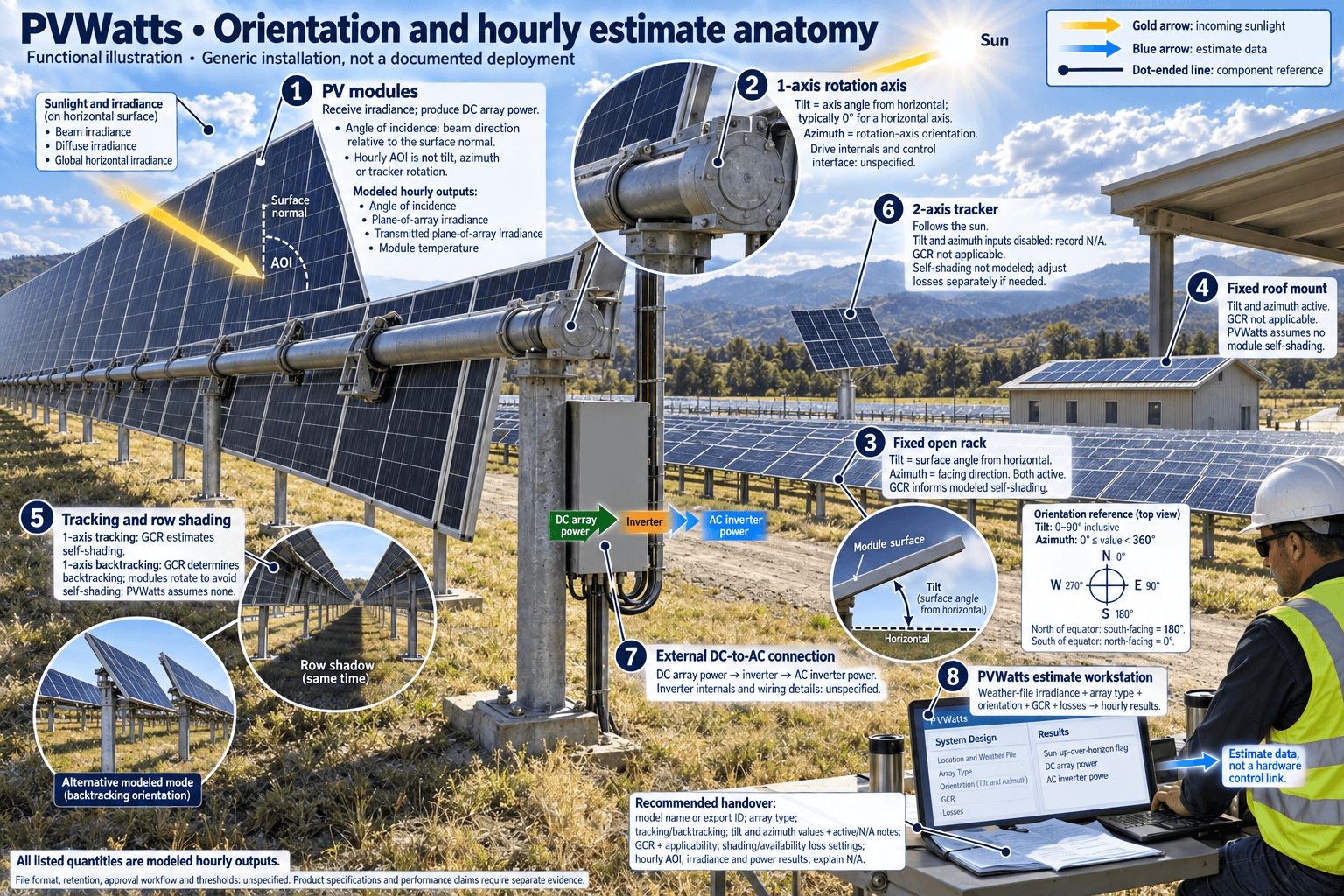
The handover record should state the PVWatts array type selected: fixed open rack, fixed roof mount, 1-axis tracking, 1-axis backtracking, or 2-axis tracking. PVWatts defines array type as whether modules are fixed or move to track the sun with one or two axes of rotation (https://samrepo.nlr.gov/help/pvwatts_system_design.html). This matters because the same tilt or azimuth number can mean different things depending on the selected array type.
For fixed open rack and fixed roof mount, the array is fixed at the specified tilt and azimuth and does not follow the sun. The handover should therefore keep both the chosen tilt and the chosen azimuth as active orientation assumptions (https://samrepo.nlr.gov/help/pvwatts_system_design.html). For fixed open rack, the record should also preserve the ground coverage ratio, because PVWatts uses it to estimate self-shading losses; for fixed roof mount, PVWatts states that roof mount does not apply GCR and assumes no self-shading between modules (https://samrepo.nlr.gov/help/pvwatts_system_design.html).
2. Record How Tilt and Azimuth Applied
The handover should not merely list tilt and azimuth values; it should identify whether PVWatts used them. PVWatts defines tilt as the array angle from horizontal, with valid values from 0 to 90 degrees inclusive, and azimuth as the east-west orientation where 0 is North, 90 is East, 180 is South, and 270 is West, with values greater than or equal to 0 and less than 360 (https://samrepo.nlr.gov/help/pvwatts_system_design.html).
For fixed arrays, the handover should state that tilt is the surface angle from horizontal and azimuth is the direction the array faces. PVWatts notes that north of the equator, a south-facing array has azimuth 180 degrees, while south of the equator, a north-facing array has azimuth 0 degrees (https://samrepo.nlr.gov/help/pvwatts_system_design.html). This should be preserved without converting it into a country-specific purchasing rule.
For 1-axis tracking or 1-axis backtracking, the handover should record that tilt is the angle between the rotation axis and horizontal, and that one-axis trackers typically use zero tilt for a horizontal tracking axis. It should also record that azimuth determines the orientation of the rotation axis, not simply the fixed face direction of the module plane (https://samrepo.nlr.gov/help/pvwatts_system_design.html).
For 2-axis tracking, the handover should explicitly mark tilt and azimuth as not applicable to the PVWatts run, because PVWatts disables those inputs for 2-axis tracking and the tracker sets tilt and azimuth to follow the sun (https://samrepo.nlr.gov/help/pvwatts_system_design.html).
3. Keep Self-Shading and Backtracking Assumptions Together
Tracking mode should be handed over with the related self-shading assumption. PVWatts models self-shading based on GCR for fixed open rack and 1-axis tracking, uses GCR to determine when to backtrack for 1-axis backtracking, and does not apply GCR to fixed roof mount or 2-axis tracking (https://samrepo.nlr.gov/help/pvwatts_system_design.html).
For 1-axis backtracking, the record should state that PVWatts assumes no self-shading because trackers rotate modules to avoid it. For 1-axis tracking without backtracking, the record should preserve the GCR used for the self-shading estimate. For 2-axis tracking, the handover should state that PVWatts does not model self-shading and that losses can be adjusted separately if needed (https://samrepo.nlr.gov/help/pvwatts_system_design.html).
4. Preserve Angle-of-Incidence Outputs and Related Hourly Results
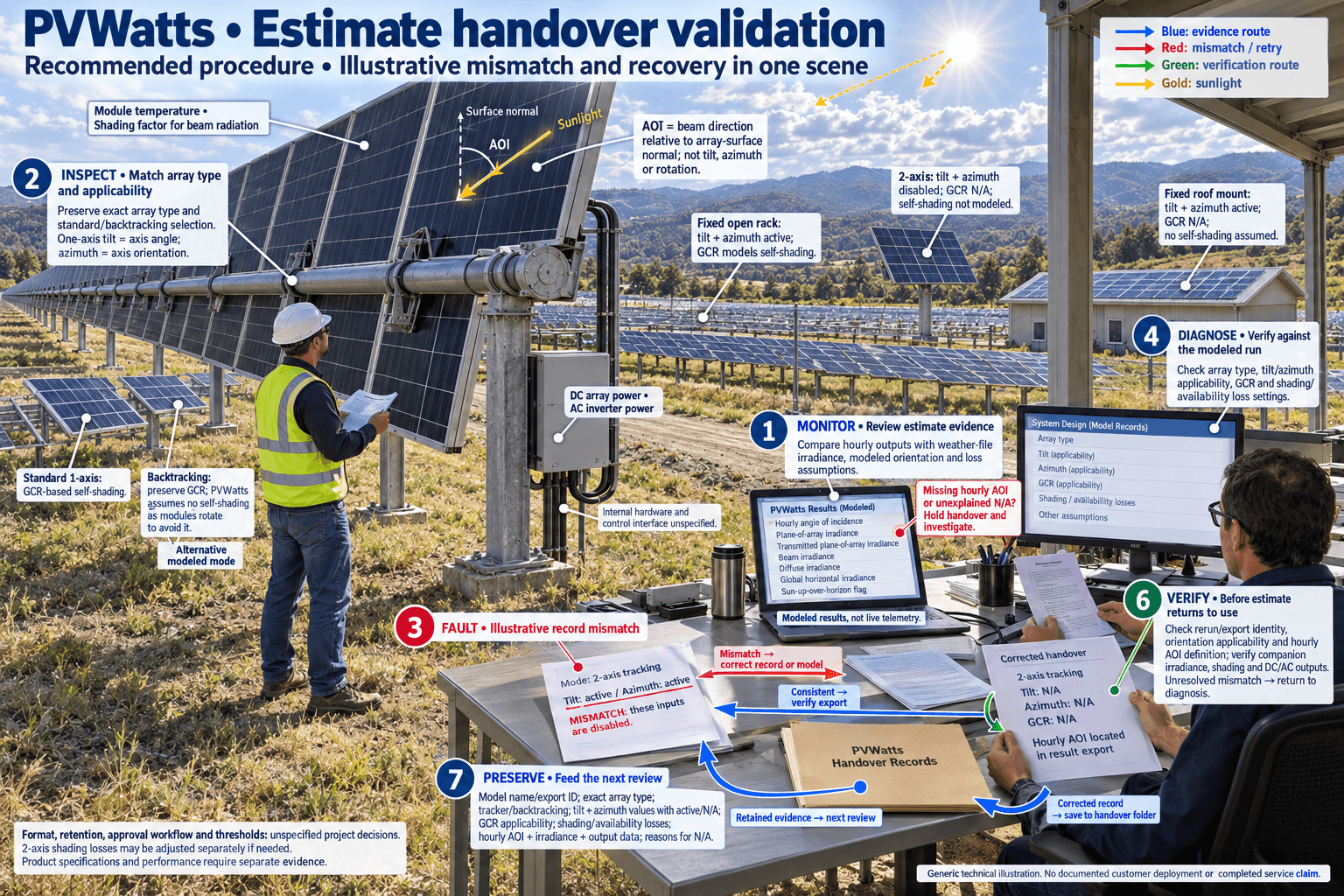
The estimate handover should include the hourly angle-of-incidence output, or at least identify where it is stored in the PVWatts result export. PVWatts defines angle of incidence as the angle between beam irradiance and a line normal to the photovoltaic array surface (https://samrepo.nlr.gov/help/pvwatts_results.html). That definition should travel with the exported data so later reviewers do not confuse angle of incidence with tilt, tracker rotation angle, or azimuth.
Useful companion outputs to preserve include plane-of-array irradiance, transmitted plane-of-array irradiance, beam irradiance, diffuse irradiance, global horizontal irradiance, DC array power, AC inverter power, module temperature, shading factor for beam radiation, and the sun-up-over-horizon flag, all of which PVWatts lists as hourly data variables (https://samrepo.nlr.gov/help/pvwatts_results.html). These records help reviewers trace whether an estimate was driven by weather-file irradiance, array orientation, shading inputs, or inverter output behavior. The supplied sources do not define a mandatory commercial retention period, file format, approval workflow, or acceptance threshold, so those items should be treated as project-governance decisions, not PVWatts facts.
5. Recommended Handover Checklist
Recommended records are: the PVWatts model name or export identifier; array type; tracker/backtracking selection; tilt value and whether it was active; azimuth value and whether it was active; GCR and its applicability; loss settings that may affect shading or availability; hourly angle-of-incidence data; hourly irradiance and output data; and a note explaining any inputs marked not applicable. This is a recommendation based on the PVWatts inputs and outputs documented in the supplied sources, not a claim that PVWatts requires this exact handover package (https://samrepo.nlr.gov/help/pvwatts_system_design.html; https://samrepo.nlr.gov/help/pvwatts_results.html).
The supplied sources do not support claims about SOLARTODO product specifications, deployed systems, certifications, stock, pricing, savings, or performance. Those items are unknown from these documents and should only be added to a quotation handover if separately evidenced by project documents.
FAQ
What is the most important PVWatts tracking record to hand over?
The selected array type or tracking mode, because PVWatts uses different tilt, azimuth, and self-shading logic for fixed, 1-axis, backtracking, and 2-axis arrays.
Should tilt always be included?
Yes, but with applicability. PVWatts uses tilt for fixed arrays and 1-axis tracking, while 2-axis tracking disables tilt because the tracker follows the sun.
Should azimuth always be included?
Yes, but with applicability. For fixed arrays it is the array-facing direction; for 1-axis tracking it is the rotation-axis orientation; for 2-axis tracking it is disabled.
Why preserve GCR?
PVWatts uses ground coverage ratio to estimate self-shading for fixed open rack and 1-axis tracking, and to determine backtracking behavior for 1-axis backtracking.
What is angle of incidence in PVWatts results?
PVWatts defines it as the angle between beam irradiance and a line normal to the photovoltaic array surface.
Which hourly outputs should accompany angle of incidence?
Useful companion outputs include plane-of-array irradiance, transmitted plane-of-array irradiance, beam irradiance, diffuse irradiance, DC array power, AC inverter power, module temperature, and shading factor.
Does PVWatts specify a mandatory handover format?
The supplied PVWatts pages do not specify a mandatory commercial handover format, retention period, or approval workflow.
Can these sources prove SOLARTODO product performance?
No. The supplied sources document PVWatts/SAM inputs and outputs; they do not prove SOLARTODO specifications, deployments, certifications, pricing, savings, or performance.
About the Author

Cinn Song
Founder & Chief Solutions Architect
Cinn Song founded SOLARTODO LIMITED and leads its smart-city infrastructure engineering — from solar, storage and integrated smart poles to the company's push into physical-AI city edge nodes: pole-mounted edge computing, vertical LLMs for smart cities, drone-based O&M with autonomous battery swapping, robotic maintenance, and high-speed counter-UAS interception. Since 2010, he has directed turnkey EPC + BOT delivery across 50+ countries, including telecom monopole supply for national grid operators, off-grid solar street-lighting for African municipalities, and integrated smart-pole programs for Gulf smart cities.
Cite This Article
Cinn Song. (2026). PVWatts Handover Records for Tracking, Tilt, Azimuth and AOI. SOLARTODO. Retrieved from https://solartodo.com/knowledge/what-handover-records-should-preserve-the-pvwatts-tracking-mode-tilt-and-azimuth-applicability-and-angle-of-incidence
@article{solartodo_what_handover_records_should_preserve_the_pvwatts_tracking_mode_tilt_and_azimuth_applicability_and_angle_of_incidence,
  title = {PVWatts Handover Records for Tracking, Tilt, Azimuth and AOI},
  author = {Cinn Song},
  journal = {SOLARTODO Knowledge Base},
  year = {2026},
  url = {https://solartodo.com/knowledge/what-handover-records-should-preserve-the-pvwatts-tracking-mode-tilt-and-azimuth-applicability-and-angle-of-incidence},
  note = {Accessed: 2026-10-13}
}
Published: October 2, 2026 | Available at: https://solartodo.com/knowledge/what-handover-records-should-preserve-the-pvwatts-tracking-mode-tilt-and-azimuth-applicability-and-angle-of-incidence
Subscribe to Our Newsletter
Get the latest solar energy news and insights delivered to your inbox.
View All Articles