What handover responsibilities should require the PV…

Cinn Song
Founder & Chief Solutions Architect

TL;DR
Require PVWatts records plus the SAM degradation table together, redact credentials, verify warnings/errors and Year 1 degradation treatment, and treat the package as modeling evidence rather than proof of actual performance.
Require bidders to hand over both the PVWatts response records and the SAM AC degradation table when those records support the bid’s energy and financial model. PVWatts documents the modeled inputs, weather basis, warnings, errors, version, and outputs; SAM documents how annual AC degradation is applied in value or schedule mode. Product performance, savings, prices, certifications, and country-specific procurement rules remain unknown unless separately evidenced.
Key Takeaways
- Require the complete PVWatts V8 response record for each modeled case, including inputs, warnings, errors, version, SSC information, station information, and outputs.
- Require the SAM AC degradation table used in the financial model, including whether value mode or schedule mode was used.
- Redact API keys while preserving enough PVWatts request metadata to reproduce the modeling basis.
- Check SAM Year 1 treatment because the source says degradation applies in Years 2 and later.
- Use PVWatts station_info and weather_data_source fields to trace the weather basis used in the simulation.
- Treat handover clauses as procurement recommendations, not as proof of actual project performance or SOLARTODO product specifications.
Summary
For a PV procurement handover, the bidder should be required to provide the PVWatts service response records used for the energy estimate and the SAM annual AC degradation table used in the financial model. This is a recommendation, not a product claim: the supplied sources support what PVWatts and SAM record or calculate, but they do not prove any SOLARTODO product output, price, saving, certification, stock, deployment, or performance.
Why the two records belong together
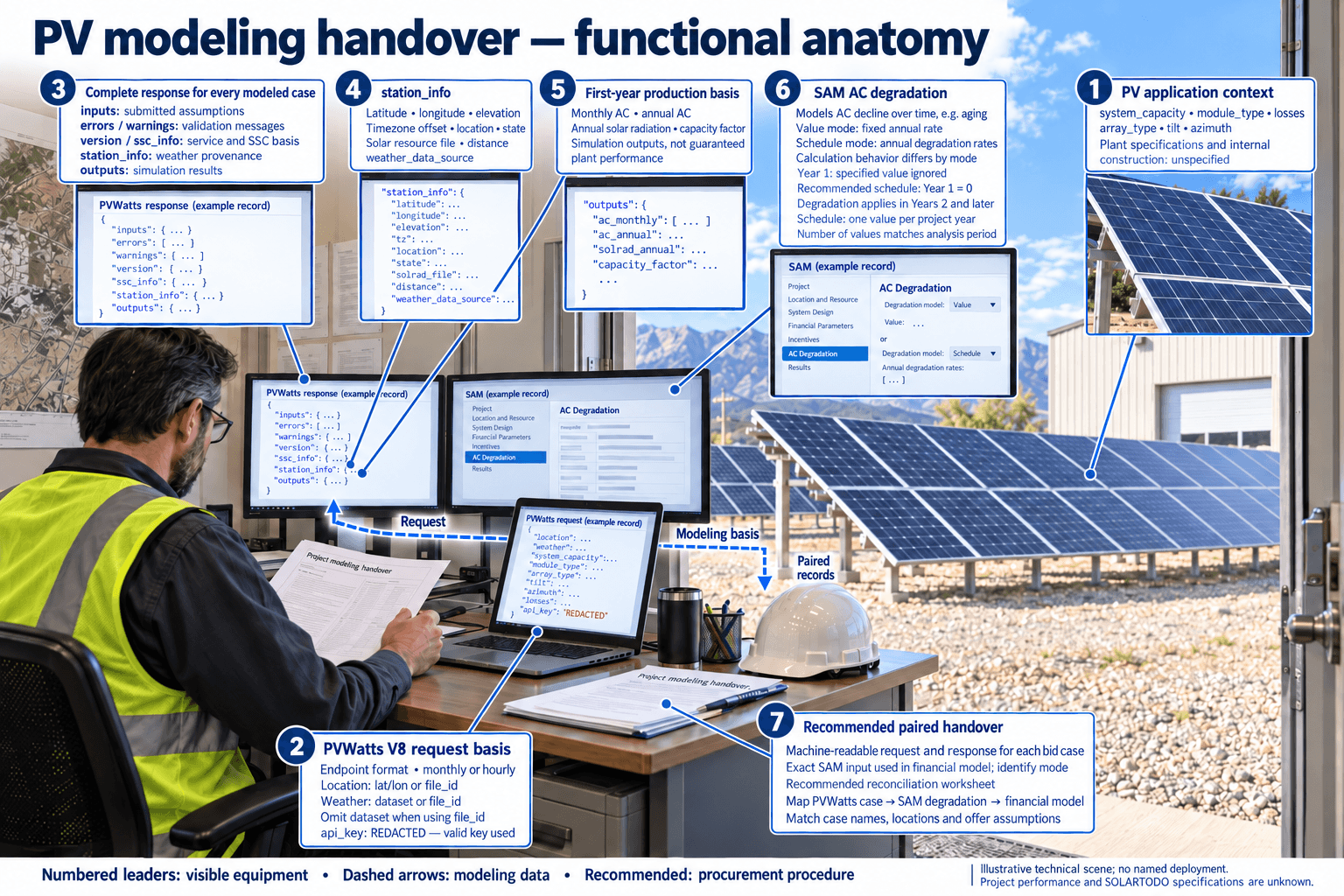
PVWatts V8 produces simulation outputs from defined request inputs. In the supplied documentation, PVWatts V8 accepts parameters such as system_capacity, module_type, losses, array_type, tilt, azimuth, and either lat/lon or file_id, and it returns inputs, errors, warnings, version, SSC information, station information, and simulation outputs. https://developer.nlr.gov/docs/solar/pvwatts/v8/
SAM’s AC Degradation inputs are used to model a decline in system AC electrical output over time, for example from equipment aging. The source states that degradation applies in Years 2 and later, and that Year 1 is before degradation begins. https://samrepo.nlr.gov/help/degradation_ac.html
Because PVWatts provides first-year production-related outputs and SAM can apply degradation across the project cash flow, a buyer should require both records in the same handover pack when the bidder’s financial model relies on both. This recommendation is limited to documentation control: the sources do not state that any specific bidder, project, or product will achieve a specific yield or financial outcome.
Recommended bidder handover responsibilities
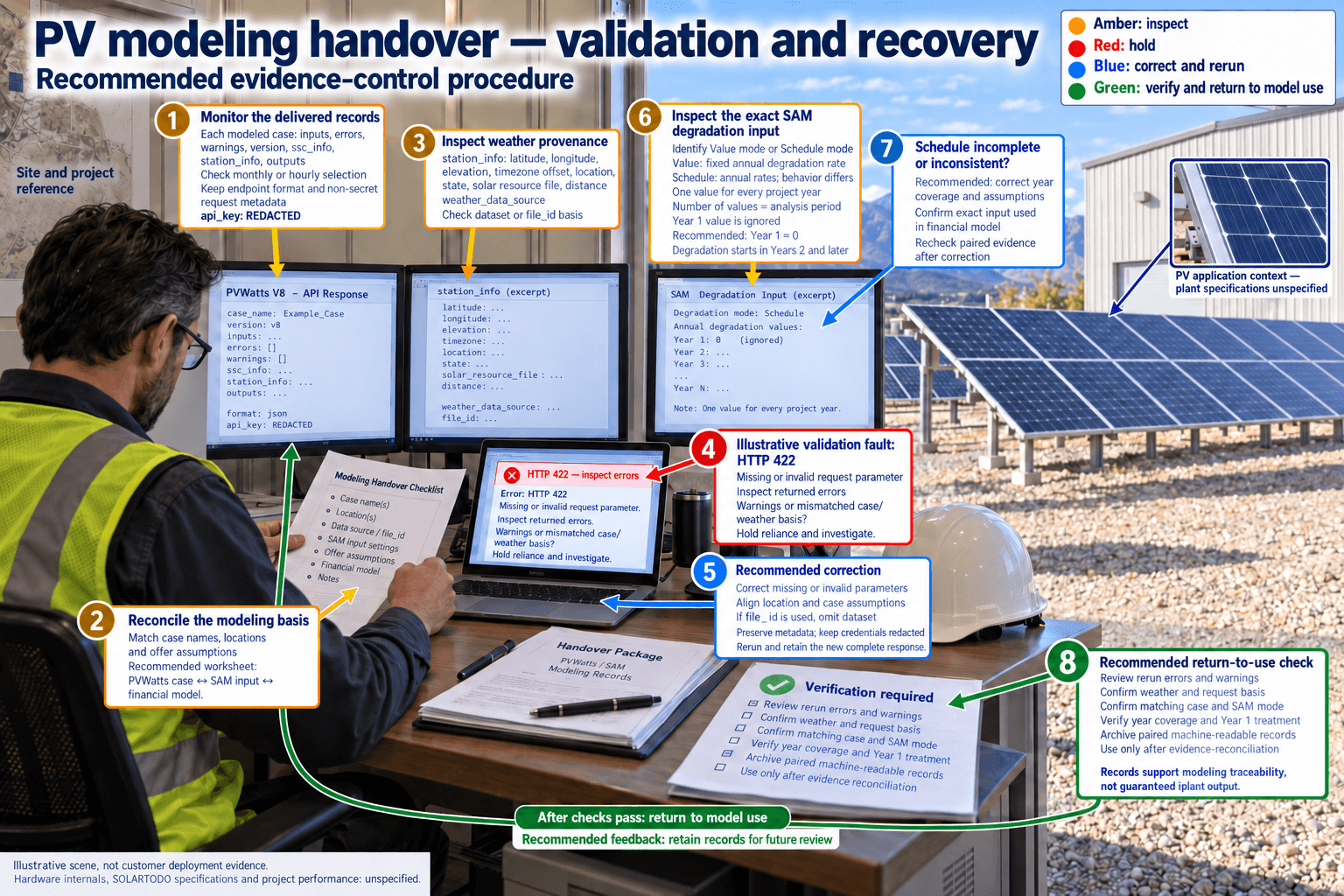
The request-for-proposal or EPC contract should require the bidder to deliver the full PVWatts response record for each modeled case. At minimum, the record should preserve the submitted inputs, returned warnings and errors, web-service version, SSC information, station information, and outputs, because these are response fields identified in the PVWatts V8 documentation. https://developer.nlr.gov/docs/solar/pvwatts/v8/
The bidder should also provide the request metadata needed to reproduce the run, including the endpoint format, timeframe selection, dataset or file_id basis, and location basis. PVWatts V8 supports monthly or hourly output granularity, and the source says dataset should not be passed when file_id is used to specify the climate data file. https://developer.nlr.gov/docs/solar/pvwatts/v8/
The delivered record should redact the API key. PVWatts requires an api_key parameter, but handover can preserve the fact that a valid key was used without exposing a credential. https://developer.nlr.gov/docs/solar/pvwatts/v8/
For the SAM side, the bidder should deliver the annual AC degradation table exactly as used in the financial model, including the number of values and the value assigned to each project year. The SAM source says that, in schedule mode, the number of rows should match the analysis period and that a value must be entered for each year. https://samrepo.nlr.gov/help/degradation_ac.html
The bidder should identify whether SAM used value mode or schedule mode. The SAM source distinguishes a fixed annual degradation rate from an annual schedule of degradation rates, and it describes different calculation behavior for schedule mode. https://samrepo.nlr.gov/help/degradation_ac.html
What buyers should verify in the handover
Buyers should check that the PVWatts records and SAM degradation table use the same modeled case names, locations, and project assumptions stated in the commercial offer. PVWatts returns station_info fields including latitude, longitude, elevation, timezone offset, location, state, solar resource file, distance, and weather data source; those fields can help trace which weather basis was used. https://developer.nlr.gov/docs/solar/pvwatts/v8/
Buyers should check whether the PVWatts response contains errors or warnings before relying on the modeled outputs. The PVWatts response includes errors and warnings arrays, and the source says service-specific errors may include HTTP 422 when parameters do not pass validation or a parameter is missing. https://developer.nlr.gov/docs/solar/pvwatts/v8/
Buyers should check the degradation table’s Year 1 treatment. SAM ignores the specified Year 1 degradation value because it assumes degradation applies in Years 2 and later; the source also recommends setting Year 1 to zero in a schedule because Year 1 is before degradation begins. https://samrepo.nlr.gov/help/degradation_ac.html
Buyers should not treat PVWatts or SAM records as proof of delivered plant performance. The PVWatts source describes simulation outputs such as monthly AC output, annual AC output, annual solar radiation, and capacity factor; it does not state that those outputs are guaranteed operating results. https://developer.nlr.gov/docs/solar/pvwatts/v8/
Practical contract language to request
A useful handover clause would say: the bidder shall provide machine-readable PVWatts V8 request and response records for every production case relied on in the bid, with credentials redacted, including inputs, version, SSC information, station information, warnings, errors, and outputs. This clause is supported by the fields listed in the PVWatts V8 documentation. https://developer.nlr.gov/docs/solar/pvwatts/v8/
A companion clause would say: the bidder shall provide the SAM AC degradation input used in the financial model, stating whether value mode or schedule mode was used and, if schedule mode was used, providing one value for every year in the analysis period. This follows the SAM documentation for fixed degradation rate and annual schedule modes. https://samrepo.nlr.gov/help/degradation_ac.html
A buyer may also require a reconciliation worksheet that maps each PVWatts case to the SAM degradation table used in the financial model. This is a procurement-control recommendation; the supplied sources support the existence and meaning of the PVWatts response fields and SAM degradation inputs, but they do not prescribe this exact worksheet.
Evidence that remains unknown
The supplied sources do not provide country-specific procurement requirements, bidder obligations, SOLARTODO product specifications, project deployment evidence, certification evidence, prices, savings, financing terms, or guaranteed performance. Those items should be marked unknown unless separate project documents support them. The sources also do not establish that a PVWatts result and a SAM financial model were used for any particular SOLARTODO quotation.
FAQ
Why ask for PVWatts response records?
PVWatts V8 returns the submitted inputs, errors, warnings, version, SSC information, station information, and outputs, so the record helps show the modeling basis used for a bid. https://developer.nlr.gov/docs/solar/pvwatts/v8/
Why ask for the SAM degradation table?
SAM’s AC Degradation inputs model decline in AC electrical output over time, and the table shows how that assumption was applied in the financial model. https://samrepo.nlr.gov/help/degradation_ac.html
Should the bidder disclose the API key?
No. PVWatts requires an api_key parameter, but a handover record should redact credentials while preserving the non-secret modeling data. https://developer.nlr.gov/docs/solar/pvwatts/v8/
What PVWatts fields should be included?
Include inputs, errors, warnings, version, ssc_info, station_info, and outputs because these are listed response fields in the PVWatts V8 documentation. https://developer.nlr.gov/docs/solar/pvwatts/v8/
What SAM degradation format should be required?
Require whether value mode or schedule mode was used; for schedule mode, require one value for each year in the analysis period. https://samrepo.nlr.gov/help/degradation_ac.html
Why is Year 1 important in SAM?
SAM assumes degradation begins in Years 2 and later, and the source says Year 1 should be set to zero in an annual schedule. https://samrepo.nlr.gov/help/degradation_ac.html
Do these sources prove actual plant output?
No. PVWatts provides simulation outputs, but the supplied documents do not prove delivered plant performance for any specific project. https://developer.nlr.gov/docs/solar/pvwatts/v8/
Do these sources prove SOLARTODO prices or specifications?
No. The supplied PVWatts and SAM sources do not establish SOLARTODO product specifications, prices, stock, certifications, deployments, savings, or performance.
About the Author

Cinn Song
Founder & Chief Solutions Architect
Cinn Song founded SOLARTODO LIMITED and leads its smart-city infrastructure engineering — from solar, storage and integrated smart poles to the company's push into physical-AI city edge nodes: pole-mounted edge computing, vertical LLMs for smart cities, drone-based O&M with autonomous battery swapping, robotic maintenance, and high-speed counter-UAS interception. Since 2010, he has directed turnkey EPC + BOT delivery across 50+ countries, including telecom monopole supply for national grid operators, off-grid solar street-lighting for African municipalities, and integrated smart-pole programs for Gulf smart cities.
Cite This Article
Cinn Song. (2026). What handover responsibilities should require the PV…. SOLARTODO. Retrieved from https://solartodo.com/knowledge/what-handover-responsibilities-should-require-the-pv-bidder-to-deliver-the-pvwatts-service-response-records-together
@article{solartodo_what_handover_responsibilities_should_require_the_pv_bidder_to_deliver_the_pvwatts_service_response_records_together,
  title = {What handover responsibilities should require the PV…},
  author = {Cinn Song},
  journal = {SOLARTODO Knowledge Base},
  year = {2026},
  url = {https://solartodo.com/knowledge/what-handover-responsibilities-should-require-the-pv-bidder-to-deliver-the-pvwatts-service-response-records-together},
  note = {Accessed: 2026-10-13}
}
Published: October 6, 2026 | Available at: https://solartodo.com/knowledge/what-handover-responsibilities-should-require-the-pv-bidder-to-deliver-the-pvwatts-service-response-records-together
Subscribe to Our Newsletter
Get the latest solar energy news and insights delivered to your inbox.
View All Articles