Battery Bidder Evidence: Models, Demonstrations and…

Cinn Song
Founder & Chief Solutions Architect
TL;DR
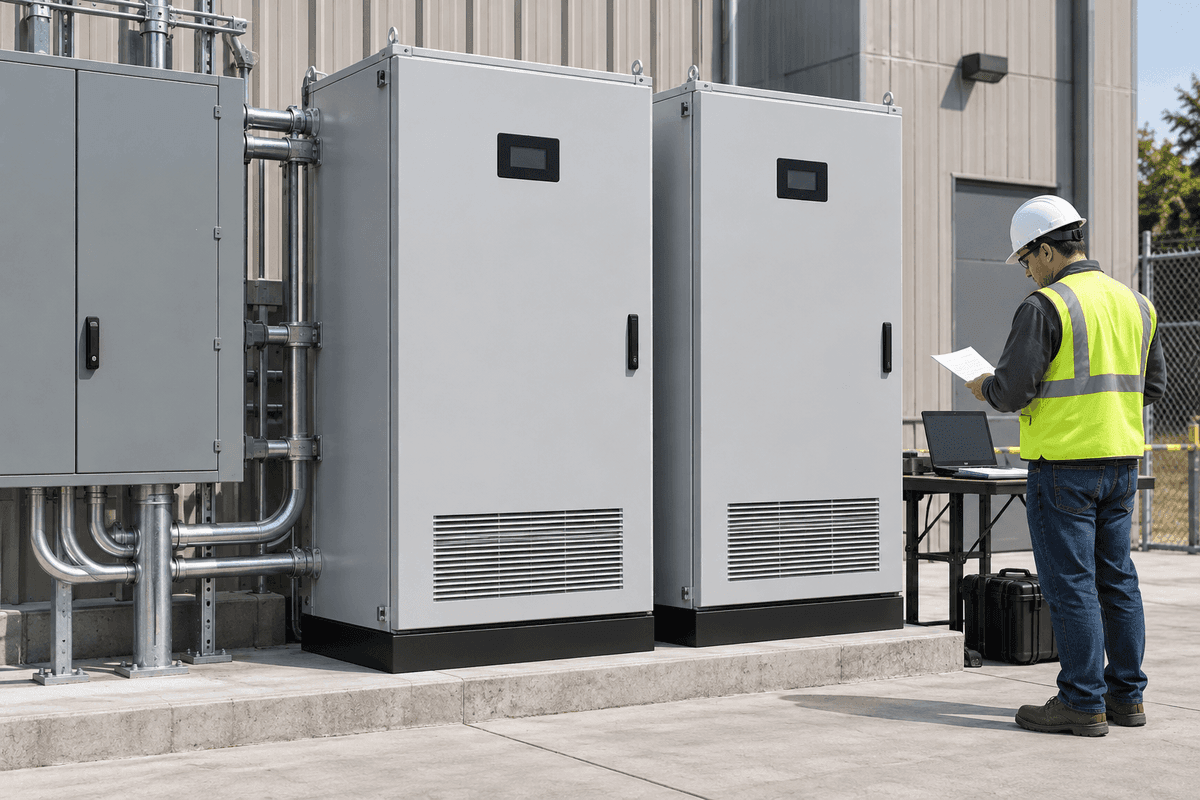
Ask for dated evidence tied to the offered system and intended duty. Separate simulations from measurements, document demonstration limits and leave unsupported readiness claims unknown.
Recommended bidder evidence includes configuration-specific test reports, operating records, transparent modeling assumptions and a documented delivery scope. The supplied sources do not verify any particular battery offer’s commercial readiness.
Key Takeaways
- Recommend labeling evidence as modeled, tested, demonstrated or commercially operated.
- SAM chemistry coverage describes modeling capability, not product validation.
- Recommend tying reports to the offered configuration, dates and operating conditions.
- Recommend examining what a demonstration tested and what development remains.
- DOE initiatives do not establish purchasing requirements for other jurisdictions.
- SOLARTODO product readiness remains unknown from the two supplied sources.
Summary
Ask bidders for evidence tied to the offered system: dated test reports, operating records, configuration details and a documented delivery scope. Treat simulations and demonstrations as separate evidence categories. The supplied sources describe modeling capabilities and research initiatives; neither verifies a specific commercial battery offer. The checklist below is a procurement recommendation, not a purchasing requirement established by these sources.
1. Separate modeling capability from product evidence
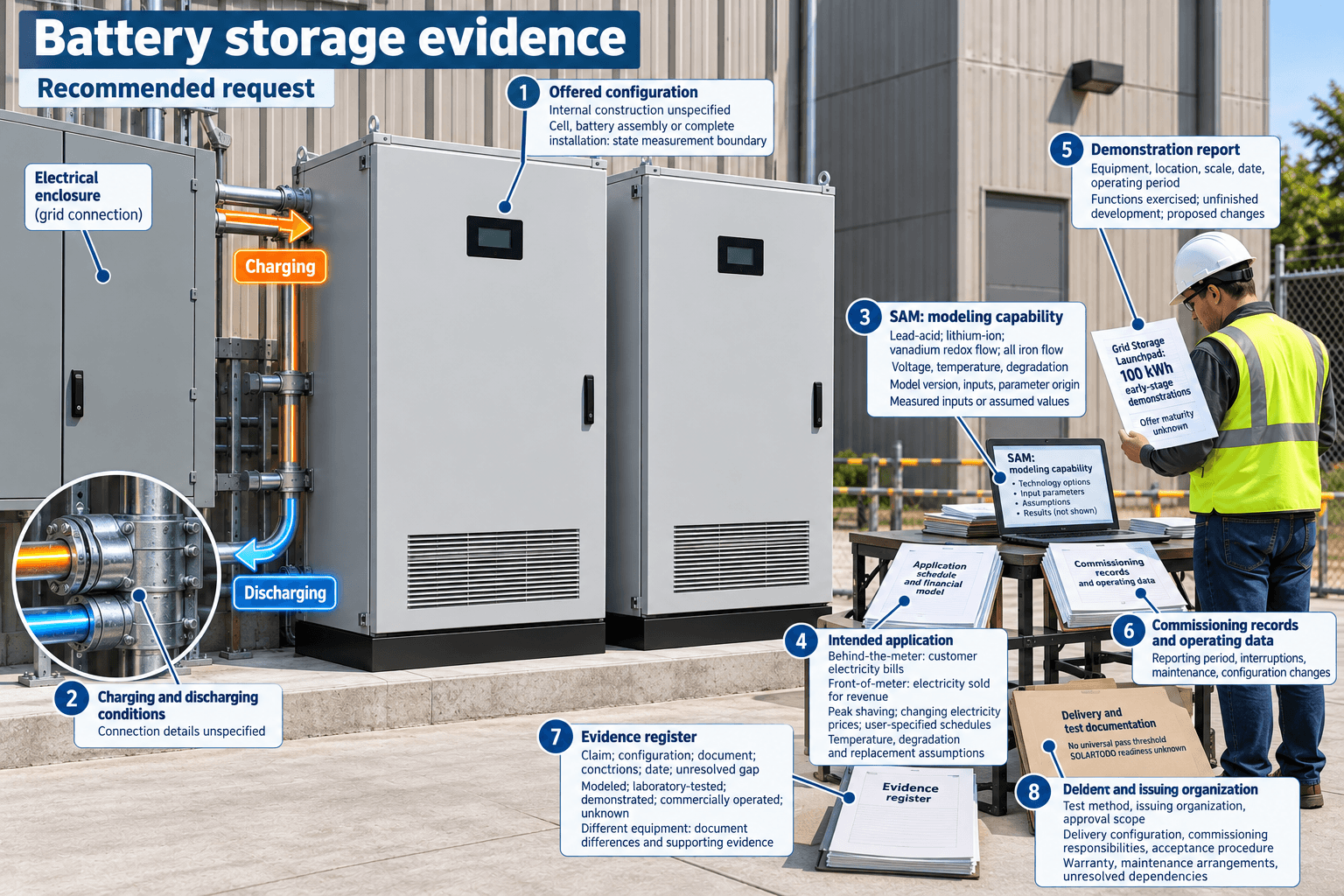
SAM supports analysis of lead-acid, lithium-ion, vanadium redox flow and all iron flow batteries. It offers dispatch options and models voltage, temperature and degradation effects. These are descriptions of software capabilities, not test results for a bidder’s equipment. SAM battery storage
Recommended request: require bidders to label each submitted result as simulated, laboratory-tested, demonstrated or commercially operated. For simulations, ask for the model version, inputs, dispatch assumptions, modeled configuration and the origin of performance parameters. Request a clear distinction between measured inputs and assumed values.
For any proposed commercial system, ask which submitted measurements concern the exact offered configuration and which concern related equipment. Where a bidder transfers results between configurations, request an explanation of the differences and the evidence supporting that transfer. Record missing support as unknown.
2. Establish what the demonstration actually tested
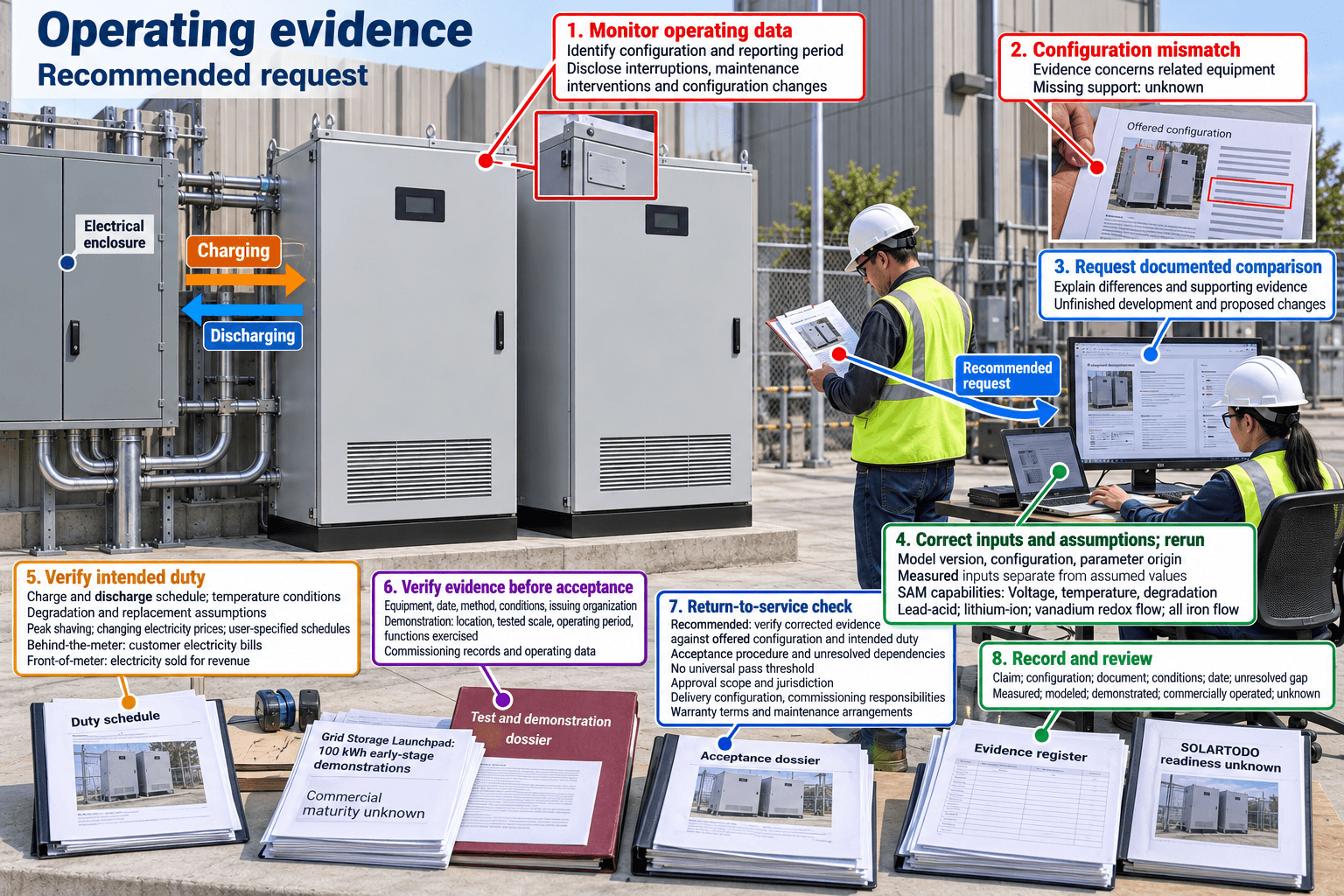
DOE describes its Grid Storage Launchpad as supporting next-generation materials testing and early-stage demonstrations at 100 kWh. That description concerns a research facility’s activities; it does not establish commercial maturity for an unnamed supplier or product. DOE Energy Storage
Recommended request: obtain a dated demonstration report identifying the equipment, test location, tested scale, operating period, charging and discharging conditions, and functions actually exercised. Ask the bidder to identify unfinished development work and changes proposed between the demonstrated equipment and the offer.
For claimed commercial operation, request commissioning records and operating data for the identified configuration. Ask for the reporting period, interruptions, maintenance interventions and configuration changes. Recommend assessing the relevance of those records to the intended project rather than accepting a demonstration label as the conclusion.
Neither supplied source establishes a minimum operating period or a universal pass threshold. If those criteria matter to the purchase, recommend defining them explicitly in the tender rather than attributing them to these documents.
3. Match performance evidence to the intended duty
SAM distinguishes behind-the-meter applications aimed at customer electricity bills from front-of-meter applications where electricity is sold for revenue. Its dispatch options include peak shaving, responses to changing electricity prices and user-specified schedules. SAM battery storage
Recommended request: ask bidders to state the intended application and provide the charge and discharge schedule used in their evidence. Request the associated temperature conditions, degradation assumptions and replacement assumptions. Ask which findings are measurements and which remain model outputs.
For each promised performance value, recommend requesting the measurement boundary, test method, date and operating conditions. Ask whether the value concerns a cell, a battery assembly or the complete offered installation. Require any extrapolation to the proposed duty to be identified and explained.
Recommend keeping modeled financial outcomes separate from measured technical results. A simulation submission should be reviewed as a forecast with stated assumptions, while an operating-data submission should identify the equipment and conditions observed. Neither supplied document verifies a particular offer’s savings, service life or performance.
4. Review validation and delivery gaps before acceptance
DOE identifies gaps in access to uniform storage performance data through its Rapid Operational Validation Initiative. Its safety strategy also addresses codes and standards, permitting, insurance and project execution phases. These are descriptions of DOE initiatives, not certification evidence or purchasing rules for another country. DOE Energy Storage
Recommended request: obtain complete test reports with equipment identifiers, dates, methods, conditions and issuing organizations. For a claimed approval or certificate, request the underlying document and ask the bidder to explain its scope and relevance to the proposed installation and jurisdiction.
Also request the delivery configuration, commissioning responsibilities, acceptance procedure, warranty terms, maintenance arrangements and unresolved dependencies. Present these as recommended commercial due diligence; the supplied sources do not prescribe this documentation package.
Recommend recording the evaluation in an evidence register: claim, offered configuration, supporting document, conditions, date and unresolved gap. Use an explicit status such as measured, modeled, demonstrated or unknown. Avoid assigning a universal maturity score: neither source supplies one.
For SOLARTODO specifically, these two sources leave product specifications, deployment history, certifications, availability, prices and performance unknown. Request product-specific evidence before making a procurement judgment.
FAQ
Does inclusion in SAM prove commercial maturity?
No. The supplied SAM text describes modeling capabilities, not validation of an offered product. SAM
What should accompany a simulation?
Recommend requesting inputs, assumptions, model version, configuration and the origin of performance parameters.
Is a demonstration enough to approve an offer?
Recommend reviewing its actual scope and remaining gaps. These sources provide no universal acceptance threshold.
What operating evidence should bidders submit?
Recommend dated commissioning records and operating data tied to the offered configuration, with interruptions and changes disclosed.
How should degradation claims be reviewed?
Recommend separating measured observations from modeled projections and requesting the operating conditions behind each.
Do DOE initiatives establish local purchasing requirements?
The supplied DOE text does not establish purchasing requirements for the buyer’s jurisdiction. DOE
What if evidence concerns different equipment?
Recommend requesting a documented comparison and justification; record unsupported transfer assumptions as unknown.
Do these sources verify SOLARTODO readiness?
No product-specific verification is supplied. Commercial readiness remains unknown from these documents.
References: DOE Energy Storage; SAM battery storage documentation.
Procurement paths
About the Author

Cinn Song
Founder & Chief Solutions Architect
Cinn Song founded SOLARTODO LIMITED and leads its smart-city infrastructure engineering — from solar, storage and integrated smart poles to the company's push into physical-AI city edge nodes: pole-mounted edge computing, vertical LLMs for smart cities, drone-based O&M with autonomous battery swapping, robotic maintenance, and high-speed counter-UAS interception. Since 2010, he has directed turnkey EPC + BOT delivery across 50+ countries, including telecom monopole supply for national grid operators, off-grid solar street-lighting for African municipalities, and integrated smart-pole programs for Gulf smart cities.
Cite This Article
Cinn Song. (2026). Battery Bidder Evidence: Models, Demonstrations and…. SOLARTODO. Retrieved from https://solartodo.com/knowledge/what-technology-maturity-evidence-should-bidders-provide-to-distinguish-a-commercially-deployable-battery-offer-from
@article{solartodo_what_technology_maturity_evidence_should_bidders_provide_to_distinguish_a_commercially_deployable_battery_offer_from,
  title = {Battery Bidder Evidence: Models, Demonstrations and…},
  author = {Cinn Song},
  journal = {SOLARTODO Knowledge Base},
  year = {2026},
  url = {https://solartodo.com/knowledge/what-technology-maturity-evidence-should-bidders-provide-to-distinguish-a-commercially-deployable-battery-offer-from},
  note = {Accessed: 2026-10-22}
}
Published: October 22, 2026 | Available at: https://solartodo.com/knowledge/what-technology-maturity-evidence-should-bidders-provide-to-distinguish-a-commercially-deployable-battery-offer-from
Subscribe to Our Newsletter
Get the latest solar energy news and insights delivered to your inbox.
View All Articles