Verification Evidence for Networked Streetlight Controls

Cinn Song
Founder & Chief Solutions Architect
TL;DR
Verify value with project-specific evidence, not feature excitement; keep U.S. federal covered-product efficiency requirements enforceable and do not apply them automatically outside the U.S.
Networked streetlight controls should be accepted only after buyer-specific value evidence is reviewed, with clear commissioning, component, and savings assumptions. For U.S. federal covered-product purchases, ENERGY STAR or FEMP efficiency requirements must remain enforceable unless a written exception applies.
Key Takeaways
- Do not treat attractive monitoring and control capabilities as proof of value; DOE says users may be uncertain how value should be assessed.
- Ask vendors to separate required controls from optional controls, reflecting DOE V2.0’s distinction between recommended and optional specifications.
- Require commissioning and startup evidence, because DOE V2.0 separates and updates those areas.
- Evaluate central management systems, backhaul communication networks, and field devices separately where multi-vendor bidding matters.
- For U.S. federal agency purchases, covered energy-consuming products must meet ENERGY STAR or FEMP-designated efficiency requirements unless a written exception applies.
- For non-U.S. buyers, local purchasing and efficiency requirements are unknown from the supplied sources and should not be inferred from U.S. FAR language.
Summary
A proposed networked streetlight control package should be verified as a procurement decision, not accepted because its monitoring and control capabilities sound attractive. DOE says users may be uncertain how or whether such systems should be implemented and how their true value can be assessed; it also notes that adaptive-lighting best practices and forecasting of energy and maintenance savings are not yet universally proven. For covered energy-consuming products in U.S. federal purchases, the controls package must not dilute ENERGY STAR or FEMP-designated efficiency requirements unless a written exception applies.
1. Buyer-Assessed Value Evidence
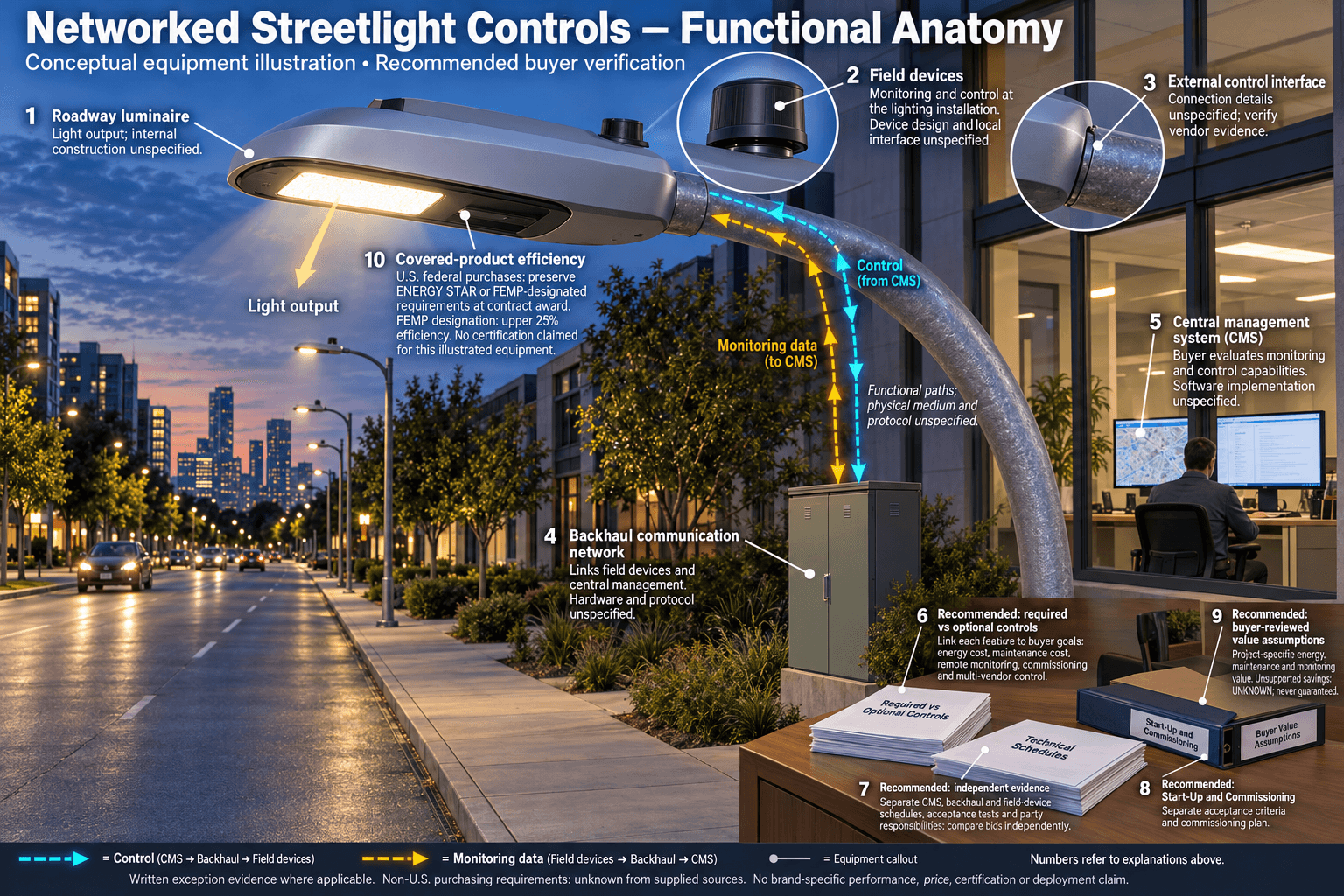
Buyers should request evidence that links each proposed control feature to the buyer’s own operating goals, such as energy-cost reduction, maintenance-cost reduction, remote monitoring, commissioning needs, or multi-vendor procurement control. This is a recommendation, because DOE describes the model specification as a tool to help cities, utilities, and local agencies adopt systems that can further reduce energy and maintenance costs, while also warning that feature value can be difficult to assess.
Useful evidence would include a feature-by-feature value table showing which capabilities are required for all users and which are optional for this project. This aligns with DOE V2.0’s continued clarification between specifications recommended for all users and those likely required by only some users.
2. Verification Beyond Enticing Capabilities
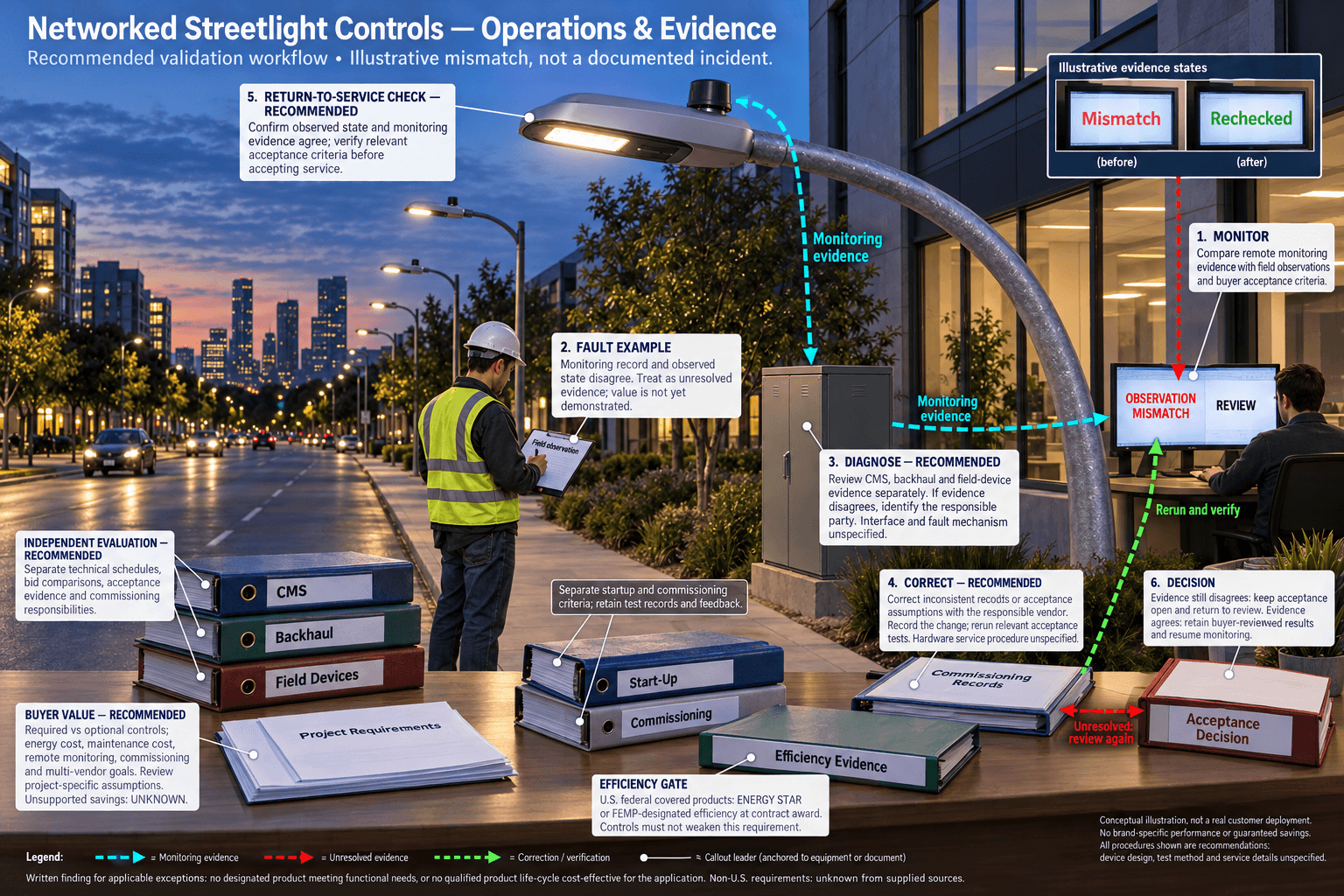
The proposal should separate demonstrated value from attractive functionality. Recommended evidence includes buyer-reviewed assumptions for energy savings, maintenance savings, monitoring value, and any other feature value; a commissioning plan; and acceptance tests for the central management system, backhaul communication network, and field devices. DOE V2.0 specifically added a Backhaul Communication Network section, separated Start-Up and Commissioning sections, and refined the specification to support independent bids for central management systems, backhaul networks, and field devices.
Where savings cannot be forecast with project-specific evidence, the proposal should mark those savings as unknown rather than present them as guaranteed. DOE states that the ability to forecast energy and maintenance savings, along with the value of other features, is not yet universally proven.
3. Multi-Vendor Procurement Evidence
For B2B buyers, the evidence package should make interfaces auditable. Recommended documents include separate technical schedules for the central management system, backhaul network, and field devices; commissioning responsibilities for each party; and bid-comparison worksheets that preserve independent evaluation of those components. This recommendation follows DOE V2.0’s focus on improving the user’s ability to tender multi-vendor, multi-bid projects.
A proposal that bundles all control functions without showing component boundaries may still be commercially valid, but the supplied DOE source does not prove that such a package gives the buyer independently assessed value.
4. Efficiency Requirements Must Stay Intact
For U.S. federal agency purchases, covered energy-consuming products must remain energy-efficient products at the time of contract award when they are delivered, acquired for use at a federally controlled facility, furnished for government use, specified in design, or incorporated during construction, renovation, or maintenance. FEMP’s cited FAR language defines energy-efficient products as ENERGY STAR products or products in the upper 25% of efficiency as designated by FEMP.
This U.S. federal purchasing rule should not be applied automatically to non-U.S. buyers. For other countries, the supplied sources do not state the purchasing law, certification rule, or required contract clause, so those requirements are unknown from the provided evidence.
5. Recommended Evidence Checklist
A useful verification file should include: a requirements matrix distinguishing required and optional controls; project-specific assumptions for energy and maintenance value; startup and commissioning acceptance criteria; separate evidence for central management, backhaul, and field devices; covered-product efficiency language where the buyer is a U.S. federal agency; and written exceptions if an ENERGY STAR or FEMP-designated product is not available or is not life-cycle cost-effective for the specific application. FEMP states that agencies may claim exceptions through a written finding under those conditions.
The strongest conclusion the supplied documents support is procedural: verify value with buyer-specific evidence, and keep covered-product efficiency clauses separate and enforceable. The sources do not support any SOLARTODO-specific claim about product performance, certifications, deployment history, price, stock, or savings.
FAQ
What should verification evidence prove first?
It should prove buyer-assessed value for the specific project, not just list attractive control capabilities.
Can projected savings be stated as guaranteed?
Not from these sources. DOE says forecasting energy and maintenance savings is not yet universally proven, so unsupported savings should be marked unknown.
Why separate CMS, backhaul, and field devices?
DOE V2.0 refines the model specification to support independent bids for central management systems, backhaul networks, and field devices.
What commissioning evidence is useful?
Startup and commissioning acceptance criteria are useful because DOE V2.0 separates those sections and updates related requirements.
Do U.S. federal efficiency clauses apply worldwide?
No. The supplied FEMP source concerns U.S. federal agency purchasing; rules for other countries are unknown from these documents.
What is an energy-efficient product under the cited FAR clause?
FEMP cites language defining it as an ENERGY STAR product or a product in the upper 25% of efficiency as designated by FEMP.
When can a U.S. federal agency claim an exception?
FEMP says an exception may be claimed through a written finding when no FEMP-designated product meets functional requirements or no ENERGY STAR-qualified product is life-cycle cost-effective for the application.
Do the sources prove any SOLARTODO product specification or price?
No. The supplied DOE and FEMP documents do not prove SOLARTODO specifications, deployments, certifications, stock, price, savings, or performance.
References
- U.S. Department of Energy, Model Specification for Networked Outdoor Lighting Control Systems: Used for networked outdoor lighting control procurement scope, buyer value uncertainty, V2.0 updates, commissioning, backhaul, and multi-vendor bid structure. — https://www.energy.gov/cmei/ssl/model-specification-networked-outdoor-lighting-control-systems
- U.S. Department of Energy FEMP, Contract Language for Energy-Consuming Product Purchases: Used for U.S. federal covered-product efficiency contract language, ENERGY STAR/FEMP definitions, applicability, and exception conditions. — https://www.energy.gov/cmei/femp/contract-language-energy-consuming-product-purchases
Procurement paths
About the Author

Cinn Song
Founder & Chief Solutions Architect
Cinn Song founded SOLARTODO LIMITED and leads its smart-city infrastructure engineering — from solar, storage and integrated smart poles to the company's push into physical-AI city edge nodes: pole-mounted edge computing, vertical LLMs for smart cities, drone-based O&M with autonomous battery swapping, robotic maintenance, and high-speed counter-UAS interception. Since 2010, he has directed turnkey EPC + BOT delivery across 50+ countries, including telecom monopole supply for national grid operators, off-grid solar street-lighting for African municipalities, and integrated smart-pole programs for Gulf smart cities.
Cite This Article
Cinn Song. (2026). Verification Evidence for Networked Streetlight Controls. SOLARTODO. Retrieved from https://solartodo.com/knowledge/what-verification-evidence-should-show-that-a-proposed-networked-streetlight-control-package-has-a-buyer-assessed-value
@article{solartodo_what_verification_evidence_should_show_that_a_proposed_networked_streetlight_control_package_has_a_buyer_assessed_value,
  title = {Verification Evidence for Networked Streetlight Controls},
  author = {Cinn Song},
  journal = {SOLARTODO Knowledge Base},
  year = {2026},
  url = {https://solartodo.com/knowledge/what-verification-evidence-should-show-that-a-proposed-networked-streetlight-control-package-has-a-buyer-assessed-value},
  note = {Accessed: 2026-10-13}
}
Published: October 13, 2026 | Available at: https://solartodo.com/knowledge/what-verification-evidence-should-show-that-a-proposed-networked-streetlight-control-package-has-a-buyer-assessed-value
Subscribe to Our Newsletter
Get the latest solar energy news and insights delivered to your inbox.
View All Articles