PVWatts Building Shading | Beam Series, Diffuse Loss and…

Cinn Song
Founder & Chief Solutions Architect
TL;DR
Specify a beam-loss time series and one sky-diffuse loss. Set the general Shading loss to zero in this setup. Match the hourly beam factor to the building shade analysis to check direct-beam reduction. Verify the diffuse loss in Edit Shading.
Require time-series beam shading losses and one sky-diffuse shading loss in the PVWatts yield submission. Check the hourly beam factor against the building shade analysis to review when the model reduces direct beam irradiance. Verify the diffuse loss in Edit Shading.
Summary
Require time-series beam shading losses and one sky-diffuse shading loss in the PVWatts yield submission. Check the hourly beam factor against the building shade analysis to review when the model reduces direct beam irradiance. Verify the diffuse loss in Edit Shading.
Key Takeaways
- Use a beam-loss time series to represent the changing direct-beam shading from the building.
- Enter one separate sky-diffuse shading loss and ask the bidder to document its basis.
- Request the shading file or input tables and a record of the enabled Edit Shading options.
- Set the general Shading loss under Losses to zero when explicit beam and diffuse shading losses are entered.
- Compare the hourly beam shading factor with the time-stamped shadow analysis to check the modeled beam reduction.
- Request matched runs and monthly AC energy if the modeled energy effect of building shading matters to bid selection.
Specify separate beam and sky-diffuse shading inputs
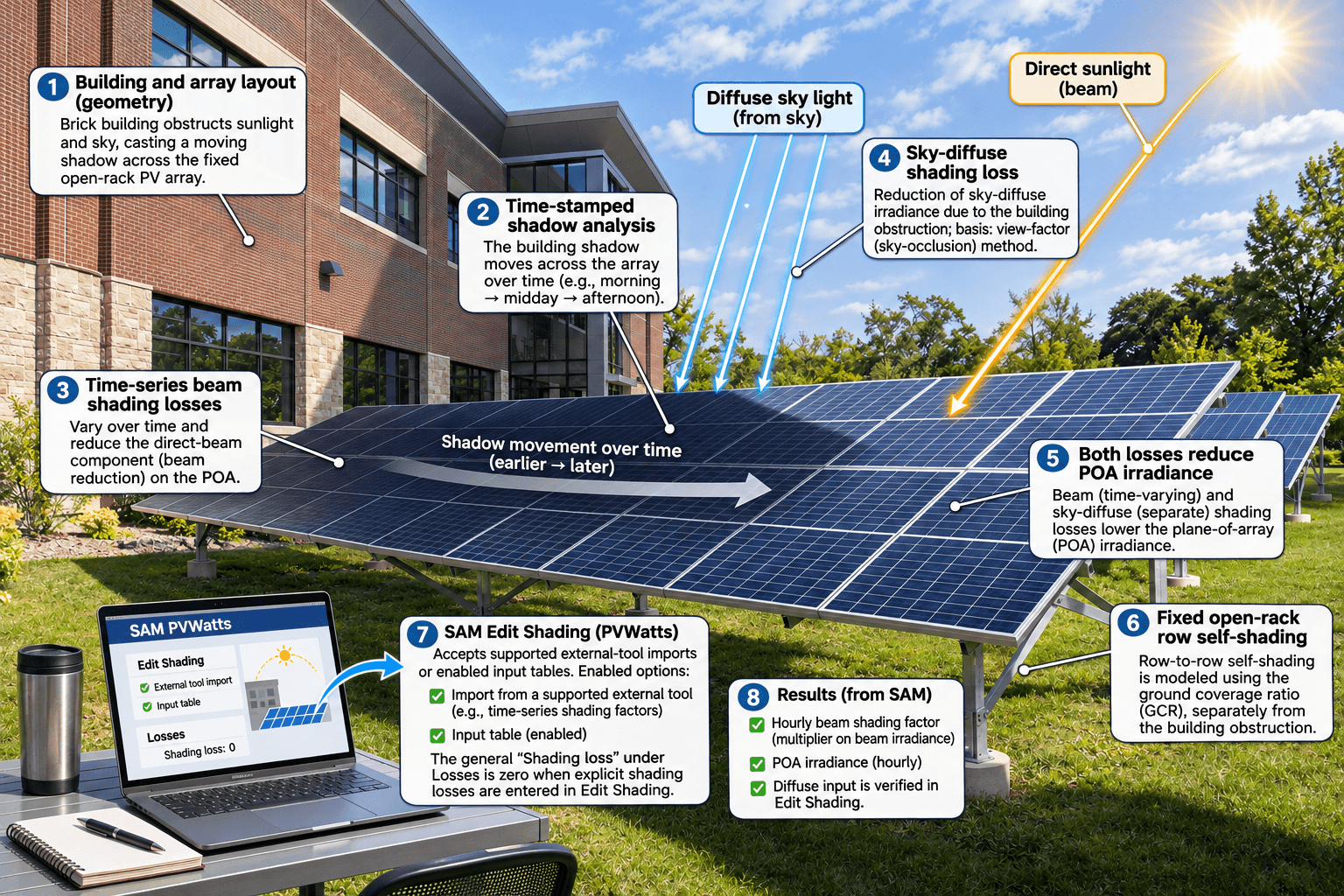
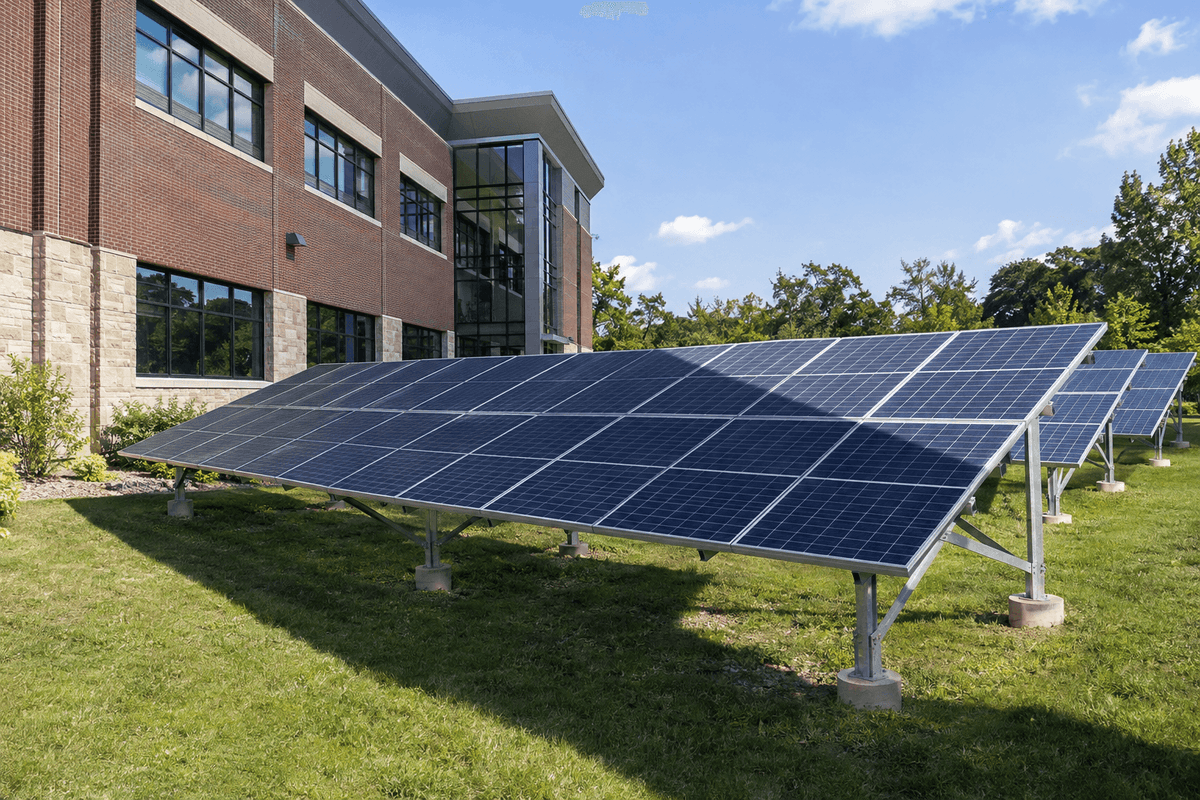
When a nearby building casts a moving shadow across a PV array, require the yield submission to include time-series beam shading losses and one sky-diffuse shading loss for the external obstruction. SAM’s PVWatts System Design help describes these as separate inputs. The beam series represents how the modeled reduction in direct beam irradiance changes over time. The single sky-diffuse value represents the modeled reduction in sky-diffuse irradiance. Both inputs reduce plane-of-array (POA) irradiance, the irradiance incident on the array surface. SAM PVWatts System Design
Ask each bidder to identify the building and array layout used in the shade analysis, provide the beam-loss series and its time basis, and explain the basis for the sky-diffuse value. For a comparison across bids, ask bidders to identify any differences in those assumptions before comparing modeled energy. A project-specific loss value remains unknown until the shade analysis supports it. SAM PVWatts System Design
Set up the external shading case in SAM
In Edit Shading, SAM can import shading data from supported external tools or accept shading factors in enabled input tables. Ask bidders to provide the shading file or tables and show which options they enabled in the submitted run. SAM allows multiple shading options to be enabled, so check that the enabled options match the intended setup. When the explicit beam and diffuse shading losses are entered, SAM’s help directs users to set the general Shading loss under Losses to zero. SAM PVWatts System Design
Check how the bidder treated shading from neighboring PV rows. The System Design help describes separate PVWatts self-shading treatment for fixed open-rack and one-axis tracking arrays using the ground coverage ratio. For those array types, keep row self-shading out of the general Shading loss. Ask the bidder to identify the array type and show where the building obstruction and any row self-shading are represented in the model. SAM PVWatts System Design
Review the hourly beam factor against the shadow analysis
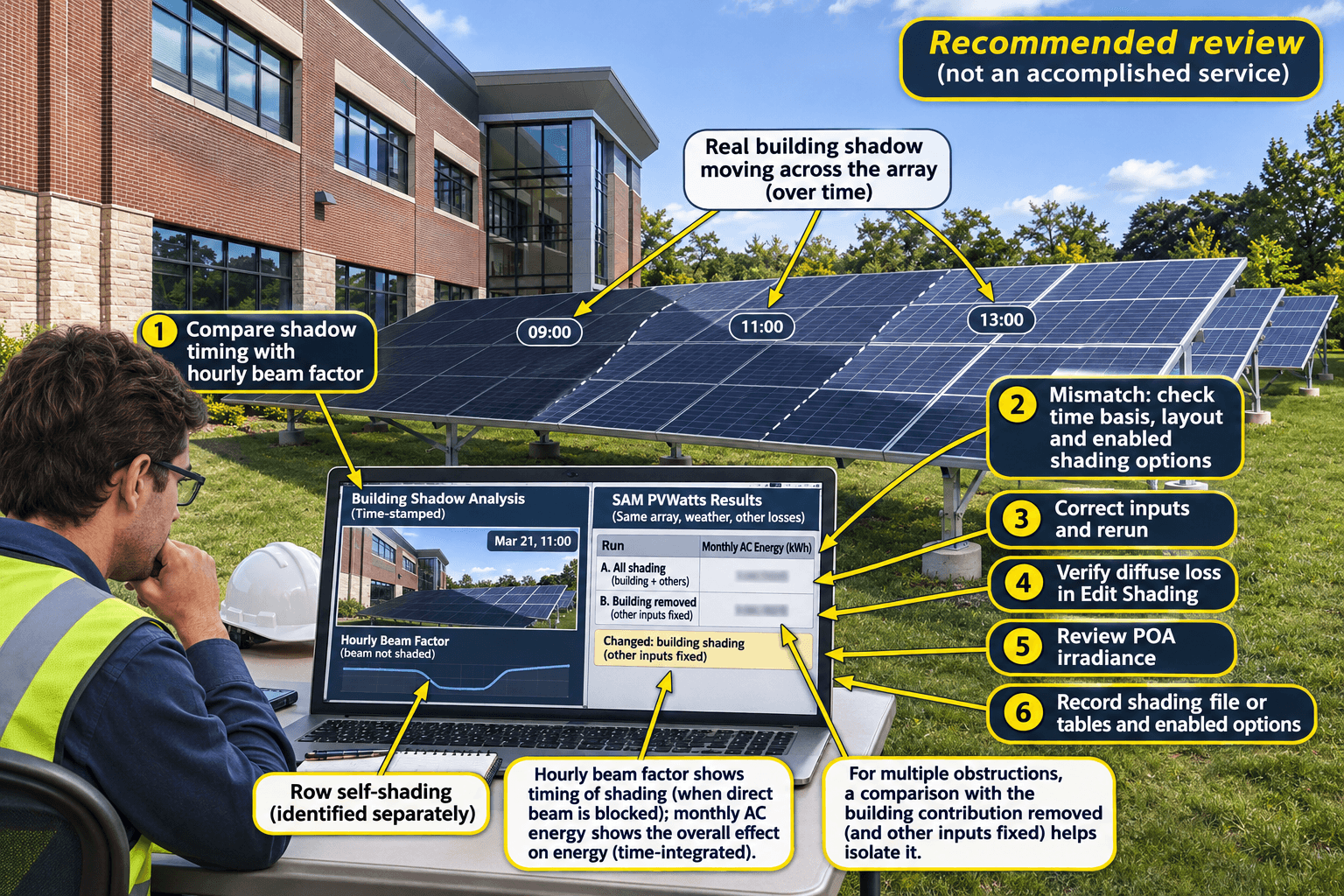
Request the hourly Shading factor for beam radiation and the corresponding POA irradiance. SAM’s PVWatts Results help defines the factor as the multiplier applied to beam radiation to represent its reduction due to shading. Compare the timing of changes in that factor with the time-stamped building shade analysis. Select hours when the analysis predicts that the shadow moves across the array, and check whether the modeled beam reduction follows the pattern reported by the bidder. If the run includes several external obstructions, request a comparison run with the building’s contribution removed and the other inputs held fixed to help isolate its effect. SAM PVWatts Results SAM PVWatts System Design
The PVWatts Results help defines the hourly shading factor specifically for beam radiation. Verify the sky-diffuse loss in the Edit Shading inputs and ask for the analysis behind that value. Review POA irradiance when examining the combined modeled irradiance effect of the two inputs. SAM PVWatts Results SAM PVWatts System Design
Ask for comparable results before using yield in a bid decision
If building shading affects bid selection, request a pair of runs with the same array design, weather file and other loss assumptions. Ask the bidder to document which building-related shading inputs changed between runs and provide the monthly AC energy from each case. SAM’s PVWatts Results help reports monthly AC energy in kWh and the hourly beam shading factor as separate outputs. Use the monthly results to compare the modeled energy effect under the agreed assumptions, and use the hourly factor to investigate the timing of the modeled beam reduction. SAM PVWatts Results SAM PVWatts System Design
FAQ
Which input represents the moving building shadow on direct sunlight?
Use the time-series beam shading losses in Edit Shading. SAM PVWatts System Design
How many sky-diffuse shading values does this setup use?
The external shading setup described in SAM’s PVWatts System Design help uses a single sky-diffuse shading loss. SAM PVWatts System Design
Can the bidder import external shading analysis?
Yes. SAM’s Edit Shading window supports imports from compatible shading tools. Ask for the imported file and the options enabled in the run. SAM PVWatts System Design
What should happen to the general Shading loss?
Set it to zero when explicit beam and diffuse shading losses are specified. SAM PVWatts System Design
What does the hourly beam shading factor show?
It shows the factor applied to beam radiation to represent the modeled reduction from shading at each reported hour. SAM PVWatts Results
Which result reflects both beam and sky-diffuse shading?
Both losses reduce plane-of-array irradiance. Use the Edit Shading settings to verify the individual diffuse input. SAM PVWatts System Design
How does SAM handle row self-shading for fixed open-rack and one-axis tracking arrays?
PVWatts uses ground coverage ratio to estimate self-shading for these array types. Keep that effect out of the general Shading loss for those options. SAM PVWatts System Design
Which output should buyers compare for monthly energy impact?
Compare monthly AC energy in kWh from runs with matching assumptions except for the documented change in building shading. SAM PVWatts Results
About the Author

Cinn Song
Founder & Chief Solutions Architect
Cinn Song founded SOLARTODO LIMITED and leads its smart-city infrastructure engineering — from solar, storage and integrated smart poles to the company's push into physical-AI city edge nodes: pole-mounted edge computing, vertical LLMs for smart cities, drone-based O&M with autonomous battery swapping, robotic maintenance, and high-speed counter-UAS interception. Since 2010, he has directed turnkey EPC + BOT delivery across 50+ countries, including telecom monopole supply for national grid operators, off-grid solar street-lighting for African municipalities, and integrated smart-pole programs for Gulf smart cities.
Cite This Article
Cinn Song. (2026). PVWatts Building Shading | Beam Series, Diffuse Loss and…. SOLARTODO. Retrieved from https://solartodo.com/knowledge/when-a-nearby-building-casts-a-moving-shadow-across-a-pv-array-which-shading-inputs-should-the-yield-specification-use
@article{solartodo_when_a_nearby_building_casts_a_moving_shadow_across_a_pv_array_which_shading_inputs_should_the_yield_specification_use,
  title = {PVWatts Building Shading | Beam Series, Diffuse Loss and…},
  author = {Cinn Song},
  journal = {SOLARTODO Knowledge Base},
  year = {2026},
  url = {https://solartodo.com/knowledge/when-a-nearby-building-casts-a-moving-shadow-across-a-pv-array-which-shading-inputs-should-the-yield-specification-use},
  note = {Accessed: 2026-11-26}
}
Published: November 26, 2026 | Available at: https://solartodo.com/knowledge/when-a-nearby-building-casts-a-moving-shadow-across-a-pv-array-which-shading-inputs-should-the-yield-specification-use
Subscribe to Our Newsletter
Get the latest solar energy news and insights delivered to your inbox.
View All Articles