PVWatts V6 to V8: Review Yield Changes and Aging Separately

Cinn Song
Founder & Chief Solutions Architect

TL;DR
Yes—separate the two. Compare V6/V8 inputs, weather sources and model records to establish the revised baseline; then verify the financial forecast’s degradation mode and justified aging assumptions.
Separate the V6-to-V8 production revision from equipment aging. Compare simulation inputs, actual weather sources and model records first; then verify the financial forecast’s degradation mode and assumptions. The documentation does not establish a project-specific aging rate.
Key Takeaways
- Review version-related production changes separately from later-year equipment degradation.
- Check the returned weather-data source rather than assuming one weather vintage for every V8 location.
- Request original and revised calculation records, including inputs, warnings and version information.
- Compare monthly and annual AC outputs before accepting the revised baseline.
- Verify SAM’s selected degradation mode; its compounded example explicitly excludes PVWatts and Detailed Photovoltaic.
- Require separate justification for project degradation assumptions and separate battery-aging settings when storage is included.
PVWatts V6 to V8: Separate Estimate Revisions from Equipment Aging
Summary
Yes. Buyers should review a PVWatts version change separately from the equipment-aging reduction used in the financial forecast. First reconcile the weather data, calculation model and project inputs behind the revised production estimate. Then review the degradation assumptions applied to that baseline. Request both simulation records and the financial model’s degradation settings before accepting a revised forecast. PVWatts V8 documentation explains why estimates can change between versions; SAM’s AC Degradation guidance explains how later-year reductions are applied. Neither establishes a project-specific aging rate.
1. Identify what changed in the production estimate
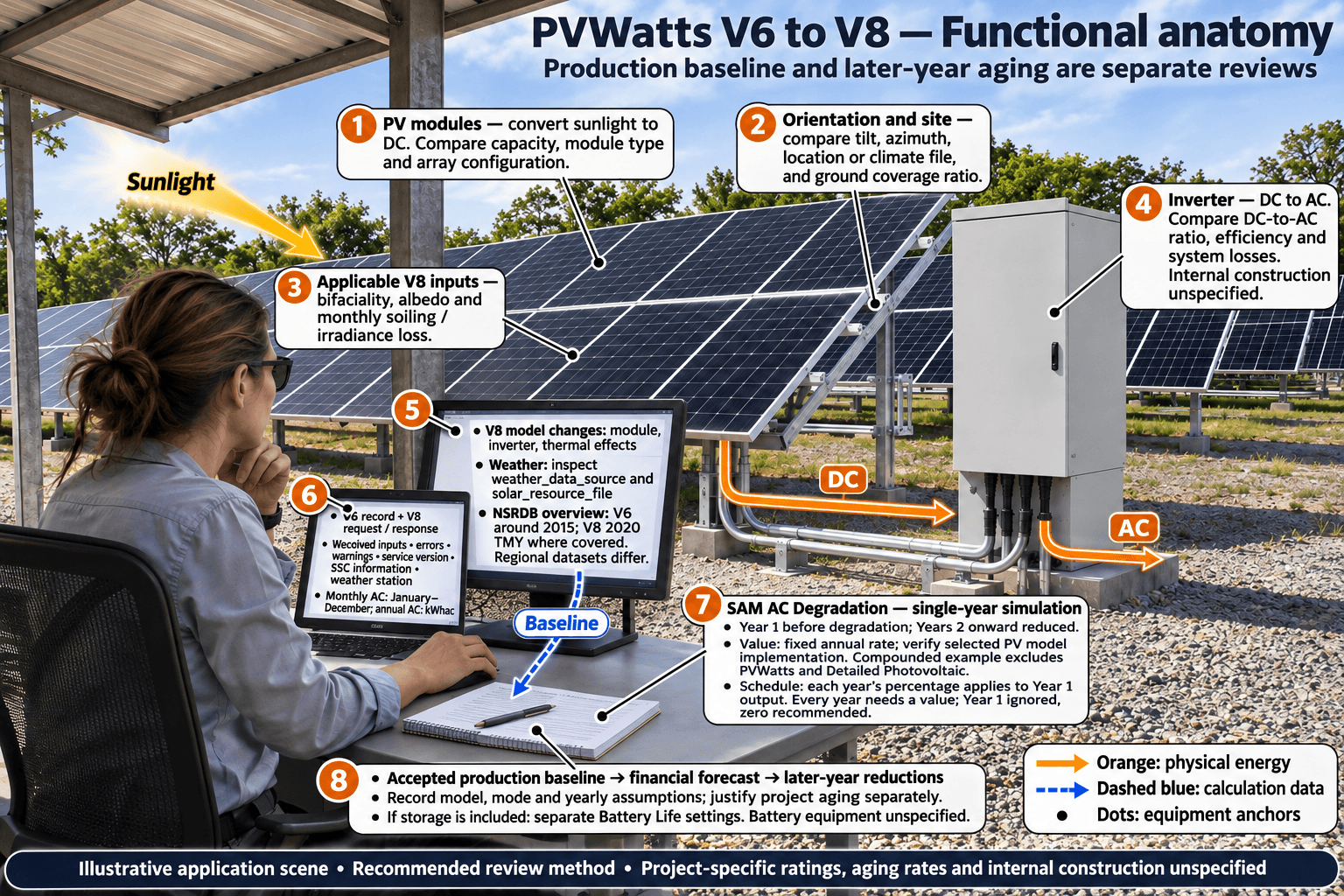
PVWatts V8 introduces updated photovoltaic module, inverter and thermal-effects models. It also adds bifacial modeling, monthly irradiance-loss inputs and albedo options. Its documentation explains that production estimates may differ from V6 depending on location and inputs. A version-related change therefore needs its own explanation before the buyer evaluates equipment aging. PVWatts V8 API documentation
Weather selection also matters. The V8 overview describes an update to 2020 TMY weather data for locations covered by NSRDB, compared with NSRDB data from around 2015 used in V6. However, the dataset parameter lists multiple regional datasets with different TMY identifiers. Buyers should inspect the actual weather source returned for each simulation rather than assume every V8 estimate uses an identical weather vintage. PVWatts V8 API documentation
As a procurement recommendation, ask the estimator to distinguish documented input changes from model and weather changes. If the available runs do not isolate their individual contributions, record that attribution as unresolved. A difference between two annual totals alone should not be presented as a measured equipment-aging effect.
2. Request a reproducible comparison
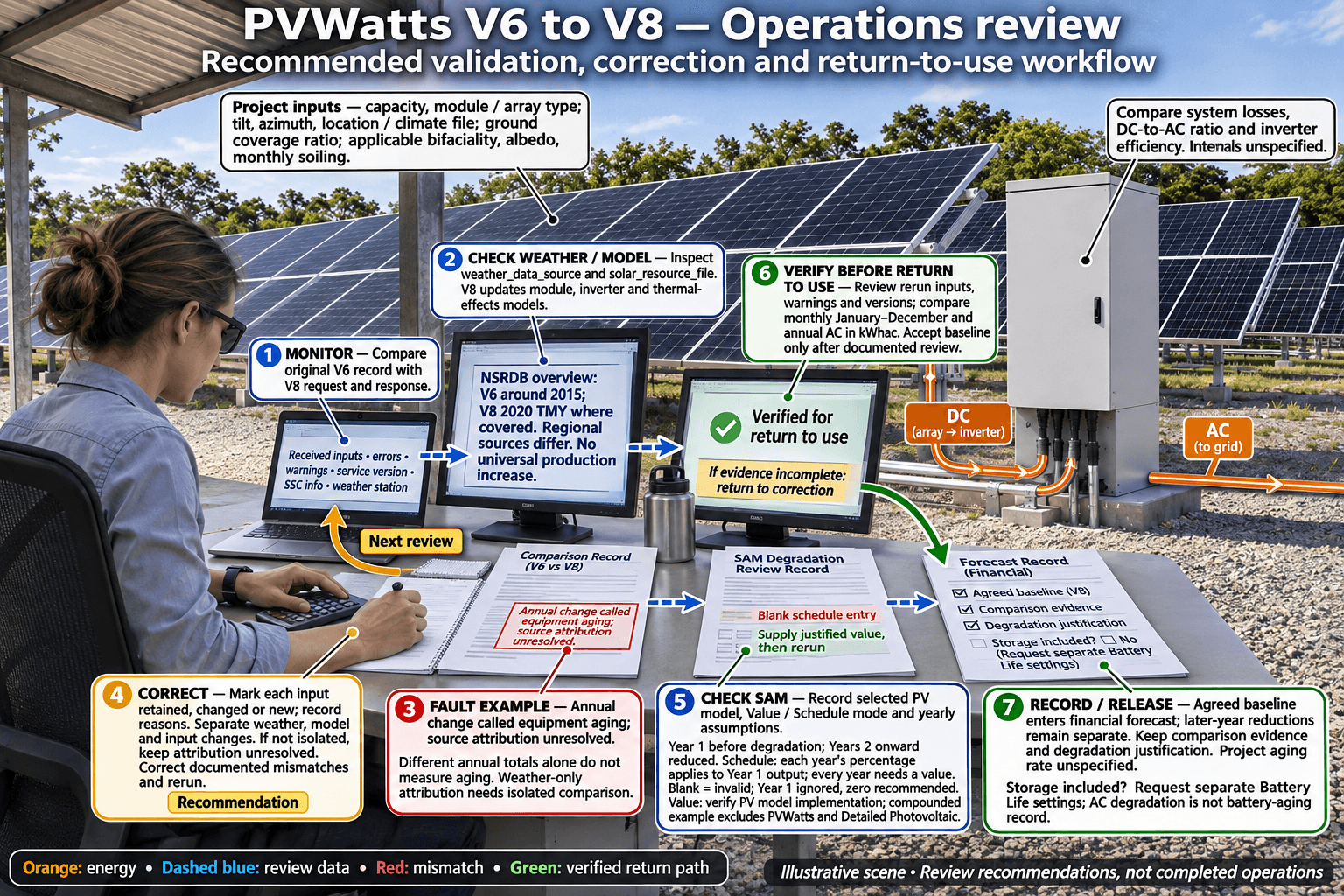
Ask for the original V6 calculation record and the revised V8 request and response. For V8, the API exposes received inputs, errors, warnings, service version, SSC information and weather-station information. These fields provide a practical basis for reviewing the revised run. PVWatts V8 API documentation
The recommended comparison should cover:
- Nameplate capacity, module type and array configuration.
- Tilt, azimuth and location or climate-file selection.
- System losses, DC-to-AC ratio and inverter efficiency.
- Ground coverage ratio and any bifaciality, albedo or monthly soiling settings.
- Returned weather-data source and solar-resource filename.
These are documented V8 inputs or response fields. Buyers should ask which settings were retained, changed or newly introduced, with a reason for each change. PVWatts V8 API documentation
Request monthly AC results alongside annual AC output. V8 reports both in kWhac, with monthly entries ordered January through December. Reviewing both is a recommended way to examine the revision without relying solely on its annual headline. Any claim that weather alone caused the difference should be supported by a comparison that actually isolates weather; the V8 documentation does not quantify that contribution for an individual project. PVWatts V8 API documentation
3. Check the degradation method separately
SAM’s AC Degradation guidance describes reductions in AC electrical output over time, for example because equipment ages. For its single-year simulation degradation settings, Year 1 precedes degradation and reductions apply in Years 2 and later. When entering a yearly schedule, SAM ignores the Year 1 degradation value and recommends setting it to zero. SAM Help: AC Degradation
The distinction between Value and Schedule modes requires care. The guidance describes a fixed annual rate, but its compounded numerical example explicitly applies to performance models other than Detailed Photovoltaic and PVWatts. Buyers should therefore ask the analyst to verify the selected PV model’s implementation rather than copy that example into a PVWatts forecast. SAM Help: AC Degradation
For Schedule mode, the guidance explicitly states that each year’s degradation percentage is applied to Year 1 output to calculate that year’s output. Buyers should verify that the submitted schedule follows this definition. SAM also requires a value for every year in the schedule; blank entries make it invalid. SAM Help: AC Degradation
4. Set a clear forecast-review requirement
Before accepting the revision, request an agreed production baseline, a documented comparison of the two simulations, and a separate degradation record identifying the model, mode and yearly assumptions. This is a recommended review method, not a software-mandated procurement requirement.
Ask the analyst to show how the accepted baseline enters the financial forecast and where later-year reductions are applied. Require the project-specific degradation assumption to have its own justification: SAM’s AC Degradation guidance explains input behavior but does not establish an aging rate for the equipment being purchased. SAM Help: AC Degradation
For projects with storage, review battery degradation separately. SAM places battery degradation inputs on the Battery Life page. Buyers should request those settings when storage is included, rather than treat the AC degradation setting as the battery-aging record. SAM Help: AC Degradation
FAQ
Should a buyer separate the V8 revision from annual aging?
Yes. Review weather, model and input changes when agreeing the production baseline, then review the degradation assumptions applied in the financial forecast.
Does V8 necessarily predict more electricity than V6?
No universal increase is stated. PVWatts V8 documentation says estimates may differ depending on location and inputs.
Does every V8 run use 2020 TMY weather?
Do not assume that. The V8 dataset list includes different regional TMY identifiers; inspect the returned weather_data_source and solar_resource_file.
Which project settings should be compared?
Compare capacity, module and array types, orientation, location, losses, DC-to-AC ratio, inverter efficiency and applicable bifacial, albedo and soiling inputs.
When does SAM’s documented AC degradation begin?
For the single-year simulation settings described in AC Degradation, reductions apply in Years 2 and later. The guidance recommends zero for Year 1 in a schedule.
How does SAM’s Schedule mode calculate each year?
The AC Degradation guidance says each year’s scheduled percentage is applied to Year 1 output to calculate that year’s output.
Can SAM’s compounded example be copied into a PVWatts forecast?
That example explicitly excludes PVWatts and Detailed Photovoltaic. Ask the analyst to verify the selected model’s degradation implementation.
Does the AC degradation setting cover battery aging?
SAM’s AC Degradation guidance directs battery degradation to the Battery Life page. Request those settings separately for a storage project.
Procurement paths
About the Author

Cinn Song
Founder & Chief Solutions Architect
Cinn Song founded SOLARTODO LIMITED and leads its smart-city infrastructure engineering — from solar, storage and integrated smart poles to the company's push into physical-AI city edge nodes: pole-mounted edge computing, vertical LLMs for smart cities, drone-based O&M with autonomous battery swapping, robotic maintenance, and high-speed counter-UAS interception. Since 2010, he has directed turnkey EPC + BOT delivery across 50+ countries, including telecom monopole supply for national grid operators, off-grid solar street-lighting for African municipalities, and integrated smart-pole programs for Gulf smart cities.
Cite This Article
Cinn Song. (2026). PVWatts V6 to V8: Review Yield Changes and Aging Separately. SOLARTODO. Retrieved from https://solartodo.com/knowledge/when-a-revised-pv-estimate-changes-after-moving-from-pvwatts-v6-to-v8-should-the-buyer-separate-changes-in-weather-data
@article{solartodo_when_a_revised_pv_estimate_changes_after_moving_from_pvwatts_v6_to_v8_should_the_buyer_separate_changes_in_weather_data,
  title = {PVWatts V6 to V8: Review Yield Changes and Aging Separately},
  author = {Cinn Song},
  journal = {SOLARTODO Knowledge Base},
  year = {2026},
  url = {https://solartodo.com/knowledge/when-a-revised-pv-estimate-changes-after-moving-from-pvwatts-v6-to-v8-should-the-buyer-separate-changes-in-weather-data},
  note = {Accessed: 2026-11-18}
}
Published: November 18, 2026 | Available at: https://solartodo.com/knowledge/when-a-revised-pv-estimate-changes-after-moving-from-pvwatts-v6-to-v8-should-the-buyer-separate-changes-in-weather-data
Subscribe to Our Newsletter
Get the latest solar energy news and insights delivered to your inbox.
View All Articles