Missed Battery Dispatch Target? Check SOC and Power Limits

Cinn Song
Founder & Chief Solutions Architect
TL;DR
Before buying more battery capacity or replacing a controller, match target and actual power by time and measurement point. Check available energy, active SOC and power limits, and request duration. If a feasible command still misses the agreed tolerance in a witnessed test, escalate with the command and measurement records.
Before approving a controller replacement or additional battery capacity, align the requested and measured power, check available energy against the active SOC window for the full interval, and verify the permitted power and charging sources. Escalate repeatable misses under agreed, feasible test conditions.
Summary
Before approving a controller replacement or additional battery capacity, align the requested and measured power, check available energy against the active SOC window for the full interval, and verify the permitted power and charging sources. Escalate repeatable misses under agreed, feasible test conditions.
Key Takeaways
- Identify whether the target refers to battery power or grid import or export, then match it to the corresponding measurement.
- Align timestamps, intervals, units, and charge/discharge sign conventions before measuring the shortfall.
- Check opening SOC, the active SOC limit, and available capacity over the requested duration.
- Review earlier dispatch and permitted charging sources when the battery enters an event with limited energy.
- Ask for the requested target, the command after limits, and measured power to locate where the shortfall begins.
- Require witnessed tracking and SOC-boundary tests with agreed conditions and tolerances before acceptance.
How to diagnose a missed automated battery dispatch target
When a battery misses an automated power target, check whether the target was feasible for the full interval before assigning a controller fault or paying for more capacity. Compare the target and actual power on the same time and measurement basis. Then check the starting state of charge (SOC), the active SOC limits, available capacity, and the permitted power and charging sources. If the miss persists in a controlled test with those conditions satisfied, ask the supplier to trace the command from dispatch calculation to equipment response.
1. Identify the target and the measurement point
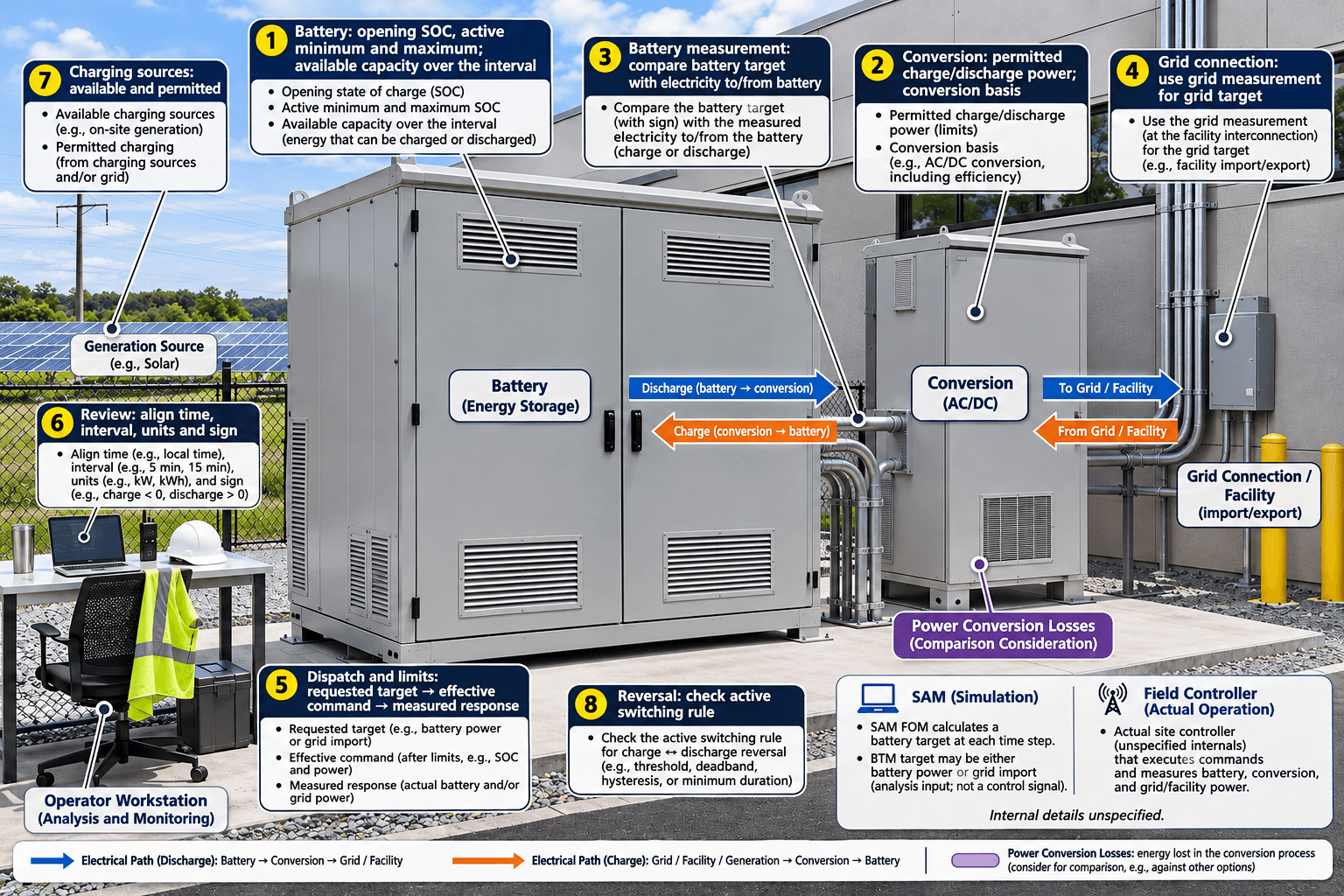
For front-of-meter (FOM) automated dispatch, the System Advisor Model (SAM) calculates a battery power target at each time step. Its help page recommends comparing Electricity battery power target for automated dispatch with Electricity to/from battery. It lists separate outputs for battery SOC, battery power delivered to the grid, and generation delivered to the grid where applicable. Start with the battery target and battery power, then use the grid outputs to investigate delivery at the grid connection. SAM Help — Battery Dispatch FOM
For behind-the-meter (BTM) projects, identify whether the target specifies battery power or grid import. SAM’s grid-target mode attempts to keep grid draw at or below the specified level, while its battery-target mode follows a requested charge or discharge series. For a project review, ask for the target definition, measurement point, units, sign convention, and interval. Align the target and actual traces before counting misses. SAM Help — Battery Dispatch BTM
2. Check energy headroom across the missed interval
SAM applies the minimum and maximum SOC limits to the capacity available at the time step. That capacity can change with degradation and replacement. For a discharge miss, check the opening SOC and the trace through the interval against the active minimum. For a charge miss, check the corresponding headroom below the maximum. Ask for the available-capacity basis used for the event and the duration of the request. A nameplate energy rating alone leaves the energy available for that interval unknown. SAM Help — Battery Dispatch FOM
A discharge that tracks its target and then falls short as SOC reaches the active minimum is consistent with the SOC floor limiting delivery. Check the preceding intervals to understand why the battery started with that amount of energy. For example, SAM’s BTM grid-target guidance identifies a depleted battery with no generation available as a case where the grid target may be missed. Ask which charging sources were both available and permitted before the event. SAM Help — Battery Dispatch BTM
3. Check the permitted power, then trace the command
Ask the supplier to show what charge or discharge power was permitted during the event and how that limit relates to the requested measurement point. SAM’s FOM automated dispatch accounts for power conversion losses, so confirm the conversion basis before comparing battery output with a grid-side target. If the dispatch involved a charge-to-discharge reversal or the reverse, check the active switching rules. In SAM, the minimum time at a charge state applies only when the simulation time step is shorter than that minimum. SAM Help — Battery Dispatch FOM
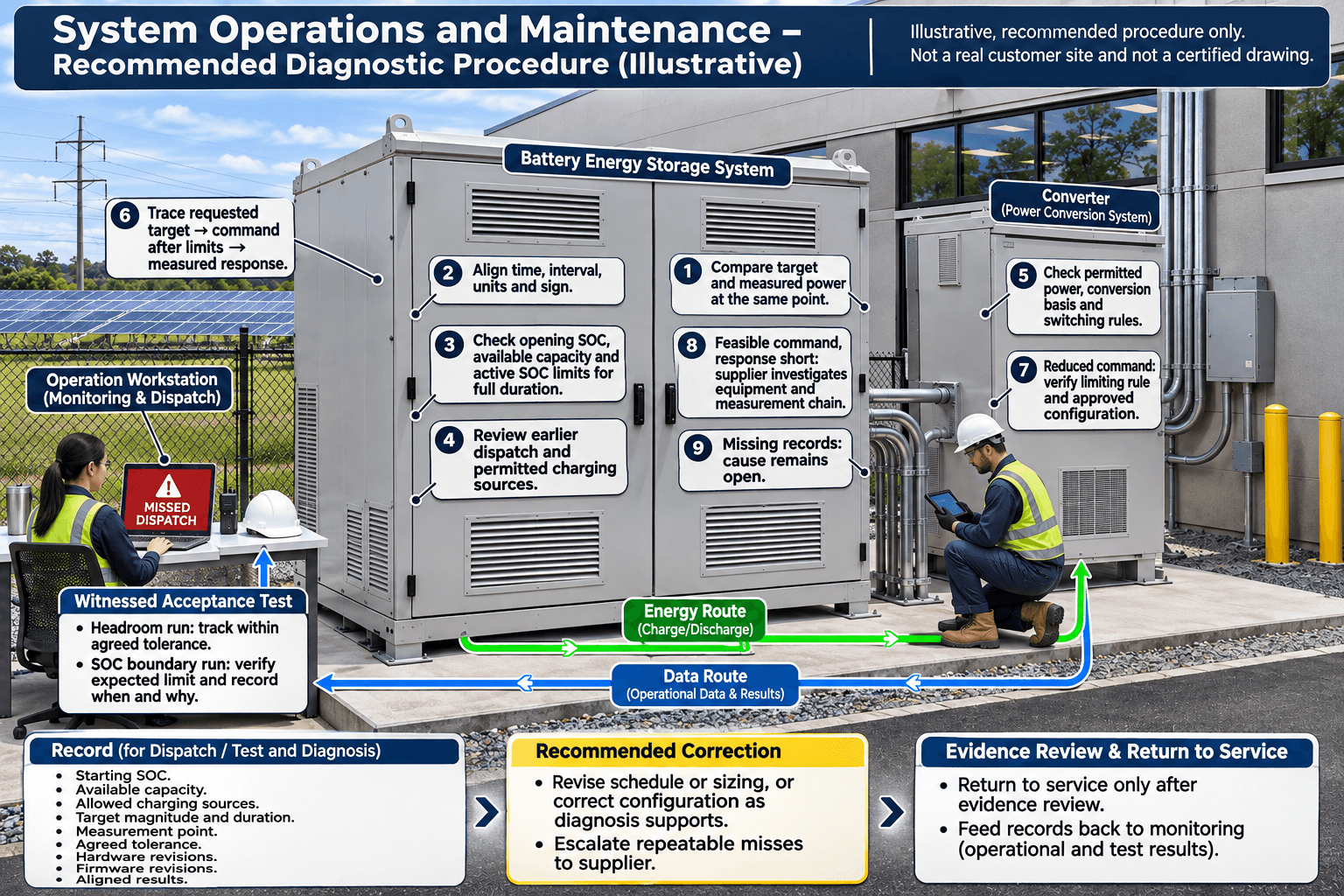
For field troubleshooting, request a common timeline showing the requested target, the effective command after limits, the measured response, SOC, and any active limits, overrides, or alarms. If the effective command was reduced, ask which rule reduced it and whether that rule matched the approved configuration. If a feasible command reached the equipment and measured power still fell short, ask the supplier to investigate the response and measurement chain. If the records leave the command or active limits unknown, keep the cause open.
4. Turn the diagnosis into an acceptance test
Require a witnessed test with a documented starting SOC, available capacity, allowed charging sources, target duration, measurement point, and tracking tolerance. Include a run with sufficient headroom and a run that reaches the agreed SOC boundary. For the first run, require tracking within the agreed tolerance. For the boundary run, require the expected power limit and a record showing when and why it took effect.
SAM Help’s Battery Dispatch FOM describes the simulation’s target and modeled response. For a specific controller, use the proposed hardware and firmware revisions in the witnessed test and request the time-aligned results. Use the outcome to decide whether to revise the operating schedule or storage sizing, correct the configuration, or escalate a repeatable tracking miss to the supplier. SAM Help — Battery Dispatch FOM
FAQ
Which SAM outputs should I compare for FOM automated dispatch?
Compare Electricity battery power target for automated dispatch with Electricity to/from battery. Review battery SOC over the same interval. SAM Help — Battery Dispatch FOM
Can I use the grid meter to check battery power tracking?
Use it for a target defined at the grid connection. For battery power tracking, use the corresponding battery power measurement and confirm its measurement point.
What suggests the minimum SOC limited discharge?
Look for power falling short as SOC reaches the configured minimum, then verify that the active limit explains the timing. SAM Help — Battery Dispatch FOM
Why ask for available capacity as well as SOC?
SAM applies SOC limits to available capacity, which can change with degradation and replacement. Ask which capacity value was used for the event. SAM Help — Battery Dispatch BTM
What should I check when a charge target is missed?
Check the headroom below maximum SOC and verify that the intended charging source was available and enabled. SAM Help — Battery Dispatch FOM
Does a missed BTM grid target identify a battery controller fault?
The cause remains open until the event is reviewed. SAM gives depletion without available generation as one reason a grid target can be missed. SAM Help — Battery Dispatch BTM
What should the supplier investigate if there was enough energy?
Ask the supplier to verify the allowed power and active limits, then trace the requested target through the effective command to the measured response.
What should a witnessed acceptance test record?
Record starting SOC, available capacity, target magnitude and duration, the measurement point, agreed tracking tolerance, and the time-aligned target, response, and limits.
Procurement paths
About the Author

Cinn Song
Founder & Chief Solutions Architect
Cinn Song founded SOLARTODO LIMITED and leads its smart-city infrastructure engineering — from solar, storage and integrated smart poles to the company's push into physical-AI city edge nodes: pole-mounted edge computing, vertical LLMs for smart cities, drone-based O&M with autonomous battery swapping, robotic maintenance, and high-speed counter-UAS interception. Since 2010, he has directed turnkey EPC + BOT delivery across 50+ countries, including telecom monopole supply for national grid operators, off-grid solar street-lighting for African municipalities, and integrated smart-pole programs for Gulf smart cities.
Cite This Article
Cinn Song. (2026). Missed Battery Dispatch Target? Check SOC and Power Limits. SOLARTODO. Retrieved from https://solartodo.com/knowledge/when-automated-battery-dispatch-misses-a-power-target-how-should-the-buyer-distinguish-insufficient-available-energy
@article{solartodo_when_automated_battery_dispatch_misses_a_power_target_how_should_the_buyer_distinguish_insufficient_available_energy,
  title = {Missed Battery Dispatch Target? Check SOC and Power Limits},
  author = {Cinn Song},
  journal = {SOLARTODO Knowledge Base},
  year = {2026},
  url = {https://solartodo.com/knowledge/when-automated-battery-dispatch-misses-a-power-target-how-should-the-buyer-distinguish-insufficient-available-energy},
  note = {Accessed: 2026-11-20}
}
Published: November 20, 2026 | Available at: https://solartodo.com/knowledge/when-automated-battery-dispatch-misses-a-power-target-how-should-the-buyer-distinguish-insufficient-available-energy
Subscribe to Our Newsletter
Get the latest solar energy news and insights delivered to your inbox.
View All Articles