Compare Bifacial Modules: Bifaciality and Rear Irradiance

Cinn Song
Founder & Chief Solutions Architect

TL;DR
Yes: under unchanged optical conditions, higher bifaciality changes the conversion weighting of rear irradiance, not the irradiance itself. Verify module data and geometry, keep comparison assumptions consistent, and assess the complete DC and AC simulation.
For unchanged optical and layout conditions, higher bifaciality changes the electrical weighting of rear irradiance, not the rear irradiance itself. Compare documented module inputs using consistent weather, geometry and loss assumptions, then review simulated DC and AC output before making a procurement decision.
Summary
For unchanged optical and layout conditions, higher bifaciality changes the electrical weighting of rear irradiance, not the rear irradiance itself. Compare documented module inputs using consistent weather, geometry and loss assumptions, then review simulated DC and AC output before making a procurement decision.
Key Takeaways
- Bifaciality is rear-side efficiency divided by front-side efficiency; it does not increase rear irradiance.
- SAM weights calculated rear irradiance by bifaciality before passing the combined irradiance input to the module model.
- Hold albedo, spacing, clearance, shading and weather assumptions constant when isolating bifaciality.
- Check module dimensions and transmission fraction before assuming identical optical conditions.
- Use documented candidate-specific electrical and thermal parameters for the final module comparison.
- Review complete DC and AC simulations; a bifaciality difference is not an equivalent annual-energy gain.
Comparing Bifacial Modules: Keep Rear Irradiance Separate from Bifaciality
Yes. When comparing bifacial modules under unchanged optical and layout conditions, a higher rear-to-front efficiency ratio should change how rear irradiance contributes to modeled electrical output. It should not increase the modeled rear irradiance itself. Both SAM’s “Module” help and the PVWatts V8 API documentation explicitly distinguish bifaciality from rear-side irradiance. SAM Module help; PVWatts V8.
For procurement, the recommended approach is to separate two questions: how much light reaches the rear surface, and how effectively the selected module converts that light. Request the candidate module’s bifaciality, electrical specifications and physical dimensions, then compare cases using a documented, consistent site and layout basis.
1. Understand What the Bifaciality Input Changes
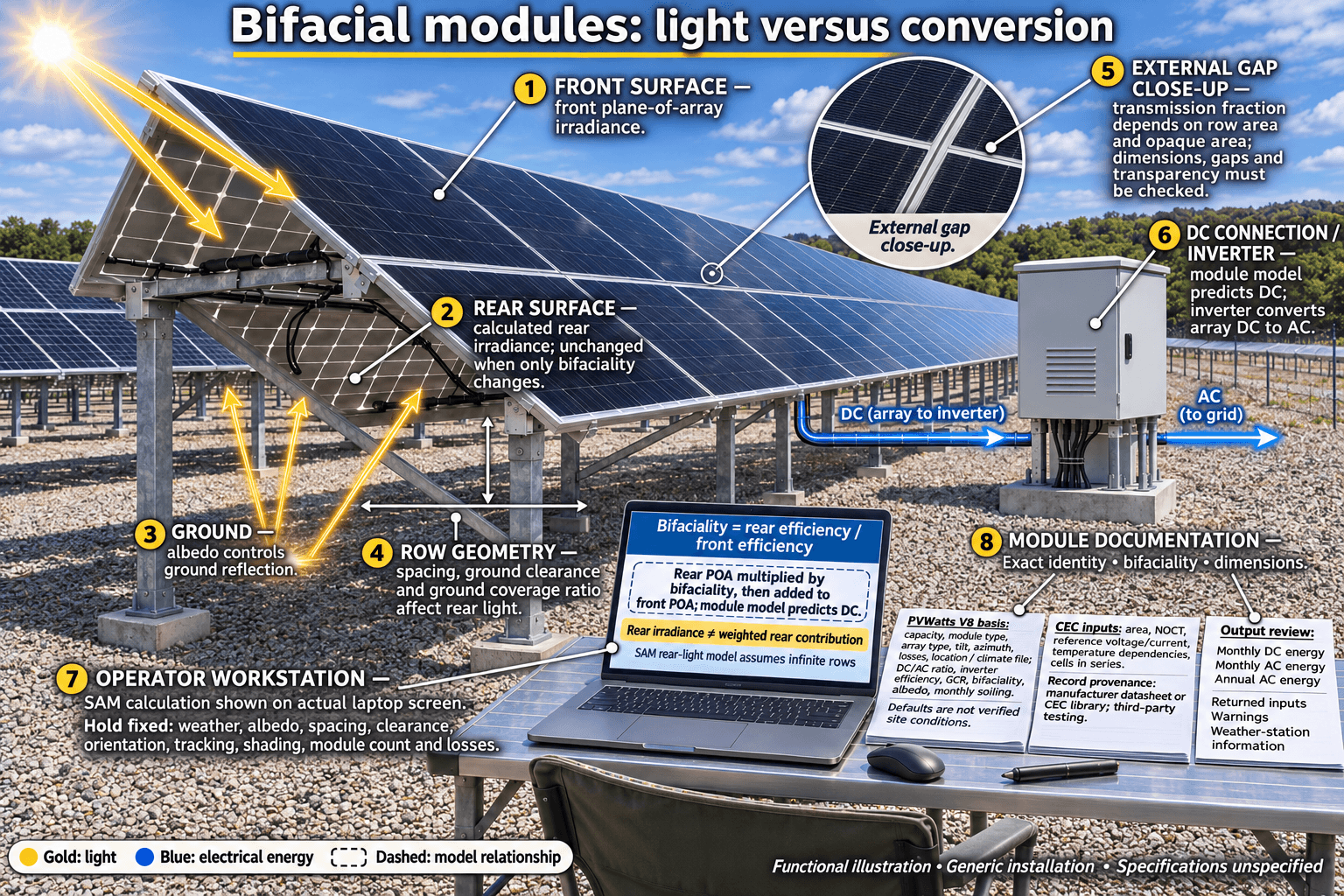
Bifaciality is the ratio of rear-side efficiency to front-side efficiency. PVWatts V8 states that this ratio does not affect solar irradiance on the module’s rear surface. A higher value therefore represents a different rear-side conversion capability, rather than a brighter operating environment. PVWatts V8, “bifaciality”.
SAM describes the calculation sequence explicitly: its bifacial model calculates rear-side plane-of-array irradiance, multiplies that irradiance by the module bifaciality factor, and adds the weighted contribution to front-side plane-of-array irradiance. The combined input then goes to the module model to predict DC power. SAM’s rear-irradiance calculation assumes infinite rows. SAM Module help, “Bifacial Specifications”.
The distinction matters when reviewing a supplier’s simulation. A larger bifaciality input can increase the rear contribution entering the electrical model without changing the underlying rear irradiance. Buyers should request clear labels distinguishing physical rear-side irradiance from the bifaciality-weighted contribution used for power prediction.
2. Define What “Same Array Layout” Includes
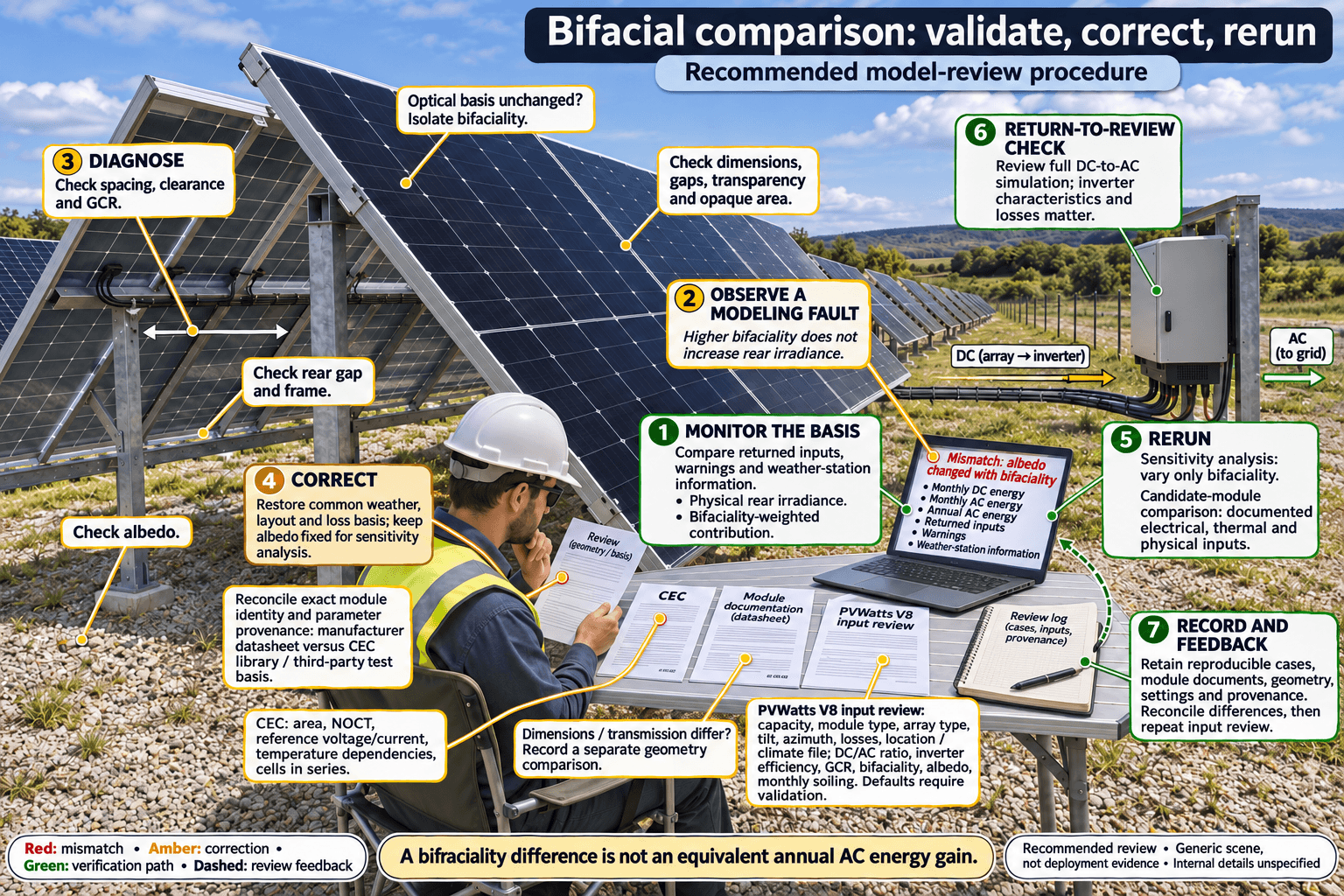
SAM identifies ground albedo, row-to-row spacing and ground clearance as primary drivers of rear-side irradiance. Its transmission-fraction input describes how much light can pass around or through modules within a row. Row spacing is also governed by ground coverage ratio and array geometry. SAM Module help, “Bifacial Specifications”.
For a comparison intended to isolate bifaciality, buyers should keep these inputs unchanged, along with the weather file, orientation, tracking and shading assumptions. SAM explains that array output depends on module count, orientation, tracking, shading and specified losses, as well as module performance. SAM Module help, introduction.
Keeping nominal row positions unchanged is not sufficient if candidate modules differ physically. SAM’s transmission fraction depends on row area and light-blocking area, including module or cell area and other opaque material. The recommended review is therefore to check dimensions, gaps and transparency before treating two candidates as optically identical. Where those inputs change, document a separate geometry comparison rather than attributing the whole result to bifaciality. SAM Module help, “Transmission Fraction”.
3. Request Inputs That Match the Comparison
Ask each bidder for the exact module identity and its documented bifaciality. For a detailed SAM comparison, request the electrical and thermal inputs required by the selected module model. SAM’s CEC user-entered model uses manufacturer specifications including module area, NOCT, reference voltages and currents, temperature dependencies and cells in series. SAM Module help, “CEC Performance Model with User Entered Specifications”.
Check parameter provenance as well as values. SAM warns that coefficients generated from a manufacturer datasheet can differ from CEC library coefficients because the library may use specifications from third-party testing facilities. Buyers should ask the modeler to identify which parameter source each candidate uses and explain any differences before comparing results. SAM Module help, CEC user-entered model notes.
For PVWatts V8, record capacity, module type, array type, tilt, azimuth, losses and location or climate-file selection. Also record relevant optional settings, including DC/AC ratio, inverter efficiency, ground coverage ratio, bifaciality, albedo and monthly soiling. These are documented API inputs; their defaults should not be presented as verified project conditions. PVWatts V8, “Request Parameters”.
4. Review Results Without Turning a Ratio into a Yield Promise
A recommended review uses two comparisons. First, vary only bifaciality to examine that input’s effect. Second, compare the actual candidate modules using their documented electrical, thermal and physical characteristics. Label the first as a sensitivity analysis and the second as a candidate-module comparison.
Do not interpret a higher bifaciality ratio as the same percentage increase in annual AC energy. SAM passes the weighted irradiance to a module model, while array output also depends on layout and losses and is subsequently fed to inverters. Review the complete simulation rather than converting the bifaciality difference directly into an energy claim. SAM Module help, introduction and “Bifacial Specifications”.
For PVWatts V8, request monthly DC and AC energy, annual AC energy, returned inputs, warnings and weather-station information. The API exposes these fields, supporting a review of both results and their modeling basis. PVWatts V8, “Response Fields”.
The procurement decision should rest on reproducible candidate-specific cases. SAM’s “Module” help explains the modeling mechanism; PVWatts V8 defines the API inputs and outputs. Neither establishes the performance of an unnamed module. Before accepting a yield comparison, ask the bidder to reconcile the selected model, module documentation, geometry and simulation settings.
FAQ
Should higher bifaciality increase modeled rear irradiance?
No. PVWatts V8 explicitly states that bifaciality does not affect rear irradiance. It describes the ratio of rear-side to front-side efficiency.
How does SAM apply bifaciality?
SAM multiplies calculated rear irradiance by bifaciality, adds that contribution to front irradiance and sends the combined input to the module model.
Which inputs primarily affect rear irradiance in SAM?
SAM identifies ground albedo, row spacing and ground clearance as primary drivers. Transmission fraction also describes light passing around or through a row.
Does identical row spacing guarantee identical optical conditions?
No. SAM’s transmission-fraction definition also involves row area and opaque area. Check candidate dimensions, gaps and transparency.
Should albedo rise when choosing a higher-bifaciality module?
Keep albedo unchanged when isolating bifaciality. PVWatts V8 defines albedo as ground reflectance, separately from module bifaciality.
Does a higher bifaciality ratio establish an annual AC gain?
No. Review the complete simulation: SAM also accounts for module behavior, layout, losses and inverter characteristics.
Why might CEC library and datasheet-based cases differ?
SAM explains that library parameters may use third-party testing specifications that differ from manufacturer datasheet values. Request each case’s parameter provenance.
What should accompany a PVWatts V8 comparison?
Request returned inputs, warnings, weather-station information, monthly DC and AC energy, and annual AC energy, together with the candidate-module documentation.
About the Author

Cinn Song
Founder & Chief Solutions Architect
Cinn Song founded SOLARTODO LIMITED and leads its smart-city infrastructure engineering — from solar, storage and integrated smart poles to the company's push into physical-AI city edge nodes: pole-mounted edge computing, vertical LLMs for smart cities, drone-based O&M with autonomous battery swapping, robotic maintenance, and high-speed counter-UAS interception. Since 2010, he has directed turnkey EPC + BOT delivery across 50+ countries, including telecom monopole supply for national grid operators, off-grid solar street-lighting for African municipalities, and integrated smart-pole programs for Gulf smart cities.
Cite This Article
Cinn Song. (2026). Compare Bifacial Modules: Bifaciality and Rear Irradiance. SOLARTODO. Retrieved from https://solartodo.com/knowledge/when-comparing-bifacial-modules-for-the-same-array-layout-should-a-higher-rear-to-front-efficiency-ratio-change-the
@article{solartodo_when_comparing_bifacial_modules_for_the_same_array_layout_should_a_higher_rear_to_front_efficiency_ratio_change_the,
  title = {Compare Bifacial Modules: Bifaciality and Rear Irradiance},
  author = {Cinn Song},
  journal = {SOLARTODO Knowledge Base},
  year = {2026},
  url = {https://solartodo.com/knowledge/when-comparing-bifacial-modules-for-the-same-array-layout-should-a-higher-rear-to-front-efficiency-ratio-change-the},
  note = {Accessed: 2026-11-10}
}
Published: November 10, 2026 | Available at: https://solartodo.com/knowledge/when-comparing-bifacial-modules-for-the-same-array-layout-should-a-higher-rear-to-front-efficiency-ratio-change-the
Subscribe to Our Newsletter
Get the latest solar energy news and insights delivered to your inbox.
View All Articles