PV Inverter Efficiency Review: Hourly Ratios and Clipping

Cinn Song
Founder & Chief Solutions Architect
TL;DR
Yes—for model review, compare matching non-clipped hourly AC/DC power with the configured curve after checking losses and output boundaries. Do not require the default nominal 96% at every point; agree equipment acceptance separately.
For a PVWatts model review, compare matching hourly AC and DC power below clipping with the configured efficiency curve after checking loss treatment and output boundaries. The default 96% is nominal efficiency, not an every-hour acceptance threshold. Equipment acceptance requires a separately agreed method and inverter-specific evidence.
Summary
For a PVWatts model review, compare matching hourly AC and DC power below clipping with the configured efficiency curve after checking loss treatment and output boundaries. The default 96% is nominal efficiency, not an every-hour acceptance threshold. Equipment acceptance requires a separately agreed method and inverter-specific evidence.
Key Takeaways
- PVWatts uses nominal inverter efficiency and an efficiency curve to calculate hourly operating efficiency.
- The default 96% does not establish a minimum efficiency at every operating point.
- Request matching AC inverter power and DC array power outputs; both are reported in watts.
- Document system-loss treatment before interpreting an AC/DC ratio as inverter conversion efficiency.
- Review clipping against rated AC capacity separately from the non-clipped efficiency-curve comparison.
- Agree on equipment-specific acceptance conditions and tolerances rather than adopting the PVWatts default as a guarantee.
PV Inverter Efficiency: Compare Hourly Ratios with the Model Curve Below Clipping
Yes. When reviewing a PVWatts simulation, buyers should compare hourly AC-to-DC power ratios with the modeled efficiency curve under corresponding operating conditions, while reviewing clipping separately. Requiring 96% at every operating point misreads the model: SAM’s PVWatts System Design help identifies 96% as the default nominal inverter efficiency and states that hourly operating efficiency is calculated using that nominal value and an efficiency curve. PVWatts System Design
1. Establish what the efficiency requirement means
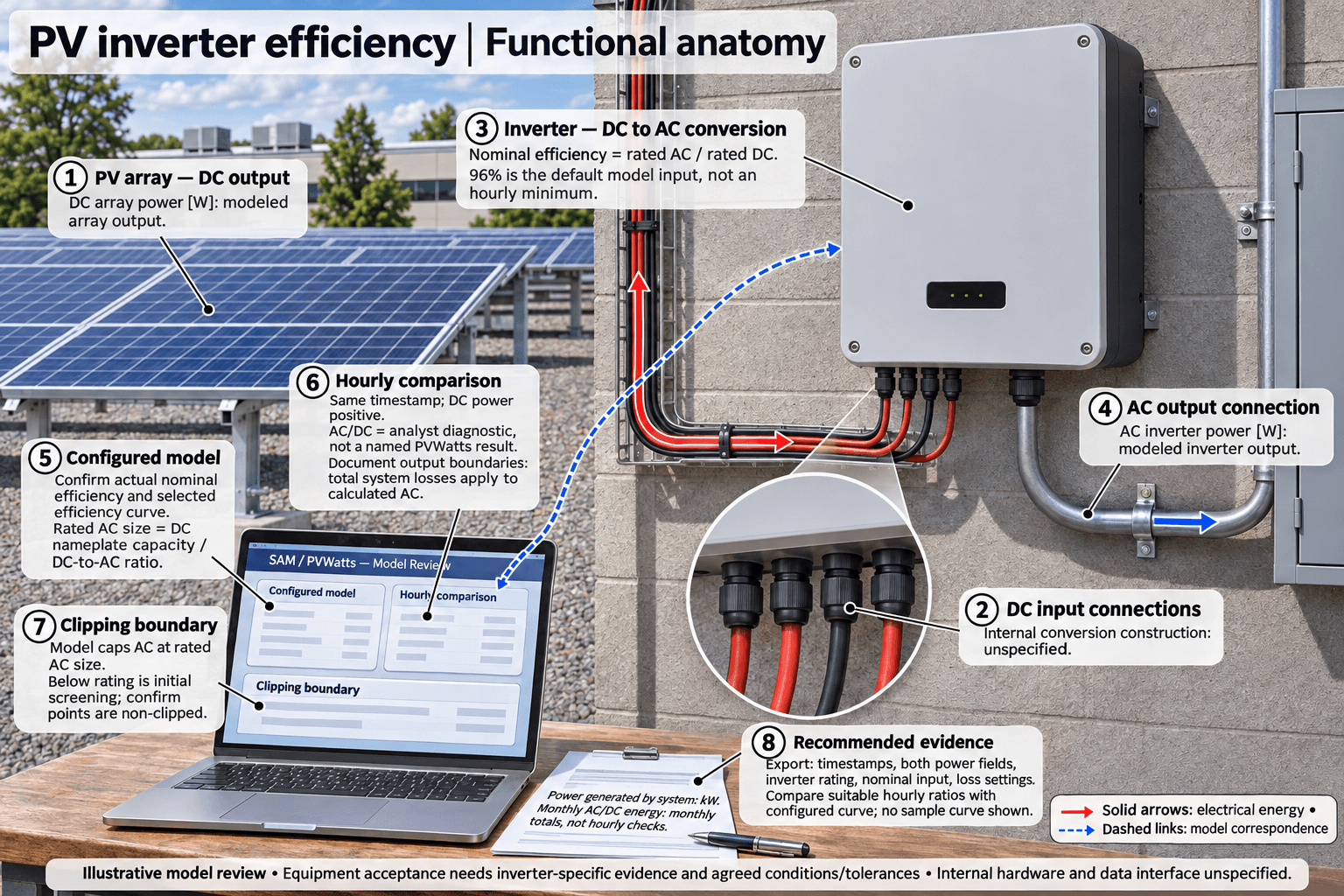
PVWatts defines nominal inverter efficiency as rated AC power divided by rated DC power, expressed as a percentage. Its hourly calculation uses an efficiency curve rather than applying the nominal percentage uniformly. A procurement specification should therefore distinguish the model’s nominal efficiency input from the expected efficiency at a particular operating point. PVWatts System Design
For a model review, request the nominal efficiency actually entered in the project file. Do not assume the default was retained. Ask the analyst to identify the efficiency curve used by that model configuration and show how the selected hourly results relate to it.
For equipment acceptance, request evidence for the proposed inverter model and agree on the applicable operating conditions and acceptance method. The PVWatts default describes a modeling input; it does not establish the performance of a particular inverter offered for purchase. Use the PVWatts System Design definition to check the simulation setup, then obtain equipment-specific documentation before making a contractual efficiency commitment.
2. Select matching hourly power fields
SAM’s PVWatts Results help identifies AC inverter power as inverter output in watts and DC array power as photovoltaic-array output in watts. These are the relevant named outputs for an hourly model comparison. The same page separately lists Power generated by system in kilowatts. PVWatts Results
As a review method, pair AC inverter power and DC array power from the same simulation time step. Calculate an AC/DC ratio only where DC power is positive, and identify the calculation as an analyst’s diagnostic ratio. Do not present it as an additional efficiency result explicitly defined by the results help.
Before interpreting that ratio, ask the analyst to document the output boundaries and any loss adjustments affecting the comparison. This matters because PVWatts System Design states that SAM applies total system losses to the AC power calculated by the model. A comparison intended to isolate inverter conversion should explain how those losses have been treated. PVWatts System Design
Request an export containing timestamps, both power fields, the inverter rating, nominal efficiency input, and relevant loss settings. A plot of the selected ratios against the corresponding modeled curve is a recommended review deliverable, rather than a universal equipment acceptance test.
3. Review clipping separately from conversion efficiency
PVWatts models clipping by limiting inverter output to its rated AC size. The design help also gives the relationship rated inverter size = DC system nameplate capacity ÷ DC-to-AC ratio. These model settings establish the rating boundary that the reviewer should check before interpreting high-output hours. PVWatts System Design
Ask the analyst to identify hours affected by the modeled output cap before selecting points for the efficiency-curve comparison. Merely finding AC output below the rating should be treated as an initial screening step; request confirmation that the selected operating points are suitable for evaluating the curve.
For points identified as clipped, assess the modeled limiting behavior separately. Because PVWatts caps AC output, a ratio involving capped output should not be judged against a requirement for unrestricted conversion at nominal efficiency. This is an interpretation of the documented clipping method, not a manufacturer performance claim.
The buyer should request two clear explanations: whether non-clipped points are consistent with the model’s curve, and when the AC rating constrains output. Keeping those questions separate makes the review actionable without introducing an unsupported efficiency tolerance.
4. Turn the model review into a procurement decision
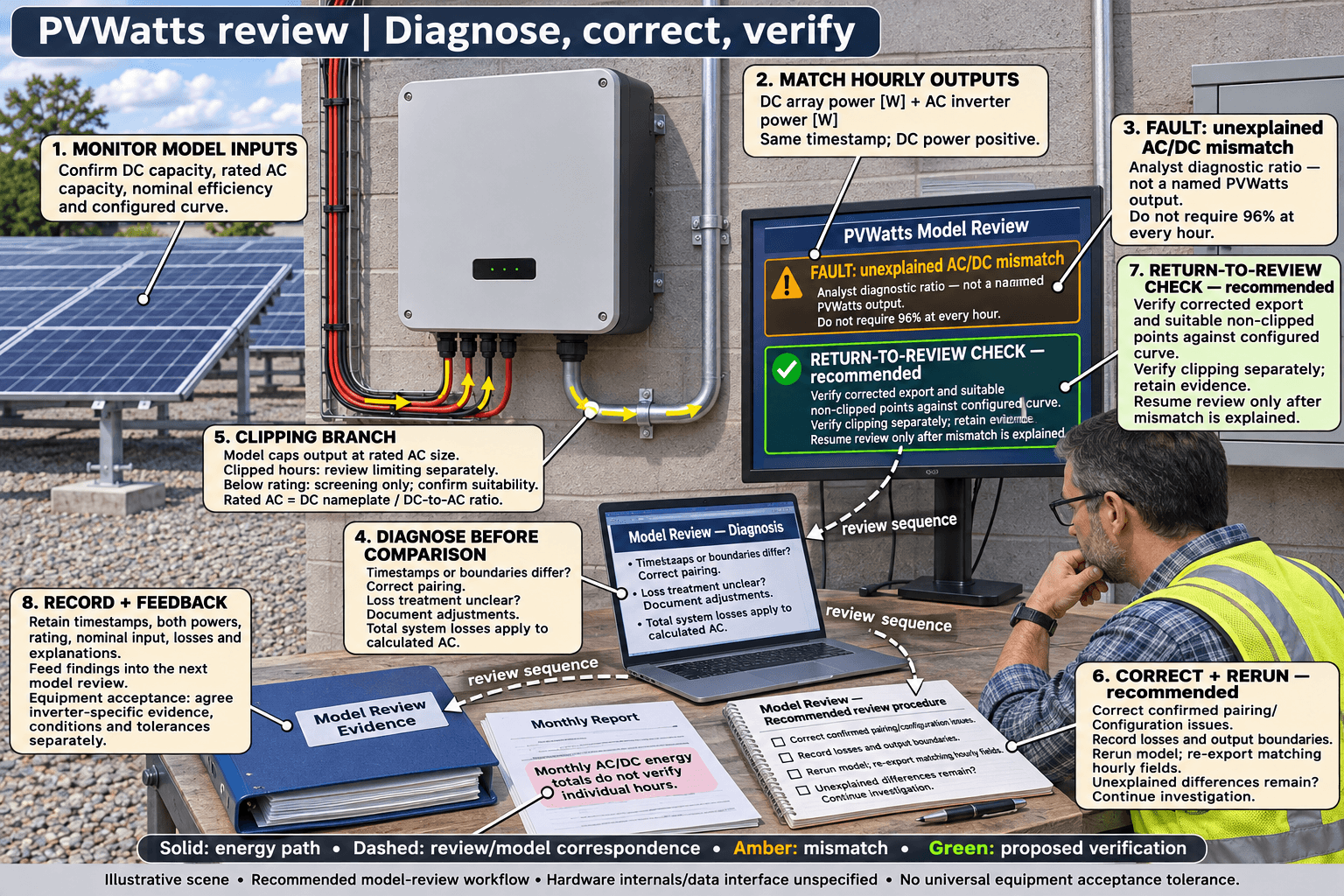
Use the following recommended review sequence:
- Confirm the simulation configuration, nominal efficiency input, DC capacity, and rated AC capacity.
- Obtain matching hourly DC array and AC inverter power exports.
- Document system-loss treatment and the boundaries of the compared outputs.
- Identify clipping-affected hours and select suitable non-clipped operating points.
- Compare the selected ratios with the corresponding modeled curve and investigate unexplained differences.
- Agree on equipment-specific acceptance evidence separately from the simulation review.
Monthly energy is useful for a different question. PVWatts Results defines monthly DC energy as the monthly total of hourly array DC output and monthly AC energy as the monthly total of hourly inverter AC output. For checking individual operating points, request the hourly power fields rather than relying on a monthly energy comparison. PVWatts Results
A suitable review instruction is: “Demonstrate consistency between selected non-clipped hourly outputs and the configured PVWatts inverter efficiency curve, documenting nominal efficiency, ratings, output boundaries, and losses.” Any contractual pass/fail tolerance should be agreed against the proposed equipment and its supporting evidence. Neither PVWatts help document establishes such a tolerance for a purchased inverter.
FAQ
Should every hourly efficiency ratio equal 96%?
No. PVWatts identifies 96% as its default nominal efficiency and calculates hourly efficiency using an efficiency curve.
Which hourly fields should the reviewer request?
Request AC inverter power and DC array power from matching time steps. PVWatts Results lists both in watts.
Is the calculated AC/DC ratio a documented PVWatts efficiency output?
Treat it as an analyst’s diagnostic calculation. PVWatts Results defines the two power fields, but does not list that ratio as a separate output.
Why check loss settings first?
PVWatts System Design states that total system losses are applied to calculated AC power. Ask the analyst to explain their effect on the selected comparison.
How does PVWatts represent clipping?
It limits inverter power output to the rated AC size. Review hours affected by that cap separately from the efficiency-curve comparison.
Is AC output below the rating enough to approve a comparison point?
Use it as initial screening. Ask the analyst to confirm that clipping, output boundaries, and loss treatment permit the intended comparison.
Can monthly energy verify each hourly operating point?
For that review, request hourly power data. PVWatts Results describes monthly AC and DC energy as monthly totals of hourly outputs.
What efficiency tolerance should a purchase contract require?
Agree on a tolerance using evidence for the proposed inverter and specified operating conditions. The two PVWatts help documents do not establish a product acceptance tolerance.
About the Author

Cinn Song
Founder & Chief Solutions Architect
Cinn Song founded SOLARTODO LIMITED and leads its smart-city infrastructure engineering — from solar, storage and integrated smart poles to the company's push into physical-AI city edge nodes: pole-mounted edge computing, vertical LLMs for smart cities, drone-based O&M with autonomous battery swapping, robotic maintenance, and high-speed counter-UAS interception. Since 2010, he has directed turnkey EPC + BOT delivery across 50+ countries, including telecom monopole supply for national grid operators, off-grid solar street-lighting for African municipalities, and integrated smart-pole programs for Gulf smart cities.
Cite This Article
Cinn Song. (2026). PV Inverter Efficiency Review: Hourly Ratios and Clipping. SOLARTODO. Retrieved from https://solartodo.com/knowledge/when-evaluating-pv-inverter-efficiency-should-the-buyer-compare-hourly-ac-to-dc-power-ratios-below-the-clipping-limit
@article{solartodo_when_evaluating_pv_inverter_efficiency_should_the_buyer_compare_hourly_ac_to_dc_power_ratios_below_the_clipping_limit,
  title = {PV Inverter Efficiency Review: Hourly Ratios and Clipping},
  author = {Cinn Song},
  journal = {SOLARTODO Knowledge Base},
  year = {2026},
  url = {https://solartodo.com/knowledge/when-evaluating-pv-inverter-efficiency-should-the-buyer-compare-hourly-ac-to-dc-power-ratios-below-the-clipping-limit},
  note = {Accessed: 2026-11-15}
}
Published: November 15, 2026 | Available at: https://solartodo.com/knowledge/when-evaluating-pv-inverter-efficiency-should-the-buyer-compare-hourly-ac-to-dc-power-ratios-below-the-clipping-limit
Subscribe to Our Newsletter
Get the latest solar energy news and insights delivered to your inbox.
View All Articles