Streetlight Sensor APIs: Specify Calibration and Accuracy

Cinn Song
Founder & Chief Solutions Architect
TL;DR
Yes—include calibration and reported-data accuracy alongside API integration. Specify intended use and conditions, request supporting evidence, and accept interface operation and measurement quality separately. Set project-specific limits rather than assuming DOE provides universal thresholds.
Include calibration and reported-data accuracy requirements alongside API integration. Define the intended use, measured quantities, operating conditions and separate acceptance checks. DOE guidance supports evaluating both interoperability and measurement quality, but supplies no universal accuracy limit or calibration interval.
Summary
Include calibration and reported-data accuracy requirements alongside API integration. Define the intended use, measured quantities, operating conditions and separate acceptance checks. DOE guidance supports evaluating both interoperability and measurement quality, but supplies no universal accuracy limit or calibration interval.
Key Takeaways
- Specify the operational decision that environmental measurements must support before selecting acceptance limits.
- Give API integration and reported-data accuracy separate deliverables and acceptance criteria.
- Request model-specific accuracy evidence with clearly stated measurement conditions.
- Review PNNL’s September 2020 calibration report and specification template when drafting calibration services.
- Require a technical basis for proposed accuracy limits and calibration intervals; the DOE overviews prescribe neither universally.
- Assign responsibility for evidence, verification, corrections and repeat checks before awarding the work package.
Specify Sensor Calibration and Reported-Data Accuracy Alongside API Integration
Yes. Buyers integrating environmental sensors into a streetlight platform through APIs should include calibration and reported-data accuracy requirements in the work package. Define the intended use, sensor quantities, operating conditions and acceptance method before agreeing on performance limits. Treat this as a procurement recommendation: the DOE guidance does not establish a universal accuracy threshold or calibration interval.
1. Define the decision the sensor data must support
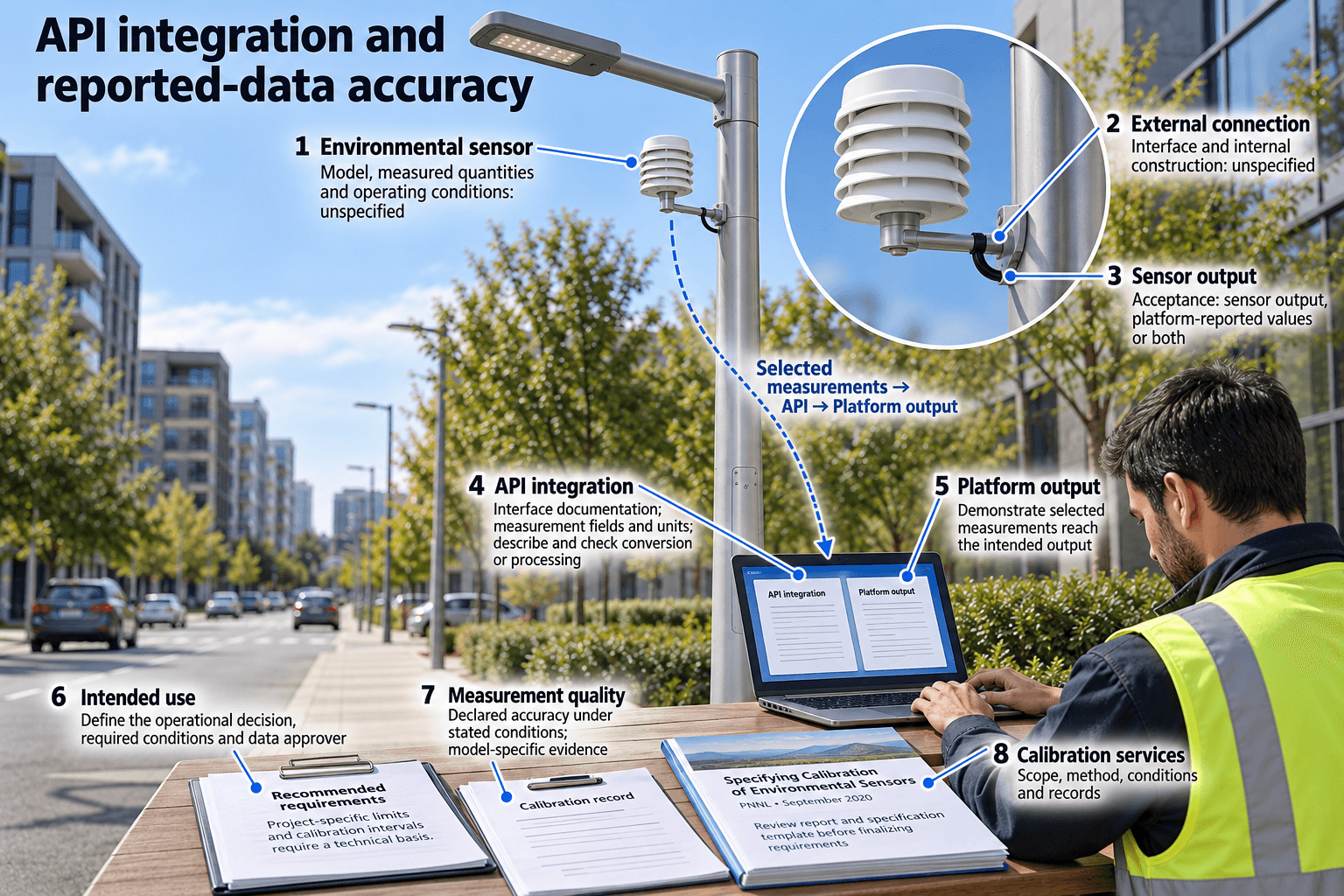
Start with the intended use of the environmental measurements. Ask bidders to explain which measurements the proposed sensors will deliver and how those measurements will support the buyer’s operational decisions. Specify the required conditions and identify who will approve the resulting data for that use.
The U.S. Department of Energy’s Sensors and Fault Detection page says that the value of many connected-lighting sensor applications has been difficult to quantify, making sensor costs difficult to justify for many end users. It also identifies reported-data accuracy as an important consideration for applications that depend on those data, while noting that accuracy is often unspecified or poorly specified. DOE, Sensors and Fault Detection
The procurement implication is to request a defined use and evidence of suitable measurement performance before accepting a general promise of environmental monitoring. A dashboard demonstration should be assessed against that agreed purpose. Do not assign financial benefits or operational savings without a separate, project-specific basis.
Recommended buyer inputs include the measured quantities, intended decisions, relevant operating conditions and the evidence needed for acceptance. Where those inputs are unresolved, ask bidders to identify assumptions explicitly so that competing proposals can be evaluated on a common basis.
2. Give API integration and measurement quality separate deliverables
Include API integration in the work package, but give it its own acceptance criteria. DOE’s Interoperability page describes PNNL research examining how APIs can facilitate connected-lighting interoperability, including the challenges, limitations and tradeoffs encountered. Its referenced CLS Interoperability Study: Application Programming Interfaces is dated October 2017. DOE, Interoperability
That research supports evaluating the integration approach; it does not establish the measurement accuracy of a particular environmental sensor. Buyers should therefore request separate evidence for the API interface and for the reported measurements.
As recommended integration deliverables, request interface documentation, an agreed mapping of measurement fields and units, and a demonstration that the selected measurements reach the intended platform output. Ask the integrator to describe any conversion or processing applied along that path and how it will be checked.
For measurement quality, request declared accuracy under stated conditions and the evidence supporting that declaration. Agree whether acceptance concerns sensor output, platform-reported values or both. This makes the evidence boundary explicit and gives the buyer a concrete way to review the complete reporting path.
3. Specify calibration services and accuracy evidence
DOE’s Sensors and Fault Detection page identifies PNNL’s Specifying Calibration of Environmental Sensors, a September 2020 report and specification template. DOE describes this work as providing best practices for evaluating and calibrating environmental sensors, together with a template for requesting calibration services. DOE, Sensors and Fault Detection
Use that named report and template as a document-review action before finalizing the calibration specification. The DOE overview does not reproduce the detailed procedure, so it should not be treated as a complete calibration protocol.
Recommended tender requirements are to identify the sensor model and measured quantities, declare the proposed calibration scope, describe the method and conditions, and specify the records to be delivered. Ask bidders to explain how those records support the proposed reported-data accuracy requirements.
Require bidders to state any proposed numerical limits and their technical basis. The DOE overview does not prescribe a common accuracy value, recalibration frequency or pass threshold for every streetlight sensor application. Those values remain project decisions requiring appropriate evidence; they should not be invented to make a specification appear complete.
4. Agree acceptance, responsibilities and commercial scope
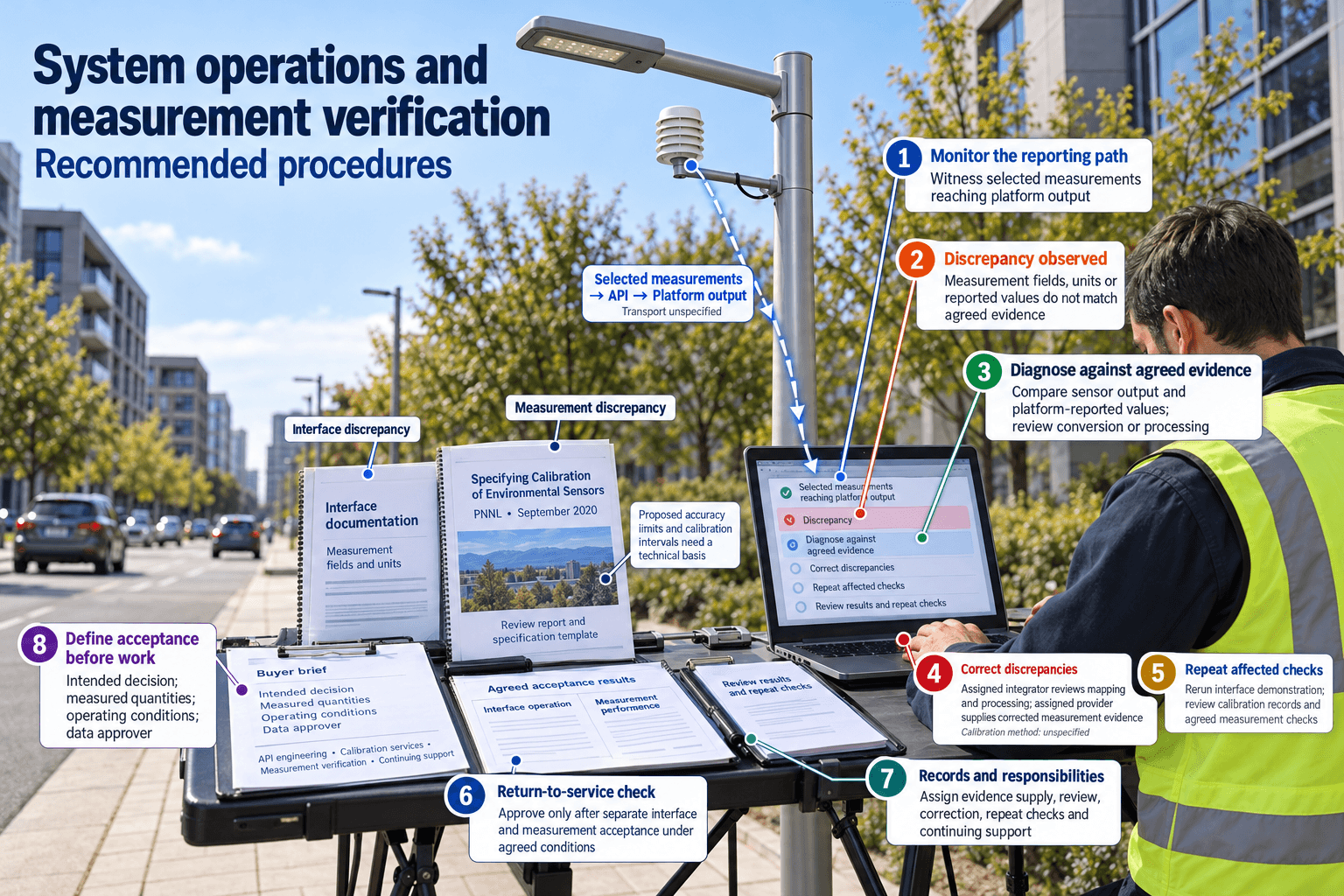
Before award, recommend establishing separate acceptance steps for interface operation and measurement performance. For the interface step, witness the agreed data path using the selected sensor and platform configuration. For the measurement step, review calibration records and conduct the agreed checks against the stated accuracy limits and conditions.
Assign responsibility for supplying calibration evidence, reviewing results, correcting discrepancies and repeating affected checks. Ask bidders to distinguish API engineering, calibration services, measurement verification and continuing support in their commercial scope. This is a recommended contracting structure, rather than a DOE purchasing mandate.
Keep the evidence boundary specific. DOE’s Interoperability page and its October 2017 API study do not approve a proposed vendor interface. DOE’s Sensors and Fault Detection page and its reference to the September 2020 calibration publication do not establish the performance of an offered sensor. Verify the actual interface documentation, model-specific evidence and agreed acceptance results before approving either deliverable.
These DOE research summaries also do not establish a purchasing obligation outside the United States—or a mandatory purchasing rule within it. Use them to inform the work package, then establish project requirements through the buyer’s applicable procurement process.
FAQ
Should calibration be included alongside API integration?
Yes, as a procurement recommendation. Include a defined calibration scope and reported-data accuracy requirements, with acceptance based on the intended application.
Does a functioning API prove sensor accuracy?
API operation alone does not establish measurement accuracy. Request separate measurement evidence and agreed checks for the reported values.
What should the buyer define first?
Define the intended decision, measured quantities, relevant operating conditions and evidence required to accept the data.
Which calibration publication should buyers review?
Review PNNL’s Specifying Calibration of Environmental Sensors, September 2020, identified on DOE’s Sensors and Fault Detection page as a report and calibration-service specification template.
What accuracy threshold should the tender use?
Set a project-specific threshold supported by technical evidence. The DOE overview does not establish a universal numerical requirement.
How often should sensors be recalibrated?
Request a justified proposal for the selected sensors and application. No universal recalibration interval is specified in the DOE overview.
How should acceptance be organized?
Recommend separate interface and measurement checks, with agreed evidence, conditions, responsibilities and procedures for correcting discrepancies.
Are these DOE pages an international purchasing requirement?
The pages describe research and guidance, not an international procurement mandate. Establish requirements through the project’s applicable purchasing process.
Procurement paths
About the Author

Cinn Song
Founder & Chief Solutions Architect
Cinn Song founded SOLARTODO LIMITED and leads its smart-city infrastructure engineering — from solar, storage and integrated smart poles to the company's push into physical-AI city edge nodes: pole-mounted edge computing, vertical LLMs for smart cities, drone-based O&M with autonomous battery swapping, robotic maintenance, and high-speed counter-UAS interception. Since 2010, he has directed turnkey EPC + BOT delivery across 50+ countries, including telecom monopole supply for national grid operators, off-grid solar street-lighting for African municipalities, and integrated smart-pole programs for Gulf smart cities.
Cite This Article
Cinn Song. (2026). Streetlight Sensor APIs: Specify Calibration and Accuracy. SOLARTODO. Retrieved from https://solartodo.com/knowledge/when-integrating-environmental-sensors-into-a-streetlight-platform-through-apis-should-the-work-package-include-sensor
@article{solartodo_when_integrating_environmental_sensors_into_a_streetlight_platform_through_apis_should_the_work_package_include_sensor,
  title = {Streetlight Sensor APIs: Specify Calibration and Accuracy},
  author = {Cinn Song},
  journal = {SOLARTODO Knowledge Base},
  year = {2026},
  url = {https://solartodo.com/knowledge/when-integrating-environmental-sensors-into-a-streetlight-platform-through-apis-should-the-work-package-include-sensor},
  note = {Accessed: 2026-11-01}
}
Published: November 1, 2026 | Available at: https://solartodo.com/knowledge/when-integrating-environmental-sensors-into-a-streetlight-platform-through-apis-should-the-work-package-include-sensor
Subscribe to Our Newsletter
Get the latest solar energy news and insights delivered to your inbox.
View All Articles