When the field devices, backhaul and central management…

Cinn Song
Founder & Chief Solutions Architect
TL;DR
Name one lead in the split streetlight contracts. Agree on the undervoltage trigger, asset ID, timestamps, handoff records and expected CMS display. Trace the event, assign repairs by contract scope and close after the agreed path passes a joint retest. Record any steps a simulated test bypasses.
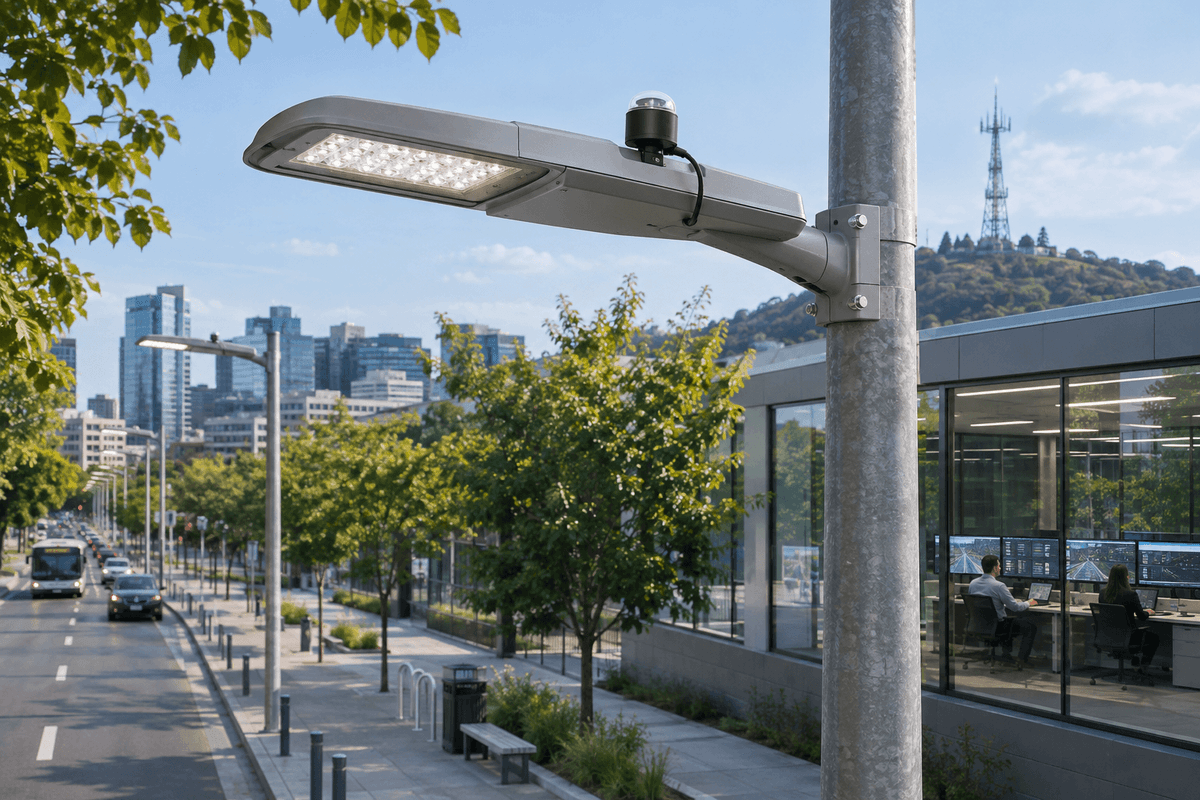
Assign one contractually named lead for missing streetlight undervoltage reports across field devices, backhaul and the CMS. Define the trigger, interface records and expected CMS display. Trace the same event across the contracts and require a joint retest before closure. DOE V2.0 supports separate bidding, while the project contracts establish troubleshooting ownership.
Summary
Assign one contractually named lead for missing streetlight undervoltage reports across field devices, backhaul and the CMS. Define the trigger, interface records and expected CMS display. Trace the same event across the contracts and require a joint retest before closure. DOE V2.0 supports separate bidding, while the project contracts establish troubleshooting ownership.
Key Takeaways
- Name a systems integrator or buyer-side technical lead with access to evidence and authority to coordinate the three suppliers.
- Put cooperation, evidence access and corrective-action duties into each affected contract.
- Define the measurement point, trigger, asset identifier, timestamp convention and expected CMS display before testing.
- Trace the same event through field detection, backhaul handoffs and CMS receipt and display.
- Ask both suppliers at an unresolved interface to review the same evidence and agree on a diagnostic check.
- Record the scope of any simulated test and require a joint retest that covers the agreed alarm path before closure.
Who should troubleshoot a missing streetlight undervoltage alarm across separate contracts?
Assign one lead for the whole incident
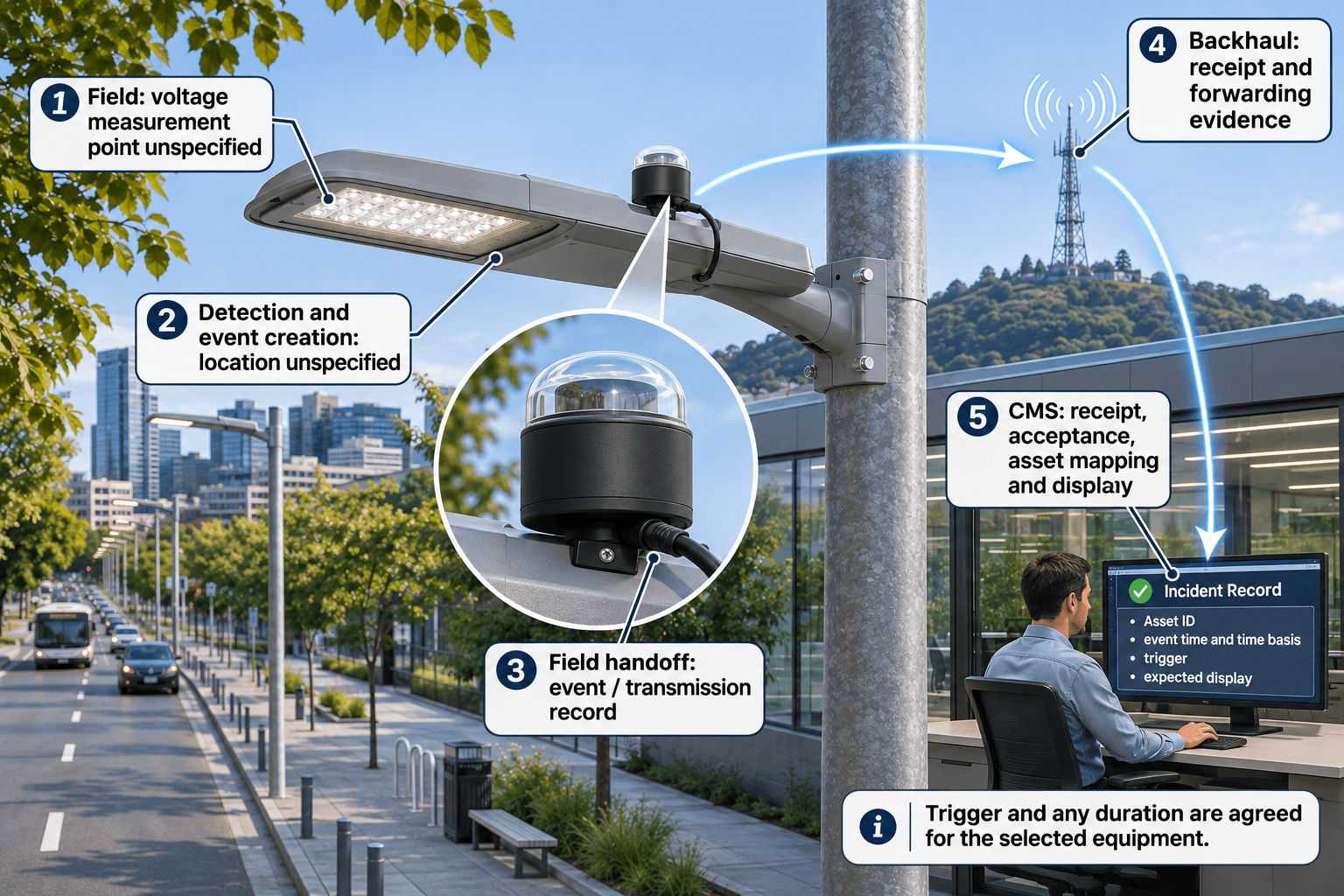
Name one end-to-end troubleshooting lead in the tender. A designated systems integrator is a suitable choice if its contract gives it access to diagnostic evidence and authority to coordinate all three suppliers. If integration stays with the buyer, name the buyer’s technical lead and write the same cooperation duties into the field-device, backhaul and central management system (CMS) contracts. Give the lead responsibility for opening the incident, coordinating diagnosis, organizing the retest and submitting closure evidence to the buyer. Require each supplier to diagnose and correct faults within its agreed scope.
The U.S. Department of Energy’s Model Specification for Networked Outdoor Lighting Control Systems, V2.0 supports independent bids for field devices, backhaul and CMS. Its overview also describes a dedicated backhaul section and separate start-up and commissioning sections. Use V2.0 as a procurement reference. To verify who owns troubleshooting on a specific project, check the integration and support clauses in each contract for the named lead, the cooperation duties and the party authorized to approve closure. DOE Model Specification V2.0
Define what the undervoltage report must show
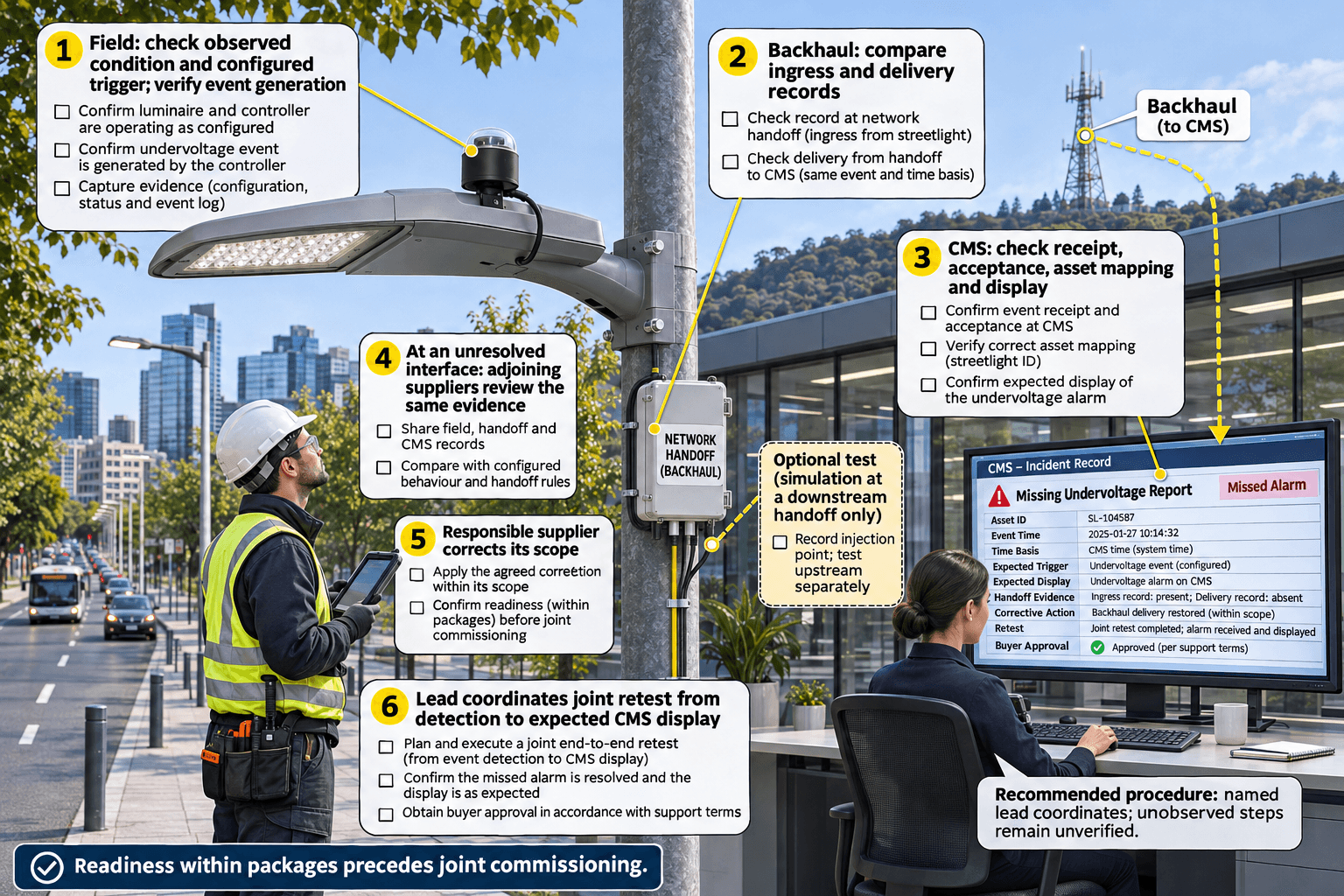
Ask bidders to identify where voltage is measured, which device or service determines that an undervoltage event has occurred, and where the event record is created. Agree on the trigger condition, any required duration, the affected asset identifier, the timestamp convention and what the operator should see in the CMS. Ask bidders to document which records they can produce at each handoff and how the lead can obtain them during an incident.
DOE’s Sensors and Fault Detection page describes Pacific Northwest National Laboratory research on undervoltage-related lighting faults and flags the importance of reported-data accuracy for uses that depend on it. The research overview leaves the selected equipment’s trigger and reporting behavior unknown. Verify these against the offered device and CMS documentation, then agree on a commissioning test for the selected configuration. DOE Sensors and Fault Detection
Trace the same event across all three contracts
Use one incident record and correlate evidence by asset identifier and time. Ask each supplier to identify the last point where it can show the expected event or message. Adapt the checkpoints to the agreed architecture and make the evidence expected at each interface part of the tender.
| Contract scope | Evidence to request during diagnosis |
|---|---|
| Field devices | Ask for the recorded condition and any event or transmission record available at the agreed field handoff. If no event is shown, ask the supplier to verify the configured trigger and whether the condition met it. |
| Backhaul | Ask for evidence of receipt at the network ingress and forwarding or delivery at the agreed CMS handoff. Use a message identifier where available or correlate by asset and time. |
| CMS | Ask the supplier to check whether the event reached the CMS and whether it was accepted and displayed against the correct asset. If receipt is confirmed, check event mapping and display rules. |
If the records stop at an interface, have both adjoining suppliers review the same incident evidence and agree on a diagnostic check. Where an observation is unavailable, record that step as unverified and ask the lead to arrange an agreed test at that interface. Keep the incident under the same lead while the suppliers work out the cause and the corrective action.
Commission the complete alarm path and define closure
Use the distinction between start-up and commissioning in DOE V2.0 to structure the project’s checks. Ask suppliers to document readiness within their packages during start-up. During joint commissioning, use an agreed way to exercise the actual detection and reporting path. Require the lead to collect evidence from the trigger through the field and backhaul handoffs to the expected CMS display. Agree on the delivery window if timing matters to acceptance. DOE Model Specification V2.0
If the test begins with a simulated message at a downstream interface, record the injection point and the checks it covers. Schedule a separate check for any upstream detection or reporting step outside that test. For an operational incident, ask the lead to record the corrective action, rerun the agreed path and submit the result. Put the buyer’s closure criteria and the suppliers’ evidence obligations in the support terms so the same process applies after handover.
FAQ
Who should take the initial ticket?
Route it to the named end-to-end lead. Put that contact and the escalation route in all three support arrangements.
Can a supplier act as the troubleshooting lead?
Yes, if the buyer assigns that role and the other contracts require cooperation and access to the agreed evidence.
Who fixes the underlying fault?
Assign correction to the party responsible for the affected scope under the contract. Keep coordination and retesting with the named lead.
What information should the incident record contain?
Capture the asset identifier, event time and time basis, expected trigger, expected CMS result and available evidence from each handoff.
What if nobody can show that the field device generated an event?
Ask the field supplier to check the configured trigger against the observed condition and demonstrate event generation using the agreed test procedure.
What if the CMS received the message but the operator saw no alarm?
Ask the CMS supplier to trace the received record through acceptance, asset mapping and alarm display.
What does a simulated message test cover?
Record where the message was injected and which downstream steps were observed. Test upstream detection and reporting separately if they were outside that path.
Who approves closure after the fix?
Specify the closure authority in the support terms. A practical arrangement is for the lead to submit the corrective action and retest evidence for buyer approval.
Procurement paths
About the Author

Cinn Song
Founder & Chief Solutions Architect
Cinn Song founded SOLARTODO LIMITED and leads its smart-city infrastructure engineering — from solar, storage and integrated smart poles to the company's push into physical-AI city edge nodes: pole-mounted edge computing, vertical LLMs for smart cities, drone-based O&M with autonomous battery swapping, robotic maintenance, and high-speed counter-UAS interception. Since 2010, he has directed turnkey EPC + BOT delivery across 50+ countries, including telecom monopole supply for national grid operators, off-grid solar street-lighting for African municipalities, and integrated smart-pole programs for Gulf smart cities.
Cite This Article
Cinn Song. (2026). When the field devices, backhaul and central management…. SOLARTODO. Retrieved from https://solartodo.com/knowledge/when-the-field-devices-backhaul-and-central-management-system-are-supplied-under-separate-contracts-who-should-own-end
@article{solartodo_when_the_field_devices_backhaul_and_central_management_system_are_supplied_under_separate_contracts_who_should_own_end,
  title = {When the field devices, backhaul and central management…},
  author = {Cinn Song},
  journal = {SOLARTODO Knowledge Base},
  year = {2026},
  url = {https://solartodo.com/knowledge/when-the-field-devices-backhaul-and-central-management-system-are-supplied-under-separate-contracts-who-should-own-end},
  note = {Accessed: 2026-11-19}
}
Published: November 19, 2026 | Available at: https://solartodo.com/knowledge/when-the-field-devices-backhaul-and-central-management-system-are-supplied-under-separate-contracts-who-should-own-end
Subscribe to Our Newsletter
Get the latest solar energy news and insights delivered to your inbox.
View All Articles