PV Diagnosis: Specify Incident and Transmitted POA

Cinn Song
Founder & Chief Solutions Architect
TL;DR
Request incident POA and transmitted POA with aligned timestamps, units and traceable inputs. Compare the two optical stages before attributing losses. SAM distinguishes both; PVWatts V8 lists no separate transmitted-POA output.
Specify separate incident POA and transmitted POA time series to review sunlight reaching the array versus transmission through its cover. Require aligned timestamps, units, weather inputs and model provenance. Verify export capability first: PVWatts V8 documents hourly POA but does not list a separate transmitted-POA output.
Summary
Specify separate incident POA and transmitted POA time series to review sunlight reaching the array versus transmission through its cover. Require aligned timestamps, units, weather inputs and model provenance. Verify export capability first: PVWatts V8 documents hourly POA but does not list a separate transmitted-POA output.
Key Takeaways
- Require incident POA irradiance and transmitted POA irradiance as separately defined channels.
- Retain beam, diffuse and global horizontal irradiance with their original reference-plane definitions.
- Include angle of incidence, beam-shading factor and sun-above-horizon status where available.
- Verify a sample export: the PVWatts V8 API output list does not document transmitted POA.
- Use aligned hourly irradiance in W/m² for the comparison; distinguish it from monthly irradiation in kWh/m².
- Require traceable inputs and a stated comparison basis before attributing a change to cover transmission.
PV diagnosis: specify incident and transmitted irradiance separately
A PV performance-diagnosis deliverable should distinguish plane-of-array (POA) irradiance incident on the array from transmitted POA irradiance passing through the module cover to the photovoltaic cells. Request both channels as separate time series, with definitions, units and model provenance. Add weather irradiance, angle of incidence and beam-shading information to help interpret the difference. The SAM PVWatts Results documentation explicitly distinguishes these two POA quantities; the PVWatts V8 API output list documents poa but does not list a separate transmitted-POA field. SAM PVWatts Results, PVWatts V8 API documentation
1. Require two distinct POA channels
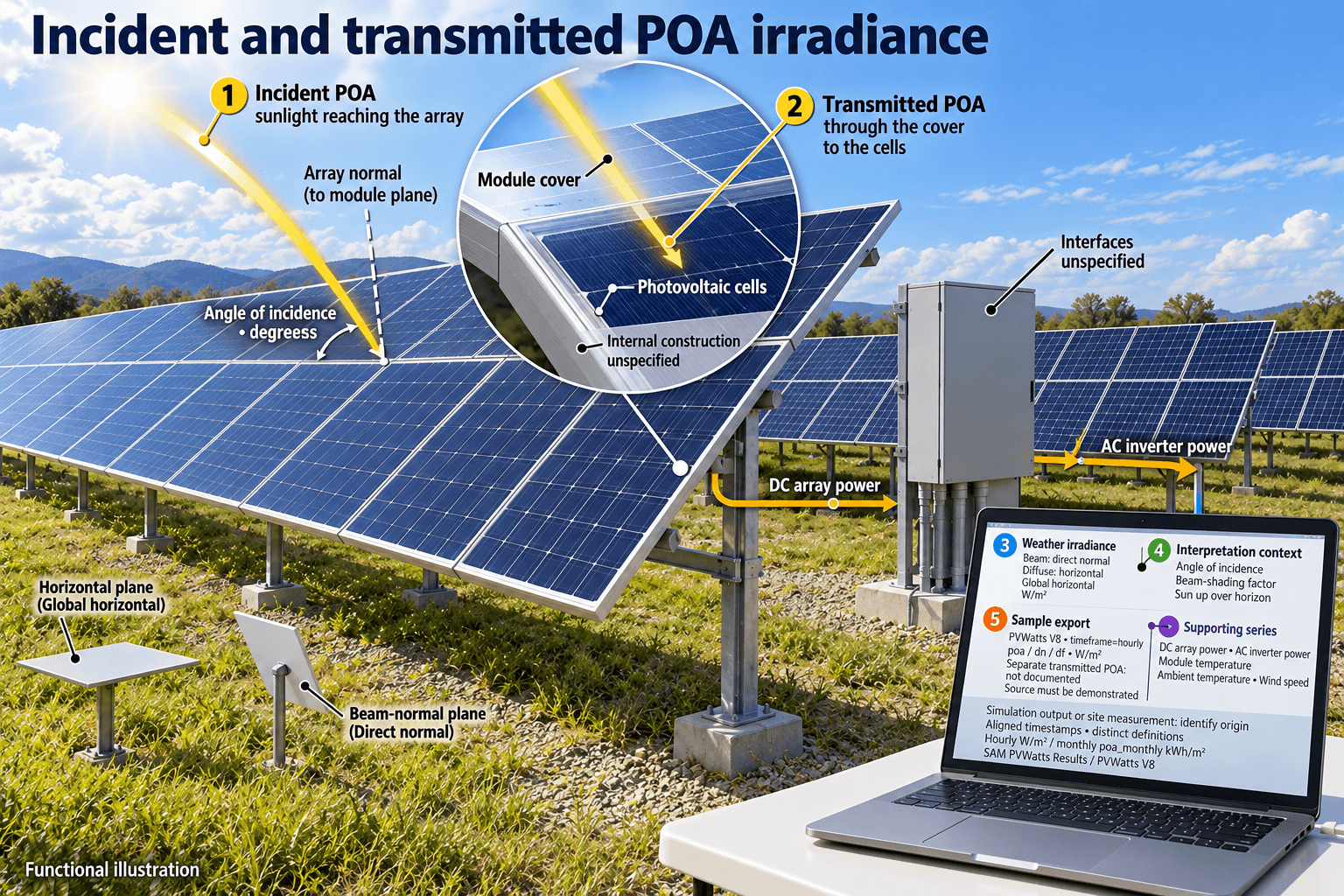
SAM defines plane-of-array irradiance, in W/m², as solar irradiance incident on the photovoltaic array. It defines transmitted plane-of-array irradiance, also in W/m², as POA irradiance transmitted through the module cover to the photovoltaic cells. These definitions identify different stages in the optical path. A deliverable that labels both simply “solar irradiance” obscures that distinction. SAM PVWatts Results
For procurement, require the analyst to preserve those names or provide an explicit mapping to equivalent fields. Ask whether each series is a simulation output or a site measurement, and require its origin to be identified. The cited SAM page describes model results; its variable definitions alone do not establish that either quantity was measured at a particular installation.
As a review method, examine incident POA first, then transmitted POA for the same timestamps. A reduction in incident POA concerns sunlight reaching the array. To investigate an additional change across the cover, compare the relationship between incident and transmitted POA under documented conditions. Treat this as an analytical comparison, rather than automatic proof of a particular physical defect.
2. Retain the channels that explain the comparison
The diagnostic export should also retain the following SAM variables, with their documented meanings:
- Beam irradiance: direct normal solar irradiance from the weather file, in W/m².
- Diffuse irradiance: diffuse horizontal solar irradiance from the weather file, in W/m².
- Global horizontal irradiance: global horizontal solar irradiance from the weather file, in W/m².
- Angle of incidence: the angle between beam irradiance and a line normal to the array surface, in degrees.
- Shading factor for beam radiation: the factor applied to beam irradiance to represent shading reduction.
- Sun up over horizon: an indicator distinguishing sun-above-horizon from sun-below-horizon time steps. SAM PVWatts Results
These channels describe different quantities and reference planes. Require separate labels rather than accepting a weather-file irradiance channel as an undocumented substitute for array-plane irradiance. For review, use the sun-position indicator to identify daylight records and retain the angle and shading fields alongside the POA comparison.
3. Check the export interface before commissioning analysis
PVWatts V8 supports hourly output through timeframe=hourly. Its documented hourly fields include poa for plane-of-array irradiance, dn for beam normal irradiance and df for diffuse irradiance, all in W/m². It also provides DC and AC power, ambient temperature, module temperature and wind speed. However, its output list does not document a separate transmitted-POA channel. PVWatts V8 API documentation
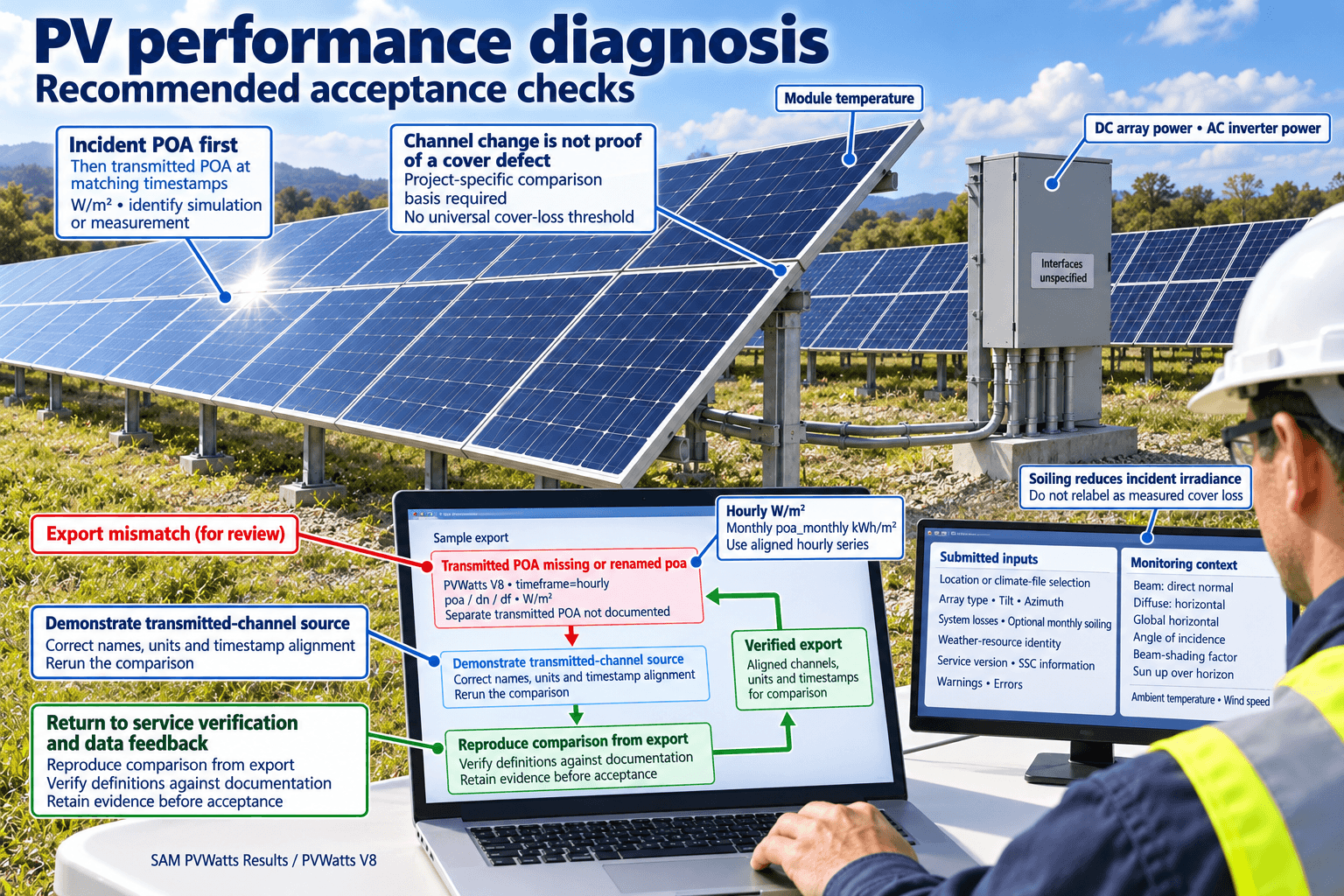
Therefore, request a sample export before accepting a scope that promises to separate incident sunlight from cover transmission. If the contractor proposes V8 API output alone, ask how the transmitted quantity will be obtained and documented. Do not accept a renamed poa column as evidence of a second optical stage.
Keep time resolution and units explicit. V8 reports hourly poa in W/m², while poa_monthly is monthly plane-of-array irradiation in kWh/m². For this diagnostic comparison, request the hourly series rather than relying solely on monthly totals. PVWatts V8 API documentation
4. Make assumptions and conclusions traceable
For a V8-based analysis, request the submitted inputs, weather-resource identity, service version, SSC information, warnings and errors. These are documented response fields. Relevant inputs include location or climate-file selection, array type, tilt, azimuth, system losses and optional monthly soiling values. V8 describes soiling as reducing incident irradiance on the subarray; it should not be silently relabeled as an independently established cover-transmission loss. PVWatts V8 API documentation
Recommended acceptance checks are to confirm matching timestamps, verify channel definitions against the named software documentation, and reproduce the reported comparison from the export. Retain DC array power, AC inverter power and module temperature as supporting series; SAM documents these separately from irradiance. SAM PVWatts Results
Require the final report to distinguish observed or modeled channel changes from their proposed causes. Neither SAM PVWatts Results nor the PVWatts V8 API documentation establishes a universal cover-loss acceptance threshold. Ask the analyst to state the project-specific comparison basis and evidence needed before recommending corrective work.
FAQ
Which two irradiance channels are essential?
Incident plane-of-array irradiance and transmitted plane-of-array irradiance through the module cover to the cells, as distinguished in SAM PVWatts Results.
Can global horizontal irradiance replace incident POA?
It should not be accepted as an undocumented substitute. SAM defines global horizontal irradiance and array-plane irradiance as separate quantities.
Does PVWatts V8 expose transmitted POA?
Its documented API output list does not include a separate transmitted-POA field. Ask the analyst to demonstrate the proposed source of that channel.
Which V8 output setting should buyers request?
Request timeframe=hourly for the documented hourly irradiance outputs, and separately verify how transmitted POA will be delivered.
What units should the comparison use?
SAM lists both POA channels in W/m². V8 hourly poa is also W/m²; its monthly poa_monthly is kWh/m².
Why retain angle of incidence and shading information?
SAM documents the beam-to-array-normal angle and a shading factor applied to beam irradiance. Request both as context for interpreting the POA series.
Should V8 soiling inputs be called measured cover losses?
No. V8 defines soiling inputs as reductions in incident irradiance on the subarray. Require a separate evidence basis for a cover-transmission conclusion.
What should determine acceptance of the diagnosis?
Recommended checks include distinct channel definitions, aligned timestamps, traceable inputs, reproducible comparisons and a documented project-specific acceptance basis.
About the Author

Cinn Song
Founder & Chief Solutions Architect
Cinn Song founded SOLARTODO LIMITED and leads its smart-city infrastructure engineering — from solar, storage and integrated smart poles to the company's push into physical-AI city edge nodes: pole-mounted edge computing, vertical LLMs for smart cities, drone-based O&M with autonomous battery swapping, robotic maintenance, and high-speed counter-UAS interception. Since 2010, he has directed turnkey EPC + BOT delivery across 50+ countries, including telecom monopole supply for national grid operators, off-grid solar street-lighting for African municipalities, and integrated smart-pole programs for Gulf smart cities.
Cite This Article
Cinn Song. (2026). PV Diagnosis: Specify Incident and Transmitted POA. SOLARTODO. Retrieved from https://solartodo.com/knowledge/which-irradiance-channels-should-a-pv-performance-diagnosis-deliverable-distinguish-to-separate-reduced-sunlight
@article{solartodo_which_irradiance_channels_should_a_pv_performance_diagnosis_deliverable_distinguish_to_separate_reduced_sunlight,
  title = {PV Diagnosis: Specify Incident and Transmitted POA},
  author = {Cinn Song},
  journal = {SOLARTODO Knowledge Base},
  year = {2026},
  url = {https://solartodo.com/knowledge/which-irradiance-channels-should-a-pv-performance-diagnosis-deliverable-distinguish-to-separate-reduced-sunlight},
  note = {Accessed: 2026-10-31}
}
Published: October 31, 2026 | Available at: https://solartodo.com/knowledge/which-irradiance-channels-should-a-pv-performance-diagnosis-deliverable-distinguish-to-separate-reduced-sunlight
Subscribe to Our Newsletter
Get the latest solar energy news and insights delivered to your inbox.
View All Articles