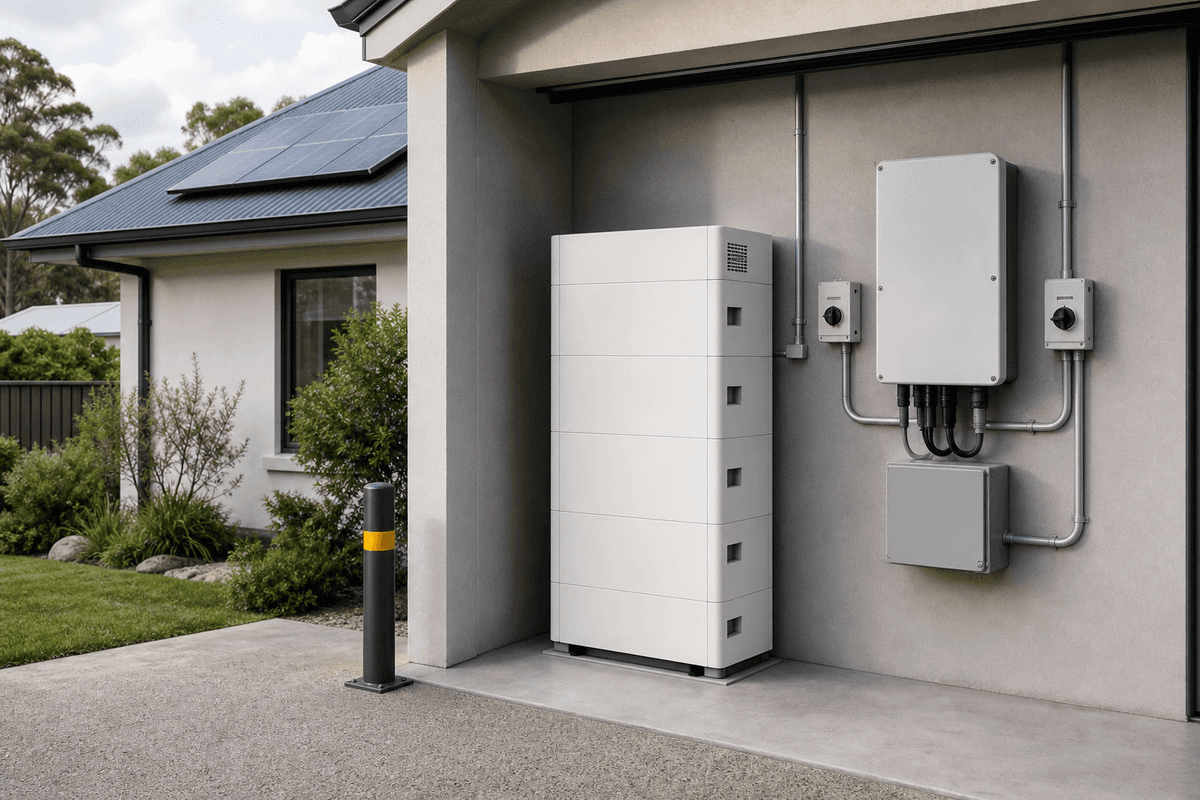
10kWh Residential Stack LFP Battery - 5kW Wall-Mount BESS
Key Features
- 10kWh nominal LFP capacity with 5kW bidirectional inverter output for residential backup and PV self-consumption.
- 6,000+ cycle design life with 90% recommended depth of discharge and 10-year / 70% capacity warranty.
- 10-unit MOQ equals 100kWh total batch capacity and 50kW aggregate inverter power for EPC pilots.
- EPC turnkey price range is $2,000-$2,400 per installed and commissioned residential BESS unit.
- Wall-mount or floor-stack cabinet uses air cooling, BMS SOC/SOH monitoring, and UL 9540A-aligned safety logic.
10kWh Residential Stack LFP is a 5kW wall-mount battery energy storage system for solar self-consumption, backup power, and grid-dependency reduction. The 10-unit MOQ package supports EPC turnkey delivery at $2,000-$2,400 per system with UL 9540, IEC 62619, UN38.3, and NFPA 855-aligned design practices.
Description
The 10kWh Residential Stack LFP is a 5kW wall-mount battery energy storage system for homes, villas, and small commercial loads that need solar self-consumption, backup power, and lower grid dependency. Each 10kWh system uses lithium iron phosphate chemistry, a bidirectional 5kW PCS, BMS-level SOC/SOH monitoring, and a 10-unit MOQ for distributor, EPC, and project procurement. EPC turnkey pricing is $2,000-$2,400 per installed unit, while FOB supply begins at $1,240-$1,632 per unit for volume buyers.
Product Overview
This 10kWh residential BESS is designed for 1-phase or small 3-phase distributed-energy projects where a 5kW inverter can cover essential circuits, evening peak loads, and daily PV shifting. The LFP chemistry targets 6,000+ cycles and a 10-year warranty with 70% retained capacity, matching the long-life safety direction used in IEC 62619 industrial battery requirements and UL 9540 energy storage system listings. For buyers comparing complete options, View all Battery Energy Storage System (BESS) products to benchmark 5kWh, 10kWh, 15kWh, and 20kWh residential configurations.
The system uses prismatic LFP cells in an aluminum-supported housing, a stackable residential cabinet format, and air-cooled thermal management suitable for systems below 100kWh. Compared with lead-acid backup batteries, a 10kWh LFP system can reduce usable-energy cost by 40%-60% over 10 years because it supports roughly 6,000 cycles instead of 500-1,200 cycles and can operate at 90% depth of discharge. IEA 2025 storage analysis and BloombergNEF 2025 battery price tracking both indicate that falling cell costs are accelerating residential storage adoption in grid-constrained markets.
Technical Specifications
| Parameter | 10kWh Residential Stack LFP value |
|---|---|
| Nominal energy capacity | 10kWh |
| Rated power | 5kW |
| Battery chemistry | LFP, lithium iron phosphate |
| Cycle life | 6,000+ cycles at recommended DoD |
| Round-trip efficiency | 96% typical system target |
| Depth of discharge | 90% recommended operating window |
| Mounting | Wall-mount or floor-stack cabinet |
| MOQ | 10 units |
| Warranty | 10 years or 70% retained capacity |
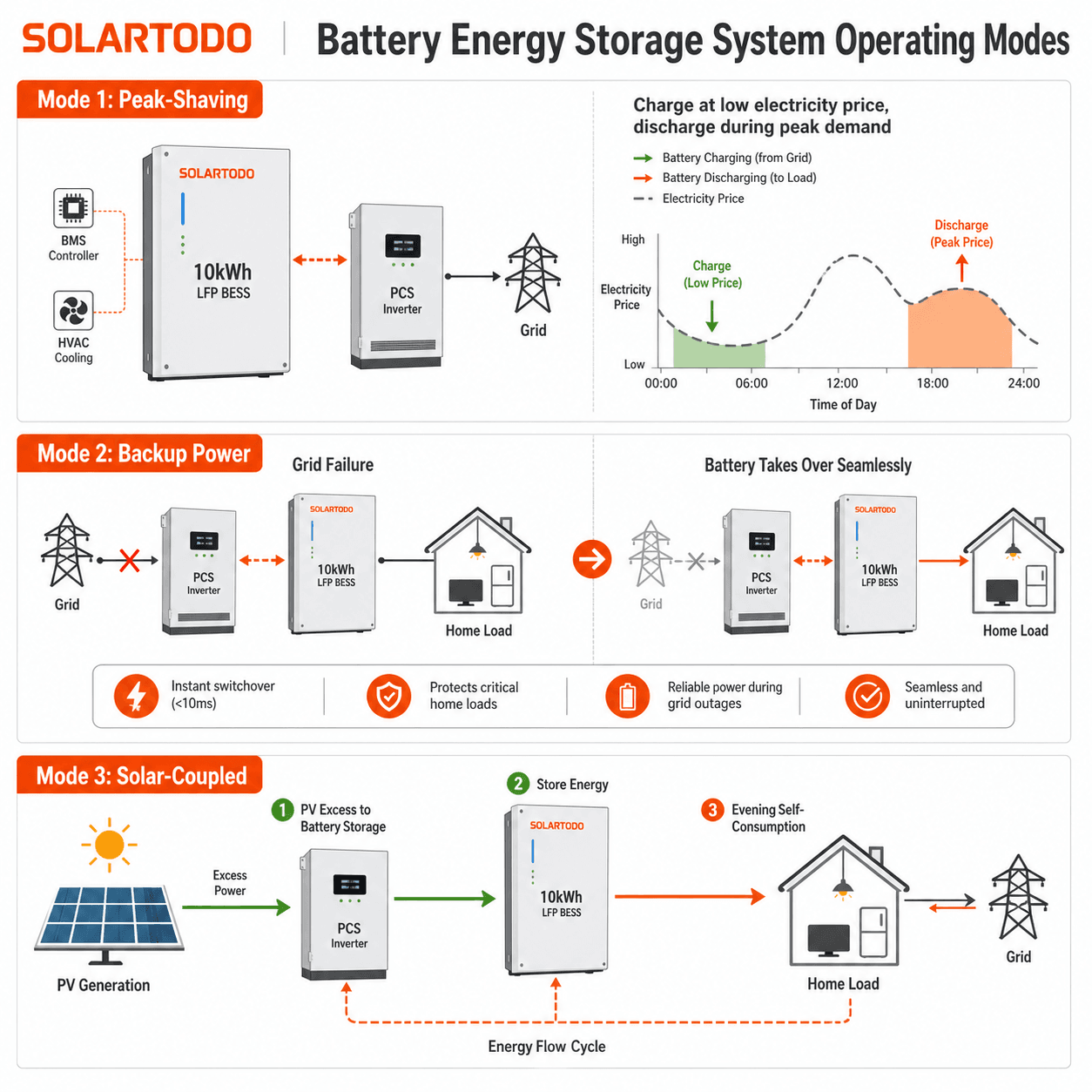
The 10kWh and 5kW pairing is sized for a household using 8kWh-18kWh per day, with 4-8 critical circuits such as refrigeration, lighting, communications, security, and medical standby loads. NREL PVWatts modeling commonly uses hourly solar generation and load matching to evaluate self-consumption, and this BESS improves PV utilization by storing midday surplus for 18:00-23:00 evening demand. For project sizing, Configure your system online with PV capacity, local tariff, and backup-hour assumptions.
System Architecture
The architecture has 4 primary layers: LFP battery modules, BMS, bidirectional PCS, and cloud or local monitoring. The BMS tracks cell voltage, pack current, state of charge, state of health, balancing status, and temperature across multiple protection thresholds. The 5kW PCS converts DC battery power to AC load power with more than 96% conversion efficiency, supports grid-tied operation, and can isolate selected circuits in island mode when local electrical codes permit backup operation.
The battery cabinet is engineered for residential installation where 1 system provides 10kWh nominal capacity and 2 parallel systems can provide 20kWh for larger villas or small offices. DC protection, AC isolation, grounding, overcurrent protection, and emergency shutdown interfaces should be configured according to UL 9540, NFPA 855, IEC 62619, and local interconnection rules. UN38.3 transport compliance is important for 10-unit MOQ shipments because lithium battery packs must pass altitude, thermal, vibration, shock, external short circuit, impact, overcharge, and forced-discharge tests before international logistics.
Safety, Standards, and Reliability
LFP chemistry uses a phosphate cathode with higher thermal stability than nickel-rich NCM chemistries, and this is one reason residential ESS suppliers select LFP for 10kWh indoor-adjacent installations. UL 9540A test methodology evaluates thermal runaway fire propagation behavior, while NFPA 855 provides installation guidance for separation, ventilation, signage, and emergency access. IEC 62619 focuses on safety requirements for industrial lithium secondary cells and batteries, including abnormal operation, short circuit, overcharge, and thermal abuse conditions.
The 10kWh cabinet applies layered protection instead of relying on 1 device. Protection layer 1 is cell-level BMS monitoring, layer 2 is pack-level disconnect and current limiting, and layer 3 is system-level inverter shutdown and alarm reporting. For residential systems below 100kWh, air cooling normally provides adequate temperature control, while liquid cooling is reserved for 100kWh+ C&I and utility-scale systems where heat density and cycling intensity are much higher.
Applications
This 10kWh stack LFP BESS fits 4 common residential scenarios: solar self-consumption, time-of-use arbitrage, backup power, and weak-grid voltage support. In a 6kW rooftop PV system, the battery can store 8kWh-9kWh of usable daily energy and shift it into evening hours when import tariffs are often 2-4 times higher than midday export credits. IRENA 2025 renewable power cost reporting links higher solar penetration with greater storage value because storage reduces curtailment and improves local utilization.
A practical application scenario is a 40-home residential compound in the MENA region using 40 units of 10kWh batteries, equal to 400kWh of distributed storage and 200kW of aggregate inverter power. Before installation, the compound exported low-value midday PV and imported expensive evening grid power for 5-6 hours per day. After installing stack LFP batteries, the operator increased onsite solar utilization from about 45% to about 75%, reduced diesel-generator runtime by more than 30%, and shortened outage impact from 4 hours to under 15 minutes for priority circuits.
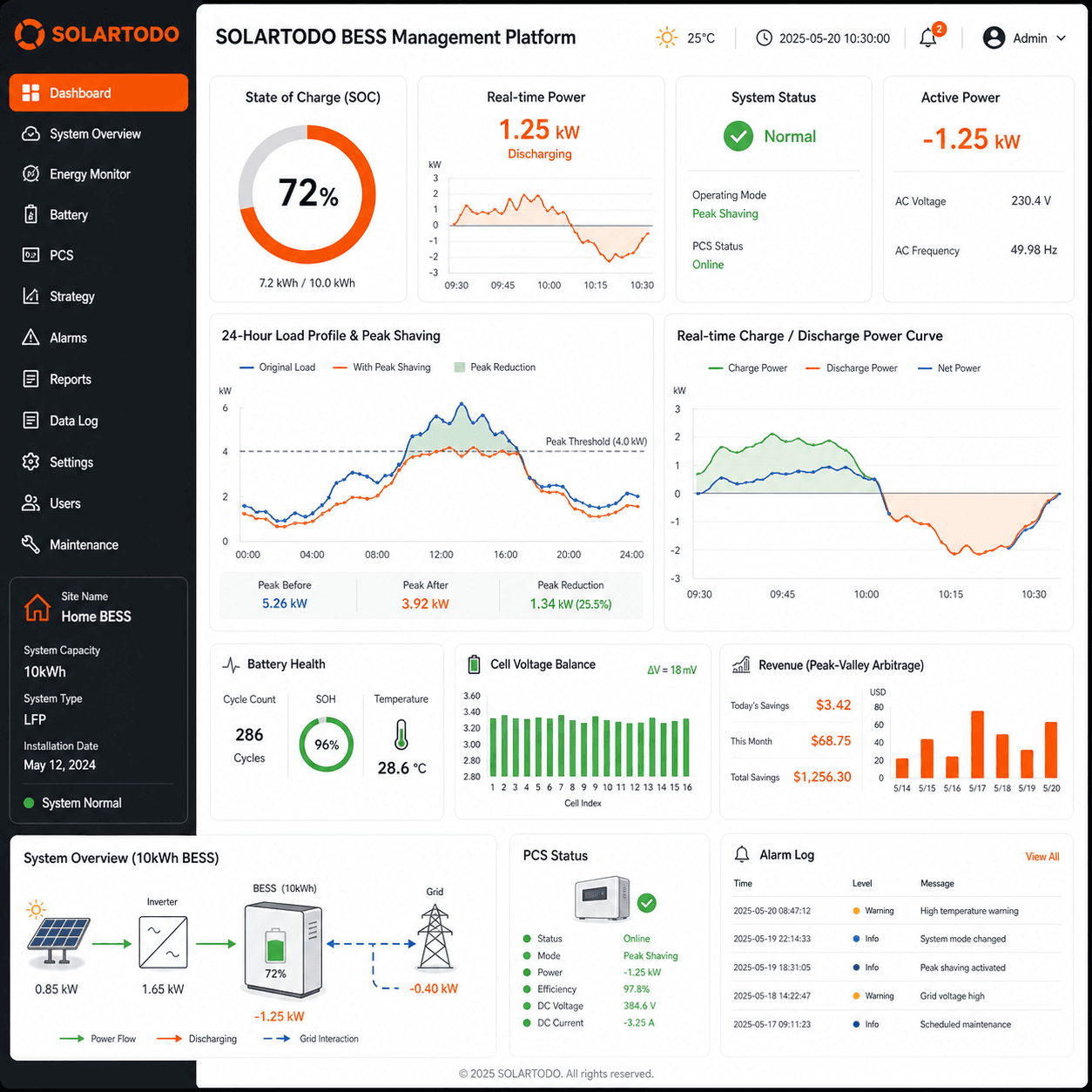
Cloud Monitoring
The cloud monitoring package reports at least 6 operating metrics: SOC, SOH, voltage, current, temperature, inverter status, and alarm code history. For distributors managing 10-unit, 50-unit, or 250-unit residential deployments, the dashboard helps compare fleet behavior, identify underperforming sites, and schedule maintenance before a customer reports reduced backup time. Buyers can Learn about topic for BESS sizing, battery safety, and solar self-consumption methods.
Monitoring also supports bankability because a 10-year battery warranty depends on measurable operating conditions, including temperature range, cycle count, depth of discharge, and charge/discharge current limits. IEEE 1547 interconnection principles are relevant where distributed energy resources interact with the grid, and local utilities may require anti-islanding, voltage ride-through, frequency ride-through, and export-limiting functions. For tariff-led projects, a 15-minute or 60-minute data interval is normally sufficient to calculate peak shaving and self-consumption value.
EPC Investment Analysis and Pricing Structure
EPC turnkey delivery includes 5 work packages: engineering, procurement, construction, commissioning, and 1-year onsite warranty support. Engineering covers single-line diagrams, load analysis, battery/inverter matching, protection coordination, and installation documentation. Procurement covers the 10kWh LFP cabinet, 5kW PCS, BMS, mounting accessories, cabling, protection devices, packaging, and logistics coordination. Construction covers wall or floor mounting, AC/DC wiring, grounding, labeling, and site acceptance. Commissioning covers capacity checks, inverter setup, protection verification, monitoring activation, and handover records.
| Pricing tier | Scope | Unit price range |
|---|---|---|
| FOB Supply | Equipment only, ex-works China | $1,240-$1,632 |
| CIF Delivered | Equipment plus ocean freight and insurance | $1,492-$1,964 |
| EPC Turnkey | Installed, commissioned, and 1-year warranty | $2,000-$2,400 |
| Order quantity | Discount from listed supply basis | Typical buyer profile |
|---|---|---|
| 50+ units | 5% | Regional distributor or installer |
| 100+ units | 10% | EPC framework purchase |
| 250+ units | 15% | Utility, developer, or national program |
ROI depends on 4 variables: electricity tariff, PV surplus, outage cost, and cycle frequency. A 10kWh system cycled 250-300 times per year can shift about 2,250kWh-2,700kWh annually at 90% usable depth of discharge. At a $0.22/kWh avoided import tariff, annual energy savings are about $495-$594 before demand-charge or outage benefits. Against a $2,000-$2,400 EPC price, the simple payback is about 4.0-4.8 years, and the 10-year usable service period can deliver 2 times or more of the original installed cost in avoided imports where tariffs are high.
Compared with a 5kW gasoline generator, the 10kWh LFP BESS reduces routine fuel use by 100% during stored-energy operation and removes 50-65 dB generator noise from typical nightly backup use. Compared with lead-acid battery backup, it uses a smaller installed footprint, supports deeper cycling, and typically avoids mid-life replacement before year 5. Wood Mackenzie 2025 storage-market commentary identifies residential storage attach rates as a key driver in mature rooftop PV markets, especially where net-metering credits are below retail import tariffs.
Payment terms are 30% T/T deposit plus 70% against B/L copy, or 100% L/C at sight for qualified buyers. Project financing can be discussed for programs above $5,000K, including phased delivery, batch commissioning, and distributor inventory planning. For quotations, compliance documents, and delivery scheduling, Request a custom quotation or contact [email protected] with quantity, destination port, grid type, PV size, and backup-load list.
Procurement and MOQ Guidance
The 10-unit MOQ is intended for B2B procurement where 1 palletized batch can support pilot projects, installer stocking, or residential community deployment. Each order should define 8 commercial items: AC voltage, inverter certification target, plug or terminal preference, wall-mount bracket requirement, monitoring language, branding, warranty responsibility, and spare-parts ratio. SOLARTODO can support solar, energy storage, smart lighting, security, telecom power towers, and smart agriculture projects from 1 supplier channel at https://solartodo.com.
For a 10-unit batch, total nominal storage is 100kWh and total inverter power is 50kW, which is enough for 10 typical homes or 1 small multifamily pilot. Procurement managers should compare not only $/kWh but also cycle life, usable DoD, inverter efficiency, warranty terms, certification package, and after-sales workflow. The strongest cost comparison uses levelized stored energy, where a 10kWh pack with 6,000 cycles and 90% usable DoD can deliver roughly 54,000kWh of lifetime throughput before warranty-end capacity assumptions.
Standards and Source Alignment
The system specification follows commonly cited energy-storage references from 6 organizations: IEC, UL, NFPA, NREL, IEA, and IRENA. IEC 62619 supports lithium battery safety evaluation, UL 9540 and UL 9540A support ESS listing and fire-propagation testing, UN38.3 supports international transport, and NFPA 855 supports stationary energy storage installation. NREL PVWatts supports hourly PV production estimation, while IEA and IRENA datasets provide market context for storage cost decline and renewable integration.
Because national electrical codes differ across more than 190 countries, final installation must be reviewed by a licensed electrician or engineer in the project jurisdiction. The product is designed as a 10kWh residential LFP platform, but grid interconnection, export control, backup-circuit selection, breaker sizing, and fire authority requirements may change the final bill of materials by 5%-15%. SOLARTODO recommends confirming these details before production release, especially for 50-unit and 100-unit batches.
Buyer Summary
The 10kWh Residential Stack LFP battery is best suited for buyers who need a compact 5kW residential BESS with long cycle life, predictable EPC pricing, and standards-aligned documentation. It is a stronger 10-year energy asset than lead-acid backup and a quieter, lower-maintenance alternative to small fuel generators. For distributors and EPCs, the 10-unit MOQ creates a practical entry batch with 100kWh of total storage and pricing from $1,240 FOB to $2,400 EPC turnkey per unit.
Technical Specifications
| Energy Capacity | 10kWh |
| Power Rating | 5kW |
| Battery Chemistry | LFP |
| Round-trip Efficiency | 96% |
| Depth of Discharge | 90% |
| Cycle Life | 6000+cycles |
| Calendar Life | 10years |
| Operating Temperature | -10 to 50degC |
| Annual Savings | 495-594USD/year |
| Payback Period | 4.0-4.8years |
| Warranty | 10 years / 70% capacity |
| Minimum Order Quantity | 10pcs |
| Mounting Type | Wall-mount or floor-stack |
| Application | Residential solar self-consumption and backup |
Price Breakdown
| Item | Quantity | Unit Price | Subtotal |
|---|---|---|---|
| LFP battery cells | 10 kWh | $55 | $550 |
| Battery Management System | 10 kWh | $15 | $150 |
| 5kW bidirectional PCS inverter | 5 kW | $80 | $400 |
| Air thermal management kit | 10 kWh | $10 | $100 |
| Wall-mount stack enclosure | 1 pcs | $220 | $220 |
| DC/AC protection and cabling | 1 pcs | $90 | $90 |
| Cloud monitoring module | 1 pcs | $120 | $120 |
| Engineering and factory QC | 1 pcs | $180 | $180 |
| Installation and commissioning | 1 pcs | $360 | $360 |
| 1-year warranty and support | 1 pcs | $120 | $120 |
| Total Price Range | $2,000 - $2,400 | ||
Frequently Asked Questions
What is included in the $2,000-$2,400 EPC turnkey price?
How much usable energy does the 10kWh LFP battery provide?
Why use LFP instead of lead-acid or NCM batteries?
Can this system operate during grid outages?
What certifications and standards apply to this residential BESS?
Certifications & Standards



Data Sources & References
- •NREL PVWatts 2025
- •IEA World Energy Outlook 2025
- •IRENA Renewable Power Generation Costs 2025
- •BloombergNEF Battery Price Survey 2025
- •Wood Mackenzie Energy Storage Market Outlook 2025
- •IEC 62619 lithium battery safety requirements
- •NFPA 855 stationary energy storage installation standard
Interested in this solution?
Contact us for a customized quote based on your specific requirements.
Contact Us