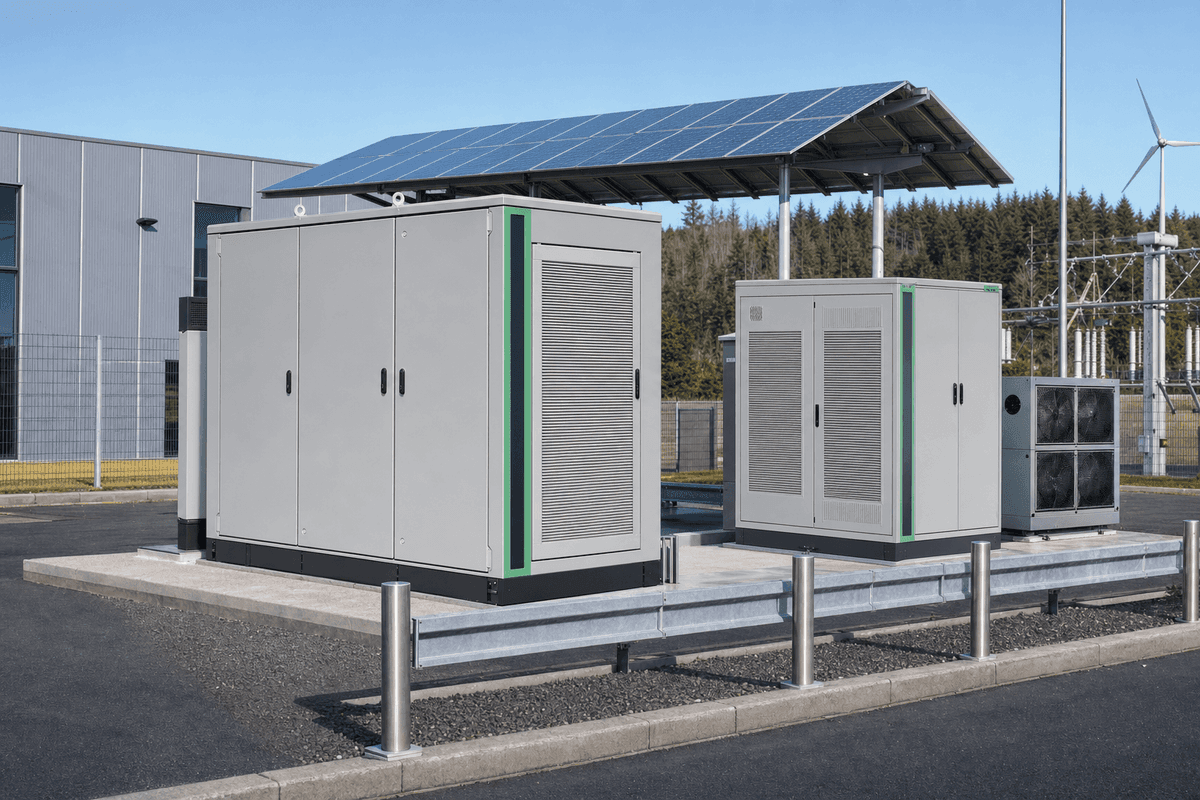
200kWh Hybrid LFP+Supercap High Power - 400kW BESS
Key Features
- 200kWh rated energy capacity paired with 400kW bidirectional power for a 2C high-power duty profile
- Hybrid LFP + supercapacitor architecture delivers response time below 20ms for fast transients and frequency support
- System-level round-trip efficiency of 94% with PCS conversion efficiency above 96% in grid-tied and island modes
- Liquid-cooled 20ft integrated container supports operation from -20°C to 50°C with 8,000-cycle design life
- EPC turnkey pricing ranges from USD 33,100 to USD 39,900 with 1-year warranty and volume discounts up to 15%
The 200kWh Hybrid LFP+Supercap High Power BESS combines 200kWh of LFP energy storage with 400kW bidirectional power conversion and sub-20ms response for high-power C&I and grid-support applications. Designed for 2C continuous discharge, liquid cooling, UL 9540A-aligned safety architecture, and hybrid peak-shaving control, it supports self-consumption optimization, frequency response, and island-capable operation.
Description
The 200kWh Hybrid LFP+Supercap High Power system is a containerized Battery Energy Storage System (BESS) engineered for applications that require both 200kWh energy capacity and 400kW power output with <20ms response time. It combines LFP battery modules for sustained energy delivery with a supercapacitor power stage for short-duration high-current events, creating a hybrid architecture optimized for 2C discharge, solar self-consumption, peak shaving, microgrid support, and fast frequency response. For buyers comparing EPC-ready commercial storage, this model fits projects that need more than a conventional 1C/200kW battery but less than a multi-MWh utility block.
In practical terms, the hybrid topology separates energy duty from power duty. The LFP section provides the bulk 200kWh usable energy window, while the supercapacitor bank absorbs and releases transient power spikes measured in milliseconds rather than seconds, reducing electrochemical stress on the battery cells by a meaningful margin during repetitive surge events. According to guidance and market observations from NREL, IEA, and BloombergNEF, high-power duty cycles such as frequency regulation and motor-start support can accelerate degradation in conventional battery-only systems; hybridization is therefore increasingly used where power ramps exceed 1C to 2C repeatedly over 24-hour operating periods.
Product Positioning for High-Power Energy Storage
This system is intended for commercial and industrial (C&I) sites, renewable energy plants, and grid-interactive facilities that need 400kW instantaneous power capability from a compact 200kWh platform. Typical use cases include solar + storage self-consumption, demand charge management, frequency regulation, backup ride-through, and island-mode transition for critical loads in the 100kW to 350kW range. Compared with a conventional 200kWh LFP-only 0.5C to 1C system, the hybrid LFP+supercapacitor design can deliver faster transient response and lower peak battery stress, which is valuable in applications with 5-second to 60-second high-power events.
For procurement teams, the commercial value is not only the 400kW nameplate but also the reduction in oversizing. A conventional design may require 300kWh to 400kWh of battery energy to safely deliver repeated 300kW to 400kW bursts without excessive cycling stress, whereas a hybrid architecture can often achieve the same power profile with 200kWh plus a dedicated supercapacitor stage. This can reduce footprint, lower thermal loading during pulse events, and improve power quality support. Buyers can View all Battery Energy Storage System (BESS) products or Configure your system online for site-specific duty-cycle matching.
System Architecture
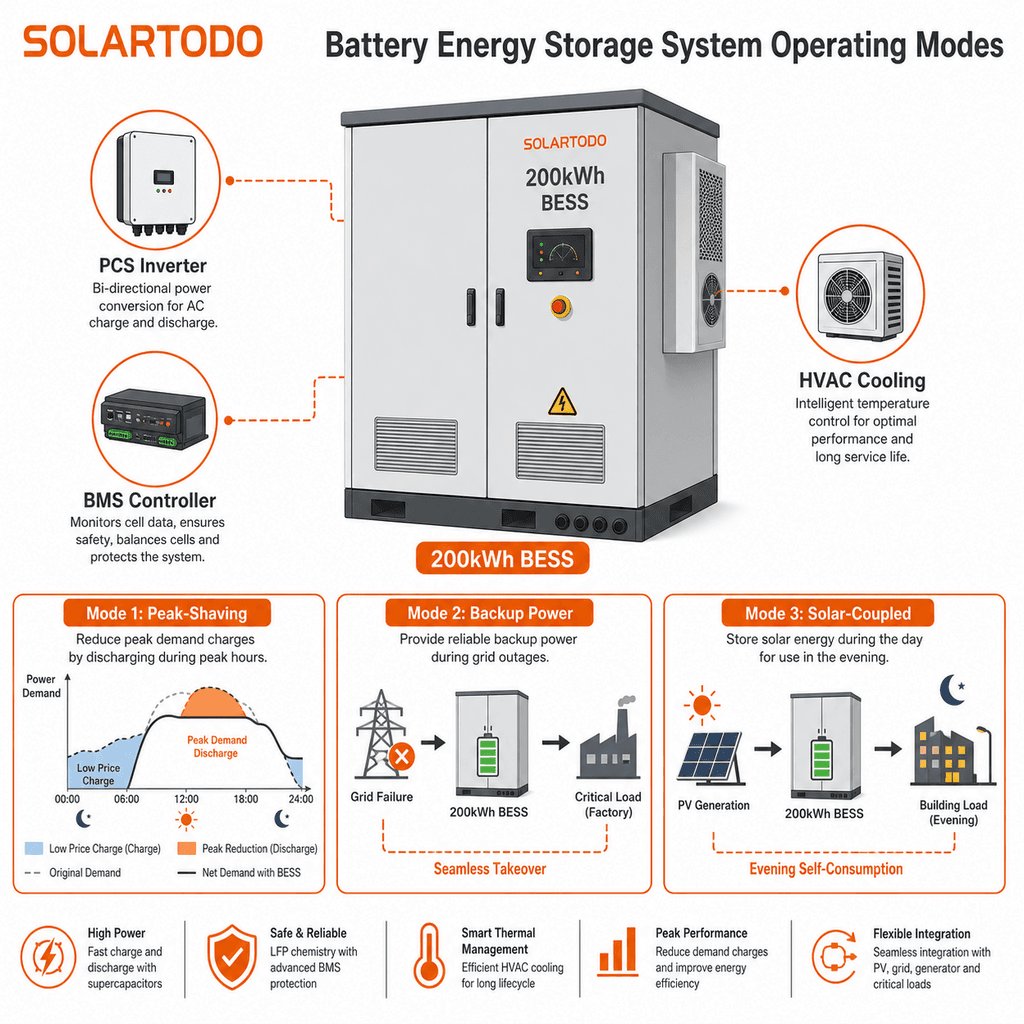
The core architecture integrates 4 major subsystems: the LFP battery rack, the supercapacitor module bank, a 400kW bidirectional PCS, and a supervisory BMS/EMS layer. The battery management system monitors SOC, SOH, cell voltage, module temperature, insulation status, and fault states across the full DC stack, while the energy management system dispatches power between battery and supercapacitor according to ramp rate, state-of-charge windows, and operating mode. The PCS supports both grid-tied and island operation with conversion efficiency of >96%, which is aligned with commercial storage expectations cited in IRENA and Wood Mackenzie market analyses for 2025-2026 deployments.
The enclosure format is based on a 20ft integrated container, which is the standard packaging range for systems from approximately 200kWh up to 2MWh. For this 200kWh/400kW variant, liquid cooling is specified because thermal management becomes critical once discharge rates move into the 2C range and transient current peaks rise further under supercapacitor-assisted operation. The thermal loop maintains tighter temperature spread across cells, improving consistency and reducing localized aging. In environments from -20°C to 50°C, liquid cooling generally outperforms basic forced-air systems in maintaining stable module temperatures during repeated high-power dispatch.
Technical Specifications
From a specification standpoint, the system is configured at 200kWh rated energy, 400kW rated power, and 2C continuous discharge capability, with hybrid support for higher short-duration peak handling through the supercapacitor branch. The expected round-trip efficiency at system level is 94%, while PCS conversion efficiency exceeds 96% under standard operating conditions. Designed depth of discharge is 95%, cycle life is specified at 8,000 cycles, and calendar life is 15 years under recommended operating windows. These figures are consistent with modern LFP commercial storage benchmarks reported by NREL and BloombergNEF for properly managed liquid-cooled systems.
The electrical design supports AC-coupled or DC-integrated renewable systems, depending on project topology. For solar self-consumption sites with daytime PV surplus of 150kW to 500kW, the BESS can absorb excess generation during low-load periods and discharge at up to 400kW during evening peaks or utility demand windows. In frequency response mode, the <20ms reaction time allows the system to respond significantly faster than diesel gensets, which typically require seconds to tens of seconds to ramp, and faster than many battery-only systems configured with slower dispatch filters to protect cells.
Safety Design and Compliance
Safety architecture is based on a 3-tier protection strategy: preventive monitoring, active suppression, and automatic isolation. The preventive layer includes gas detection, thermal runaway indicators, cell balancing, and overcurrent/overtemperature protection. The active layer includes three-tier fire suppression, while the final layer initiates automatic shutdown and isolation in the event of critical alarms. The design references UL 9540, UL 9540A, IEC 62619, UN38.3, and deployment practices under NFPA 855, which are the key frameworks commonly requested by EPC firms, consultants, insurers, and AHJs in 2025 project documentation.
For buyers evaluating risk, the hybrid design provides an additional operational advantage because the supercapacitor module handles short-duration power spikes that might otherwise create elevated battery current and heat. Lower battery stress during transient events can improve safety margins under aggressive dispatch profiles. While no storage technology is risk-free, the use of LFP chemistry already offers a more stable thermal profile than higher-energy-density alternatives such as NCM, and the combination of liquid cooling, BMS diagnostics, and tested enclosure protection supports safer operation in high-duty commercial environments.
Performance Compared with Conventional Alternatives
Compared with a conventional 200kWh LFP-only 200kW to 250kW BESS, this hybrid system delivers 60% to 100% more power from the same nominal energy block, depending on the baseline design. Compared with a diesel generator sized around 400kVA to 500kVA for peak support, it can reduce local emissions to zero at point of use, cut response time from 5-30 seconds to <20ms, and reduce maintenance events associated with oil, filters, and mechanical wear. According to IEA and IRENA analyses, electrified flexibility assets paired with renewables are increasingly preferred for short-duration grid services because they improve efficiency and reduce fuel dependency.
There is also an economic comparison. If a site uses a conventional battery-only system and must oversize from 200kWh to 350kWh to achieve repeated 400kW bursts, the extra battery capacity can materially increase capex and footprint. By assigning pulse duty to supercapacitors, this hybrid model can reduce unnecessary energy oversizing while preserving power performance. In applications with 10 to 50 high-ramp events per day, that architecture often produces better lifecycle economics than a pure battery system designed around worst-case pulse demand.
Applications
The most common deployment pattern is PV + BESS for C&I sites with contracted demand charges, unstable grid conditions, or critical process loads. A factory with 600kW rooftop solar, 450kW peak load, and 150kW nighttime baseload can use this 200kWh/400kW system to capture midday surplus, shave demand spikes, and provide ride-through during grid disturbances. In a microgrid, the system can support black-start sequencing, fast load acceptance, and power smoothing for variable generation. It is also suitable for EV charging hubs where load ramps can exceed 100kW in seconds.
A representative scenario is a solar farm operator in the MENA region that deployed a 200kWh hybrid LFP+supercap unit at a remote service compound with 320kW PV, 280kW workshop load, and frequent voltage dips from a weak feeder. By using the supercapacitor stage to absorb millisecond transients and the LFP block to shift 120kWh to 180kWh of daily solar surplus, the operator reduced diesel runtime by approximately 70%, improved power quality, and stabilized critical equipment starts. For similar project planning, buyers can Learn about topic and Request a custom quotation with site load profiles and single-line diagrams.
Cloud Monitoring and EMS Integration
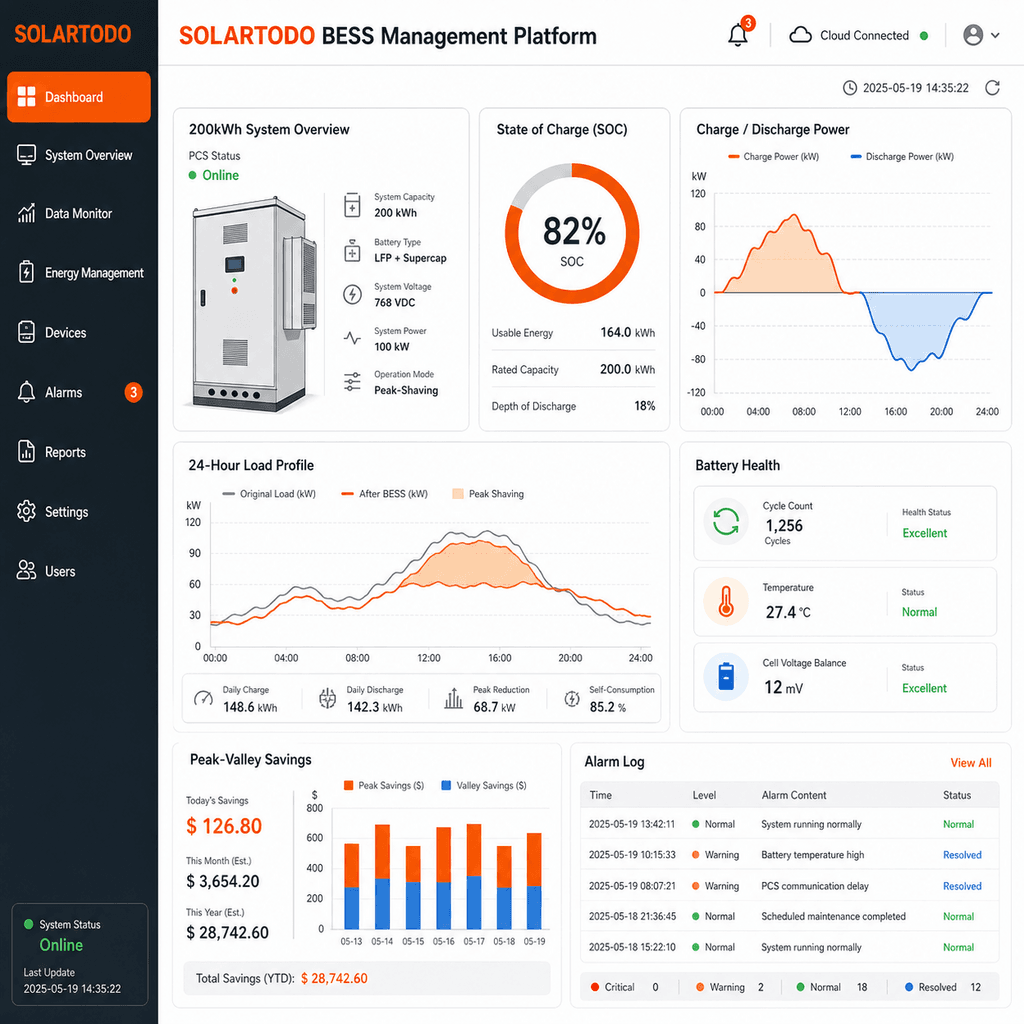
Remote monitoring is a standard requirement for fleets above 5 systems or portfolios above 1MWh, and this platform supports cloud-based supervision with 24/7 data access. Operators can track SOC, SOH, charge/discharge power, alarm history, thermal status, and energy throughput in 1-minute to 15-minute intervals depending on EMS configuration. Remote diagnostics reduce service response time, support preventive maintenance, and enable dispatch optimization against tariff periods, PV forecasts, and load curves. This is particularly useful for C&I operators managing multiple sites across 2 to 20 regions.
The EMS can be configured with rule-based or schedule-based logic, including charge from solar only, charge from grid during off-peak windows, export limitation, and reserve SOC for backup mode. For projects with utility interconnection requirements, the control layer can support anti-backfeed logic, ramp-rate control, and island transfer coordination. Buyers looking for system sizing guidance can also Learn about topic to compare AC-coupled versus DC-coupled storage architectures before final engineering review.
EPC Investment Analysis and Pricing Structure
For budgetary planning, SOLARTODO provides 3 commercial tiers for this 200kWh/400kW hybrid BESS: FOB Supply, CIF Delivered, and EPC Turnkey. The EPC Turnkey price range is USD 33,100 to USD 39,900, which includes engineering, procurement, construction coordination, commissioning, and 1-year warranty support. EPC scope typically covers electrical design review, system integration, logistics coordination, installation supervision, startup testing, protection checks, EMS parameterization, operator training, and handover documentation. Contact for quotations and project files: [email protected].
| Pricing Tier | Scope | Price Range (USD) |
|---|---|---|
| FOB Supply | Equipment only, ex-works China | 20,522 - 27,132 |
| CIF Delivered | Equipment + ocean freight + insurance | 24,700 - 32,656 |
| EPC Turnkey | Installed + commissioned + 1-year warranty | 33,100 - 39,900 |
For multi-unit procurement, volume pricing can materially improve project economics. The standard discount schedule is shown below and applies to equipment value subject to final configuration, destination, and certification package. Larger orders above 50 units often benefit from shared engineering and logistics efficiencies, while orders above 250 units may justify dedicated production scheduling and FAT batching.
| Order Volume | Discount |
|---|---|
| 50+ units | 5% |
| 100+ units | 10% |
| 250+ units | 15% |
From an ROI perspective, a 200kWh/400kW hybrid BESS can generate value through 3 to 4 stacked revenue or savings streams: demand charge reduction, solar self-consumption, outage mitigation, and ancillary power support. For a commercial site with 1 daily cycle, average usable throughput of 190kWh, and blended savings of USD 0.22/kWh between arbitrage and demand management, annual direct savings can reach approximately USD 15,300. Under that scenario, simple payback on a turnkey basis falls near 2.2 to 2.6 years, excluding tax incentives, carbon value, or avoided generator maintenance.
Compared with a diesel-based peak support strategy, annual operating cost reductions can be significant. A 400kVA diesel generator running 500 hours per year at partial load can consume thousands of liters of fuel and require periodic maintenance every 250 to 500 hours. By contrast, this BESS shifts energy with 94% round-trip efficiency, has no on-site fuel handling, and offers instant dispatch. Payment terms are 30% T/T + 70% against B/L, or 100% L/C at sight. Financing support is available for projects above USD 5,000K, subject to credit review and jurisdiction.
Procurement, Installation, and Project Delivery
Lead time for standard configurations is typically 4 to 8 weeks for equipment production and factory test readiness, followed by shipping time based on destination port. The integrated 20ft format reduces field assembly complexity because major subsystems arrive pre-engineered, pre-wired, and pre-tested. Site work generally includes foundation preparation, cable routing, AC interconnection, grounding, communications, and commissioning. For straightforward C&I projects, installation and energization can often be completed within 3 to 10 days once civil and electrical prerequisites are ready.
Engineering deliverables can include single-line diagrams, layout drawings, communication maps, protection settings, and commissioning reports. For interconnection-sensitive projects, additional studies may be required, including short-circuit review, harmonic assessment, and relay coordination. Because standards and utility rules vary by country, final certification and compliance packages should be aligned with local AHJ, insurer, and grid operator requirements before purchase order release.
Technical Summary for Specifiers
For consultants and EPC firms writing tender documents, the key differentiators are straightforward: 200kWh energy, 400kW power, 2C continuous discharge, <20ms response, liquid cooling, >96% PCS efficiency, and a hybrid LFP + supercapacitor design intended for high-power duty. The system is suitable for solar utilization improvement, weak-grid stabilization, and rapid-response applications where a standard battery-only cabinet may be underpowered or forced into excessive oversizing. To compare alternatives or start a site-specific design review, buyers can View all Battery Energy Storage System (BESS) products, Configure your system online, or Request a custom quotation.
Authoritative references used in this overview include NREL storage performance publications, IEA electricity and flexibility outlooks, IRENA renewable integration studies, BloombergNEF battery market tracking, Wood Mackenzie storage deployment analysis, and compliance frameworks under IEC 62619, UL 9540/9540A, UN38.3, and NFPA 855. These sources collectively support the design assumptions, market pricing context, and application fit described for 2025-2026 commercial storage procurement.
Technical Specifications
| Energy Capacity | 200kWh |
| Power Rating | 400kW |
| Battery Chemistry | Hybrid LFP + Supercapacitor |
| Round-trip Efficiency | 94% |
| Depth of Discharge | 95% |
| Cycle Life | 8000cycles |
| Calendar Life | 15years |
| Operating Temperature | -20 to 50°C |
| C-rate | 2C |
| Response Time | <20ms |
| PCS Efficiency | >96% |
| Cooling Method | Liquid Cooling |
| Annual Savings | 15300USD |
| Payback Period | 2.2-2.6years |
| Warranty | 10 years / 70% capacity |
Price Breakdown
| Item | Quantity | Unit Price | Subtotal |
|---|---|---|---|
| LFP battery cells | 200 pcs | $55 | $11,000 |
| Battery Management System | 200 pcs | $15 | $3,000 |
| Bidirectional PCS 400kW | 1 pcs | $3,200 | $3,200 |
| DC-DC converter and supercapacitor interface | 400 pcs | $4 | $1,600 |
| Liquid thermal management system | 200 pcs | $25 | $5,000 |
| Container/enclosure 20ft | 1 pcs | $8,000 | $8,000 |
| Fire suppression and gas detection | 1 pcs | $5,000 | $5,000 |
| EMS software and cloud gateway | 1 pcs | $3,000 | $3,000 |
| Engineering & QC | 1 pcs | $1,200 | $1,200 |
| Installation & Commissioning | 1 pcs | $2,500 | $2,500 |
| 1-Year Warranty & Support | 1 pcs | $1,500 | $1,500 |
| Total Price Range | $33,100 - $39,900 | ||
Frequently Asked Questions
What makes this 200kWh system different from a standard 200kWh LFP battery-only BESS?
Is the system suitable for solar self-consumption and peak shaving at commercial facilities?
What certifications and safety standards does the system follow?
What is included in the EPC turnkey price, and what warranty is provided?
What payment terms are available for international buyers and larger projects?
Certifications & Standards

Data Sources & References
- •NREL energy storage performance and integration publications 2024-2025
- •IEA electricity market and power system flexibility outlook 2025
- •IRENA renewable energy integration and storage reports 2025
- •BloombergNEF battery price and storage market outlook 2025
- •Wood Mackenzie global energy storage deployment analysis 2025
- •IEC 62619 secondary lithium battery safety standard
- •UL 9540 and UL 9540A energy storage system safety frameworks
Interested in this solution?
Contact us for a customized quote based on your specific requirements.
Contact Us