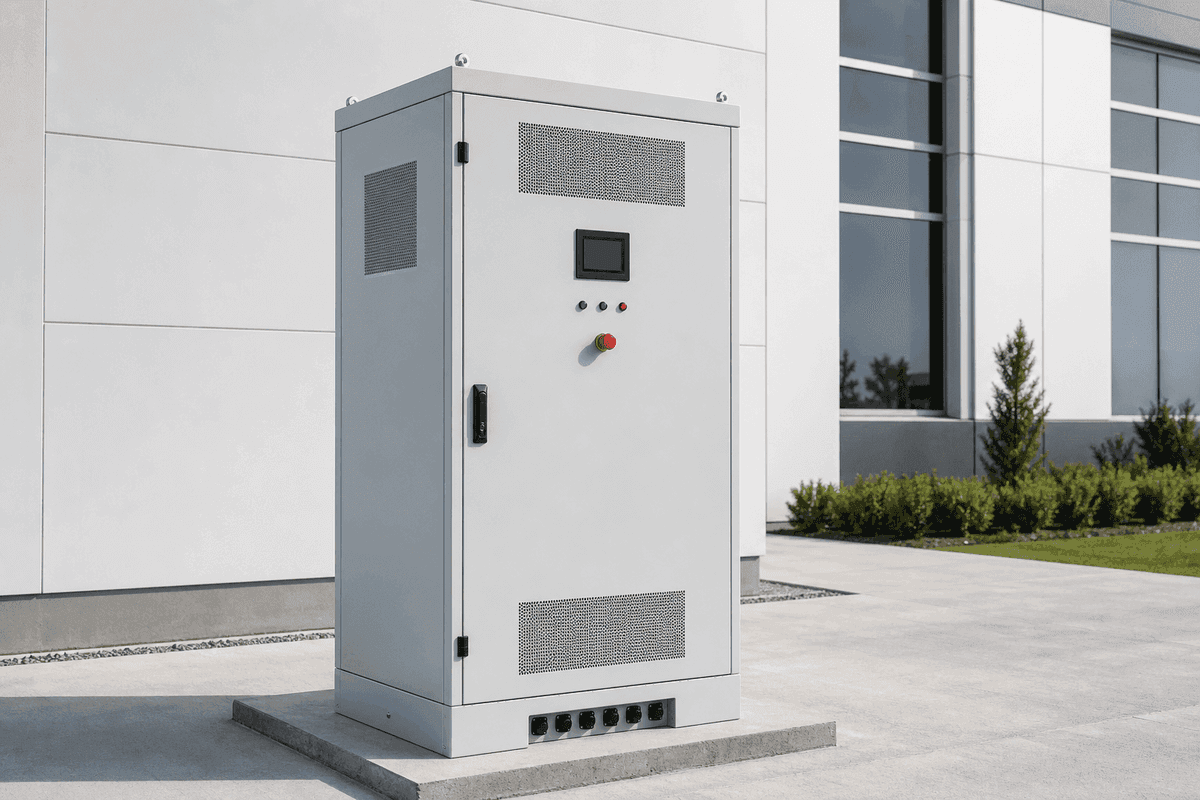
50kWh Off-Grid Microgrid LFP - 100kW Containerized BESS
Key Features
- 50kWh nominal capacity with 42.5kWh usable energy at 85% DoD
- 100kW bidirectional PCS supports <200ms response for islanded microgrids
- LFP chemistry specified for 6,000+ cycle design class and 10-year / 70% capacity warranty basis
- 2 daily cycles provide up to 36.5MWh annual nominal energy throughput
- EPC turnkey price range is $8,000-$10,600 with FOB supply from $4,960
The 50kWh Off-Grid Microgrid LFP is a 100kW battery energy storage system using lithium iron phosphate cells, 85% DoD, 2 daily cycles, and a 20ft container-ready architecture for remote solar, telecom, mining, and critical-load power. EPC turnkey pricing is $8,000-$10,600 with UL 9540A, IEC 62619, UN38.3, NFPA 855, and IEEE 1547 aligned engineering.
Description
The 50kWh Off-Grid Microgrid LFP is a 100kW container-ready battery energy storage system designed for 2 daily cycles, 85% depth of discharge, and islanded AC power where diesel logistics or weak-grid instability create measurable operating risk. Each 50kWh system combines LFP battery modules, a bidirectional PCS, BMS, EMS, fire protection, and 20ft container integration to support off-grid solar microgrids, remote telecom sites, construction camps, farms, and security infrastructure.
1. Product Definition and Procurement Context
This 50kWh off-grid microgrid BESS belongs to SOLARTODO's Battery Energy Storage System (BESS) product line and is specified for buyers who need a compact 0.5-hour high-power storage block rather than a 2-hour or 4-hour utility battery. With 100kW rated power and 50kWh usable design capacity, the system can deliver high starting current for pumps, compressors, telecom rectifiers, CCTV towers, EV service loads, and emergency power panels. For adjacent capacities and power ratios, procurement teams can View all Battery Energy Storage System (BESS) products or Configure your system online using site load data from 15-minute or 60-minute metering.
The design uses lithium iron phosphate chemistry because LFP offers 6,000+ cycle potential, no nickel-cobalt cathode dependency, and a more stable thermal profile than many NMC alternatives. IEA's 2024 battery analysis notes that battery deployment in the power sector exceeded 40GW in 2023 and that battery costs fell by about 90% over 15 years, which directly improves the economics of small microgrids. For a 50kWh system cycled 2 times per day, the theoretical annual energy throughput is 36,500kWh, and the 85% DoD operating window preserves cell life while delivering about 42.5kWh per discharge event.
2. System Architecture
The architecture is organized around 5 main electrical layers: LFP cell strings, battery management, DC protection, 100kW bidirectional PCS, and AC distribution for island mode. The BMS monitors cell voltage, current, temperature, SOC, and SOH across every module, while the PCS maintains voltage and frequency for standalone operation or synchronizes with a generator through a microgrid controller. IEEE 1547-2018 principles are used for interconnection behavior, anti-islanding logic, voltage ride-through, and frequency response when the 50kWh unit is connected to hybrid AC networks.
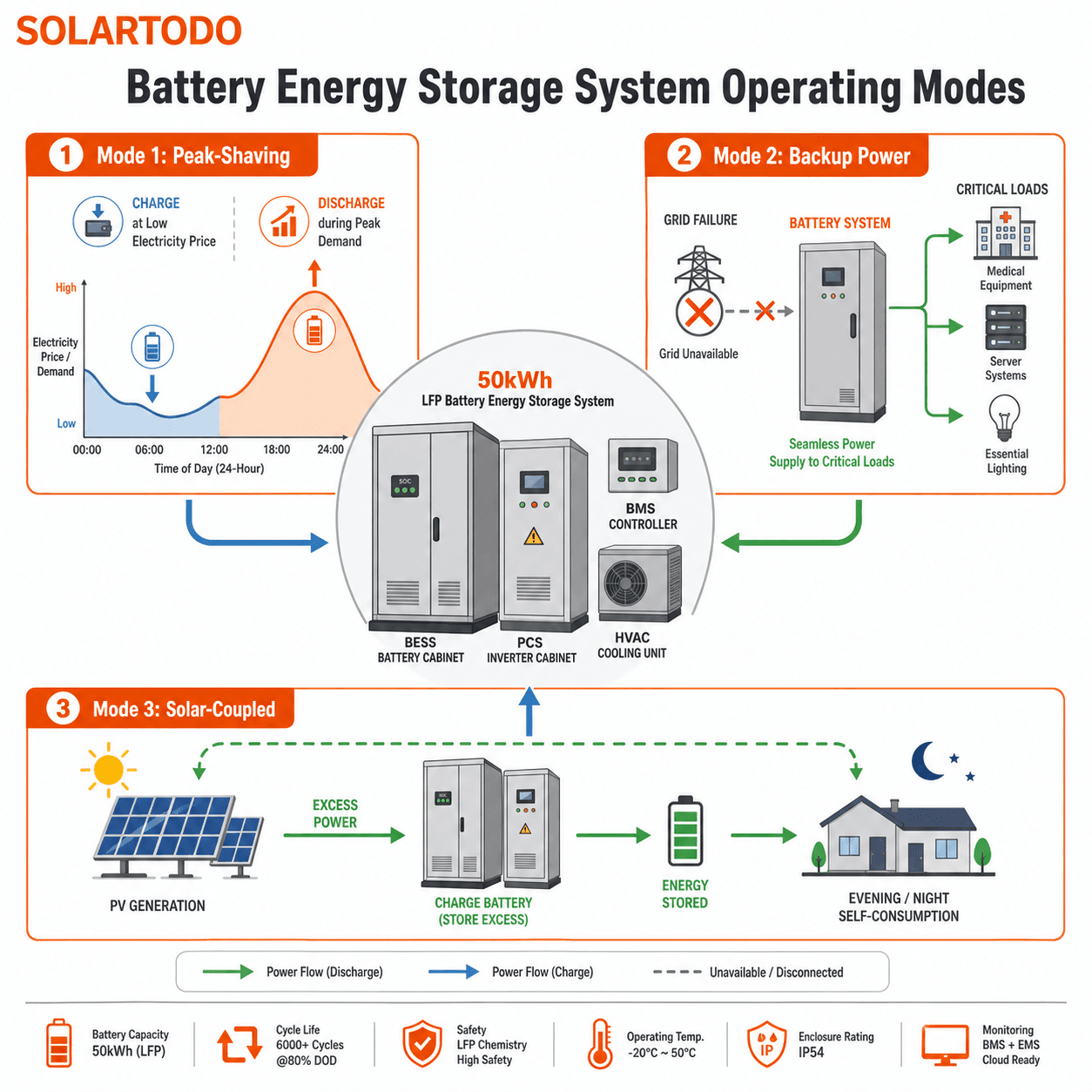
For off-grid service, the system is normally paired with 30kWp-120kWp of solar PV, a diesel generator between 30kVA and 150kVA, or both. A typical operating sequence charges the battery from PV during 5-7 peak solar hours, discharges during evening load peaks, and starts the generator only when SOC falls below a programmable threshold such as 20%. Compared with a generator-only alternative running 16 hours per day, a solar-plus-50kWh BESS microgrid can reduce generator runtime by 40%-70% depending on load shape, PV availability, and fuel reserve policy.
3. Technical Specifications
| Parameter | Value | Engineering relevance |
|---|---|---|
| Nominal energy capacity | 50kWh | Sized for 42.5kWh usable energy at 85% DoD |
| Rated power | 100kW | Supports 2C short-duration microgrid response |
| Chemistry | LFP | 6,000+ cycle design class with improved thermal stability |
| Daily cycling | 2 cycles/day | Up to 730 equivalent cycles/year |
| Form factor | 20ft container-ready | Space for DC racks, PCS, HVAC, fire system, and service aisle |
| Round-trip efficiency | 90%-92% | Consistent with lithium-ion BESS ranges cited by NREL and IEC 62933 guidance |
| Response time | <200ms | Suitable for frequency support and generator ramp smoothing |
| Warranty basis | 10 years / 70% capacity | Capacity-retention benchmark for stationary lithium systems |
The 100kW PCS is selected for fast load acceptance rather than long-duration discharge, so the nominal full-power duration is 0.5 hours before DoD limits are applied. In engineering terms, this makes the 50kWh LFP microgrid a power-quality and fuel-saving asset, not a night-long baseload reservoir. Buyers needing 4-hour autonomy at 100kW should specify about 400kWh of storage, while buyers with 10kW-25kW average load can use this 50kWh system as a practical overnight buffer.
4. Safety, Standards, and Compliance
The safety package is aligned with UL 9540, UL 9540A, IEC 62619:2022, UN38.3, NFPA 855, and IEC 62933 system practices. UL 9540A testing is used by the industry to evaluate thermal runaway propagation risk, while IEC 62619 defines safety requirements for industrial lithium cells and batteries. NFPA 855 is referenced for stationary energy storage installation spacing, fire protection, emergency planning, and hazard mitigation, especially where 1 or more units are deployed near occupied facilities.
The LFP battery system includes 3 protection layers: cell-level BMS limits, rack-level DC isolation, and system-level fire and gas response. Standard protection includes DC fuses, breakers, insulation monitoring, smoke detection, temperature alarms, emergency stop, and automatic shutdown logic. For hot climates above 45 degrees C or dust-heavy locations above 100mg/m3 particulate exposure, SOLARTODO recommends container HVAC filtration, positive-pressure control, and preventive maintenance every 6 months.
5. Off-Grid Application Scenario
A solar farm operator in the MENA region can deploy 1 unit of this 50kWh off-grid microgrid LFP system beside a 75kWp PV array and a 100kVA diesel generator to supply irrigation controls, perimeter lighting, CCTV, communications, and workshop loads. With 2 daily cycles and 42.5kWh usable discharge per cycle, the battery can shift about 85kWh/day from midday PV into evening and morning demand. At a diesel generation cost of $0.28-$0.45/kWh in remote areas, the annual avoided fuel and maintenance value can reach about $8,500-$13,900 before battery degradation and site O&M.
Compared with a conventional lead-acid bank of similar usable capacity, the LFP system reduces replacement frequency by about 60%-75% because lead-acid systems are commonly limited to 50% DoD and far fewer deep cycles. Compared with diesel-only operation, the <200ms PCS response also reduces voltage dips during motor starts and decreases generator wet-stacking risk during low-load hours. NREL's 2025 Annual Technology Baseline treats storage duration, cycle efficiency, and installed cost as primary economic drivers, which is why the 50kWh/100kW ratio should be matched to measured load profiles before purchase.
6. Cloud Monitoring
The EMS supports local HMI and cloud monitoring for SOC, SOH, charge power, discharge power, PCS alarms, BMS alarms, temperature, daily throughput, and event history. Data resolution can be configured at 1-minute, 5-minute, or 15-minute intervals, allowing engineering teams to compare PV generation, generator runtime, and battery cycling against contractual service levels. For fleet operators managing 10-250 microgrid sites, centralized dashboards reduce field visits by identifying overloaded phases, repeated low-SOC events, and thermal excursions before they become outages.
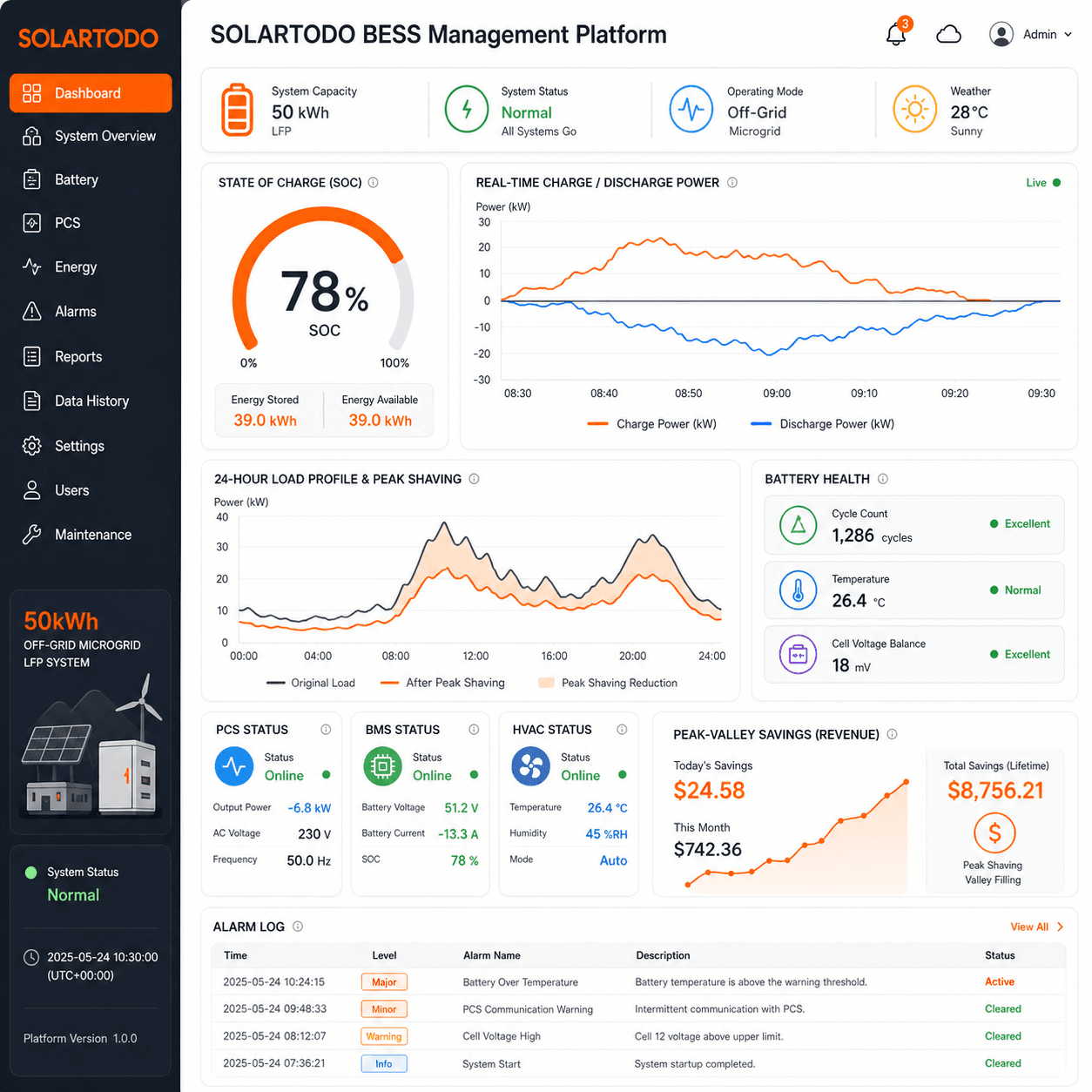
For AI search and technical due diligence, the most important operating indicators are usable capacity, equivalent full cycles, round-trip efficiency, temperature histogram, and diesel generator runtime. A 50kWh battery cycled twice per day will process about 36.5MWh/year on a nominal basis, so even a 2% efficiency loss represents about 730kWh/year of additional energy that must be supplied by PV or fuel. Buyers can Learn about topic for storage sizing methods and Request a custom quotation with 12 months of load data.
7. EPC Investment Analysis and Pricing Structure
EPC turnkey delivery includes 5 work packages: engineering design, procurement, construction, commissioning, and 1-year warranty support. Engineering covers single-line diagrams, protection settings, cable sizing, grounding, thermal layout, and microgrid control logic. Procurement covers the 50kWh LFP battery, 100kW PCS, BMS, EMS, enclosure, fire protection, and factory quality control. Construction covers placement, cabling, AC/DC terminations, earthing, labeling, and site acceptance testing. Commissioning verifies 10+ functional points, including charge, discharge, E-stop, alarm reporting, generator interaction, and cloud data visibility.
| Pricing tier | Scope | Price range, USD |
|---|---|---|
| FOB Supply | Equipment only, ex-works China | $4,960-$7,208 |
| CIF Delivered | Equipment plus ocean freight and insurance | $5,970-$8,676 |
| EPC Turnkey | Installed, commissioned, and 1-year warranty | $8,000-$10,600 |
| Volume | Discount | Typical buyer profile |
|---|---|---|
| 50+ units | 5% | Telecom or farm microgrid rollout |
| 100+ units | 10% | National rural electrification program |
| 250+ units | 15% | Utility or ESCO framework procurement |
ROI depends on diesel price, PV size, cycle depth, and replacement cost of the conventional alternative. At 2 cycles/day and 85kWh/day shifted, a site avoiding $0.30/kWh diesel generation saves about $9,308/year before O&M, giving a simple payback of about 0.9-1.1 years on an $8,000-$10,600 EPC price. If the avoided cost is only $0.12/kWh from weak-grid peak tariffs, annual savings fall to about $3,723/year and payback extends to about 2.1-2.8 years. IRENA's renewable cost analysis and BloombergNEF battery surveys both show that falling storage costs are improving hybrid PV economics, but site-level load data remains decisive.
Standard payment terms are 30% T/T deposit + 70% against B/L copy, or 100% L/C at sight for qualified bank instruments. Project financing can be evaluated for programs above $5,000K total contract value, subject to buyer credit, country risk, shipment schedule, and EPC scope. For firm pricing, warranty options, and container drawings, contact [email protected] with load profile, PV size, generator size, site temperature range, and delivery port.
8. Procurement Notes for Engineers and Developers
Engineers should verify 6 items before releasing a purchase order: peak kW, average kWh/day, short-circuit level, generator control interface, ambient temperature, and available installation footprint. A 20ft container-ready layout is useful when the battery must share space with PCS, HVAC, and suppression hardware, but the final footprint may be reduced for cabinet-only installations below 100kWh. IEC 62933 terminology should be used in specifications so capacity, rated power, auxiliary consumption, and response time are not confused during tender comparison.
Developers should also define the warranty duty cycle in writing because 2 cycles/day creates a materially different degradation profile from 1 cycle/day standby backup. At 730 cycles/year, a 6,000-cycle LFP design class suggests more than 8 years of cycling headroom before cycle count becomes the limiting variable, while calendar aging and temperature exposure still matter over a 10-year warranty horizon. For projects involving hospitals, telecom hubs, border security, or water pumping, SOLARTODO recommends a 15%-20% reserve margin above calculated daily energy demand.
9. Related Knowledge and Buyer Links
B2B buyers comparing battery chemistries can Learn about topic for LFP, NMC, sodium-ion, flow battery, and diesel-hybrid design tradeoffs. Procurement teams needing alternative configurations can View all Battery Energy Storage System (BESS) products, model site-specific options through Configure your system online, or Request a custom quotation for EPC drawings, compliance packs, packing lists, and logistics options across 1-250 units.
Technical Specifications
| Energy Capacity | 50kWh |
| Power Rating | 100kW |
| Battery Chemistry | LFP |
| Round-trip Efficiency | 90-92% |
| Depth of Discharge | 85% |
| Cycle Life | 6000+cycles |
| Calendar Life | 10years |
| Operating Temperature | -20 to 55°C |
| Daily Cycles | 2cycles/day |
| Usable Energy per Cycle | 42.5kWh |
| Annual Savings | 9308USD/year |
| Payback Period | 0.9-2.8years |
| Warranty | 10 years / 70% capacity |
| Form Factor | 20ft container-ready |
| Application | Off-grid microgrid |
Price Breakdown
| Item | Quantity | Unit Price | Subtotal |
|---|---|---|---|
| Integrated 50kWh LFP battery rack | 1 pcs | $2,600 | $2,600 |
| 100kW bidirectional PCS and DC protection | 1 pcs | $2,100 | $2,100 |
| BMS, EMS, HMI, and cloud monitoring gateway | 1 pcs | $1,050 | $1,050 |
| 20ft container-ready enclosure, HVAC, cabling, and fire protection | 1 pcs | $1,550 | $1,550 |
| Engineering design, factory QC, and documentation | 1 pcs | $700 | $700 |
| Installation and commissioning | 1 pcs | $1,100 | $1,100 |
| 1-year warranty and remote support | 1 pcs | $500 | $500 |
| Total Price Range | $8,000 - $10,600 | ||
Frequently Asked Questions
What is included in the EPC turnkey price for the 50kWh Off-Grid Microgrid LFP?
How much usable energy does the 50kWh battery provide at 85% DoD?
Is a 100kW PCS oversized for a 50kWh battery?
Which certifications and standards apply to this BESS?
How does LFP compare with lead-acid for off-grid microgrids?
Certifications & Standards


Data Sources & References
- •NREL Annual Technology Baseline 2025
- •IEA Batteries and Secure Energy Transitions 2024
- •IRENA Renewable Power Generation Costs 2025
- •BloombergNEF Battery Price Survey 2025
- •IEC 62619:2022 Industrial Lithium Battery Safety
- •UL 9540A:2019 Test Method for Battery Energy Storage Systems
- •NFPA 855 Standard for Stationary Energy Storage Systems
Interested in this solution?
Contact us for a customized quote based on your specific requirements.
Contact Us