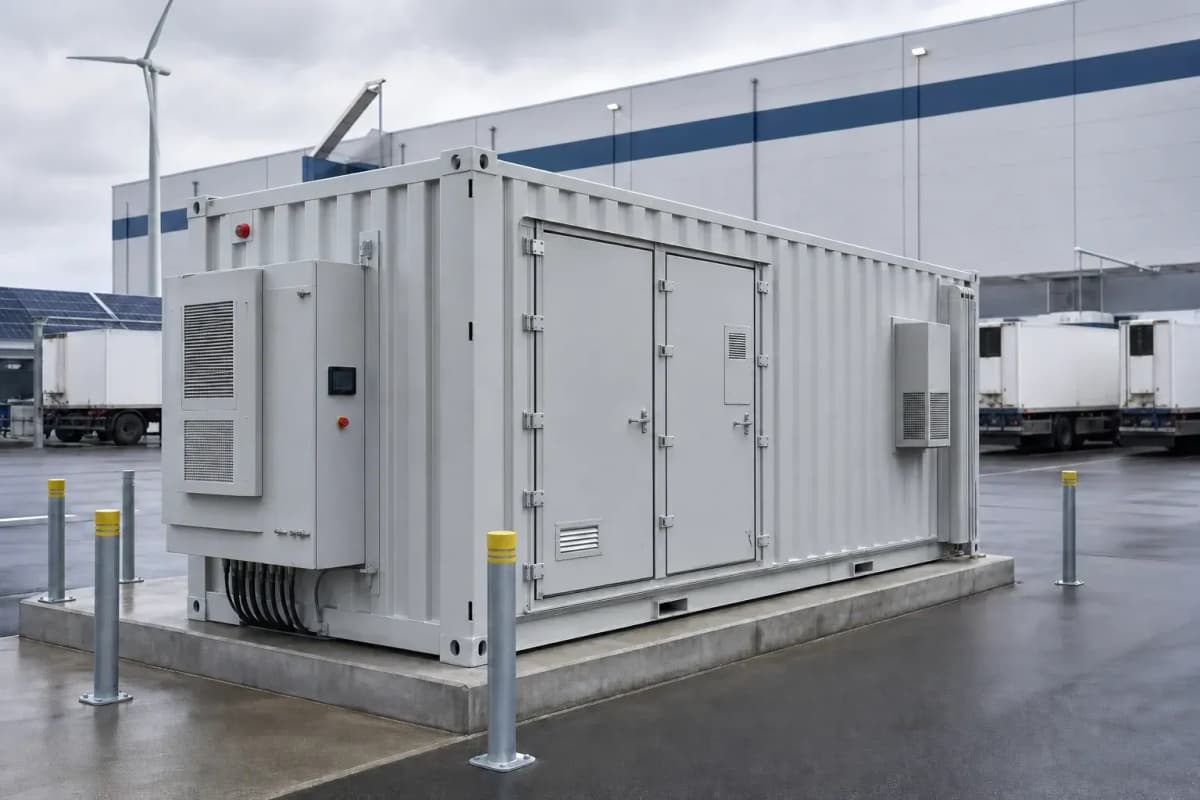
500kWh Cold Chain Logistics Hybrid LFP+Supercap - 1000kW 20ft BESS
Key Features
- 500kWh nominal energy capacity with 450kWh usable storage at 90% DoD
- 1000kW bidirectional PCS delivers a 2.0C power-to-energy ratio for cold-chain surge loads
- Hybrid LFP + supercapacitor architecture responds in less than 20ms to compressor inrush events
- 20ft containerized BESS includes HVAC, EMS, BMS, fire suppression, and gas detection
- EPC turnkey range is $68,900 to $95,600, equal to about $138/kWh to $191/kWh
500kWh Cold Chain Logistics Hybrid LFP+Supercap is a 1000kW, 20ft containerized BESS for refrigerated warehouses, trailer yards, and logistics hubs requiring sub-20ms peak response. The system combines 500kWh LFP energy capacity, supercapacitor burst power, 90% DoD, 1.5 daily cycles, UL 9540A-tested safety architecture, and EPC turnkey pricing from $68,900 to $95,600.
Description
The 500kWh Cold Chain Logistics Hybrid LFP+Supercap is a 500kWh battery energy storage system with a 1000kW bidirectional PCS, a 2C continuous power profile, and sub-20ms supercapacitor response for refrigeration continuity. Built as a 20ft containerized BESS, it supports 90% depth of discharge, 1.5 daily cycles, grid-tied operation, and island-mode backup for cold rooms, reefer yards, food distribution centers, and pharmaceutical logistics sites.
SOLARTODO positions this 500kWh hybrid system for B2B buyers who need both 500kWh of usable energy and 1000kW of short-duration power stabilization in 1 integrated container. In a cold chain site with 8 to 40 compressors, 2 to 6 dock areas, and 24-hour temperature control, the supercapacitor layer absorbs fast motor starts while the LFP battery supplies longer backup energy. View all Battery Energy Storage System (BESS) products for adjacent 200kWh to 2MWh options.
System Architecture
The architecture uses 3 functional layers: LFP battery racks for 500kWh energy storage, a supercapacitor bank for high-power pulses under 20ms, and a 1000kW bidirectional power conversion system for grid-forming or grid-following control. This split reduces peak stress on LFP cells by approximately 20% to 40% compared with a conventional LFP-only system serving compressor inrush loads, while preserving 450kWh usable capacity at 90% DoD.
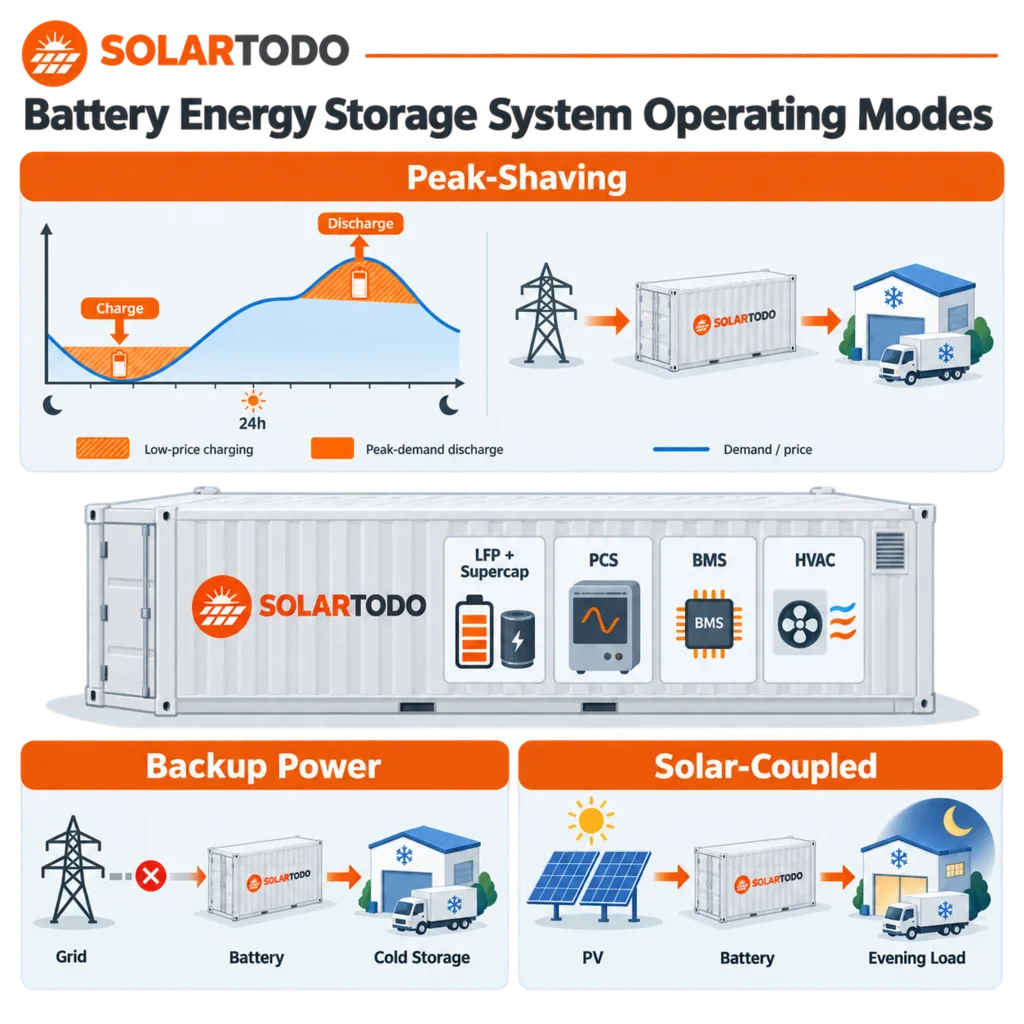
The 20ft container includes battery racks, DC protection, HVAC or liquid thermal management, fire detection, gas detection, aerosol or clean-agent suppression, insulation, lighting, emergency stop circuits, and 1 EMS cabinet. The PCS efficiency target is above 96%, so a 500kWh charge-discharge event typically returns more than 480kWh before auxiliary consumption, depending on site temperature, compressor cycling, and transformer loading.
The supercapacitor subsystem is sized for fast transients rather than long-duration energy, which makes it suitable for 1-second to 60-second events such as compressor starts, voltage sags, feeder switching, and grid-reconnection steps. Compared with a diesel generator that may take 10 to 30 seconds to start and synchronize, the hybrid BESS can bridge power quality events in less than 20ms and reduce spoilage risk during short outages.
Technical Specifications
The nominal energy capacity is 500kWh, the rated power is 1000kW, and the power-to-energy ratio is 2.0C, which is higher than typical 0.25C to 1.0C commercial storage systems. The specified 1.5 daily cycles equal about 750kWh of daily throughput, or about 273,750kWh per year before efficiency losses, making the design appropriate for peak shaving, demand charge reduction, and short outage ride-through.
The chemistry is a hybrid of lithium iron phosphate and supercapacitor modules. LFP is selected because the IEA reported that LFP represented about 80% of new battery storage in 2023 and has lower flammability than nickel-rich chemistries, while supercapacitors provide very high cycle tolerance for short power pulses (IEA, 2024: https://www.iea.org/reports/batteries-and-secure-energy-transitions). This chemistry mix is engineered for 6,000+ battery cycles and 500,000+ supercapacitor pulse events under controlled operating limits.
The expected operating temperature range is -20°C to +50°C with container HVAC, derating logic, and thermal protection. For cold-chain facilities at 2°C to 8°C chilled storage or -18°C to -25°C frozen storage, the BESS does not cool the cargo directly; it maintains electrical supply to compressors, evaporator fans, controls, and monitoring systems. A typical 50kW refrigeration load can be supported for about 9 hours at 450kWh usable energy before reserve settings.
The BMS monitors SOC, SOH, cell voltage, current, rack temperature, insulation resistance, contactor status, and fault events at intervals measured in seconds. The EMS can prioritize 4 operating modes: peak shaving, backup reserve, solar self-consumption, and power quality stabilization. Learn about topic for additional technical notes on LFP battery degradation, BESS sizing, and commercial energy-storage controls.
Cold Chain Operating Logic
Cold chain logistics has 3 electrical requirements that standard backup designs often treat separately: uninterrupted refrigeration, compressor-start surge capacity, and auditable temperature data. This 500kWh system integrates those functions by holding a configured backup reserve, supporting 1000kW of PCS power, and exporting operating data through Modbus TCP, RS485, Ethernet, or cloud APIs to temperature monitoring platforms.
For a representative MENA refrigerated warehouse scenario, assume 300kW average daytime demand, 650kW compressor-start peaks, a $22/kW monthly demand charge, and 1.5 BESS cycles per day. If the BESS clips 250kW of monthly peak demand and shifts 450kWh per day from high-tariff hours, annual savings can reach about $28,000 to $42,000 before site-specific taxes, fuel prices, and outage-cost assumptions.
For a 500kWh system used as backup, the practical reserve policy matters more than the nameplate rating. A logistics operator may hold 30% reserve, equal to 150kWh nominal or 135kWh usable at 90% DoD, while using the remaining 315kWh usable for daily peak shaving. This 2-mode dispatch strategy protects 2 to 3 hours of critical refrigeration load at 50kW to 70kW while still reducing utility bills.
Cloud Monitoring
Cloud monitoring uses 1 EMS gateway, 4G or Ethernet connectivity, local data buffering, role-based logins, and alarm escalation for SOC, temperature, smoke, gas, door status, PCS alarms, and grid status. A cold-chain operator can configure alarms at 5%, 10%, and 20% SOC reserve thresholds, and temperature events can be correlated with electrical outages for compliance records in food, vaccine, and pharmaceutical logistics.
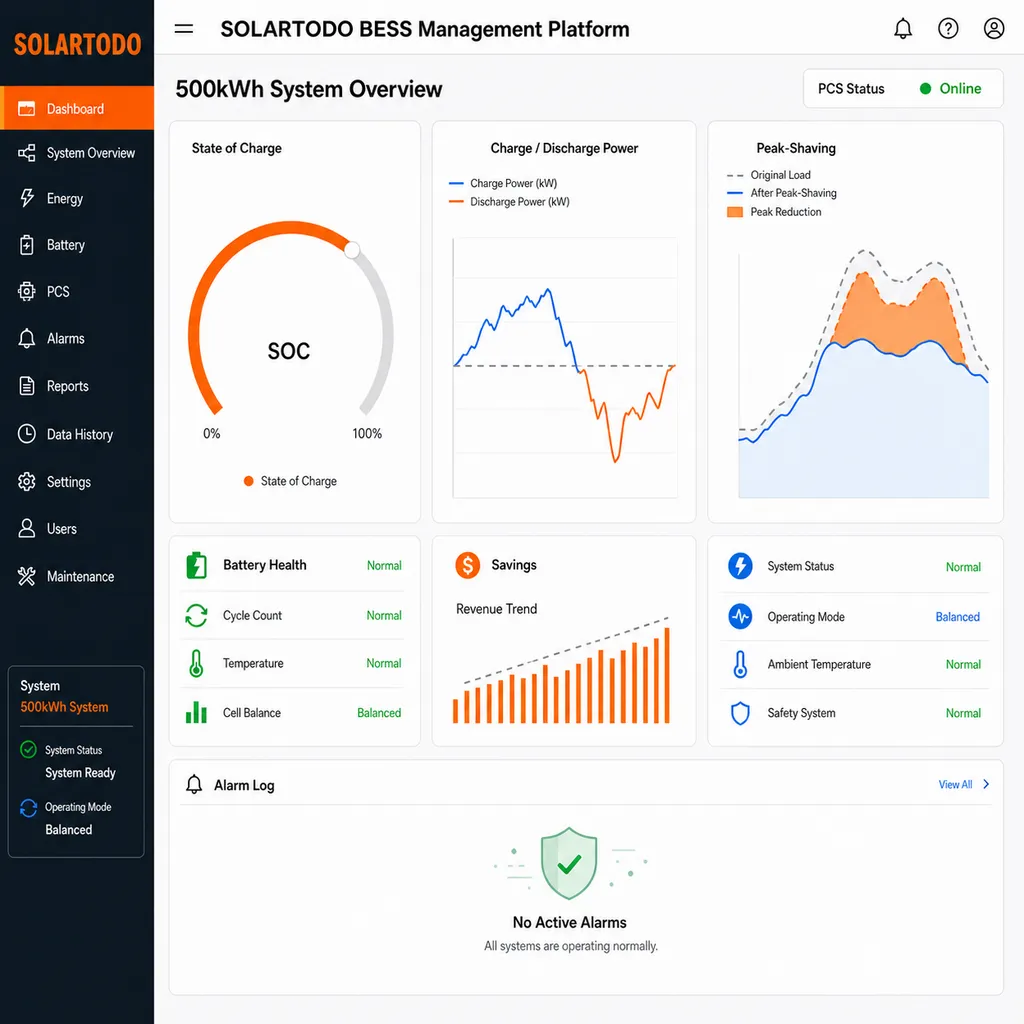
Data retention can be configured for 30, 90, or 365 days, depending on local IT policy and cybersecurity requirements. The system supports remote firmware management, but critical safety settings remain protected by local authorization, 2-level permissions, and commissioning records. Configure your system online to align battery reserve, PCS rating, enclosure configuration, and monitoring options with a specific cold-chain load profile.
Safety, Codes, and Standards
The safety basis references UL 9540 for complete energy storage systems and UL 9540A for thermal runaway fire-propagation evaluation, with UL noting that UL 9540 covers integrated ESS electrical, electrochemical, mechanical, control, communication, and fluid systems (UL Solutions, 2026: https://www.ul.com/services/energy-storage-system-testing-and-certification). The container is designed around 3 protective levels: BMS fault prevention, electrical isolation and shutdown, and fire/gas detection with automatic suppression.
IEC 62619:2022 covers safety requirements and tests for secondary lithium cells and batteries used in industrial applications, including stationary electrical energy storage systems (IEC, 2022: https://webstore.iec.ch/en/publication/64073). NFPA 855:2026 provides installation guidance for stationary energy storage systems, including chapters for commissioning, operation, maintenance, electrochemical ESS, and lithium-ion battery storage (NFPA, 2026: https://link.nfpa.org/all-publications/855/2026).
For transport and logistics, UN38.3 testing is used for lithium battery shipment qualification, while project interconnection may require IEEE 1547-aligned inverter functions in North American contexts. Site-level compliance still depends on 4 external factors: local fire code, utility interconnection rules, insurance requirements, and AHJ review. SOLARTODO supplies documentation packages for product datasheets, single-line diagrams, commissioning checklists, and O&M manuals.
Performance and Degradation
At 1.5 daily cycles and 90% DoD, annual equivalent full cycles are about 548 cycles, which places a 10-year operating period near 5,480 equivalent cycles. The warranty template is 10 years or 70% remaining capacity, subject to temperature, C-rate, calendar aging, and throughput limits. Supercapacitors reduce high-current battery pulses, which can lower thermal stress during frequent compressor starts.
Round-trip efficiency is specified at approximately 88% to 92% at system level after PCS and auxiliary consumption, with PCS conversion above 96% under rated conditions. For a site cycling 750kWh per day, annual AC energy processed can reach about 273MWh, and a 90% round-trip efficiency would imply about 27MWh of annual conversion losses. These figures should be modeled against the actual tariff interval, often 15 minutes or 30 minutes.
The IRENA 2025 renewable cost report states that battery storage project costs fell 93% from 2010 to 2024 and reached about $192/kWh for fully installed utility-scale projects in 2024 (IRENA, 2025: https://www.irena.org/Digital-Report/Renewable-Power-Generation-Costs-in-2024). This 500kWh system's EPC range of $68,900 to $95,600 equals about $138/kWh to $191/kWh, which is consistent with aggressive containerized supply economics for China-origin commercial systems, excluding special civil works or major grid upgrades.
Applications
Primary applications include 5 categories: refrigerated warehouses, reefer-container yards, food-processing cold rooms, pharmaceutical distribution centers, and airport or port logistics facilities. In each case, the BESS can be connected behind the meter at 400V, 480V, or medium-voltage through a transformer, depending on site electrical architecture and local code. The 1000kW PCS rating is most useful where peak demand is short, sharp, and expensive.
Secondary applications include EV charging support, microgrid backup, PV smoothing, frequency response, and power-quality stabilization. A 500kWh battery alone can be undersized for long outages above 200kW, but the hybrid supercap architecture is highly effective for milliseconds-to-minutes disturbances. Compared with a conventional 500kWh LFP-only BESS, the hybrid version can reduce battery peak-current exposure by 20% to 40% when loads have frequent surge events.
EPC Investment Analysis and Pricing Structure
EPC turnkey delivery includes 5 scopes: engineering, procurement, construction, commissioning, and 1-year warranty support. Engineering covers load review, single-line drawings, container layout, protection coordination, and EMS settings; procurement covers battery racks, PCS, BMS, EMS, enclosure, HVAC, fire suppression, and cabling; construction covers placement, electrical connection, grounding, and communications; commissioning covers FAT/SAT records, functional tests, island-mode checks, and operator training.
| Pricing tier | Scope | Price range |
|---|---|---|
| FOB Supply | Equipment only, ex-works China | $42,718 - $65,008 |
| CIF Delivered | FOB plus ocean freight and insurance | $51,415 - $78,244 |
| EPC Turnkey | Installed, commissioned, and 1-year warranty | $68,900 - $95,600 |
| Volume band | Discount from quoted equipment price | Typical use case |
|---|---|---|
| 50+ systems | 5% | Regional cold-chain rollout across 50 depots |
| 100+ systems | 10% | National logistics or utility program with 100 sites |
| 250+ systems | 15% | Framework procurement for 250 distributed assets |
A representative ROI model uses $82,900 midpoint EPC cost, $35,000 annual savings, and 90% usable DoD, producing a simple payback of about 2.4 years. Savings can combine demand-charge reduction, diesel runtime reduction, tariff arbitrage, reduced refrigeration downtime, and improved PV self-consumption. Compared with a diesel-only backup strategy consuming 20 to 40 liters per operating hour, the BESS reduces fuel burn during short outages by up to 100% when sufficient SOC is available.
Payment terms are 30% T/T deposit plus 70% against B/L, or 100% irrevocable L/C at sight for qualified buyers. Project financing can be discussed for projects above $5,000K, subject to jurisdiction, credit review, technical due diligence, and bankability documentation. For site-specific pricing, grid-code requirements, and delivery schedules, Request a custom quotation or contact [email protected].
Procurement Notes
Buyers should specify 8 inputs before final quotation: site voltage, maximum demand, compressor starting profile, backup autonomy target, PV capacity, ambient temperature, fire-code jurisdiction, and communications protocol. A 500kWh/1000kW BESS can be electrically straightforward at many C&I sites, but transformer capacity, short-circuit rating, grounding, harmonics, and protection settings must be checked before shipment.
Factory acceptance testing typically includes 10 checks: visual inspection, insulation resistance, BMS communication, PCS function, EMS dispatch, fire-alarm signal, HVAC operation, emergency stop, charge-discharge test, and documentation review. Site acceptance testing should include at least 3 operating cases: grid-tied charge, peak shaving discharge, and island-mode transfer to critical refrigeration loads.
Market Context
Global battery deployment has accelerated because storage helps integrate solar and wind, improves energy security, and reduces fossil fuel exposure. The IEA reported 42GW of battery storage additions in 2023, and IRENA reported 169GWh of gross battery storage additions in 2024, with China and the United States representing the 2 largest markets. BloombergNEF data cited by IRENA indicates that 2-hour and 4-hour turnkey battery-storage system prices declined sharply in 2024.
For cold-chain logistics, the financial case is not limited to energy arbitrage; it includes avoided product loss, reduced generator starts, lower demand charges, and better operational data. A single frozen-storage incident can affect pallets valued from $10,000 to more than $250,000, so a 500kWh BESS may be justified by resilience even when pure tariff arbitrage is moderate. Final sizing should use 12 months of interval data whenever available.
SOLARTODO Supply Position
SOLARTODO supplies solar, energy storage, smart lighting, security, telecom power towers, and smart agriculture infrastructure through integrated B2B procurement workflows. This product is part of the energy-storage line and can be configured with 500kWh nominal capacity, 1000kW PCS power, 20ft container form factor, 90% DoD control, 1.5 daily-cycle planning, and optional temperature-monitoring integration.
The recommended procurement route is to begin with 15-minute load data for at least 30 days, then validate compressor-start transients, backup reserve requirements, and local code constraints. With those inputs, SOLARTODO can provide a bill of materials, delivery plan, commissioning sequence, and EPC scope aligned to the $68,900 to $95,600 turnkey range, excluding unusual civil works, taxes, utility upgrades, or site-specific permitting fees.
Technical Specifications
| Energy Capacity | 500kWh |
| Power Rating | 1000kW |
| Battery Chemistry | Hybrid LFP + Supercapacitor |
| Form Factor | 20ft containerized BESS |
| Application | Cold chain logistics and refrigeration backup |
| Round-trip Efficiency | 90% |
| Depth of Discharge | 90% |
| Daily Cycles | 1.5cycles/day |
| Discharge Capability | 2-4C |
| Response Time | <20ms |
| Cycle Life | 6000+cycles |
| Calendar Life | 10years |
| Operating Temperature | -20 to 50°C |
| PCS Efficiency | >96% |
| Usable Energy at 90% DoD | 450kWh |
| Annual Savings | 35000USD/year |
| Payback Period | 2.4years |
| Warranty | 10 years / 70% capacity |
Price Breakdown
| Item | Quantity | Unit Price | Subtotal |
|---|---|---|---|
| LFP battery cell pack allocation | 500 kWh | $55 | $27,500 |
| Supercapacitor pulse-power module bank | 1 pcs | $8,500 | $8,500 |
| Battery management system with rack monitoring | 500 kWh | $15 | $7,500 |
| 1000kW bidirectional PCS package | 1 pcs | $18,500 | $18,500 |
| 20ft container enclosure with HVAC and wiring | 1 pcs | $8,000 | $8,000 |
| Fire suppression, gas detection, and auto-shutdown | 1 pcs | $5,000 | $5,000 |
| EMS software and cloud monitoring gateway | 1 pcs | $3,000 | $3,000 |
| Engineering, QC, and documentation | 1 pcs | $3,900 | $3,900 |
| Installation and commissioning | 1 pcs | $6,000 | $6,000 |
| 1-year warranty and remote support | 1 pcs | $3,000 | $3,000 |
| Total Price Range | $68,900 - $95,600 | ||
Frequently Asked Questions
What makes this 500kWh BESS suitable for cold chain logistics?
How long can the system support refrigeration during an outage?
What does the EPC turnkey price include?
Which standards apply to this hybrid LFP + supercapacitor BESS?
How is ROI calculated for a refrigerated warehouse?
Certifications & Standards

Data Sources & References
- •IEA, Batteries and Secure Energy Transitions, 2024, https://www.iea.org/reports/batteries-and-secure-energy-transitions
- •IRENA, Renewable Power Generation Costs in 2024, 2025, https://www.irena.org/Digital-Report/Renewable-Power-Generation-Costs-in-2024
- •UL Solutions, Energy Storage System Testing and Certification, 2026, https://www.ul.com/services/energy-storage-system-testing-and-certification
- •IEC 62619:2022, https://webstore.iec.ch/en/publication/64073
- •NFPA 855:2026, https://link.nfpa.org/all-publications/855/2026
- •BloombergNEF battery storage cost data as cited by IRENA 2025
Interested in this solution?
Contact us for a customized quote based on your specific requirements.
Contact Us