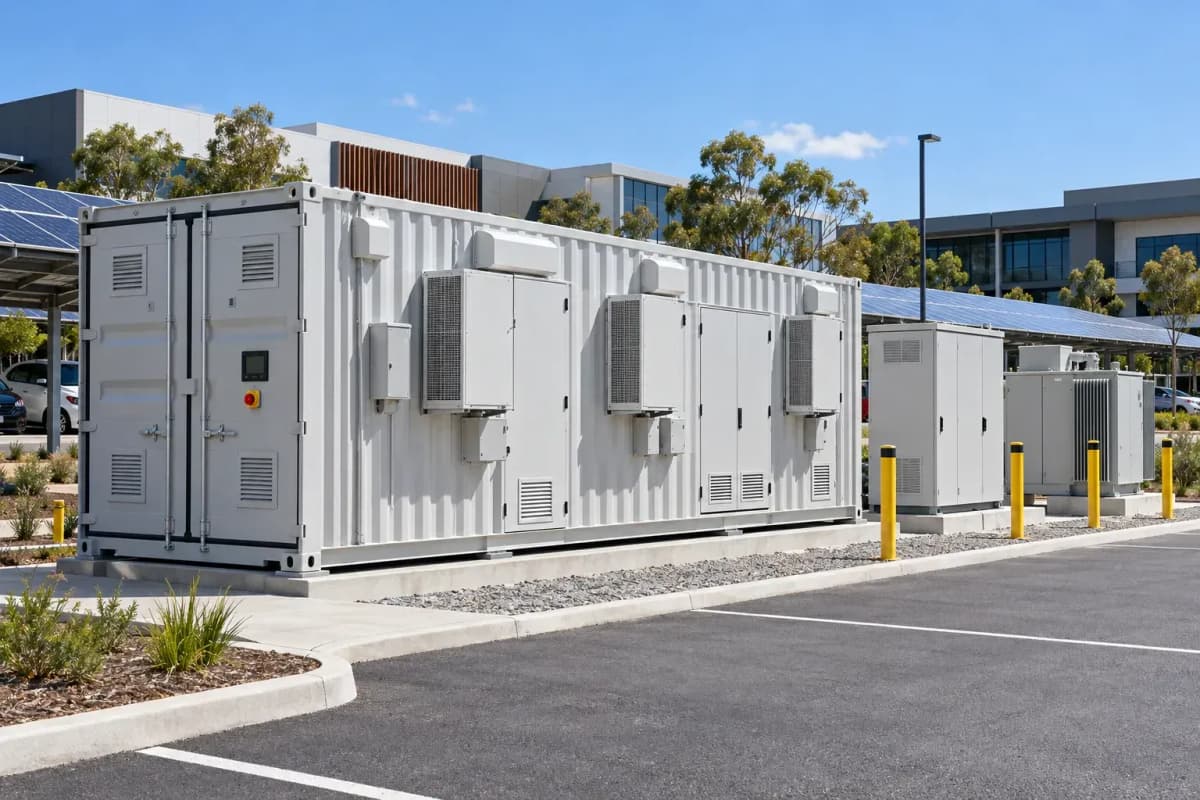
3MWh Commercial Complex Hybrid LFP+Supercap - 1,500kW Containerized BESS
Key Features
- 3,000kWh nominal storage with 2,700kWh calculated usable DC energy at 90% depth of discharge.
- 1,500kW continuous rated power, equivalent to a 0.5C system energy-to-power ratio.
- 40ft containerized hybrid architecture combining LFP energy storage and supercapacitor power buffering.
- Below-20ms fast-control response target, subject to subsystem-specific acceptance testing.
- Indicative EPC investment of $345,600–$417,067, including the stated 1-year warranty.
The SOLARTODO 3MWh Commercial Complex Hybrid LFP+Supercap combines 3,000kWh nominal storage with 1,500kW rated power in a 40ft containerized configuration. At 90% depth of discharge, calculated usable DC energy is 2,700kWh; indicative EPC turnkey pricing is $345,600–$417,067.
Description
The 3MWh Commercial Complex Hybrid LFP+Supercap is a containerized battery energy storage system combining 3,000kWh nominal energy, 1,500kW rated power, and lithium iron phosphate batteries with a supercapacitor subsystem. Configured for 1 daily cycle and 90% depth of discharge, it provides a calculated 2,700kWh usable DC energy window for commercial solar self-consumption, demand management, and engineered backup applications.
The 40ft configuration separates sustained energy delivery from short-duration power buffering: LFP batteries supply the energy reserve, while supercapacitors accommodate selected rapid fluctuations. Indicative EPC investment is $115.20–$139.02 per nominal kWh, based on the supplied $345,600–$417,067 range. These are budgetary project figures; the final offer must identify equipment models, supercapacitor sizing, site conditions, certification evidence, and contractual performance guarantees.
System Architecture
The 3,000kWh architecture comprises LFP battery racks, a supercapacitor bank, coordinated power electronics, battery management, an energy management system, cooling, protection, and electrical distribution. A bidirectional PCS provides the specified 1,500kW interface. The transformer and switchgear belong within the integrated project scope, although final drawings must establish whether every assembly fits inside the 40ft enclosure or requires an adjacent service area.
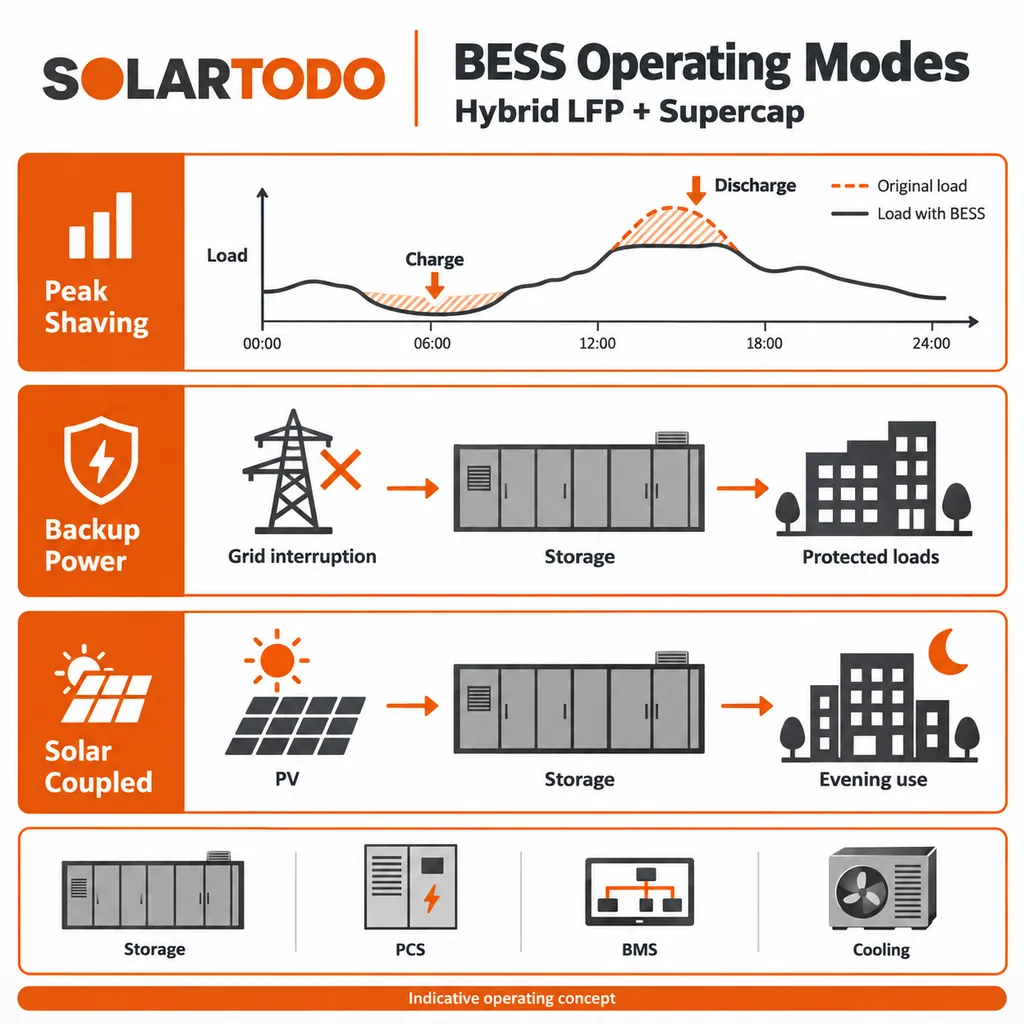
The hybrid controller assigns slower energy movements to the LFP subsystem and faster power variations to the supercapacitor subsystem. A response target below 20ms applies to the specified fast-control function, subject to verification. It does not establish a universal transfer time for commercial loads: measurement latency, converter response, protection coordination, and the point at which response is measured must all appear in the acceptance procedure.
The continuous system rating is 0.5C, calculated as 1,500kW divided by 3,000kWh. Generic references to 2–4C hybrid discharge capability cannot establish this configuration's continuous output. Any additional pulse capability requires a separately documented supercapacitor power rating, usable energy, pulse duration, recovery interval, and PCS overload envelope. Buyers should specify those parameters before procuring frequency-response or motor-starting functionality.
Technical Specifications and Energy Boundaries
The 3,000kWh nameplate describes nominal stored energy, while the 90% operating window yields 2,700kWh before discharge-path losses and auxiliary consumption. Dividing this usable DC quantity by 1,500kW gives 1.8 hours as an idealized energy-to-power calculation. Actual AC runtime will be lower and depends on discharge efficiency, cooling demand, ambient temperature, battery condition, and the operational reserve retained by the controller.
| Parameter | Configuration or procurement requirement |
|---|---|
| Nominal energy | 3,000kWh |
| Rated power | 1,500kW |
| Storage architecture | LFP batteries plus supercapacitors |
| Scheduled cycling | 1 cycle per day |
| Depth of discharge | 90% |
| Calculated usable DC energy | 2,700kWh |
| Nominal energy-to-power ratio | 2 hours |
| Usable DC energy-to-power ratio | 1.8 hours |
| Container format | 40ft ISO configuration |
| PCS efficiency | Greater than 96% design target; verify operating point |
| Fast-control response | Below 20ms target; verify subsystem and measurement boundary |
| Thermal management | Liquid cooling for battery subsystem |
PCS efficiency above 96% describes a conversion operating point rather than complete AC round-trip efficiency. Charging, discharging, supercapacitor conversion, cooling, and standby operation contribute additional losses. For context, the NREL 2024 Annual Technology Baseline adopts an 85% representative round-trip efficiency for its residential storage model. That benchmark illustrates the importance of explicit assumptions; it is not a measured result for this 3MWh product.
At 1 cycle per day, the operating schedule represents 365 cycles annually and approximately 3,650 cycles over 10 years. Neither figure establishes warranted cycle life. Calendar life, retained capacity, and cycling endurance require supplier-backed curves specifying temperature, discharge rate, SOC window, and throughput. The generic 10-year/70%-capacity template must therefore be negotiated separately from the stated EPC package's 1-year warranty.
Commercial Applications and Hybrid Comparison
For a commercial complex, the 1,500kW PCS can support coordinated dispatch across retail premises, offices, parking infrastructure, HVAC equipment, and selected critical services. Solar charging can move surplus daytime generation into later consumption periods. Demand management can reduce imported power during tariff measurement intervals, but realizable savings depend on the site's load profile, export rules, available charging energy, and contracted demand methodology.
Compared with conventional LFP-only storage, the hybrid design introduces a second power-buffering resource rather than automatically increasing sustained energy capacity. In an illustrative control allocation, a 500kW, 10-second transient contains approximately 1.39kWh. If the supercapacitor subsystem supplies the full event, the LFP branch's contribution to that specific transient falls by 100%; this does not imply a 100% reduction in total battery cycling or degradation.
Selecting hybrid storage should therefore follow a comparison of at least 2 alternatives: a conventional 3MWh LFP system and the proposed LFP-plus-supercapacitor system. Compare installed cost, measured transient duty, auxiliary consumption, maintenance, and supported warranties. The IRENA storage cost and market study to 2030 provides technology-level context, while project selection still requires a current supplier proposal and site-specific operating model.
Cloud Monitoring
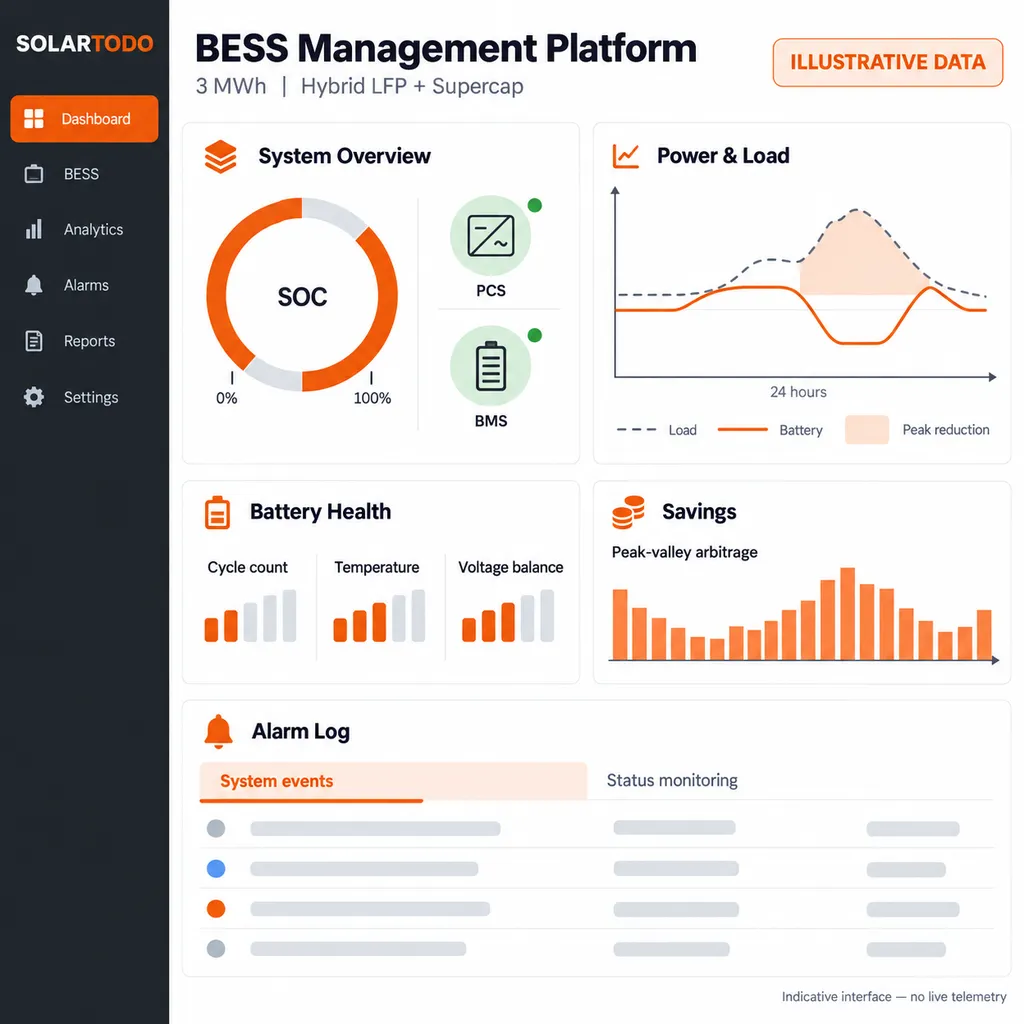
The monitoring scope should cover at least 6 operating categories: SOC, SOH, battery temperature, PCS power, supercapacitor condition, and protective alarms. Procurement documents should distinguish local controls from optional cloud services and specify data ownership, retention, communication interfaces, and user permissions. Remote dashboards support engineering analysis, while protective actions and time-critical power control must remain available locally when the external communication link fails.
A practical reporting specification can request 1-minute operational trends alongside higher-resolution event records for transient investigation. These are recommended procurement settings rather than confirmed platform capabilities. Interval energy reports should reconcile charging, discharge, and auxiliary consumption at defined meters. Engineers can Learn about topic before selecting data resolution and reporting boundaries for the 3,000kWh installation.
Safety, Standards, and Interconnection
The battery safety procurement baseline should reference IEC 62619:2022, which specifies safety requirements and tests for industrial secondary lithium cells and batteries, including stationary applications. Compliance must be supported by documentation for the actual supplied battery model. A 3,000kWh system description alone does not establish certified status, and a certificate for one component does not automatically cover the complete hybrid assembly.
For projects requiring North American approval, UL's energy storage certification guidance distinguishes UL 9540 system safety requirements from UL 9540A thermal-runaway fire-propagation testing. Request the applicable listing and test reports for the proposed configuration. Neither a generic claim of UL 9540A testing nor a report for a different enclosure establishes approval for this 40ft installation; NFPA 855 requirements also depend on the installation jurisdiction.
The proposed safety concept uses 3 coordinated layers: early detection, electrical isolation, and suppression or emergency response. Gas and temperature sensing should initiate defined alarm and shutdown sequences. Suppression medium, ventilation, emergency access, drainage, and separation distances require the selected equipment's hazard assessment and local approval. UN 38.3 transport evidence should also be requested for the supplied lithium battery configuration before international shipment.
For applicable United States interconnections, IEEE 1547-2018 provides requirements concerning distributed-resource interconnection and interoperability. Other markets require their own utility rules. Grid-tied operation, island operation, black start, and resynchronization must be specified individually: a 1,500kW bidirectional PCS does not establish every function automatically. Protective settings and switching arrangements require approval by the relevant utility and project engineer.
Representative Commercial Complex Scenario
Representative scenario—not a customer reference: consider a MENA commercial complex scheduling 1 cycle per day, with sufficient solar surplus or off-peak supply to charge the 2,700kWh operating window. Assume 90% AC round-trip efficiency solely for this simplified model, with charging and discharge energy boundaries normalized for calculation. Annual charging is 985,500kWh, and modeled annual AC delivery is 886,950kWh; actual metered performance requires equipment-specific validation.
Assume an avoided purchase price of $0.20/kWh and a charging-energy opportunity cost of $0.06/kWh. Annual delivered-energy value is $177,390, charging cost is $59,130, and the resulting energy margin is $118,260. Charging from solar is not treated as free: its opportunity cost may reflect export revenue or another alternative use. The calculation excludes taxes, financing, degradation, and abnormal downtime.
Add an illustrative 500kW reduction in monthly billed demand at $12/kW-month, producing $72,000 annually, and deduct a provisional $6,000 annual operating allowance. Modeled net annual benefit becomes $184,260. This assumes the same dispatch schedule can achieve both energy shifting and demand reduction without double-counting capacity. Confirm feasibility using interval simulation and the actual tariff before relying on these values for investment approval.
EPC Investment Analysis and Pricing Structure
EPC covers engineering, procurement, construction, commissioning, and the stated 1-year warranty. For the 3MWh configuration, engineering should define electrical interfaces, protection, civil requirements, thermal operation, and control logic; procurement should identify the approved equipment schedule; construction should cover the contracted installation works. Commissioning should verify operating modes, alarms, metering, and handover documentation against measurable acceptance criteria agreed before purchase.
| Pricing tier | Indicative total, USD | Scope boundary |
|---|---|---|
| FOB Supply | $214,272–$283,606 | Equipment supply; confirm named loading port |
| CIF Delivered | $257,898–$341,348 | Equipment, ocean freight, and insurance to named destination port |
| EPC Turnkey | $345,600–$417,067 | Agreed engineering, procurement, construction, commissioning, and 1-year warranty |
The 3 pricing tiers require explicit contractual boundaries. FOB and ex-works are different delivery arrangements, so the equipment-only commercial schedule must name the agreed term and location. CIF does not automatically include inland transport, import clearance, duties, or installation. EPC allowances depend on local access, foundations, cable routes, transformer interfaces, and utility requirements; exclusions must be identified before the quoted investment becomes contractual.
| Volume threshold | Indicative discount | Equivalent nominal storage |
|---|---|---|
| 50+ systems | 5% | 150MWh+ |
| 100+ systems | 10% | 300MWh+ |
| 250+ systems | 15% | 750MWh+ |
The 5%, 10%, and 15% volume discounts are indicative purchasing assumptions requiring a written commercial offer. They should apply only to the agreed eligible supply value; freight, taxes, site works, and third-party charges may be excluded. For example, 5% of a $260,000 eligible equipment package equals $13,000. Buyers should confirm delivery phasing, specification consistency, and whether discounts can be combined with other commercial arrangements.
Using the representative $184,260 annual benefit, simple payback across the supplied EPC range is approximately 1.88–2.26 years. At the illustrative $380,000 budget, payback is approximately 2.06 years and annual benefit divided by initial investment is 48.5%. These are undiscounted scenario calculations rather than guaranteed returns or an internal rate of return; a finance model must include degradation, replacement, taxation, financing, and residual value.
For sensitivity, halving both the $118,260 energy margin and $72,000 demand benefit while retaining $6,000 annual operating cost reduces net benefit to $89,130 per year. Simple payback then becomes approximately 3.88–4.68 years. Compare a conventional LFP alternative using the same tariff, service requirements, and study period; no verified alternative quotation has been supplied, so a defensible percentage reduction in installed cost cannot be stated.
The accompanying $380,000 breakdown is an illustrative package-level allocation, not an independently quoted component bill of materials. Its $260,000 integrated equipment allowance covers the hybrid storage package, PCS, cooling, protection, container, transformer, switchgear, and EMS without separately pricing their internal components. The supplied generic cell, BMS, PCS, and liquid-cooling benchmarks alone total $405,000, demonstrating why those standalone averages cannot substantiate this complete EPC budget. Reconciliation against an actual integrated supplier quotation is required.
Payment options are 30% T/T plus 70% against B/L, or 100% L/C at sight, subject to the signed agreement. EPC construction and acceptance milestones should be reconciled with the equipment shipping schedule. Financing may be considered for projects above $5,000,000, subject to lender eligibility and underwriting. Send technical schedules, delivery location, tariff data, and requested warranty terms to [email protected].
Procurement and Acceptance
For the 1,500kW installation, require acceptance records covering continuous power, usable energy, efficiency boundaries, supercapacitor pulse performance, control response, and protective shutdowns. The test plan should identify ambient conditions, starting SOC, auxiliary loads, meter accuracy, and pass criteria. Acceptance must also distinguish factory testing from site commissioning; successful subsystem tests do not establish commercial-building backup performance without testing the agreed load and switching configuration.
The IEA's 2024 battery transition analysis places stationary storage within the wider expansion of electricity-system flexibility. For this 3MWh procurement, convert that context into a project-specific specification: View all Battery Energy Storage System (BESS) products, Configure your system online, or Request a custom quotation with the load profile, interconnection requirements, and required performance evidence.
Technical Specifications
| Nominal Energy Capacity | 3000kWh |
| Power Rating | 1500kW |
| Battery Chemistry and Hybrid Architecture | Lithium iron phosphate batteries plus supercapacitors |
| Depth of Discharge | 90% |
| Calculated Usable DC Energy | 2700kWh |
| Continuous System C-Rate | 0.5C |
| Daily Cycles | 1cycle/day |
| Nominal Energy-to-Power Ratio | 2h |
| Usable DC Energy-to-Power Ratio | 1.8 before discharge losses and auxiliariesh |
| Round-trip Efficiency | Not verified; 90% assumed only for representative economic scenario% |
| PCS Efficiency | >96 design target; operating point and test evidence required% |
| Fast-Control Response | <20 target; subsystem and measurement boundary require verificationms |
| Supercapacitor Power and Energy | Not specified; requires pulse-duty sizing |
| Cycle Life | Not established; supplier endurance curves and warranty requiredcycles |
| Calendar Life | Not established; supplier specification requiredyears |
| Operating Temperature | Not specified; ambient range and derating curve required°C |
| Thermal Management | Liquid-cooled battery subsystem |
| Form Factor | 40ft ISO container configuration; final equipment layout required |
| Annual Savings | 184260 under stated representative assumptions; not guaranteedUSD/year |
| Simple Payback | 1.88–2.26 under stated representative assumptionsyears |
| EPC Warranty | 1 year; coverage subject to signed agreement |
| Proposed Extended Capacity Warranty | 10 years / 70% retained capacity only if separately contracted |
| Illustrative EPC Breakdown Total | 380000; package allocation requires supplier BOM reconciliationUSD |
Price Breakdown
| Item | Quantity | Unit Price | Subtotal |
|---|---|---|---|
| Integrated hybrid BESS equipment package — provisional allowance, not a component quotation | 1 pcs | $260,000 | $260,000 |
| Installation allowance for 3,000kWh at reference $20/kWh | 1 pcs | $60,000 | $60,000 |
| Commissioning service | 1 pcs | $5,000 | $5,000 |
| Engineering, protection coordination and quality-control allowance | 1 pcs | $20,000 | $20,000 |
| Freight, insurance and inland logistics allowance | 1 pcs | $20,000 | $20,000 |
| 1-Year Warranty and Support allowance | 1 pcs | $15,000 | $15,000 |
| Total Price Range | $345,600 - $417,067 | ||
Frequently Asked Questions
How long can the 3MWh system deliver its rated power?
What does the supercapacitor add to the LFP battery system?
What does EPC pricing include, and which warranty applies?
Is this configuration certified to IEC and UL standards?
What annual savings and payback can a commercial buyer expect?
Certifications & Standards

Data Sources & References
- •User-supplied SOLARTODO configuration and commercial ranges; no verified project references or configuration-specific certificates supplied.
- •NREL, 2024 Annual Technology Baseline, Residential Battery Storage: https://atb.nrel.gov/electricity/2024/residential_battery_storage
- •IEC, IEC 62619:2022: https://webstore.iec.ch/en/publication/64073
- •UL Solutions, Energy Storage System Testing and Certification: https://www.ul.com/services/energy-storage-system-testing-and-certification
- •IEEE Standards Association, IEEE 1547-2018: https://standards.ieee.org/ieee/1547/5915/
- •IRENA, Electricity Storage and Renewables: Costs and Markets to 2030, 2017: https://www.irena.org/publications/2017/Oct/Electricity-storage-and-renewables-costs-and-markets
- •IEA, Batteries and Secure Energy Transitions, Executive Summary, 2024: https://www.iea.org/reports/batteries-and-secure-energy-transitions/executive-summary
Interested in this solution?
Contact us for a customized quote based on your specific requirements.
Contact Us