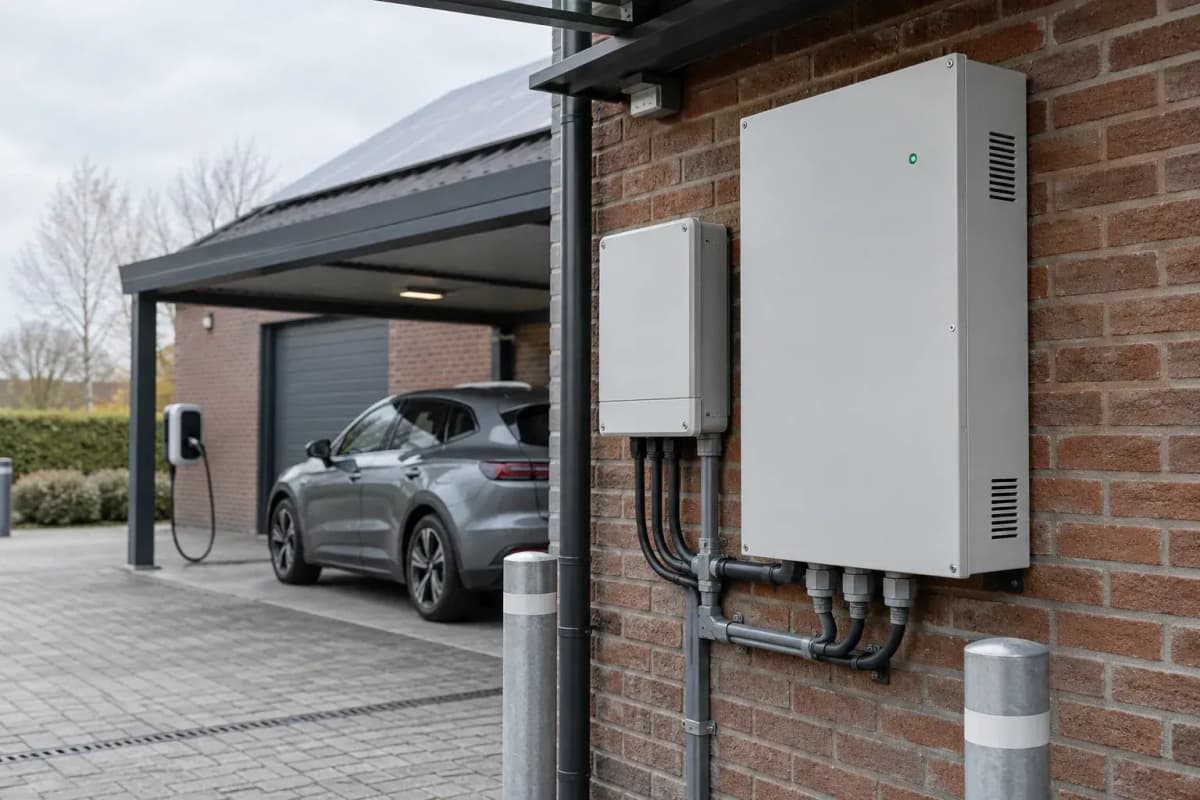
10kWh EV Charging Buffer LFP - 5kW Wall-Mount BESS
Key Features
- 10kWh LFP battery capacity with 8.5kWh usable energy at 85% DoD
- 5kW bidirectional PCS for EV charging peak shaving and load shifting
- 1.5 daily cycles supports about 12.75kWh/day of storage throughput
- 6,000+ cycle LFP design with 10-year / 70% capacity warranty basis
- EPC turnkey price range of $2,000-$2,400 with 50+ unit discounts from 5%
The 10kWh EV Charging Buffer LFP is a 5kW wall-mount battery energy storage system for small EV charging sites that need peak shaving, load shifting, and grid-connection relief. It uses LFP cells, 85% depth of discharge, 1.5 daily cycles, bidirectional PCS control, and EPC turnkey pricing of $2,000-$2,400.
Description
The 10kWh EV Charging Buffer LFP is a 5kW wall-mount battery energy storage system designed to buffer small EV charging loads, reduce grid peak demand, and support approximately 8.5kWh usable discharge at 85% depth of discharge. With LFP chemistry, 1.5 daily cycles, and an EPC turnkey price range of $2,000-$2,400, it gives engineers and procurement teams a compact 2-hour storage block for residential compounds, small commercial car parks, retail chargers, and fleet depots.
This SOLARTODO unit belongs to the Battery Energy Storage System product line and is configured for sites where a 7kW, 11kW, or 22kW AC charger creates short-duration peaks that exceed contracted grid capacity. The 5kW bidirectional power conversion system charges the battery during lower-load periods and discharges during charging peaks, so a site can reduce instantaneous grid draw by up to 5kW per unit compared with a conventional direct-grid-only charger layout.
Product Definition
The 10kWh EV Charging Buffer LFP is a stationary, wall-mount BESS using lithium iron phosphate cells, a battery management system, a 5kW bidirectional inverter, air thermal management, DC protection, AC isolation, and cloud-ready monitoring. The configuration is optimized around 10kWh nameplate energy, 8.5kWh usable energy at 85% DoD, and 1.5 cycles per day, which equals about 12.75kWh of daily delivered storage service before round-trip efficiency losses.
For B2B buyers, the main design value is connection-capacity control rather than long-duration backup. A conventional charger may require the feeder, breaker, and service agreement to be sized for its maximum 1-minute or 15-minute demand, while this buffer can absorb up to 5kW of the charging load for roughly 1.7 hours at 85% usable energy. The result is a smaller grid interface, fewer upgrade discussions, and a clearer procurement scope for sites with 1-4 charge points.
System Architecture
The system architecture has 5 functional layers: LFP cell modules, BMS, PCS, local EMS, and cloud monitoring. The battery pack stores 10kWh at DC level, the BMS monitors cell voltage and temperature, the PCS converts power at more than 96% peak conversion efficiency, the EMS enforces charging rules, and the cloud layer records SOC, SOH, alarms, and 15-minute operating data for maintenance teams.
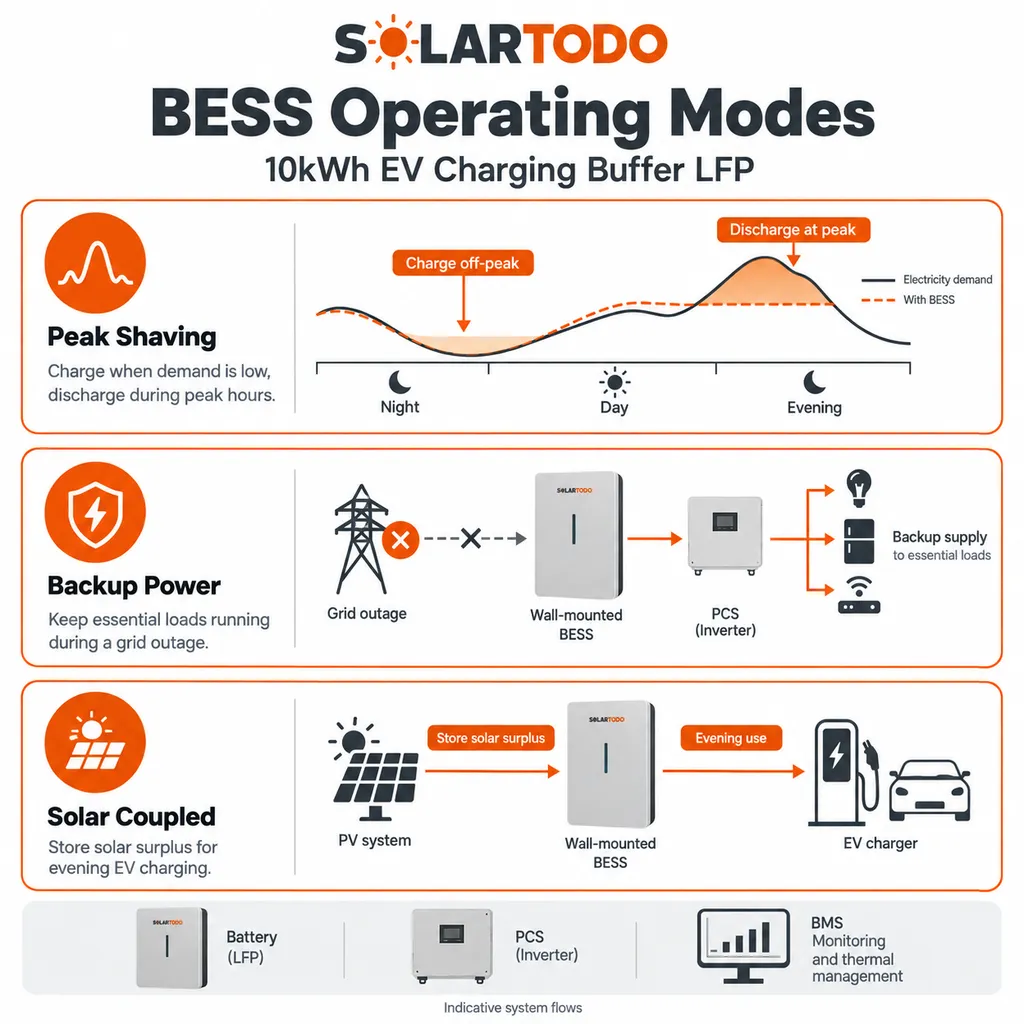
The electrical path is designed around a bidirectional PCS rather than a simple battery charger. During low-demand periods, the PCS imports up to 5kW from the grid or from a local PV inverter where permitted; during a vehicle charging peak, it exports up to 5kW to the AC bus. This 2-way topology aligns with IEC 62909-1 guidance for bidirectional grid-connected power converters up to 1,000V AC and 1,500V DC in energy-storage interfaces IEC 62909-1.
Technical Specifications
The nominal energy capacity is 10kWh, the rated AC power is 5kW, and the usable capacity is calculated as 10kWh x 0.85 = 8.5kWh. For small EV charging buffers, this 2:1 energy-to-power ratio supports peak shaving, charger smoothing, and time-of-use arbitrage without moving into the higher-cost 30kWh or 50kWh cabinet class.
| Parameter | Value | Engineering Note |
|---|---|---|
| Nominal capacity | 10kWh | LFP battery module set |
| Rated power | 5kW | Bidirectional AC PCS |
| Usable energy | 8.5kWh | 85% depth of discharge |
| Daily operating cycles | 1.5 cycles | 12.75kWh daily throughput basis |
| Round-trip efficiency | 92%-96% | Depends on load ratio and temperature |
| Cycle life | 6,000+ cycles | LFP operating profile |
| Design life | 10 years | 70% retained-capacity warranty basis |
| Operating temperature | -20°C to 55°C | Air-cooled wall-mount enclosure |
| Form factor | Wall mount | Slim cabinet for indoor or sheltered outdoor areas |
LFP chemistry is selected because it provides long cycle life, cobalt-free material composition, and stronger thermal stability than many nickel-rich lithium-ion chemistries. IEC 62619 covers safety requirements and tests for secondary lithium cells and batteries in industrial applications, including stationary energy storage, so the specification language is familiar to AHJs, EPC teams, and technical due-diligence reviewers IEC 62619.
EV Charging Buffer Operation
In a typical 5kW buffer mode, the unit charges when site load is below a preset threshold and discharges when EV charging pushes the site toward a demand limit. If a small retail site has a 15kW contracted limit and a 22kW charger, a 10kWh buffer can reduce the measured grid draw by 5kW during the highest-load interval, which can lower the required service upgrade from a 22kW peak design to an approximately 17kW managed-load design.
This is not a replacement for a full DC fast-charging battery bank, because 10kWh is sized for AC charger buffering and short peaks rather than 50kW or 150kW high-power charging. It is best treated as a modular building block: 1 unit supports a small charger, 2 units provide 20kWh and 10kW, and 4 units provide 40kWh and 20kW for larger depots that still need a wall-mount or distributed cabinet layout.
Representative Scenario
Representative MENA small commercial scenario: a convenience store installs 2 AC EV chargers rated at 11kW each, but the site has only 15kW of spare grid headroom after lighting, refrigeration, and HVAC loads. Installing 1 SOLARTODO 10kWh EV Charging Buffer LFP behind the charger panel allows the EMS to discharge up to 5kW during charging overlap, reducing peak grid draw by about 23% compared with a 22kW direct-grid charger peak.
Assuming 1.5 daily cycles, 85% DoD, 92% effective round-trip operation, and $0.16/kWh blended energy value from avoided demand charges and time-shifting, the representative annual savings are about $610. This estimate uses 12.75kWh daily throughput x 365 days x $0.16/kWh plus a conservative $120/year demand-charge benefit, so the payback is approximately 3.3-3.9 years on a $2,000-$2,400 EPC turnkey installed price.
Comparison with Conventional Alternatives
Compared with a conventional direct-grid-only EV charging connection, the 10kWh buffer reduces peak feeder loading by up to 5kW per unit and can reduce panel or service upgrade requirements by 20%-35% in small sites where charger use is intermittent. Compared with a diesel generator used only for peak support, the BESS has 0 local exhaust emissions, sub-second response, and no fuel logistics, although it provides 8.5kWh usable energy rather than unlimited runtime.
Compared with a larger 50kWh floor-standing cabinet, the 10kWh wall-mount system has lower absolute EPC cost, simpler physical placement, and easier phased procurement, but it has less reserve for multi-hour charging congestion. Procurement teams can start with 1 unit, confirm 30-90 days of charger-load data, and then scale to 2-6 units if measured 15-minute demand profiles justify additional storage.
Market and Standards Context
EV charging growth is a grid-planning issue because charging behavior affects congestion, reliability, and the timing of electricity demand; the IEA notes that managed charging and flexibility can reduce stress on power systems as EV adoption rises IEA Global EV Outlook 2025. For a small site, a 10kWh buffer is a practical flexibility asset because it changes the local load profile without waiting for a utility-side transformer upgrade.
Battery cost trajectories also support smaller distributed buffers. IRENA reports that utility-scale BESS installed costs fell 93% from 2010 to 2024, reaching about $192/kWh in 2024, while NREL storage projections show continuing cost declines for complete battery systems through 2035 IRENA Renewable Power Generation Costs 2024 NREL 2025 Storage Cost Projections. Small wall-mount systems remain above utility-scale $/kWh because enclosure, BMS, PCS, installation, and commissioning costs do not scale linearly at 10kWh.
Safety documentation should be specified at 3 levels: cell safety, system safety, and installation safety. UL 9540 remains the main product safety standard for energy storage systems, UL 9540A evaluates thermal runaway fire propagation, and NFPA 855 defines installation requirements for stationary energy storage systems UL overview NFPA 855. For international logistics, lithium batteries must also meet UN Manual of Tests and Criteria Section 38.3 transport testing before shipment PHMSA UN 38.3 summary.
Cloud Monitoring
The monitoring package records 24-hour SOC, charge/discharge power, battery temperature, fault codes, and grid status so an operator can compare charger demand with battery activity. Typical data intervals are 1 minute locally and 15 minutes in cloud dashboards, allowing operations teams to verify whether the 5kW discharge limit is being used, whether 1.5 daily cycles are realistic, and whether the site needs additional 10kWh modules.
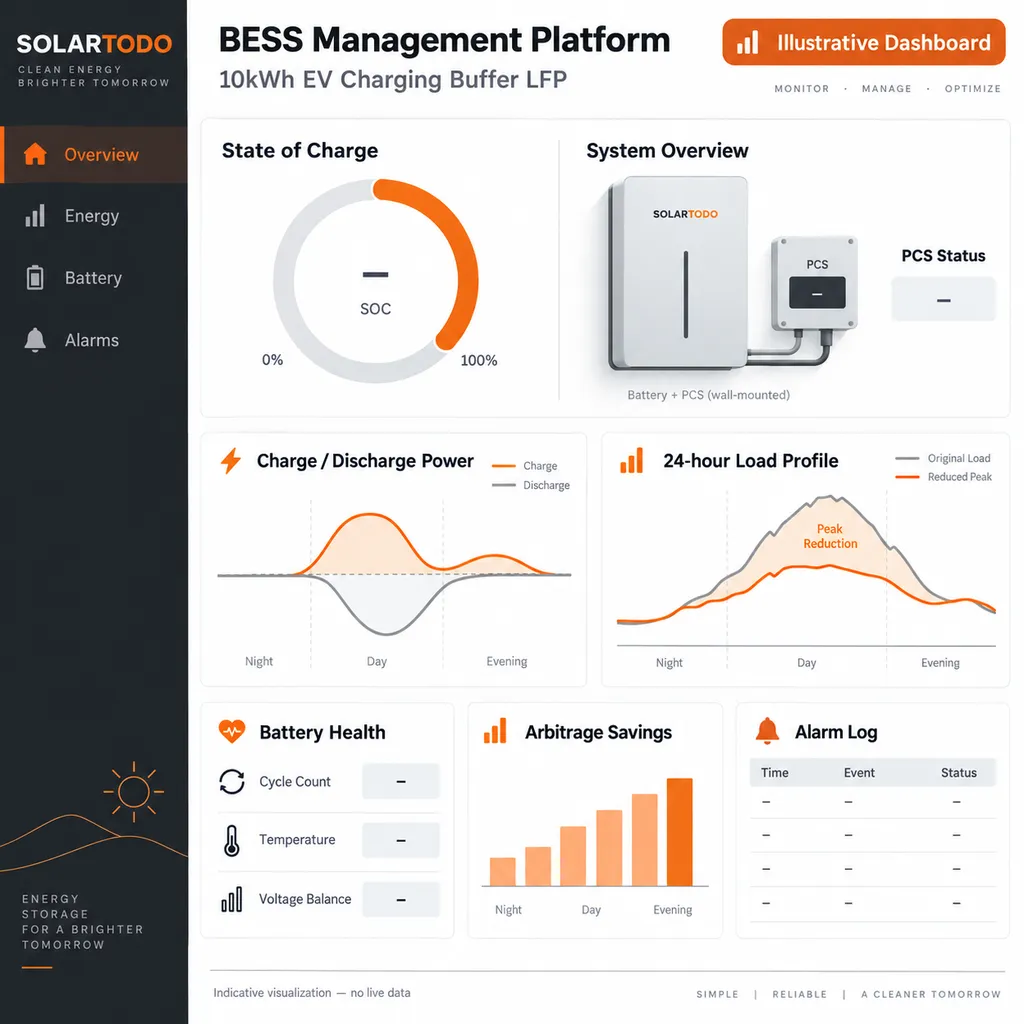
Cloud monitoring is useful for warranty governance because battery claims should be tied to measured SOC windows, temperature history, cycle count, and alarm records. A 10-year or 70% capacity warranty depends on staying inside declared operating limits, so the EMS logs charge events, discharge events, high-temperature warnings, low-temperature derating, and abnormal isolation alarms for engineering review.
Applications
The main application is EV charging buffer service for 1-4 AC chargers at retail, hotel, residential-community, office, light-industrial, telecom-compound, and rural-service sites. The same 10kWh wall-mount platform can also support solar self-consumption, backup for critical lighting or security loads, and peak shaving for small three-phase distribution boards when local codes permit parallel operation with the grid.
Buyers planning a wider energy project can configure your system online by entering charger rating, tariff structure, grid limit, PV capacity, and daily charging sessions. For project-specific layouts, single-line diagrams, and BOQ validation, procurement teams can request a custom quotation with 30 days of meter data or a charger utilization forecast.
For buyers comparing energy-storage use cases, SOLARTODO also provides technical background through Learn about BESS design and safety and Learn about EV charging load management. These references help engineers align a 10kWh buffer with transformer capacity, breaker ratings, metering rules, and site-level energy-management strategy before final EPC pricing.
EPC Investment Analysis and Pricing Structure
The EPC scope includes 5 work packages: engineering, procurement, construction, commissioning, and 1-year warranty support. Engineering covers load assessment, wall-mount location, AC/DC protection, communications, and commissioning method statements; procurement covers the battery, PCS, BMS, enclosure, wiring, and logistics; construction covers mounting and electrical connection; commissioning verifies SOC calibration, inverter response, EMS thresholds, and protection settings.
| Pricing Tier | Scope | Price Range |
|---|---|---|
| FOB Supply | Equipment only, ex-works China | $1,240-$1,632 |
| CIF Delivered | Equipment plus ocean freight and insurance | $1,492-$1,964 |
| EPC Turnkey | Installed, commissioned, and 1-year warranty | $2,000-$2,400 |
| Order Volume | Discount | Example EPC Range After Discount |
|---|---|---|
| 50+ units | 5% | $1,900-$2,280 per unit |
| 100+ units | 10% | $1,800-$2,160 per unit |
| 250+ units | 15% | $1,700-$2,040 per unit |
ROI depends on 3 variables: the demand-charge value of reducing up to 5kW of peak load, the tariff spread between charging and discharging periods, and the avoided cost of a service upgrade. Using the representative $610/year savings model, the payback period is approximately 3.6 years at the $2,200 midpoint EPC price, while a grid-service upgrade that costs $3,000-$8,000 can make the avoided-capex case stronger in constrained sites.
Payment terms are 30% T/T deposit plus 70% against bill of lading, or 100% irrevocable L/C at sight for approved trade-finance customers. Project financing can be discussed for programs above $5,000K, including multi-site EV charging rollouts with 50-250 units, phased delivery schedules, and installation acceptance milestones. For commercial terms, contact [email protected] with project country, unit quantity, grid voltage, and charger rating.
Procurement and Compliance Notes
A complete submittal package should include a datasheet, single-line diagram, installation manual, UN 38.3 transport summary, IEC 62619 cell or battery evidence, inverter compliance evidence, warranty terms, and commissioning checklist. For North American projects, AHJ review may also request UL 9540, UL 9540A, NEC wiring documentation, and NFPA 855 installation spacing evidence before energization.
SOLARTODO recommends validating each 10kWh unit against local grid-code requirements before purchase, because interconnection rules, export limits, anti-islanding settings, and fire-code interpretations vary across 1 country, 1 utility, and even 1 municipality. The safest procurement path is to align the BESS model, charger model, protection scheme, and monitoring gateway before ordering the first 50-unit or 100-unit batch.
Why Specify a 10kWh Buffer
A 10kWh EV charging buffer is small enough for wall-mount deployment but large enough to influence a 15-minute billing interval when charger peaks are short. For developers, that means a measurable operational function at a $2,000-$2,400 EPC price point; for engineers, it means a defined 5kW controllable resource; for procurement teams, it means a repeatable BESS package that can be purchased as 1 unit or scaled across 50, 100, or 250 sites.
Technical Specifications
| Energy Capacity | 10kWh |
| Power Rating | 5kW |
| Battery Chemistry | LFP |
| Round-trip Efficiency | 92-96% |
| Depth of Discharge | 85% |
| Cycle Life | 6000+cycles |
| Calendar Life | 10years |
| Operating Temperature | -20 to 55°C |
| Annual Savings | 610USD/year |
| Payback Period | 3.6years |
| Warranty | 10 years / 70% capacity |
| Application | EV charging buffer |
| Form Factor | Wall mount |
| Daily Cycles | 1.5cycles/day |
| Usable Energy at 85% DoD | 8.5kWh |
Price Breakdown
| Item | Quantity | Unit Price | Subtotal |
|---|---|---|---|
| LFP battery cells | 10 kWh | $55 | $550 |
| Battery Management System | 10 kWh | $15 | $150 |
| 5kW bidirectional PCS | 5 kW | $80 | $400 |
| Air thermal management | 10 kWh | $10 | $100 |
| Wall-mount enclosure and mounting hardware | 1 pcs | $180 | $180 |
| EMS software and cloud gateway allocation | 1 pcs | $90 | $90 |
| Fire safety sensors and DC protection set | 1 pcs | $120 | $120 |
| AC/DC wiring, breakers, and accessories | 1 pcs | $95 | $95 |
| Installation & Commissioning | 1 pcs | $220 | $220 |
| Engineering & QC documentation | 1 pcs | $175 | $175 |
| 1-Year Warranty & Support | 1 pcs | $120 | $120 |
| Total Price Range | $2,000 - $2,400 | ||
Frequently Asked Questions
What is the main use of a 10kWh EV charging buffer?
How is EPC turnkey pricing different from FOB supply pricing?
What standards should buyers request for compliance review?
Can this 10kWh unit support DC fast charging?
What payback period should a project developer assume?
Certifications & Standards

Data Sources & References
- •IEA Global EV Outlook 2025 - Electric vehicle charging
- •IEA Global EV Outlook 2026 - Executive summary
- •IRENA Renewable Power Generation Costs in 2024
- •NREL Cost Projections for Utility-Scale Battery Storage: 2025 Update
- •IEC 62619:2017 industrial lithium battery safety standard
- •UL overview of UL 9540A and NFPA 855 for BESS
- •PHMSA lithium battery UN 38.3 transport guidance
Interested in this solution?
Contact us for a customized quote based on your specific requirements.
Contact Us