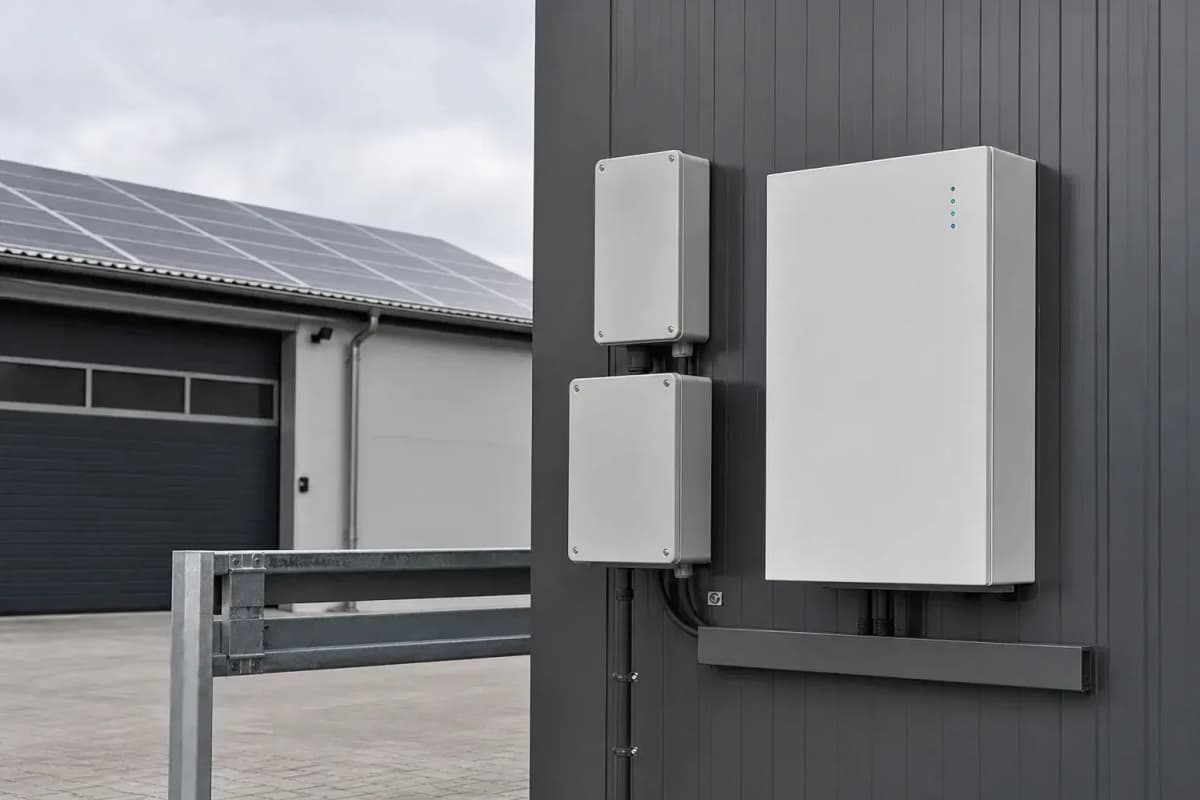
30kWh Self-Consumption Hybrid LFP+Supercap - 30kW Cabinet BESS
Key Features
- 30kWh nominal energy capacity with 95% DoD for about 28.5kWh usable planning capacity
- 30kW bidirectional PCS with 1C continuous power ratio and 2C-4C hybrid pulse capability
- Sub-20ms LFP+supercapacitor response for PV ramping, motor starts, and grid events
- Designed for 2 daily self-consumption cycles with 10-year / 70% capacity warranty basis
- EPC turnkey price range from $5,267 to $6,667, with 5%-15% volume discounts
The 30kWh Self-Consumption Hybrid LFP+Supercap is a 30kW cabinet BESS using LFP energy storage plus supercapacitor peak-power buffering, 95% DoD, and 2 daily cycles for solar self-consumption. It is specified for bidirectional grid-tied/island operation, sub-20ms response, and EPC turnkey delivery from $5,267 to $6,667.
Description
The 30kWh Self-Consumption Hybrid LFP+Supercap is a 30kWh, 30kW cabinet battery energy storage system for homes, shops, telecom shelters, farms, and small C&I sites that need 2 daily solar-shifting cycles. Its hybrid architecture combines LFP cells for 30kWh usable energy planning with supercapacitor peak buffering, 95% depth of discharge, sub-20ms power response, and EPC turnkey pricing from $5,267 to $6,667.
SOLARTODO positions this 30kWh BESS as a compact self-consumption unit for 400V-class low-voltage AC systems, rooftop PV arrays from roughly 20kWp to 45kWp, and load profiles with 1 to 2 high-power start events per hour. Buyers comparing multiple storage formats can View all Battery Energy Storage System (BESS) products, model the 30kWh/30kW ratio in the Configure your system online workflow, or use Learn about topic for background on battery sizing, self-consumption, and inverter dispatch.
Technical Specifications
The 30kWh cabinet is specified around a 1C continuous power-to-energy ratio, with 30kW bidirectional PCS output and short-duration 2C to 4C discharge support through the LFP-supercapacitor hybrid layer. The LFP section provides energy capacity over a 10-year warranty basis, while the supercapacitor section absorbs ramping, motor-start, cloud-edge PV transients, and grid-interactive control events that may occur in less than 1 second.
| Parameter | Specification | Engineering Note |
|---|---|---|
| Nominal energy capacity | 30kWh | Sized for 2 daily cycles and 95% DoD |
| Rated AC power | 30kW | 1C nominal power ratio for compact C&I loads |
| Hybrid chemistry | LFP + supercapacitor | LFP for energy, supercap for power peaks |
| Response time | <20ms | Suitable for fast self-consumption dispatch |
| Round-trip efficiency | >96% PCS, about 90-94% system | Depends on temperature, dispatch, and AC coupling |
| Cooling method | Air cooling | Appropriate below 100kWh cabinet class |
| Warranty basis | 10 years / 70% capacity | Subject to operating profile and approved installation |
The LFP battery module is selected for thermal stability, high cycle life, and cobalt-free supply chains, while the supercapacitor bank is selected for hundreds of thousands of shallow pulse events. Compared with a conventional 30kWh LFP-only cabinet that must absorb every 10kW to 30kW transient through electrochemical cells, this hybrid design can reduce high-current pulse stress on the LFP section by an estimated 30% to 60% in sites with frequent compressor, pump, elevator, or EV-charger load spikes.
System Architecture
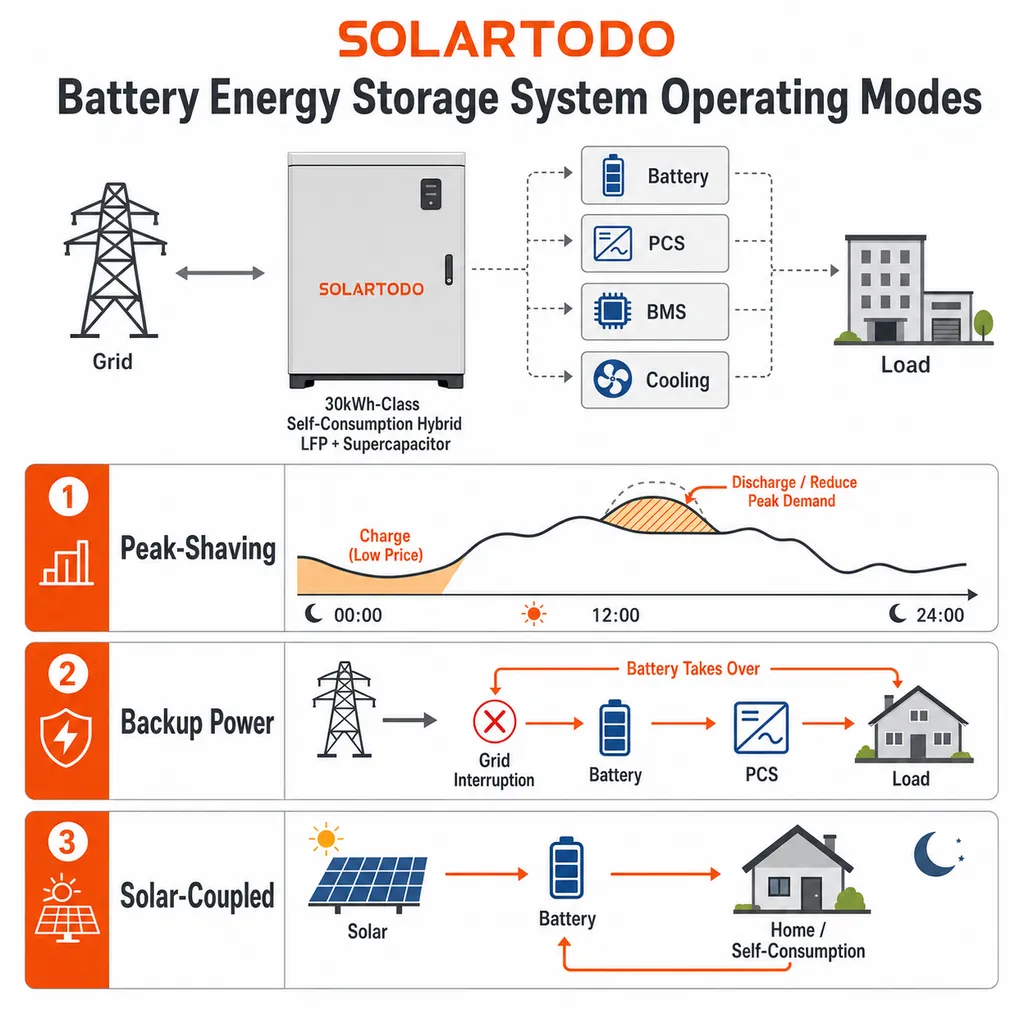
The architecture uses 4 primary layers: battery modules, supercapacitor power buffer, bidirectional PCS, and EMS/BMS control. The BMS monitors cell voltage, cell temperature, pack current, SOC, SOH, balancing status, insulation resistance, and alarm thresholds, while the EMS coordinates PV surplus charging, evening discharge, peak shaving, backup reserve, and grid-import limits in 5-minute to 15-minute operating intervals.
At the AC interface, the 30kW PCS supports grid-tied operation for solar self-consumption and island-mode operation for essential loads when local rules allow backup switching. A typical cabinet arrangement includes 1 integrated DC bus, 1 hybrid energy stack, 1 bidirectional inverter, 1 air-cooling path, 1 protection compartment, and networked metering at the grid connection point, allowing the EMS to prioritize PV self-use before exporting or importing power.
The hybrid LFP-supercapacitor control method separates energy and power by time scale: supercapacitors handle milliseconds-to-seconds events, and LFP modules handle minutes-to-hours dispatch. In practice, the supercapacitor bank can respond within <20ms to a 10kW step change, while the LFP section follows with a smoother current profile, reducing thermal cycling and improving the operating margin of contactors, fuses, DC bus capacitors, and PCS semiconductors.
Standards, Safety, and Compliance
Safety engineering should be evaluated against UL 9540 for energy storage system listing, UL 9540A for thermal runaway propagation testing, IEC 62619 for industrial lithium battery safety, UN38.3 for transport testing, and NFPA 855 for stationary storage installation practice. For grid interconnection, engineers typically cross-check local utility requirements against IEEE 1547-2018 for distributed energy resource behavior and anti-islanding expectations.
The cabinet safety stack includes 3 protection tiers: electrical protection, battery-level monitoring, and enclosure-level mitigation. Electrical protection uses DC fuses, AC breakers, surge protection, insulation monitoring, and emergency disconnects; battery-level monitoring uses cell balancing, temperature cutoffs, and current limits; enclosure-level mitigation may include smoke sensing, gas detection, alarm relay, and automatic shutdown according to the final AHJ-approved design.
For shipping and procurement, UN38.3 transport documentation, MSDS files, IEC 62619 test evidence, factory QA records, and PCS conformity documentation should be requested before dispatch. SOLARTODO can provide certificate packs for procurement review, but final grid approval, fire authority approval, and installation spacing depend on 1 site-specific design package, 1 local code review, and 1 commissioning inspection.
Self-Consumption Applications
The 30kWh unit is designed for solar self-consumption optimization rather than utility-scale arbitrage, making it suitable for rooftops where midday PV output exceeds daytime load for 2 to 5 hours. In a 30kWp rooftop system producing around 110kWh to 150kWh on a strong solar day, this cabinet can shift roughly 25kWh to 28.5kWh of usable energy after accounting for 95% DoD and system losses.
A representative operating schedule uses 1 morning charge window, 1 midday PV surplus window, and 1 evening discharge window. For example, a bakery with a 22kW daytime peak, a 12kW evening load, and 2 refrigeration compressors can use the supercapacitor layer for start events while reserving LFP capacity for 3 to 4 evening hours, reducing grid dependency without oversizing to a 60kWh cabinet.
Representative MENA solar-retail scenario: for a 30kWp rooftop PV site with $0.18/kWh imported electricity, 300 high-sun days per year, and 25kWh average daily shifted energy, annual bill-offset value is approximately $1,350 before demand-charge effects. If demand-charge mitigation adds $300 to $600 per year, total annual savings can reach $1,650 to $1,950, giving a simple payback of about 2.7 to 4.0 years against the $5,267 to $6,667 EPC range.
Cloud Monitoring
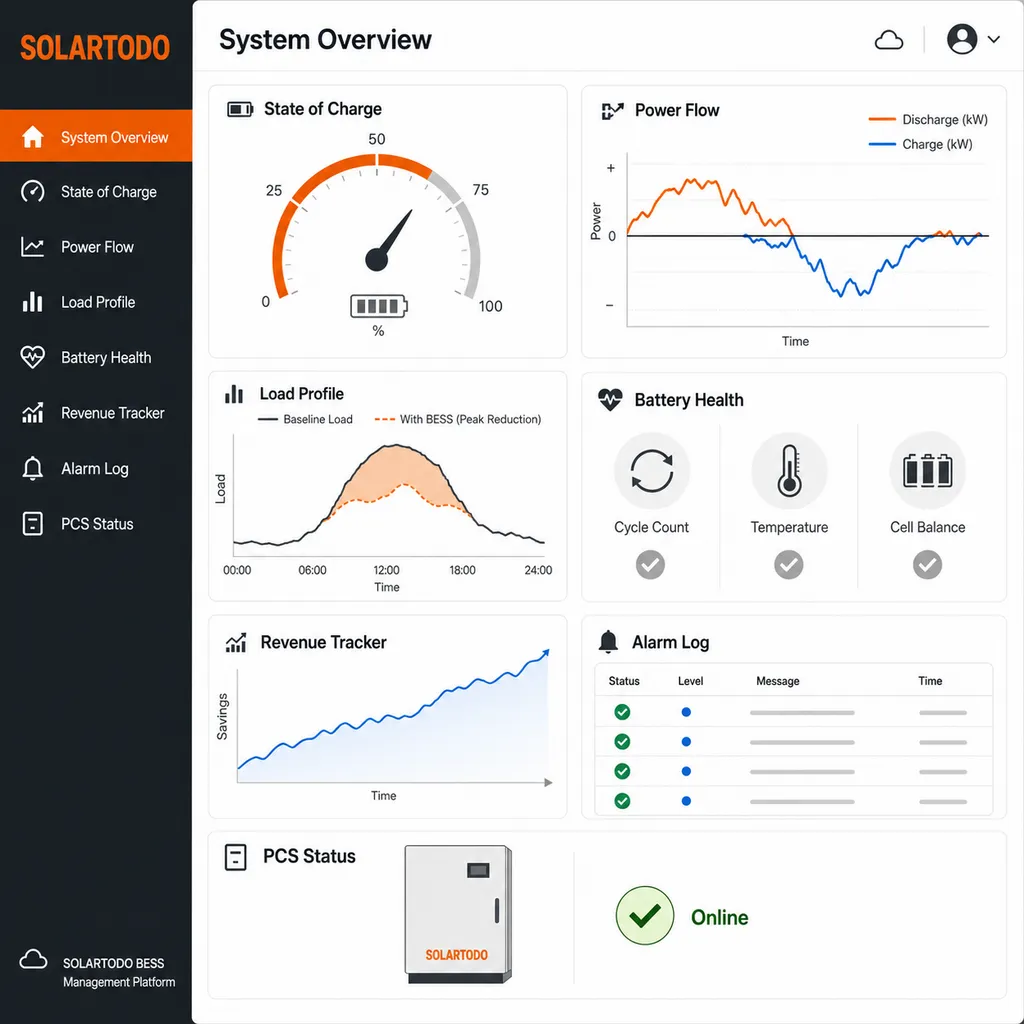
The cloud monitoring layer records at least 10 operating data categories: PV input, grid import, grid export, load demand, battery SOC, battery SOH, charge power, discharge power, alarms, and temperature. For B2B operators managing 5 to 500 distributed cabinets, the dashboard can support daily energy reports, fault history, remote firmware coordination, and operating-mode changes under defined access control.
Data should be exported in 5-minute, 15-minute, or 1-hour resolution depending on metering hardware and local bandwidth. Engineers normally use these logs to validate 3 outcomes: PV self-consumption ratio, peak grid import reduction, and battery cycling depth; procurement teams use the same logs to compare warranty compliance, delivered savings, and maintenance events across multiple assets.
Performance and Market Context
NREL storage-cost benchmarks have shown rapid declines in installed battery costs across residential and commercial segments, while BloombergNEF has reported global lithium battery pack prices below historical levels in recent editions. IEA analysis continues to identify battery storage as a core flexibility resource for solar-heavy grids, and IRENA has documented that storage supports higher variable renewable energy penetration when paired with digital controls and appropriate grid rules.
For this 30kWh class, the most important engineering metric is not only $/kWh but also $/kW, response speed, cycle durability, and installed-service cost over 10 years. A low-cost LFP-only unit may look attractive at 30kWh, but if it lacks pulse buffering, 30kW PCS coordination, and robust thermal monitoring, it may experience higher stress under 2 daily cycles and repeated high-current events.
Compared with diesel backup for short evening peaks, the 30kWh BESS can reduce on-site fuel use by 100% during battery-supplied intervals and avoid routine generator starts for loads below 30kW. Compared with exporting solar at a low feed-in tariff of $0.03/kWh and buying back power at $0.18/kWh, each stored kWh can protect roughly $0.15 of value before losses, which is the main economic reason to size storage for self-consumption.
EPC Investment Analysis and Pricing Structure
The EPC turnkey scope includes 5 delivery categories: engineering, procurement, construction, commissioning, and 1-year workmanship/support warranty. Engineering covers single-line diagrams, load review, battery sizing, protection coordination, and installation layout; procurement covers cabinet, inverter, BMS, EMS, safety accessories, and logistics; construction covers mounting, cabling, AC/DC protection, grounding, and site integration; commissioning covers functional testing, EMS setup, alarm verification, and operator handover.
| Pricing Tier | Scope | Price Range (USD) |
|---|---|---|
| FOB Supply | Equipment only, ex-works China | $3,266 - $4,534 |
| CIF Delivered | Equipment + ocean freight + insurance | $3,931 - $5,457 |
| EPC Turnkey | Installed + commissioned + 1-year warranty | $5,267 - $6,667 |
Volume pricing can be applied to multi-site programs where standard cabinet design, standard PCS settings, and repeatable installation drawings reduce engineering hours per unit. For 50 or more cabinets, the indicative discount is 5%; for 100 or more cabinets, the indicative discount is 10%; for 250 or more cabinets, the indicative discount is 15%, subject to final shipping lanes, Incoterms, and local installation scope.
| Quantity Band | Indicative Discount | Procurement Use Case |
|---|---|---|
| 50+ units | 5% | Regional distributor stocking program |
| 100+ units | 10% | Multi-city retail or telecom rollout |
| 250+ units | 15% | Framework agreement with standardized drawings |
ROI depends on 4 site variables: tariff spread, PV surplus, demand-charge structure, and daily cycle count. Using 25kWh shifted per day, 300 operating days per year, and $0.18/kWh import cost, annual energy value is about $1,350; adding $300 to $600 demand-charge value gives $1,650 to $1,950 per year, supporting a 2.7 to 4.0 year simple payback on EPC pricing before taxes, incentives, and maintenance assumptions.
Payment terms are 30% T/T deposit + 70% against B/L copy, or 100% L/C at sight for approved trade-finance buyers. Project financing can be discussed for portfolios above $5,000K, especially where 100 or more standardized cabinets are deployed across sites with predictable tariffs, metering access, and documented EPC acceptance criteria; procurement teams can Request a custom quotation or email [email protected].
Procurement and Engineering Notes
Before ordering, the buyer should confirm 8 technical inputs: PV array size, grid voltage, phase configuration, maximum import limit, maximum export limit, backup-load requirement, installation temperature range, and communication protocol. These inputs determine whether the default 30kW PCS, 30kWh cabinet, 95% DoD setting, and air-cooling design are sufficient or whether parallel cabinets are needed.
The recommended acceptance test includes 6 checks: visual inspection, insulation test, BMS communication test, PCS charge/discharge test, emergency-stop test, and monitoring-platform verification. A commissioning report should record at least 12 values, including SOC, SOH, AC voltage, AC frequency, charge power, discharge power, cabinet temperature, alarm status, grid import, grid export, firmware version, and protection settings.
For B2B buyers comparing product families, this 30kWh cabinet is best matched to self-consumption and short peak events, while larger 100kWh to 500kWh systems are better for demand-charge management and multi-hour commercial backup. Related product education is available through Learn about topic, and the broader storage portfolio can be reviewed at View all Battery Energy Storage System (BESS) products.
Technical Specifications
| Energy Capacity | 30kWh |
| Power Rating | 30kW |
| Battery Chemistry | Hybrid LFP + Supercapacitor |
| Round-trip Efficiency | 90-94 system, >96 PCS% |
| Depth of Discharge | 95% |
| Daily Cycles | 2cycles/day |
| Cycle Life | 6000-8000cycles |
| Calendar Life | 10-15years |
| Operating Temperature | -20 to 55°C |
| Response Time | <20ms |
| Form Factor | Cabinet |
| Cooling Method | Air cooling |
| Annual Savings | 1650-1950USD/year |
| Payback Period | 2.7-4.0years |
| Warranty | 10 years / 70% capacity |
Price Breakdown
| Item | Quantity | Unit Price | Subtotal |
|---|---|---|---|
| Hybrid LFP + supercapacitor battery module set | 1 pcs | $2,100 | $2,100 |
| Battery Management System with SOC/SOH monitoring | 1 pcs | $450 | $450 |
| 30kW bidirectional PCS inverter | 1 pcs | $1,200 | $1,200 |
| DC/DC and supercap interface controller | 1 pcs | $480 | $480 |
| Air-cooling and thermal protection assembly | 1 pcs | $260 | $260 |
| Cabinet enclosure with AC/DC protection hardware | 1 pcs | $620 | $620 |
| Gas detection, alarm relay, and shutdown accessories | 1 pcs | $290 | $290 |
| EMS software gateway and cloud monitoring setup | 1 pcs | $360 | $360 |
| Installation and commissioning labor | 1 pcs | $520 | $520 |
| Engineering, factory QC, and documentation package | 1 pcs | $240 | $240 |
| 1-Year warranty and technical support allowance | 1 pcs | $120 | $120 |
| Total Price Range | $5,267 - $6,667 | ||
Frequently Asked Questions
What is included in the EPC turnkey price for the 30kWh system?
Why use LFP plus supercapacitors instead of a conventional LFP-only battery?
How much solar capacity should be paired with this 30kWh cabinet?
Which standards should procurement teams request before shipment?
What is the expected payback period for self-consumption use?
Certifications & Standards

Data Sources & References
- •NREL Annual Technology Baseline and storage cost benchmark references
- •IEA electricity and battery storage flexibility analysis
- •IRENA renewable power generation cost and storage integration publications
- •BloombergNEF lithium-ion battery price survey references
- •IEC 62619 industrial battery safety standard
- •UL 9540 and UL 9540A energy storage safety standards
- •NFPA 855 stationary energy storage installation standard
Interested in this solution?
Contact us for a customized quote based on your specific requirements.
Contact Us