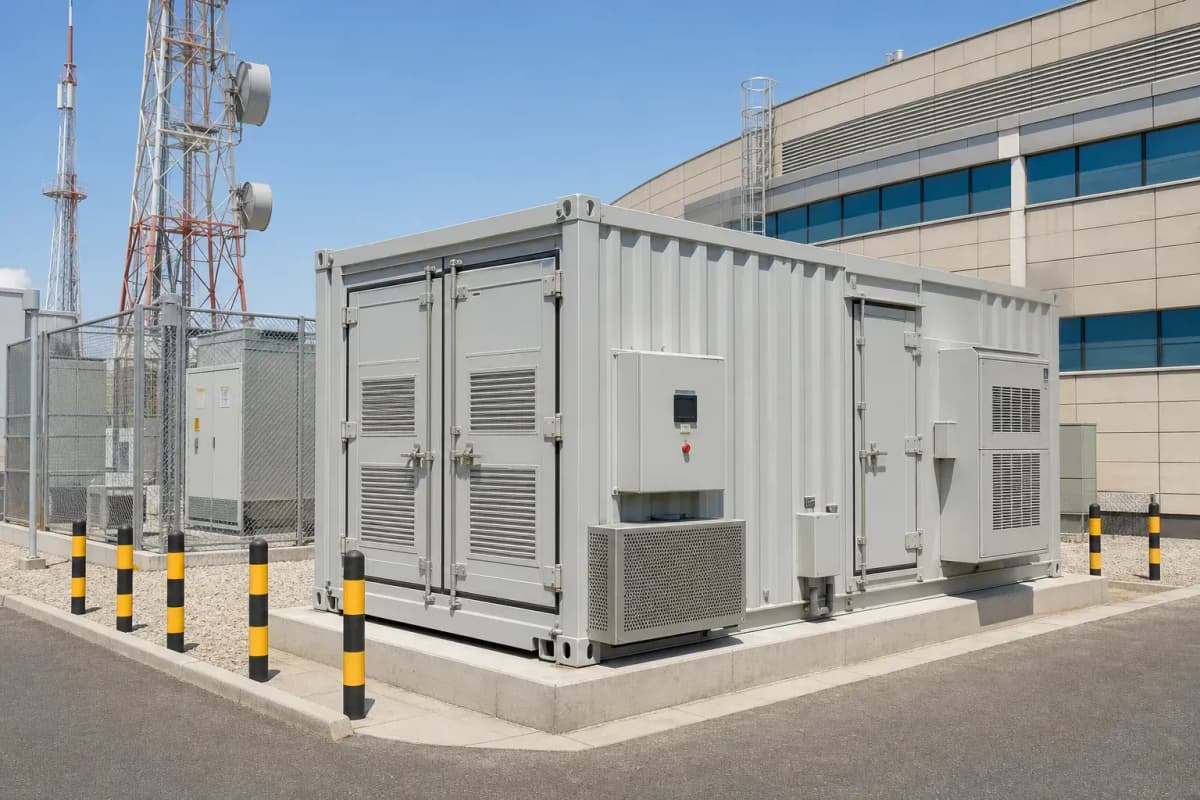
150kWh Telecom Backup LFP - 300kW Container BESS
Key Features
- 150 kWh LFP battery capacity with 95% depth of discharge for telecom backup autonomy.
- 300 kW bidirectional PCS supports grid-tied, island-mode, and generator-parallel operation.
- Sub-10 ms transfer logic is designed for UPS replacement and critical telecom loads.
- 6,000+ cycle LFP design basis supports about 10.9 years at 1.5 daily cycles.
- 20ft container integrates BMS, EMS, liquid cooling, fire suppression, and cloud monitoring.
150kWh Telecom Backup LFP is a 20ft containerized BESS with 300kW bidirectional power, LFP chemistry, 95% DoD, 1.5 daily cycles, sub-10ms backup transfer, and EPC turnkey pricing from $21,800 to $27,900.
Description
The 150kWh Telecom Backup LFP is a 20ft containerized battery energy storage system configured for 150 kWh energy, 300 kW bidirectional power, 95% depth of discharge, and 1.5 daily cycles in telecom backup or UPS-replacement projects. It uses lithium iron phosphate (LFP) battery modules, a 300 kW PCS, BMS/EMS controls, liquid thermal management, fire detection, and sub-10 ms transfer logic for sites that require 1 to 8 hours of autonomy.
Product Overview
For telecom operators, tower companies, and infrastructure EPCs, this 150 kWh BESS is sized for high-power backup at macro base stations, edge data cabinets, microwave hubs, and smart-infrastructure shelters with loads from 20 kW to 150 kW. At 300 kW peak inverter capacity, the system can support short-duration surge loads, rectifier restart events, and generator-parallel operating modes while keeping the battery energy reserve within a 95% DoD design envelope.
LFP chemistry is selected because stationary storage now favors lower-cost, cobalt-free, thermally stable cells; the IEA reported in 2026 that LFP packs were more than 40% cheaper than NMC alternatives in 2025, with stationary storage predominantly using LFP (IEA Global EV Outlook 2026). For a 150 kWh telecom backup asset, the practical procurement result is lower $/kWh capex, reduced exposure to nickel and cobalt price volatility, and a safety profile aligned with industrial lithium battery standards.
The 20ft form factor integrates battery racks, DC protection, PCS, HVAC or liquid-cooling loops, clean-agent suppression, combustible gas detection, smoke detection, emergency-stop circuits, and EMS communications in 1 transportable package. Buyers comparing 48 V lead-acid strings, diesel-only backup, and rack-mounted lithium cabinets should treat this unit as a modular BESS node that can be expanded in 150 kWh increments or paralleled behind a larger site controller.
SOLARTODO positions this product inside the broader View all Battery Energy Storage System (BESS) products category for telecom, C&I, off-grid, and hybrid power projects. Buyers can Configure your system online with voltage, autonomy, enclosure, and monitoring options, then Request a custom quotation for site-specific single-line diagrams, civil drawings, and logistics assumptions.
System Architecture
The architecture is a DC battery block plus an AC power conversion block, controlled by a BMS/EMS stack that samples cell voltage, pack temperature, current, SOC, SOH, insulation resistance, contactor state, and fault status at multiple levels. A typical 150 kWh layout uses prismatic LFP cells in aluminum housings, modular racks, a 300 kW bidirectional PCS above 96% conversion efficiency, and an EMS that supports grid-tied operation, island mode, diesel-generator coordination, and dry-contact integration with telecom rectifiers.
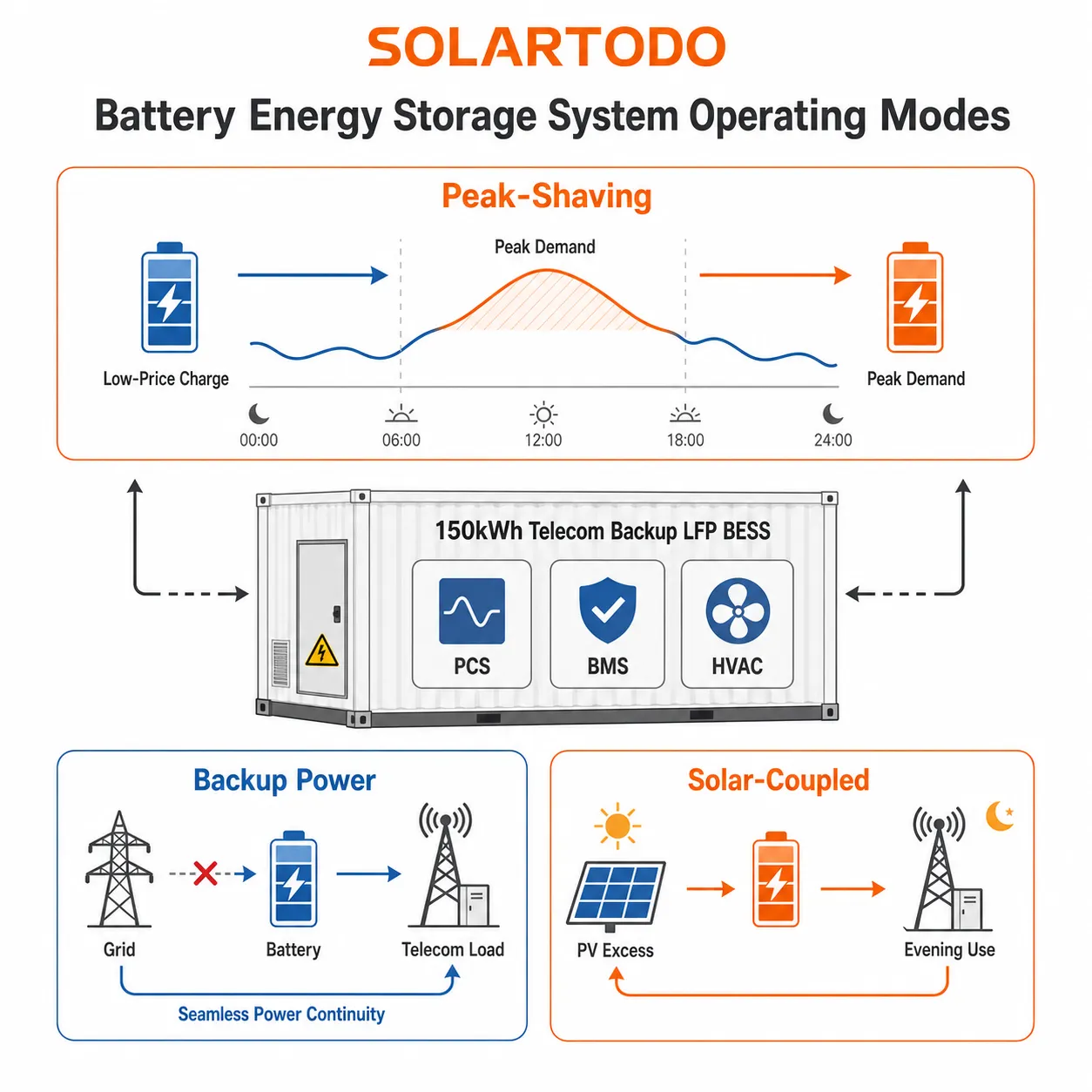
The grid-to-island sequence is engineered for sub-10 ms switchover when upstream AC power fails and the site critical bus must stay energized. In a telecom shelter with a 60 kW average DC-equivalent load, 150 kWh of energy provides about 2.4 hours of runtime after reserving 95% usable DoD and inverter losses; at 30 kW, the same system can support approximately 4.8 hours, while at 120 kW it is sized for roughly 1.2 hours.
The BMS performs cell balancing, over-voltage protection, under-voltage protection, over-current protection, short-circuit isolation, insulation monitoring, and thermal interlock functions across module, rack, and container levels. IEC 62619:2022 explicitly covers secondary lithium cells and batteries for industrial stationary applications including telecom, UPS, utility switching, emergency power, and ESS use cases, making it a relevant safety reference for this 150 kWh configuration (IEC 62619:2022).
The PCS converts DC battery power to site AC power and can operate in grid-following or island-forming logic depending on the grid code, switchgear, and telecom load architecture. Where interconnection rules apply, IEEE 1547-2018 provides a widely used framework for distributed energy resource interconnection, including response to abnormal conditions, power quality, interoperability, commissioning tests, and maintenance considerations (IEEE 1547-2018).
Technical Specifications
The nominal configuration is 150 kWh / 300 kW, equivalent to a 0.5-hour high-power rating at full discharge power or a 2.5-hour class rating at a 60 kW telecom load. SOLARTODO recommends validating actual autonomy using rectifier load logs, HVAC duty cycle, radio equipment peak draw, battery reserve policy, ambient temperature, and generator-start delay rather than relying on nameplate load alone.
| Parameter | 150kWh Telecom Backup LFP configuration |
|---|---|
| Nominal energy capacity | 150 kWh |
| Power conversion rating | 300 kW bidirectional PCS |
| Battery chemistry | LFP, prismatic cells |
| Usable DoD design | 95% |
| Daily cycling assumption | 1.5 cycles/day |
| Round-trip efficiency | 90% system-level estimate |
| PCS efficiency | >96% conversion stage |
| Switchover target | <10 ms for backup transfer logic |
| Cycle life basis | 6,000+ cycles under controlled operating conditions |
| Calendar-life design | 10 years with 70% retained capacity warranty basis |
| Container class | 20ft integrated BESS container |
| Operating temperature | -20°C to +55°C with thermal management |
At 1.5 cycles per day, the system processes about 225 kWh of battery throughput per day and about 82,125 kWh per year before efficiency adjustment. With a 6,000-cycle LFP design basis, the theoretical cycle-life envelope is roughly 10.9 years at 1.5 cycles per day, although warranty, ambient temperature, C-rate, charge ceiling, and maintenance practices determine the bankable operating life.
The container is designed for field installation with skid-mounted equipment, cable entry, grounding points, ventilation paths, and service access clearances that should be checked against local code. NFPA 855:2026 is a relevant installation reference because it addresses stationary ESS topics such as fire detection, suppression, explosion control, exhaust ventilation, gas detection, and thermal-runaway risk controls (NFPA 855:2026).
Safety, Standards, and Compliance
UL 9540 covers complete energy storage systems and equipment, including electrical, electrochemical, mechanical, control, communication, fluid-movement, enclosure, and grid-interaction aspects of an ESS. UL Solutions also identifies UL 9540A as the test method used to evaluate thermal-runaway fire propagation in battery ESS, which is important for 150 kWh industrial systems located near telecom shelters, diesel tanks, or property boundaries (UL Energy Storage System Testing).
The safety concept uses 3 layers: cell and rack monitoring by BMS, container-level detection and shutdown by EMS, and active fire suppression with alarm outputs to the site controller. Compared with flooded lead-acid battery rooms that require acid handling, ventilation checks, water maintenance, and frequent string replacement, the LFP container reduces routine battery-maintenance visits by approximately 60% to 80% in many telecom service models, subject to site policy.
LFP is not a substitute for engineering controls, so the design still includes temperature sensors, DC fuses, contactors, insulation monitoring, emergency stops, smoke sensors, gas sensors, and forced shutdown logic. UN38.3 transport testing, IEC 62619 industrial battery safety, UL 9540 system evaluation, UL 9540A propagation testing, and NFPA 855 installation controls together create a 5-layer compliance framework for procurement review.
Telecom Backup Applications
The primary use case is backup power for telecom base stations where uptime targets, grid instability, and fuel logistics create high operating costs. At a 40 kW critical load, a 150 kWh system can provide about 3.6 hours of backup after efficiency and reserve assumptions; at an 80 kW load, it provides about 1.8 hours, which is usually enough to bridge grid faults, ride through feeder switching, or start a generator under controlled conditions.
For a representative MENA telecom tower cluster scenario, assume 10 macro sites each consume 60 kW during peak traffic periods, experience 180 outage hours per year, and currently rely on diesel backup at 0.28 liters per kWh delivered. Replacing short outage runtime with 10 units of 150 kWh LFP BESS could offset roughly 302,400 kWh of diesel-generated electricity per year after 90% system efficiency, reducing fuel use by about 84,672 liters before considering generator standby losses.
For procurement teams, the telecom value case usually combines 4 quantified benefits: avoided diesel runtime, reduced maintenance visits, lower battery replacement frequency, and improved power-quality ride-through for rectifiers and radio equipment. Learn more about storage sizing, diesel hybridization, and site energy modeling in the SOLARTODO knowledge center at Learn about topic, where related design notes can support early tender preparation.
The system can also support smart-city edge nodes, C-UAS sensors, security towers, telecom shelters, rural broadband cabinets, and microgrid communications hubs. In these applications, 300 kW PCS headroom allows the battery to absorb transient loads, support black-start sequences, and synchronize with photovoltaic arrays, generators, or grid supply through external switchgear.
Cloud Monitoring
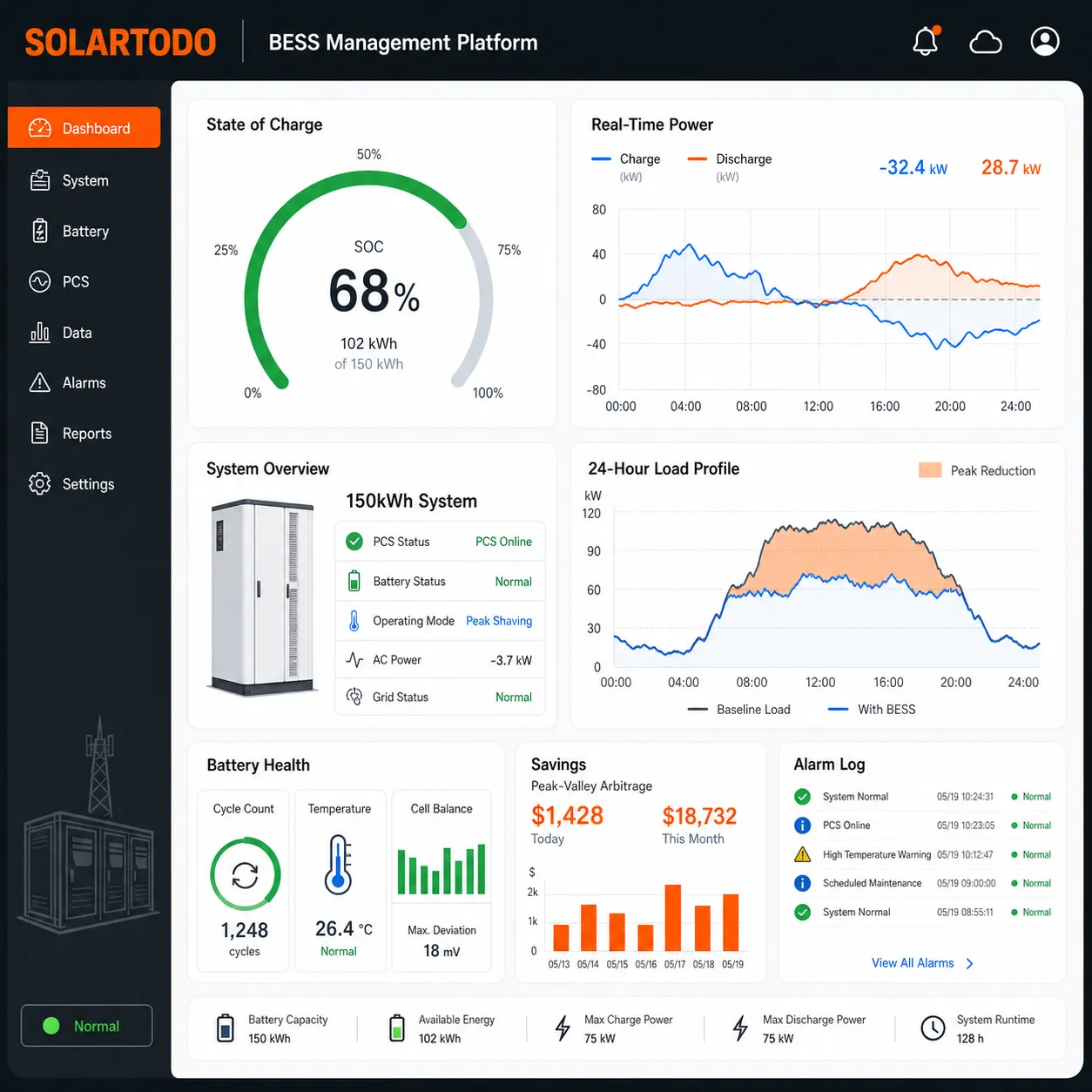
Cloud monitoring turns the 150 kWh BESS from a passive backup asset into a measurable power platform with SOC, SOH, alarms, temperature, charge/discharge energy, outage history, PCS status, and daily cycle counts available to operators. A typical EMS reporting interval of 1 to 5 minutes gives network operations centers enough resolution to detect weak grids, overloaded feeders, charger faults, or abnormal thermal behavior before a service outage occurs.
Remote operations can reduce truck rolls by allowing technicians to confirm 5 categories of data before dispatch: alarm type, battery reserve, rectifier load, thermal state, and communication status. For multisite rollouts above 50 units, this diagnostic visibility can materially lower O&M planning risk because every container reports the same battery, PCS, and environmental data model.
The data model also supports warranty governance because cycle count, DoD, temperature exposure, event logs, and fault codes create an auditable operating record. IRENA's storage valuation framework emphasizes that storage economics depend on service stacking and proper valuation of system benefits, which aligns with using EMS data to quantify backup value, peak shaving, PV self-consumption, and diesel offset in one project model (IRENA ESVF 2020).
EPC Investment Analysis and Pricing Structure
The EPC package includes 5 major scopes: engineering, procurement, construction, commissioning, and a 1-year project warranty. Engineering covers single-line diagrams, container layout, grounding, cable schedule, battery sizing, protection coordination, monitoring architecture, and interface definition; procurement covers battery racks, PCS, BMS, EMS, fire suppression, container, switchgear interfaces, freight, insurance, and factory acceptance testing.
| Pricing tier | Scope | Price range (USD) |
|---|---|---|
| FOB Supply | Equipment only, ex-works China | $13,516 - $18,972 |
| CIF Delivered | Equipment plus ocean freight and insurance | $16,268 - $22,835 |
| EPC Turnkey | Installed, commissioned, and 1-year warranty | $21,800 - $27,900 |
| Volume band | Discount from list price | Procurement note |
|---|---|---|
| 50+ units | 5% | Suitable for regional tower-cluster rollouts |
| 100+ units | 10% | Suitable for national telecom framework contracts |
| 250+ units | 15% | Suitable for multi-country infrastructure programs |
A representative ROI model can use a turnkey EPC midpoint of $24,850, annual diesel displacement of $9,600, battery maintenance reduction of $2,100, and outage-risk savings of $1,200, giving about $12,900 annual value and a 1.9-year simple payback. If the same site uses diesel-only backup at 0.28 liters/kWh and $1.10/liter fuel cost, the BESS can reduce short-outage fuel cost by roughly 70% for outages that fit within the 150 kWh reserve window.
Payment terms are 30% T/T deposit plus 70% against B/L copy, or 100% L/C at sight for qualified buyers. Project financing can be structured for portfolios above $5,000K, with documentation normally including buyer KYC, project schedule, site list, interconnection status, and 12 months of telecom load or outage data; contact [email protected] for EPC quotation files.
Procurement Notes
B2B buyers should request 6 documents before purchase: battery datasheet, PCS datasheet, BMS/EMS protocol list, fire-suppression specification, factory test report, and shipping packing list. For cross-border tenders, the compliance matrix should map every line item to IEC 62619, UL 9540, UL 9540A, UN38.3, NFPA 855, IEEE 1547, and local electrical code clauses.
A conventional lead-acid telecom battery room may need replacement every 3 to 5 years under hot climates, while controlled LFP systems are commonly specified with 6,000+ cycles and a 10-year/70% capacity warranty basis. That difference can cut battery replacement events from 2 or 3 rounds to 1 planned lifecycle program over 10 years, improving procurement predictability for large tower fleets.
For final design, SOLARTODO recommends combining site survey data, 15-minute load logs, historical outage records, ambient-temperature profile, grid tariff, generator fuel price, and telecom uptime SLA penalties. The NREL Annual Technology Baseline notes that lithium-ion storage cost and performance assumptions depend on system size, duration, chemistry, and market segment, so project economics should be modeled with site-specific duration and dispatch assumptions rather than a single global $/kWh value (NREL ATB Battery Storage).
Technical Specifications
| Energy Capacity | 150kWh |
| Power Rating | 300kW |
| Battery Chemistry | LFP |
| Round-trip Efficiency | 90% |
| Depth of Discharge | 95% |
| Cycle Life | 6000+cycles |
| Calendar Life | 10years |
| Operating Temperature | -20 to 55°C |
| Annual Savings | 12900USD/year |
| Payback Period | 1.9years |
| Warranty | 10 years / 70% capacity; 1-year EPC support |
| Form Factor | 20ft containerized BESS |
| Backup Transfer Target | <10ms |
| Daily Cycling Assumption | 1.5cycles/day |
Price Breakdown
| Item | Quantity | Unit Price | Subtotal |
|---|---|---|---|
| LFP Battery Cells and Modules | 1 pcs | $7,800 | $7,800 |
| Battery Management System | 1 pcs | $1,200 | $1,200 |
| 300 kW Bidirectional PCS | 1 pcs | $4,200 | $4,200 |
| 20ft Container, DC Protection, and Wiring | 1 pcs | $3,100 | $3,100 |
| Liquid Thermal Management | 1 pcs | $1,850 | $1,850 |
| Fire Suppression and Gas Detection | 1 pcs | $1,250 | $1,250 |
| EMS Software and Cloud Monitoring Gateway | 1 pcs | $900 | $900 |
| Ocean Freight, Insurance, and Export Packing | 1 pcs | $1,700 | $1,700 |
| Installation and Commissioning | 1 pcs | $2,600 | $2,600 |
| Engineering, FAT, QC, and Documentation | 1 pcs | $1,200 | $1,200 |
| 1-Year Warranty and Remote Support | 1 pcs | $930 | $930 |
| Total Price Range | $21,800 - $27,900 | ||
Frequently Asked Questions
What does the $21,800 to $27,900 EPC turnkey price include?
How long can a 150 kWh telecom BESS support a tower load?
Why use LFP instead of lead-acid or NMC for telecom backup?
Which standards are relevant for this 150 kWh BESS?
Can the system work with diesel generators and solar PV?
Certifications & Standards

Data Sources & References
- •IEA Global EV Outlook 2026 - Electric vehicle batteries: https://www.iea.org/reports/global-ev-outlook-2026/electric-vehicle-batteries
- •IEC 62619:2022 industrial lithium battery safety: https://webstore.iec.ch/en/publication/64073
- •UL Solutions Energy Storage System Testing and Certification: https://www.ul.com/services/energy-storage-system-testing-and-certification
- •NFPA 855:2026 stationary energy storage systems: https://link.nfpa.org/all-publications/855/2026
- •IEEE 1547-2018 DER interconnection: https://standards.ieee.org/ieee/1547/5915/
- •IRENA Electricity Storage Valuation Framework 2020: https://www.irena.org/publications/2020/Mar/Electricity-Storage-Valuation-Framework-2020
- •NREL Annual Technology Baseline Battery Storage: https://atb.nrel.gov/electricity/2024/residential_battery_storage
Interested in this solution?
Contact us for a customized quote based on your specific requirements.
Contact Us