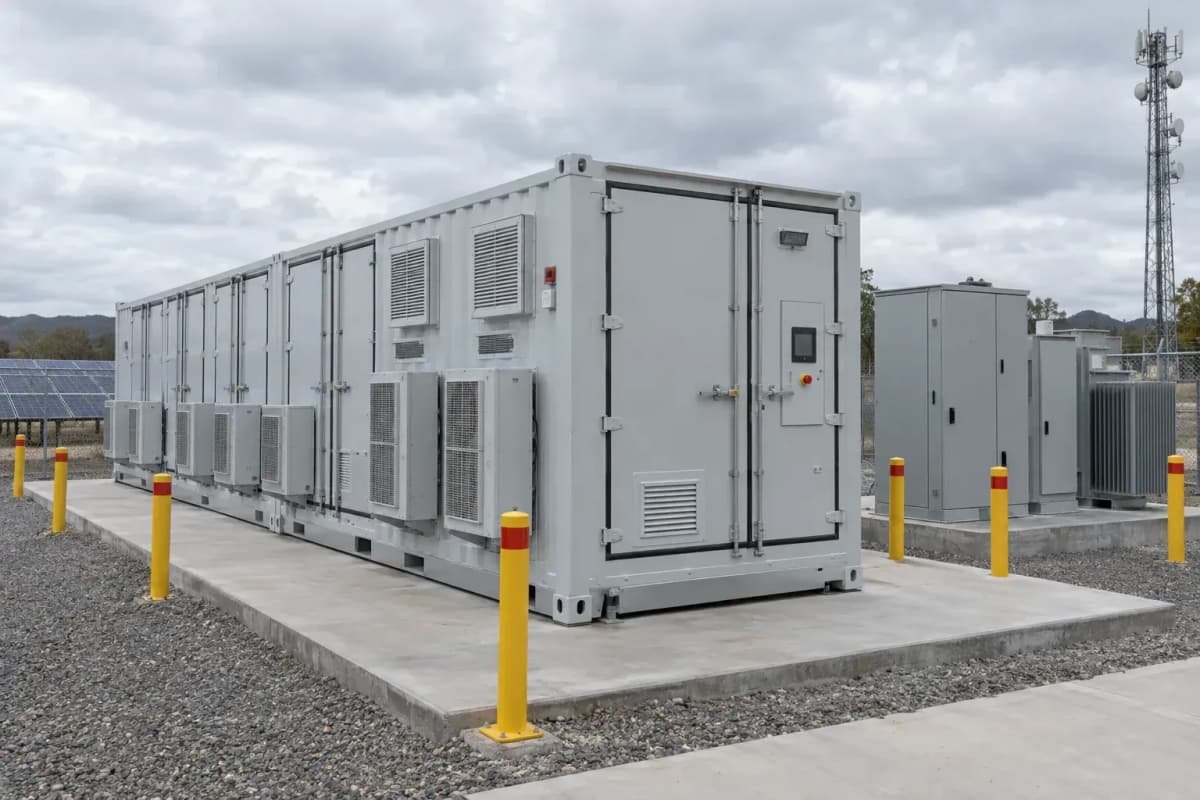
2MWh Telecom Backup LFP - 4MW 40ft Container BESS
Key Features
- 2,000 kWh containerized LFP capacity with 95% DoD for about 1,900 kWh usable energy.
- 4,000 kW bidirectional PCS supports high-rate telecom backup and less than 10 ms transfer target.
- 40ft ISO container integrates BMS, EMS, liquid cooling, switchgear, fire suppression, and transformer interface.
- 6,000+ cycle LFP design with 10-year / 70% capacity warranty under agreed operating limits.
- EPC turnkey price range is $246,500 - $297,500, equal to about $123/kWh - $149/kWh.
The 2MWh Telecom Backup LFP is a 40ft containerized BESS rated at 2,000 kWh and 4,000 kW for high-availability telecom backup, UPS replacement, and grid-to-island transfer below 10 ms. It uses LFP chemistry, 95% DoD, liquid cooling, bidirectional PCS, BMS/EMS controls, and safety alignment with UL 9540A, IEC 62619, UN38.3, and NFPA 855.
Description
The 2MWh Telecom Backup LFP is a 40ft containerized battery energy storage system with 2,000 kWh usable-scale capacity, 4,000 kW bidirectional power, 95% depth of discharge, and up to 2 daily cycles for telecom hubs, switching centers, data backhaul sites, and remote network shelters. Designed as a lithium iron phosphate BESS for backup power and UPS replacement, it targets seamless grid-to-island transfer in less than 10 ms, 1C to 2C short-duration discharge profiles, and EPC turnkey delivery from $246,500 to $297,500.
SOLARTODO positions this system for B2B buyers who need a technically specified backup platform rather than a small rack battery, because a 2 MWh container can support either a 4 MW peak load for about 0.5 hours or a 250 kW telecom compound for about 8 hours before reserve margins are applied. Buyers comparing stationary storage options can View all Battery Energy Storage System (BESS) products, Configure your system online, or Request a custom quotation for site-specific autonomy, grid voltage, and transformer requirements.
Product Definition and Buyer Fit
The product line is Battery Energy Storage System (BESS), the form factor is a 40ft ISO container, and the chemistry is LFP, which is widely used in stationary storage because it avoids nickel and cobalt while maintaining long cycle life. The supplied configuration uses 2,000 kWh nominal energy, 4,000 kW PCS power, 2 cycles per day, and 95% DoD, making it better suited to telecom switching nodes and regional network aggregation sites than to small tower cabinets below 50 kWh.
For telecom procurement teams, the practical selection question is often whether to replace diesel runtime, lead-acid strings, or a legacy UPS with a containerized lithium system sized around 1 to 8 hours of autonomy. A conventional valve-regulated lead-acid battery bank typically uses only about 50% DoD for life protection, while this LFP design uses 95% DoD; for the same usable 1,900 kWh, lead-acid may require roughly 3,800 kWh of installed nameplate capacity, before HVAC and replacement penalties are counted.
System Architecture
The architecture uses prismatic LFP cells in aluminum housings, rack-level BMS boards, liquid cooling loops, a central EMS, a 4,000 kW bidirectional PCS, DC protection, AC switchgear, and a transformer interface selected for the project voltage. In a typical telecom microgrid layout, the BESS sits between the utility service, diesel generator set, solar PV inverter bus, and critical AC/DC telecom loads, allowing grid-tied charging and island-mode discharge through a controlled transfer sequence below 10 ms.
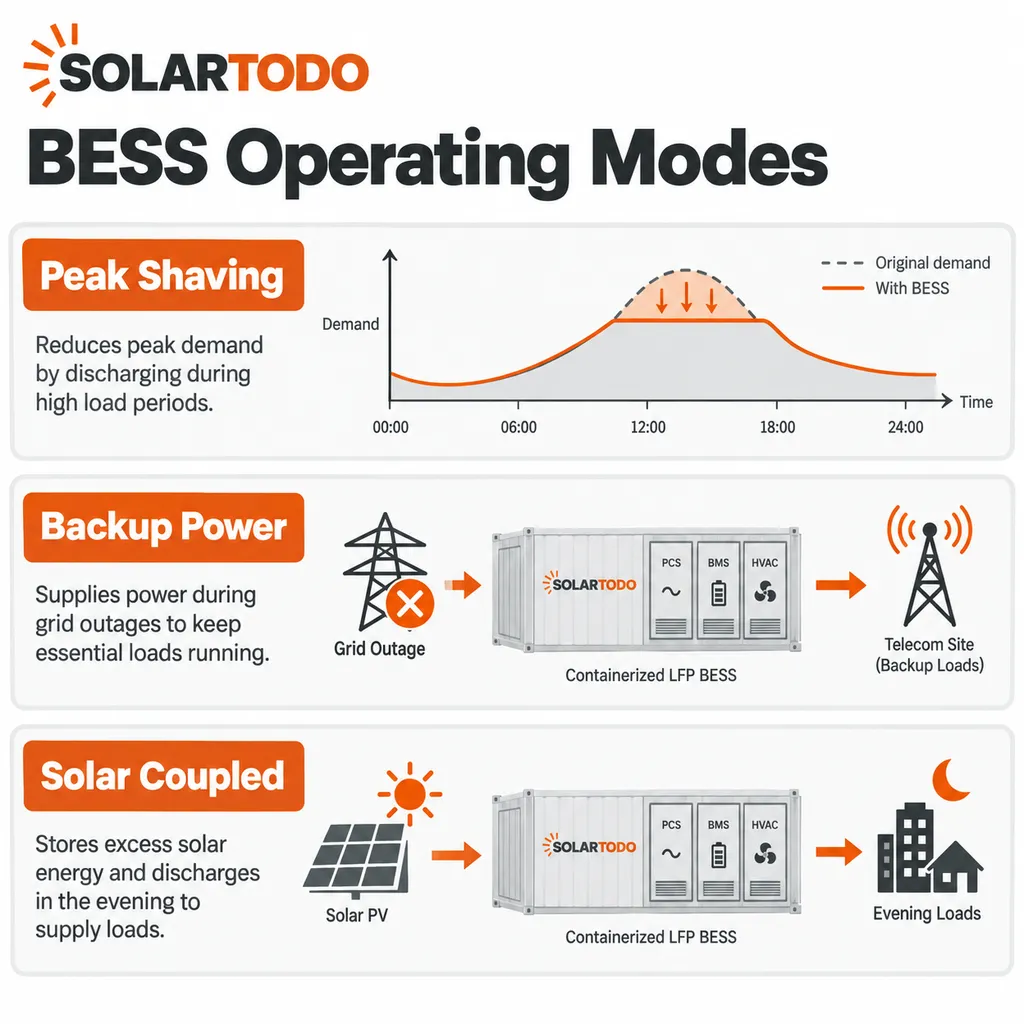
At the battery layer, the BMS monitors cell voltage, current, temperature, state of charge, and state of health across 2,000 kWh of storage, with balancing logic intended to reduce cell drift during repeated partial cycling. At the power layer, the PCS supports charge and discharge conversion above 96% peak efficiency under suitable operating conditions, and at the control layer the EMS coordinates charging windows, generator start thresholds, alarm escalation, and cloud telemetry at intervals such as 1 minute or 5 minutes.
Technical Specifications
The standard electrical specification is 2,000 kWh energy capacity, 4,000 kW power rating, LFP chemistry, 95% DoD, more than 6,000 design cycles, and a 10-year warranty to 70% retained capacity under agreed operating limits. Thermal design uses liquid cooling because containerized systems above 100 kWh accumulate enough heat during high-rate cycling that air-only cooling can produce larger rack-to-rack temperature deltas and accelerate cell imbalance.
| Parameter | Standard Value | Engineering Note |
|---|---|---|
| Energy capacity | 2,000 kWh | Containerized telecom backup reserve |
| PCS power | 4,000 kW | High-rate backup and short-duration ride-through |
| Discharge duration at full PCS rating | 0.5 h | Longer autonomy available at lower telecom load |
| Depth of discharge | 95% | About 1,900 kWh usable energy before reserves |
| Daily cycling | 2 cycles/day | Suitable for outage support and tariff shifting |
| Cycle life | 6,000+ cycles | Dependent on temperature, C-rate, and DoD profile |
| Switchover target | <10 ms | UPS-style transfer objective for critical loads |
| Operating temperature | -20°C to +55°C | Derating may apply above site design limits |
IEC 62619:2017 covers safety requirements and tests for secondary lithium cells and batteries used in industrial applications, including stationary telecom, UPS, and energy storage applications. UL 9540A provides a thermal-runaway fire-propagation test method, and NFPA 855 addresses stationary energy storage installation criteria; these standards are important because a 2 MWh container is an engineered electrical installation, not a consumer battery appliance.
Telecom Backup Applications
The 2MWh Telecom Backup LFP system can support macro telecom sites, regional switching centers, edge data cabinets, microwave relay stations, rail communications hubs, and public-safety network shelters where outages of 5 minutes to 8 hours can interrupt service-level agreements. A network operator with 10 critical compounds can standardize on one container design while adjusting AC switchgear, DC rectifier integration, and generator controls per site.
In backup mode, the BESS can replace or reduce diesel generator runtime by absorbing short outages that occur several times per month, while retaining generator integration for extended events beyond 8 hours. Compared with a diesel-only backup strategy, a battery-first dispatch plan can reduce generator starts by 60% to 90% in sites dominated by short interruptions, because the BESS covers voltage sags, brownouts, grid reclose events, and transfer delays without warm-up time.
For a representative MENA telecom hub scenario, assume a 350 kW critical load, 6 hours of required autonomy, grid outages averaging 240 hours/year, diesel cost of $1.10/liter, generator consumption of 0.27 liters/kWh, and BESS round-trip efficiency of 90%. The BESS can supply about 1,900 kWh usable energy per full discharge, covering roughly 5.4 hours at 350 kW, while saving about 22,680 liters/year of diesel if it offsets 84,000 kWh/year of generator energy.
Cloud Monitoring
The EMS can expose operating data including SOC, SOH, rack temperature, PCS status, alarms, site load, charge power, discharge power, and event logs through a cloud platform with configurable 1-minute or 15-minute dashboards. Telecom operations teams can use these records to verify whether a site delivered 400 kW, 1,000 kW, or 4,000 kW during an outage, and to separate utility failures from battery, rectifier, generator, or load-side events.
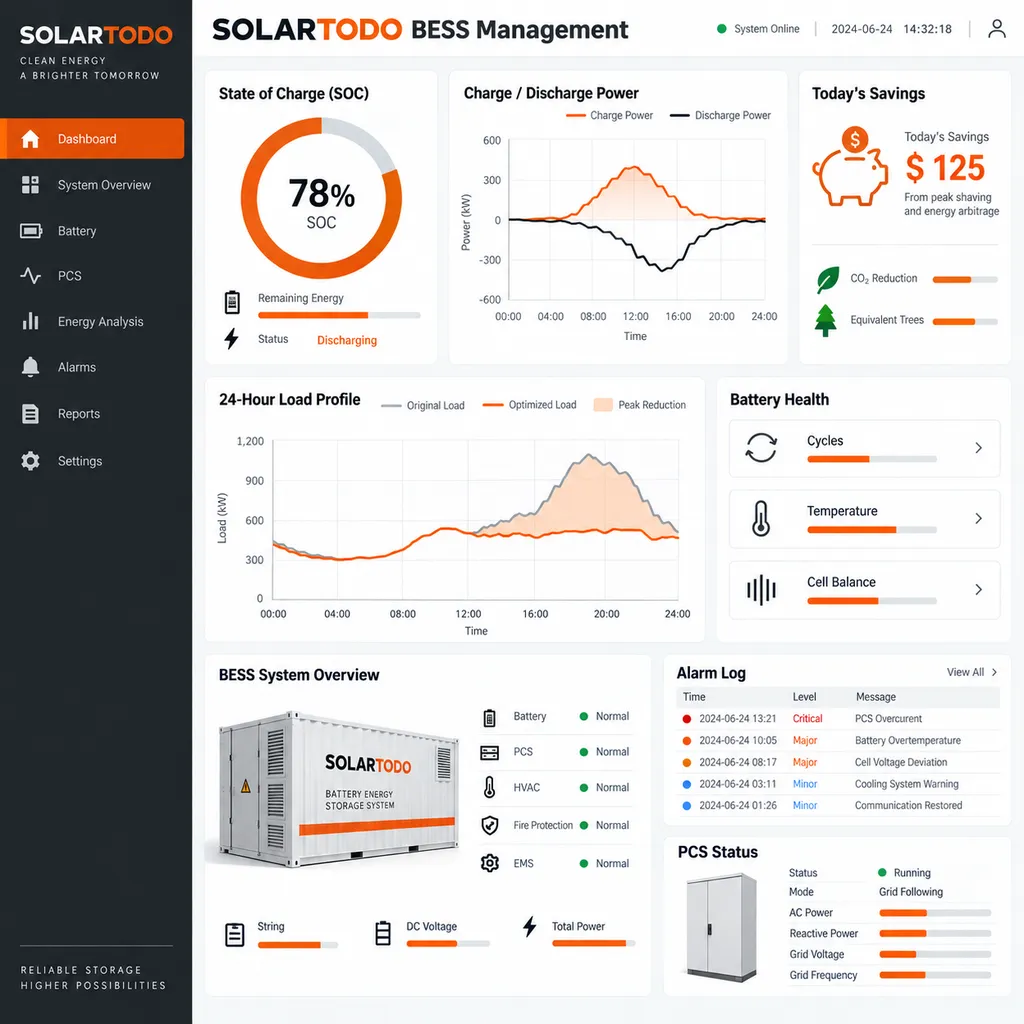
Remote monitoring is especially valuable for distributed telecom networks because truck rolls can cost hundreds of USD per visit and require 2 to 12 hours depending on site access. A well-configured alarm hierarchy can flag 3 categories of events: advisory conditions such as high ambient temperature, operational conditions such as low SOC below 20%, and critical shutdown conditions such as smoke detection, gas detection, or DC insulation failure.
Safety, Standards, and Compliance
The safety concept uses 3 protection layers: cell and rack monitoring through the BMS, electrical protection through breakers/contactors/fuses, and container-level mitigation through gas detection, ventilation logic, fire suppression, and automatic shutdown. SOLARTODO specifies LFP chemistry because its phosphate cathode has stronger thermal stability than nickel-rich chemistries, but every 2 MWh installation still requires spacing, ventilation, signage, emergency response planning, and AHJ review.
Relevant standards include UL 9540 for energy storage systems and equipment, UL 9540A for thermal runaway propagation data, IEC 62619 for industrial lithium battery safety, UN38.3 for lithium battery transport testing, and NFPA 855 for stationary ESS installation. IEEE interconnection practices and local grid codes may also apply when the 4 MW PCS operates grid-tied, exports power, or provides voltage and frequency functions at medium voltage.
The International Energy Agency reported that LFP reached about 80% of new battery storage installations in 2023, reflecting cost and supply-chain advantages for stationary systems (IEA, Batteries and Secure Energy Transitions, 2024). IRENA’s storage valuation framework emphasizes that storage value depends on stacked services and dispatch context, while NREL’s utility-scale storage cost work models 4-hour lithium-ion systems as a benchmark for cost trajectories, not as a substitute for project-specific EPC pricing.
EPC Investment Analysis and Pricing Structure
EPC turnkey delivery includes 5 work scopes: engineering, procurement, construction, commissioning, and a 1-year site warranty/support package. For this 2MWh Telecom Backup LFP project, SOLARTODO’s quoted EPC range is $246,500 to $297,500, while equipment-only FOB supply is $152,830 to $202,300 and CIF delivered pricing is $183,946 to $243,488 before local civil works and interconnection labor.
| Pricing Tier | Scope | Price Range (USD) |
|---|---|---|
| FOB Supply | Equipment only, ex-works China | $152,830 - $202,300 |
| CIF Delivered | Equipment, ocean freight, and insurance | $183,946 - $243,488 |
| EPC Turnkey | Installed, commissioned, and 1-year warranty | $246,500 - $297,500 |
| Volume Band | Discount | Commercial Basis |
|---|---|---|
| 50+ systems | 5% | Framework purchase order or annual call-off |
| 100+ systems | 10% | Multi-country telecom rollout or EPC bundle |
| 250+ systems | 15% | Strategic supply agreement with forecasted deliveries |
A representative ROI model uses 84,000 kWh/year of diesel displacement, 0.27 liters/kWh generator fuel consumption, $1.10/liter diesel, and $0.08/kWh battery recharge energy. The gross avoided diesel cost is about $24,948/year, recharge energy cost is about $6,720/year, and net direct energy savings are about $18,228/year before maintenance reduction, outage penalties, and generator overhaul deferral.
When maintenance and reliability are included, the economic case improves because avoided generator starts reduce oil, filters, runtime inspections, and emergency refueling across 10-year asset life. If the project assigns $7,000/year to avoided maintenance and outage response, total annual savings rise to about $25,228/year, giving a simple payback of about 9.8 to 11.8 years against the $246,500 to $297,500 EPC range.
Payment terms are 30% T/T deposit plus 70% against bill of lading, or 100% L/C at sight for approved buyers. For project portfolios above $5,000,000, SOLARTODO can discuss financing support, phased shipment schedules, inspection milestones, and bank documentation; commercial inquiries should be directed to [email protected] with site voltage, autonomy target, ambient temperature, and quantity.
Integration and Commissioning Workflow
A typical project starts with 4 engineering inputs: single-line diagram, critical load profile, required autonomy, and grid/generator interface details. SOLARTODO then sizes DC racks, PCS settings, protection coordination, transformer rating, container auxiliary loads, and EMS communication before issuing drawings for buyer review, because a 4 MW PCS can create very different protection requirements at 400 V, 690 V, or medium-voltage interconnection.
Commissioning includes insulation checks, torque verification, BMS communication checks, liquid-cooling loop validation, PCS energization, EMS alarm tests, simulated outage transfer, and capacity or functional discharge testing over an agreed 1 to 4 hour procedure. Final handover should include as-built drawings, O&M manuals, spare-parts list, warranty statement, training records, and test sheets showing at least 10 critical alarms and control functions.
Lifecycle, Operations, and Maintenance
The maintenance plan normally includes monthly remote data review, quarterly visual inspection, 6-month HVAC or liquid-cooling service checks, and annual protection/alarm verification. Because the design target is 6,000+ cycles and 10 years to 70% capacity, operators should avoid unnecessary high-temperature cycling, maintain container seals, keep filters clear, and keep SOC windows aligned with the telecom outage model.
Battery degradation is influenced by 4 primary variables: temperature, average SOC, C-rate, and DoD. A site cycling 2 times per day at 95% DoD uses about 730 equivalent cycles per year, so lifetime planning should compare contractual cycle limits, usable capacity warranty, and expected outage frequency rather than relying only on a calendar-life number.
Procurement Notes for B2B Buyers
For procurement evaluation, request a bill of materials, cell brand, PCS topology, transformer specification, IP rating, fire suppression type, UL 9540A test evidence where applicable, IEC 62619 cell or battery documentation, and UN 38.3 transport documentation. Buyers should also verify whether the quoted EPC price includes cranes, foundations, cable trenches, medium-voltage work, permitting, taxes, and site security, because those items can shift installed cost by more than 10% in remote telecom projects.
For technical background, buyers can Learn about topic on BESS sizing, safety standards, and telecom backup architectures before issuing an RFQ. SOLARTODO recommends attaching at least 12 months of load and outage data when available, because a 2 MWh battery can be optimized very differently for rare 8-hour outages than for frequent 15-minute disturbances.
Market Context and Cost Benchmarks
Battery storage costs changed rapidly between 2020 and 2026, so procurement teams should separate cell cost, DC block cost, PCS cost, logistics, installation, and warranty reserves. IEA analysis in 2024 highlighted the growth of LFP in storage, IRENA tracks storage value by use case rather than nameplate alone, and BloombergNEF has repeatedly identified lithium-ion pack-cost declines as a major driver of stationary storage adoption.
This SOLARTODO price band equals about $123/kWh to $149/kWh on an EPC basis using 2,000 kWh nameplate energy, or about $61.6/kW to $74.4/kW using 4,000 kW PCS power. Those ratios are useful screening metrics, but the final bankable comparison should model usable kWh, guaranteed cycles, safety documentation, local installation scope, and telecom downtime value over at least 10 years.
Ordering Information
Use this product when the project requires a containerized BESS with 2 MWh nominal energy, 4 MW peak power, high-rate backup, liquid cooling, integrated EMS, and telecom-specific outage logic. To proceed, send SOLARTODO the required quantity, country, site count, AC voltage, autonomy target, maximum ambient temperature, grid/export restrictions, and preferred Incoterm, then request a technical and commercial package through Request a custom quotation.
Technical Specifications
| Energy Capacity | 2000kWh |
| Power Rating | 4000kW |
| Battery Chemistry | LFP |
| Form Factor | 40ft ISO container |
| Application | Telecom backup and UPS replacement |
| Round-trip Efficiency | 90% |
| Depth of Discharge | 95% |
| Daily Cycles | 2cycles/day |
| Cycle Life | 6000+cycles |
| Calendar Life | 10years |
| Operating Temperature | -20 to 55deg C |
| Transfer Time Target | <10ms |
| Annual Savings | 25228USD/year |
| Payback Period | 9.8 - 11.8years |
| Warranty | 10 years / 70% capacity |
Price Breakdown
| Item | Quantity | Unit Price | Subtotal |
|---|---|---|---|
| LFP battery cells and rack modules | 2000 kWh | $55 | $110,000 |
| Battery Management System with SOC/SOH monitoring | 2000 kWh | $15 | $30,000 |
| Integrated 4MW bidirectional PCS allowance | 4000 kW | $10 | $40,000 |
| Liquid thermal management package | 1 pcs | $25,000 | $25,000 |
| 40ft ISO container and enclosure integration | 1 pcs | $8,000 | $8,000 |
| Fire suppression, gas detection, and shutdown kit | 1 pcs | $5,000 | $5,000 |
| EMS software and cloud monitoring gateway | 1 pcs | $3,000 | $3,000 |
| Transformer, AC switchgear, and protection package | 1 pcs | $14,000 | $14,000 |
| Installation and commissioning labor | 1 pcs | $20,000 | $20,000 |
| Factory engineering, documentation, and QC | 1 pcs | $15,000 | $15,000 |
| 1-year warranty and remote support reserve | 1 pcs | $10,000 | $10,000 |
| Total Price Range | $246,500 - $297,500 | ||
Frequently Asked Questions
How much usable energy does the 2MWh Telecom Backup LFP system provide?
What does the EPC turnkey price include?
Which standards are relevant for this telecom BESS?
Can this system replace a diesel generator completely?
Why use LFP instead of lead-acid or NCM for telecom backup?
Certifications & Standards


Data Sources & References
- •NREL Cost Projections for Utility-Scale Battery Storage: 2025 Update
- •IEA Batteries and Secure Energy Transitions 2024
- •IEA Global EV Outlook 2026 battery chapter
- •IRENA Electricity Storage Valuation Framework 2020
- •UL Solutions UL 9540A and NFPA 855 ESS safety guidance
- •IEC 62619:2017 industrial lithium battery safety standard
- •NFPA 855 Standard for the Installation of Stationary Energy Storage Systems
Interested in this solution?
Contact us for a customized quote based on your specific requirements.
Contact Us