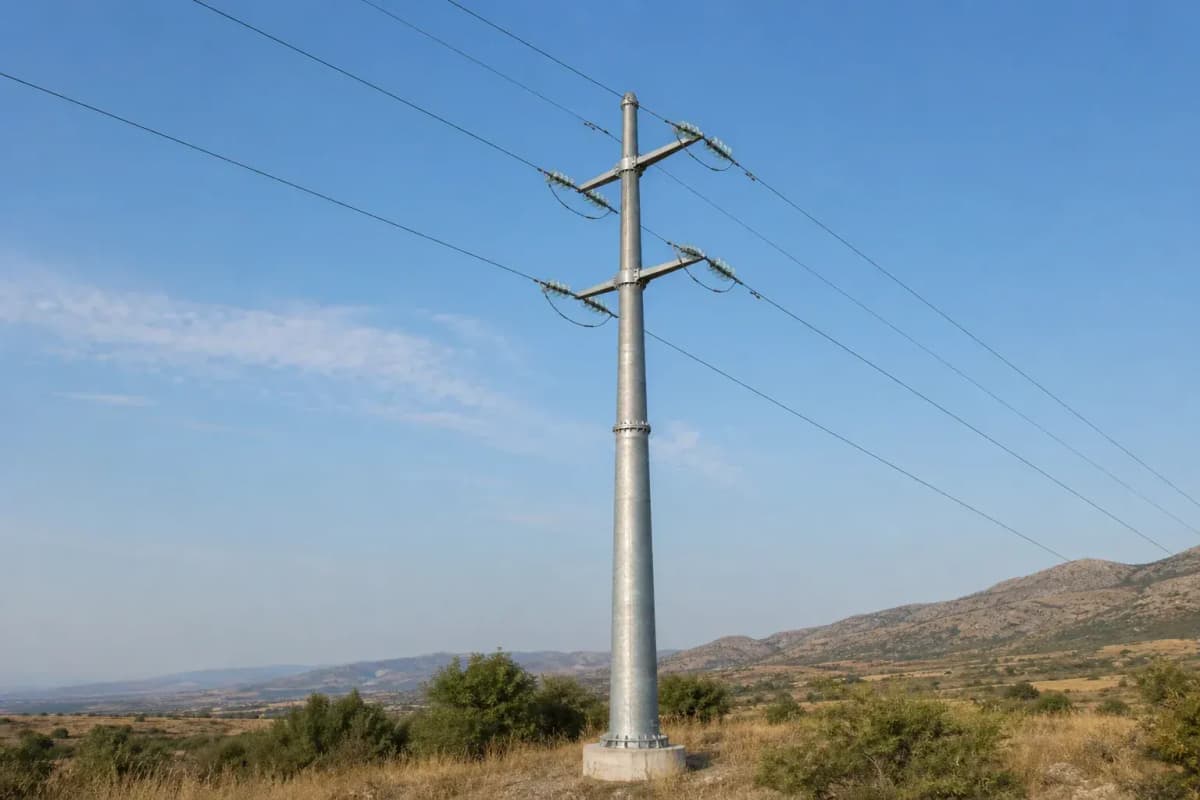
15m 10kV Round Tubular Distribution Flanged Pole - Dual-Circuit Steel Monopole
Key Features
- 15m hot-dip galvanized round tubular steel pole for 10kV distribution feeders
- 2-circuit configuration with 1 conductor per phase and 6 phase attachment points
- 105m representative design span with Class B wind and 15mm ice assumption
- Flanged base connection supports faster replacement and 15%-25% lower alignment time in repetitive corridors
- EPC Turnkey price range of $4,000-$6,300 with 1-year warranty included
The 15m 10kV Round Tubular Distribution Flanged pole is a dual-circuit, hot-dip galvanized steel monopole for 105m distribution spans. It uses a flanged base connection, 1 conductor per phase, Class B wind design, 15mm ice allowance, and EPC turnkey pricing from $4,000 to $6,300.
Description
The 15m 10kV Round Tubular Distribution Flanged pole is a hot-dip galvanized steel monopole for 10kV urban and suburban distribution feeders, designed for 2 circuits, 1 conductor per phase, and a representative 105m span. SOLARTODO specifies this 15m flanged tubular structure for projects that need compact right-of-way use, 50-year design life, predictable foundation interfaces, and EPC turnkey delivery in the $4,000-$6,300 range.
This product belongs to SOLARTODO's Power Transmission Tower/Pole line for 10kV to 110kV utility corridors, distributed energy plants, industrial parks, telecom-energy hybrid sites, and smart infrastructure projects. Buyers comparing steel monopoles, lattice towers, FRP poles, and concrete poles can View all Power Transmission Tower/Pole products or Configure your system online before issuing a bill of quantities for 50, 100, or 250+ pole packages.
System Architecture
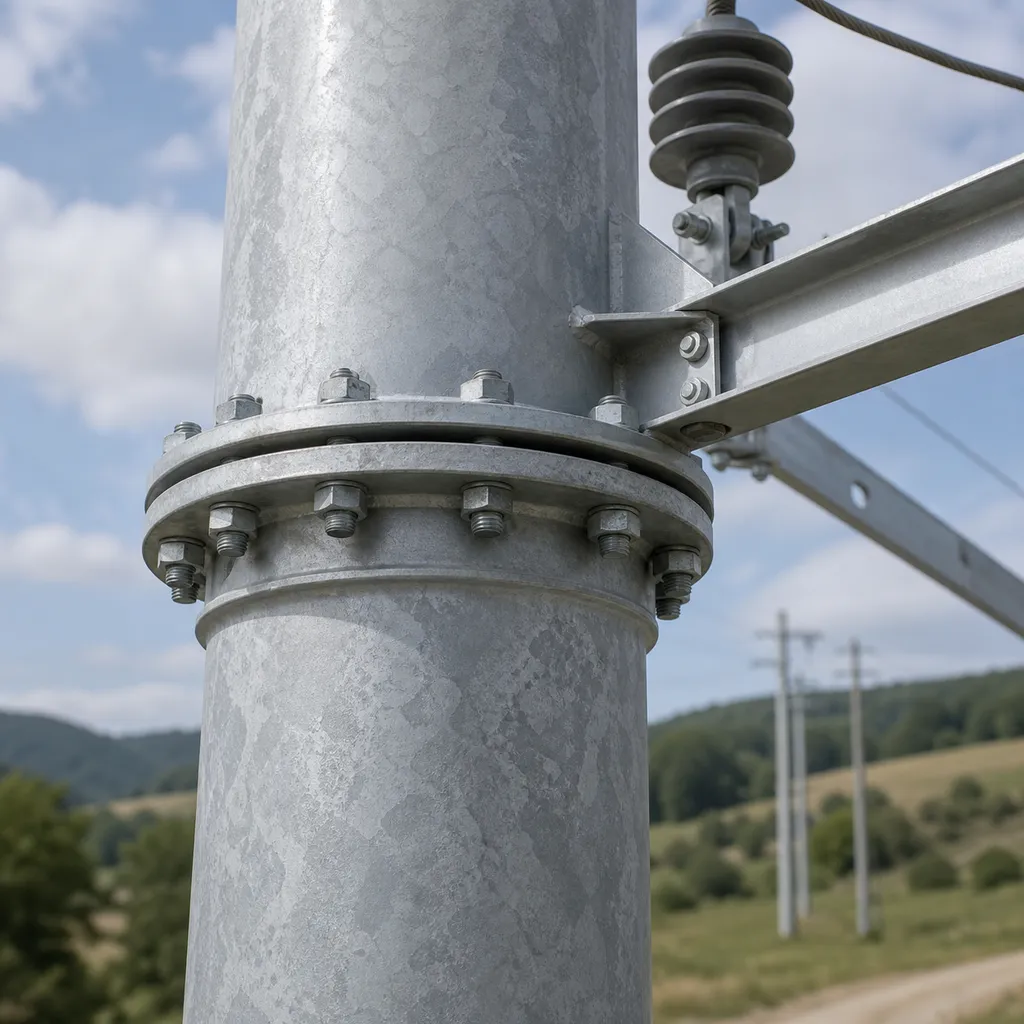
The structural architecture uses a round or slightly tapered steel tube shaft, a factory-welded base flange, anchor bolts, cross-arm attachments, insulator brackets, grounding lugs, and hot-dip galvanizing on all exposed steel surfaces. In a typical 10kV double-circuit layout, the pole supports 6 phase attachment points, 1 optional overhead ground wire or OPGW route, and a base plate designed to transfer overturning moment into a reinforced concrete foundation.
For distribution feeders using ACSR conductors, the 15m height provides electrical clearance while keeping the visual profile lower than many 18m to 24m sub-transmission structures. The 105m design span is a practical planning value, because actual ruling span, sag, tension, terrain class, and clearance must be checked against local utility codes, IEC 60826 load combinations, and IEEE 738 conductor thermal-rating calculations.
Technical Specifications
The standard specification is 15m height, 10kV voltage rating, distribution service, steel round tubular material, 2 circuits, 1 conductor per phase, flanged base connection, and 105m design span. The default environmental assumption is Class B wind with 15mm ice, while the project-specific design should confirm wind speed in m/s, ice thickness in mm, conductor diameter, conductor tension, broken-wire case, seismic zone, soil bearing capacity, and required tower-footing resistance.
Steel tube selection is normally based on Q355, Q420, or Q460 grade depending on bending moment and procurement standard, with Q460 galvanized tube commonly budgeted near $1,500 per metric ton as an industry average. Galvanizing should follow ISO 1461 or ASTM A123 practices where applicable, because zinc coating thickness, vent-hole layout, edge preparation, and bath immersion quality directly affect the 50-year corrosion-maintenance plan.
The flanged connection is selected where installation speed, replaceability, and foundation dimensional control matter more than direct-buried simplicity. Compared with a direct-embedded pole, a flanged base can reduce on-site lifting and alignment time by about 15%-25% in repetitive 50+ pole corridors, provided anchor templates are controlled within millimeter-level tolerances during concrete placement.
Standards and Engineering Basis
IEC 60826 is the primary international reference for overhead transmission line loading, including wind, ice, temperature, and reliability-based load cases for structures and conductors. IEEE 738 is relevant for calculating conductor current-temperature behavior, while ASCE 10-15 is commonly referenced for lattice transmission structures and offers useful load-path discipline even when a tubular monopole is governed by local steel-pole codes.
For China-origin EPC or supply contracts, GB 50545 is frequently used for overhead line design, and it should be cross-checked against the destination country's grid code before fabrication drawings are released. NREL grid-modernization research, IEA electricity-system analysis, and IRENA renewable-integration reports all point to 10kV-35kV distribution networks as critical infrastructure for integrating distributed PV, storage, EV charging, and smart loads at scale.
The product can be paired with porcelain insulators at about $80 per unit or composite polymer insulators at about $150 per unit, depending on pollution class, vandal-resistance requirements, leakage distance, and maintenance policy. Composite insulators typically reduce installed weight by more than 50% compared with many porcelain strings, while porcelain remains familiar for utilities with conservative stock management and established inspection routines.
Representative Scenario
For a representative MENA industrial-solar feeder scenario with 10MW of distributed PV, a 10kV double-circuit pole line, 105m average span, and 1 ACSR conductor per phase, approximately 10 poles are needed per 1.05km route before adding terminal, angle, and dead-end structures. If the route uses 50 standard tangent poles plus several heavier angle poles, SOLARTODO would separate structural classes so the 15m flanged tubular unit is not over-specified for every location.
In this scenario, the 15m round tubular profile is well suited to road-adjacent corridors, factory estates, ports, logistics yards, and hybrid solar-storage microgrids where land use and aesthetics have measurable value. A tubular monopole can require 40%-70% less ground footprint than a conventional 4-legged lattice tower at comparable distribution voltage, although the exact percentage depends on foundation design, conductor clearance envelope, access road width, and grounding grid geometry.
Applications
Typical applications include 10kV feeder extensions, renewable-energy collector routes, industrial park distribution backbones, telecom power corridors, smart-lighting backbone lines, agricultural irrigation energy networks, and compact suburban utility upgrades. The pole's 2-circuit configuration supports feeder redundancy or staged energization, allowing 1 circuit to be commissioned first and the second circuit to be reserved for a future 5MW-20MW load block where utility protection settings permit.
The product is also appropriate for smart-infrastructure projects where power distribution shares a corridor with fiber, monitoring, lighting, or security systems. OPGW can provide lightning shielding and optical communication in 1 cable, but at roughly $8,000 per km it should be justified by SCADA, protection, metering, or telecom revenue requirements rather than added automatically to every 10kV pole line.
Cloud Monitoring
When required, SOLARTODO can integrate pole-line assets with cloud monitoring for inspection records, maintenance tickets, image evidence, grounding checks, and weather-related event tracking. A practical monitoring scope for 100 poles may include GPS coordinates, serial numbers, coating batch records, torque reports, inspection photos, and annual resistance readings, with alarm thresholds such as <10 ohm for standard grounding and <4 ohm for high-lightning zones.
Cloud monitoring does not replace electrical protection design, but it improves asset traceability for multi-site owners operating 10 or more distribution corridors. IEA grid reports emphasize that power networks need digital visibility as electrification expands, and IRENA has repeatedly identified grid reinforcement as a constraint for renewable-energy integration, especially where distributed PV and storage are added faster than medium-voltage feeders are upgraded.
Materials, Fabrication, and Quality Control
Fabrication normally includes plate cutting, tube forming, longitudinal welding, flange welding, bracket welding, trial assembly, hot-dip galvanizing, dimensional inspection, marking, and protective packing for ocean freight. Quality control should include 100% visual weld inspection, dimensional checks on flange-hole pitch, coating-thickness measurement in microns, bolt-grade verification, and packing lists matched to the 1-pole installation kit.
For a 15m pole, transport planning should verify container length limits, bundled diameter, lifting points, and local road turning radius before shipment. CIF Delivered pricing from $3,171 to $5,478 includes ocean freight and insurance allowance, but inland trucking, port congestion, import duties, VAT, crane waiting time, and route permits can add 5%-20% to delivered project cost in some countries.
Foundation and Installation
The default foundation is a reinforced concrete block or drilled pier sized by geotechnical capacity, overturning moment, uplift, and shear at the anchor bolt group. A budgetary concrete foundation can be estimated from $350 per m3, but final dimensions must be signed by a licensed civil or structural engineer using soil data, pole reactions, groundwater level, and local safety factors.
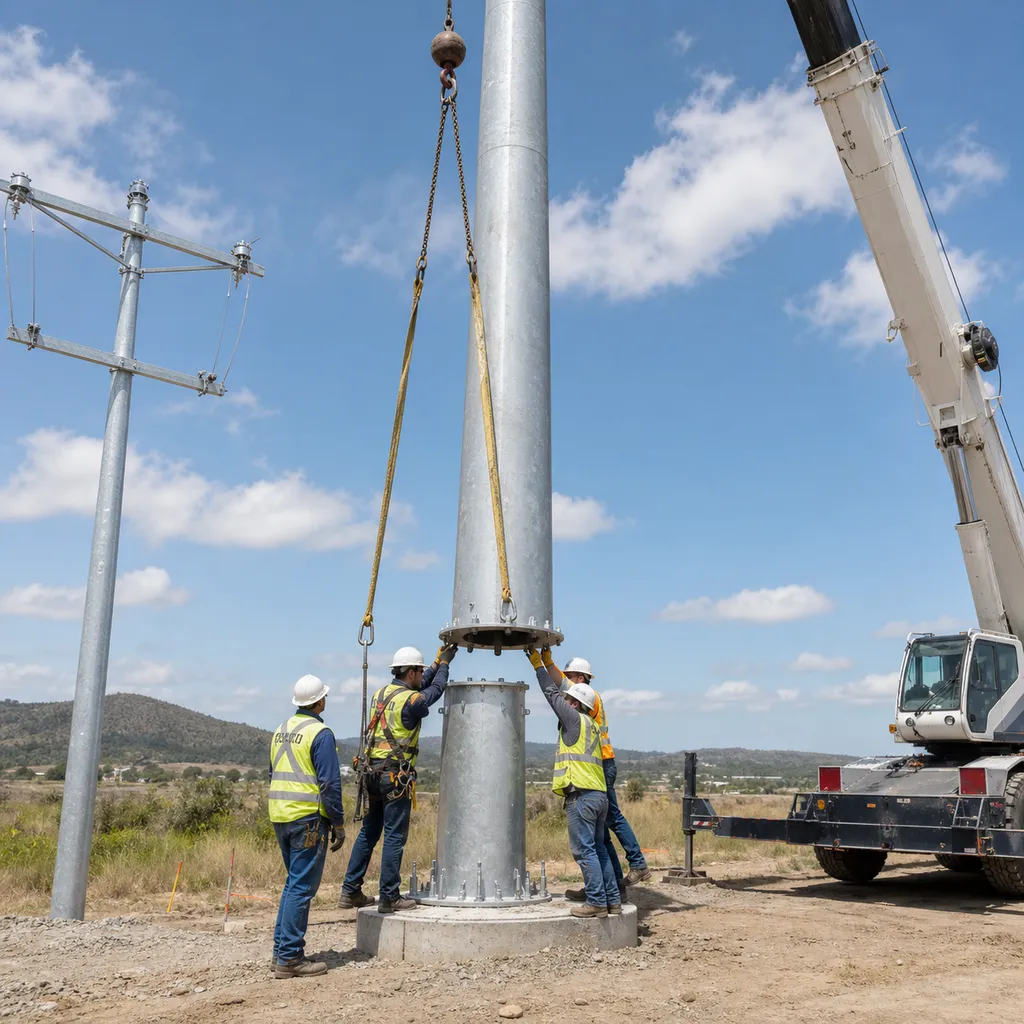
Installation work includes anchor template setting, rebar cage placement, concrete pouring, curing time, pole erection, bolt torqueing, cross-arm installation, insulator mounting, conductor stringing support, grounding installation, and final commissioning checks. Installation labor is commonly estimated near $200 per ton of steel as an early budgeting value, but the EPC turnkey price already includes engineering, procurement, construction, commissioning, and 1-year warranty scope for this specific product range.
EPC Investment Analysis and Pricing Structure
EPC delivery includes engineering drawings, procurement, fabrication coordination, quality inspection, export packing, freight coordination where selected, civil foundation works, erection, grounding, commissioning documentation, and a 1-year warranty. For this 15m 10kV flanged tubular pole, SOLARTODO prices EPC Turnkey delivery at $4,000-$6,300 per installed unit, while FOB Supply remains $2,480-$4,284 and CIF Delivered remains $3,171-$5,478.
| Pricing tier | Scope | Unit price range |
|---|---|---|
| FOB Supply | Equipment only, ex-works China | $2,480-$4,284 |
| CIF Delivered | Equipment, ocean freight, and insurance | $3,171-$5,478 |
| EPC Turnkey | Installed, commissioned, and 1-year warranty | $4,000-$6,300 |
| Volume quantity | Discount from quoted unit price |
|---|---|
| 50+ poles | 5% |
| 100+ poles | 10% |
| 250+ poles | 15% |
A realistic ROI case compares the flanged tubular pole against a wider-footprint lattice or direct-buried alternative where land access, outage time, and maintenance visits create measurable costs. If a 100-pole corridor saves $150 per pole-year in inspection access, right-of-way management, and faster replacement logistics, annual savings are about $15,000; against an added upfront premium of $120,000, the simple payback is about 8 years before valuing aesthetics, land retention, or reduced outage exposure.
Payment terms are normally 30% T/T deposit + 70% against B/L copy, or 100% irrevocable L/C at sight for bankable buyers. Project financing can be discussed for qualified packages above $1,000K, and procurement teams can Request a custom quotation or contact [email protected] with route length, voltage, soil data, wind speed, ice thickness, conductor type, and delivery port.
Procurement Notes for Engineers
To avoid change orders, tender documents should define at least 12 inputs: voltage, circuits, span, conductor type, wind speed, ice thickness, altitude, pollution level, grounding resistance, soil bearing capacity, corrosion category, and drawing approval workflow. Buyers should also define whether the pole is tangent, angle, terminal, or dead-end, because the mechanical duty can change steel tonnage, base flange thickness, and anchor bolt diameter by more than 20%.
The most important commercial boundary is separating supply-only pricing from installed EPC pricing. A FOB number may look 30%-40% lower than EPC, but it excludes foundation excavation, concrete, crane time, conductor work coordination, grounding tests, commissioning records, warranty service, and local project management; therefore procurement comparisons should normalize all bids to the same 1-pole scope.
Related Knowledge
For design teams building medium-voltage corridors, SOLARTODO recommends reviewing Learn about topic for grid-integration concepts and distribution infrastructure planning. Engineers may also use Learn about topic when comparing ACSR conductor choices, OPGW communication value, grounding resistance targets, and IEC 60826 load-case assumptions for 10kV, 35kV, and 110kV pole-line projects.
Buyer Checklist
Before fabrication, confirm 6 electrical items and 6 civil items: conductor model, phase spacing, insulator type, earthing method, lightning protection, protection clearance, soil report, foundation size, anchor template, access route, lifting plan, and corrosion category. Before shipment, confirm 4 documents: approved drawings, packing list, galvanizing inspection report, and installation method statement.
Summary
The 15m 10kV Round Tubular Distribution Flanged pole is a compact, standards-aligned structure for dual-circuit distribution routes where land use, installation speed, corrosion resistance, and predictable EPC delivery matter. With a 105m design span, 50-year design life basis, 15mm ice design assumption, and EPC budget of $4,000-$6,300, it gives engineers and procurement teams a defined starting point for bankable 10kV feeder planning.
Technical Specifications
| Tower Height | 15m |
| Voltage Rating | 10kV |
| Tower Type | Distribution steel tubular monopole |
| Material | Hot-dip galvanized steel round tubular |
| Number of Circuits | 2 |
| Conductor Bundle | 1 x ACSR per phase |
| Design Span | 105m |
| Wind/Ice Load | Class B / 15mm ice |
| Connection Type | Flanged base |
| Foundation | Reinforced concrete with anchor bolts |
| Grounding Resistance Target | <10 standard, <4 high-lightningohm |
| Design Life | 50years |
| Standards | IEC 60826 / GB 50545 / IEEE 738 / ASCE 10-15 |
Price Breakdown
| Item | Quantity | Unit Price | Subtotal |
|---|---|---|---|
| Galvanized round tubular steel pole assembly | 1 pcs | $2,400 | $2,400 |
| Flanged base plate and anchor bolt kit | 1 pcs | $320 | $320 |
| Porcelain insulator set for double circuit | 6 pcs | $80 | $480 |
| Grounding system and earthing hardware | 1 pcs | $500 | $500 |
| Reinforced concrete foundation allowance | 2 pcs | $350 | $700 |
| Engineering drawings and quality control | 1 pcs | $350 | $350 |
| Installation and commissioning labor | 1 pcs | $400 | $400 |
| Ocean freight and insurance allocation | 1 pcs | $350 | $350 |
| 1-Year warranty and support | 1 pcs | $150 | $150 |
| Commissioning tests and documentation | 1 pcs | $150 | $150 |
| Total Price Range | $4,000 - $6,300 | ||
Frequently Asked Questions
What is included in the EPC Turnkey price for this 15m 10kV pole?
Can the 15m flanged pole support 2 circuits at 10kV?
Which standards are relevant for design review?
How does a tubular monopole compare with a lattice tower?
What information is needed for a quotation?
Certifications & Standards



Data Sources & References
- •IEC 60826 overhead transmission line loading criteria
- •IEEE 738 standard for calculating current-temperature relationship of bare overhead conductors
- •IRENA grid integration and renewable power system planning reports
- •IEA electricity grids and energy system transition analysis
- •NREL grid modernization and distributed energy integration research
- •BloombergNEF clean power and grid investment market analysis
Interested in this solution?
Contact us for a customized quote based on your specific requirements.
Contact Us