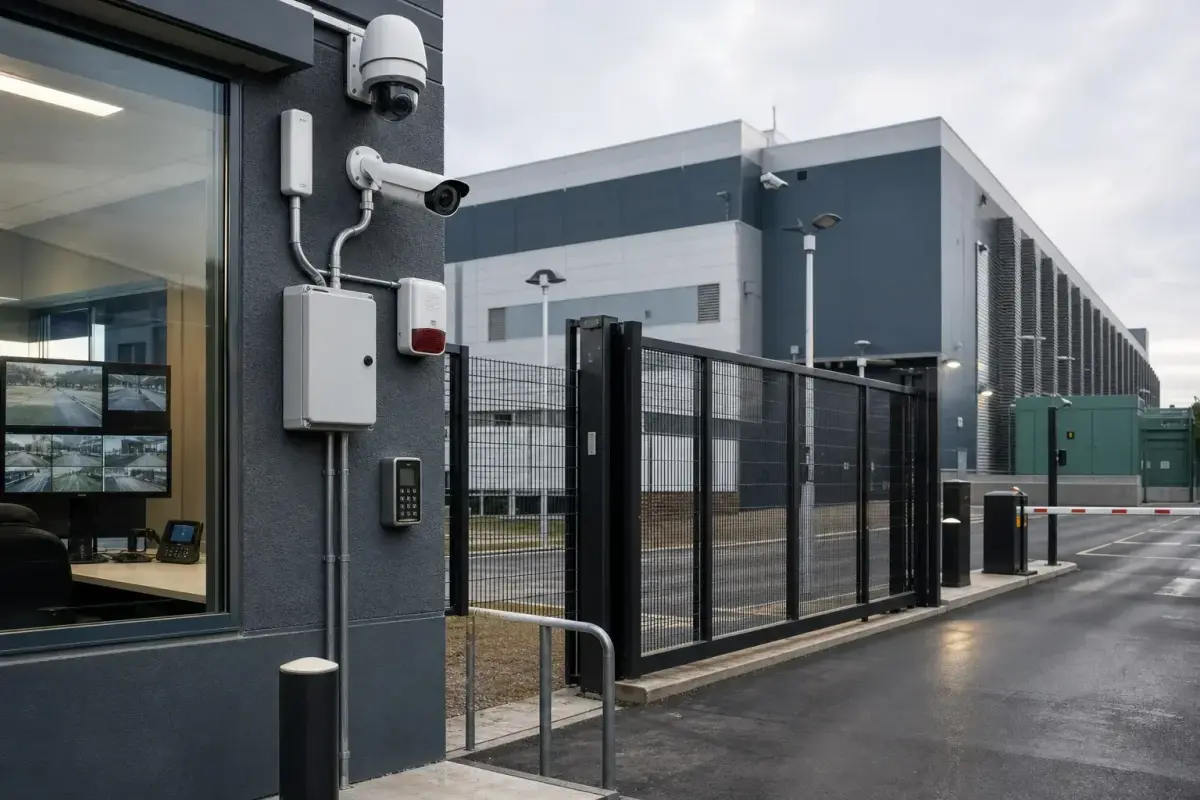
Data Center 48-Zone Grid - 23-Camera Cloud Security System
Key Features
- 48 alarm zones with expansion capacity up to 64 zones
- 23-camera mix with 18 fixed 4K IP, 3 PTZ, and 2 thermal cameras
- 42 detectors covering PIR, dual-tech, door, glass, smoke, and vibration events
- 30-day 4K retention on a 48-channel NVR with RAID storage
- EPC turnkey price range from $9,200 to $14,400 per commissioned site
Data Center 48-Zone Grid is a 48-zone, 23-camera, 42-detector security and surveillance system for grid-powered data centers with cloud monitoring, 30-day 4K storage, and EPC turnkey pricing from $9,200 to $14,400.
Description
Data Center 48-Zone Grid is a high-security facility surveillance package with 48 alarm zones, 23 cameras, 42 detectors, grid power, cloud monitoring, and 30-day 4K video retention. The system is designed for data centers requiring 3-layer protection across perimeter, building, and room-level areas, with EPC turnkey delivery priced from $9,200 to $14,400.
System Architecture
The 48-zone architecture uses a hybrid wired and wireless alarm panel sized for 8 to 64 zones, which leaves 16 spare zones for future cages, electrical rooms, or loading docks. A typical data center layout assigns 12 zones to perimeter fence or wall lines, 14 zones to external doors and service corridors, 10 zones to technical rooms, 8 zones to tenant halls, and 4 zones to control-room or biometric areas, creating a structured alarm map that supports fast operator response within 1 incident workflow.
The surveillance layer combines 18 fixed 4K IP cameras, 3 PTZ cameras with 20x zoom, and 2 thermal cameras for human detection at 300 m or more in long perimeter approaches. IEC 62676 defines system concepts for video surveillance used in security applications, and this configuration maps camera coverage, recording, and monitoring functions to a 48-channel NVR platform with RAID storage and H.265+ compression for 30 days at 4K resolution.
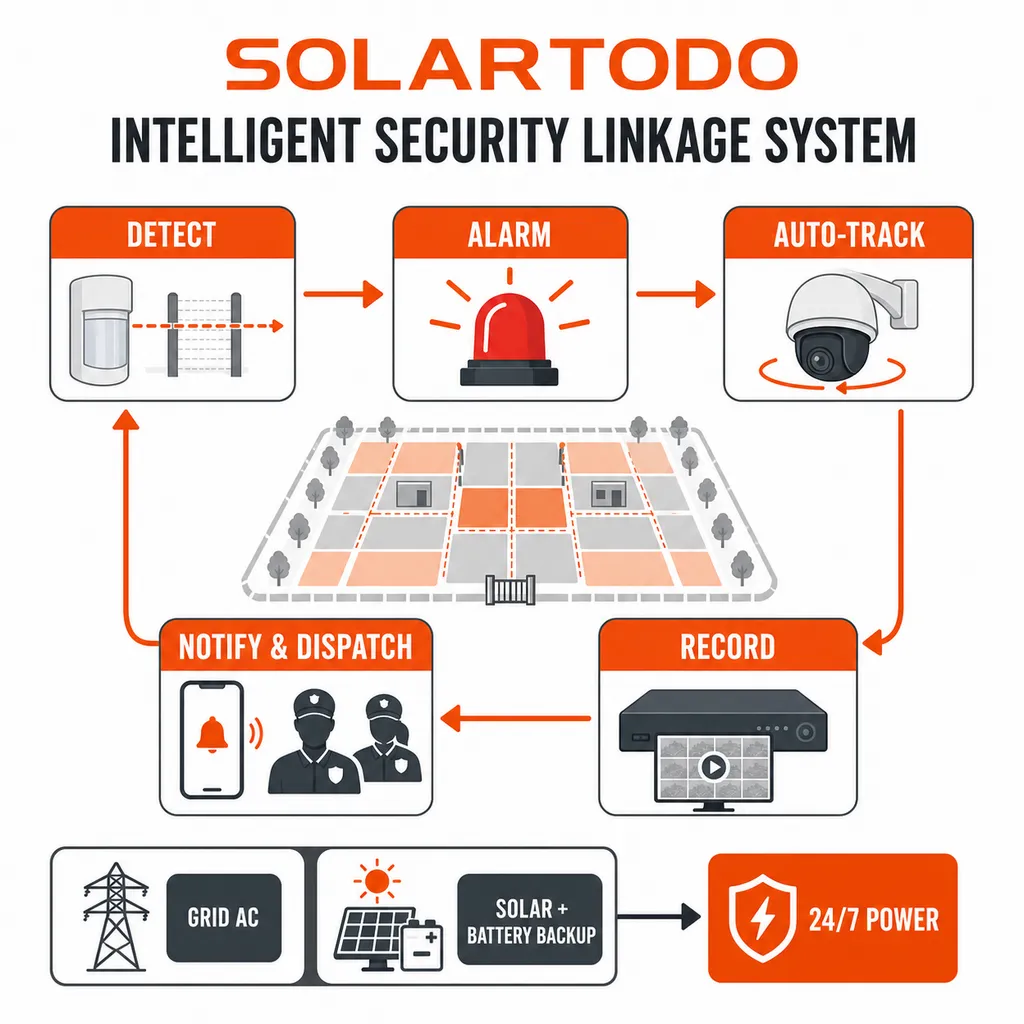
The detector schedule includes 12 PIR detectors, 8 dual-tech microwave plus PIR detectors, 8 door contacts, 4 glass-break detectors, 4 smoke detectors, and 6 vibration sensors, totaling 42 field detection points. Dual-tech units reduce false alarms in hot aisles, generator rooms, and airflow-heavy spaces because 2 sensing methods must correlate before a security alarm is escalated.
Technical Specifications
The command center design supports Ethernet, WiFi, and 4G backup communication, with AES-256 encrypted alarm paths and anti-jamming logic for wireless sensors. For data centers, a 2-path communications design is preferred because a single Ethernet path can fail during 1 switch outage, 1 fiber cut, or 1 power-distribution event.
| Parameter | Value |
|---|---|
| Security zones | 48 zones |
| Cameras | 23 cameras |
| Detectors | 42 detectors |
| Power system | Grid with UPS interface |
| Video storage | 30 days at 4K |
| Monitoring | Cloud monitoring |
| Communication | 4G, Ethernet, WiFi |
| Expansion capacity | Up to 64 zones |
| Warranty | 2 years parts, 1 year labor |
The alarm system is specified around EN 50131 intrusion principles, UL 681 installation practice for burglar alarm systems, NFPA 72 fire alarm signaling interfaces, and IEC 62676 video surveillance terminology. These 4 standards are not interchangeable, so SOLARTODO treats intrusion, CCTV, fire signaling, and installation workmanship as 4 separate compliance layers during engineering review.
Cloud Monitoring
Cloud monitoring connects the 48-zone alarm panel, 23-camera NVR, and 42-detector event log to a remote operator dashboard with alarm classification, event replay, and maintenance alerts. The monitoring service is budgeted at $45 per month in the reference bill of materials, while the EPC configuration includes 12 months of cloud setup and support for 1 commissioned site.
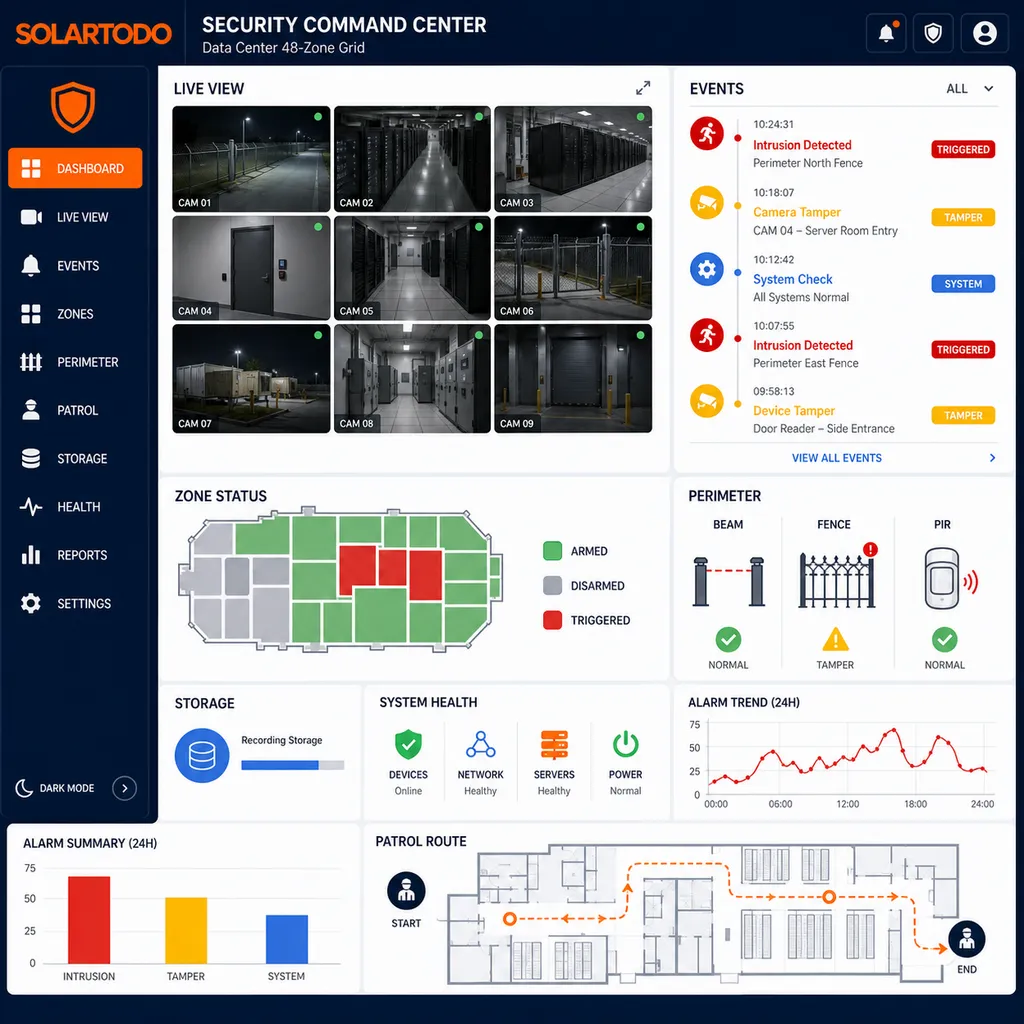
AI analytics classify people and vehicles, detect line crossing, identify object left or removed events, and reduce nuisance alarms by up to 90% compared with conventional motion-only CCTV. Compared with a basic 23-camera recorder without zone logic, this 48-zone design gives operators 48 named alarm locations instead of 1 undifferentiated video wall, reducing verification time during a multi-door incident.
Data Center Application
For a representative MENA data center scenario with 1 perimeter ring, 2 vehicle gates, 4 staff entrances, 6 electrical rooms, 8 tenant corridors, and 2 meet-me rooms, the 48-zone grid is sized for a medium facility requiring 24/7 monitoring. The 23-camera mix covers exterior approach, loading bay, generator yard, UPS room, network rooms, mantrap entries, and security desk positions without assuming any verified customer deployment.
Data centers have rising operational risk because power density, uptime targets, and AI workloads are increasing together; the IEA has reported that data center electricity demand could more than double by 2030 in some scenarios. Security design therefore needs 2 parallel priorities: protect physical access to high-value compute infrastructure and avoid false dispatches that interrupt 24-hour operations.
The grid-powered design integrates with a UPS layer sized for 4 to 8 hours of alarm, network, and recording autonomy, while generator backup can support critical sites where local codes require extended operation. SOLARTODO can also adapt the same 48-zone topology into solar-hybrid architectures with 48 to 120 hours of autonomy when utility reliability is below project thresholds.
Security Layers
Layer 1 covers the perimeter using IR beam pairs rated for 100 m class segments, vibration sensors on fence or wall elements, and thermal cameras for 300 m human detection in low-light areas. Layer 2 covers building access using door contacts, dual-tech motion detection, and camera verification at 4 or more controlled entrances.
Layer 3 covers room-level control using biometric readers, PIN or card authentication, and mantrap or airlock logic where required by the project specification. A high-security data hall may use 3-factor access at 1 critical room, while lower-risk corridors may use 2-factor controls to reduce user friction during normal 8-hour shifts.
The 48-channel NVR gives 25 spare channels after the installed 23 cameras, allowing phased expansion to cages, customer suites, or new outdoor yards. Storage is specified for 30 days at 4K using H.265+ and RAID, with final disk sizing dependent on frame rate, scene complexity, retention policy, and continuous versus event-based recording ratio.
Standards and Engineering References
IEC 62676 is referenced for CCTV system structure, while EN 50131 is referenced for intrusion system grading and alarm concepts. NFPA 72 is relevant where smoke detector alarm signaling must interface with a building fire alarm system, and UL 681 is relevant to installation classification for burglar alarm systems in monitored premises.
NREL resilience research is relevant because security systems must keep communications, sensing, and monitoring active during grid disturbance events, not only during normal operation. IRENA power-sector resilience guidance also supports planning around backup energy and digital infrastructure, while IEEE 802.3 Ethernet practice informs PoE camera and switch design for 23 IP endpoints.
EPC Investment Analysis and Pricing Structure
EPC delivery includes engineering, procurement, construction, commissioning, operator handover, and warranty support for 1 data center site. Engineering covers 48-zone mapping, 23-camera placement, cable routing, bandwidth calculation, UPS interface design, and commissioning forms; procurement covers alarm panels, cameras, detectors, NVR, RAID storage, mounting hardware, and cloud monitoring setup.
| Pricing tier | Scope | Price range |
|---|---|---|
| FOB Supply | Equipment only, ex-works China | $5,704-$9,792 |
| CIF Delivered | Equipment plus ocean freight and insurance | $6,093-$10,460 |
| EPC Turnkey | Installed, commissioned, and supported for 1 year | $9,200-$14,400 |
| Volume quantity | Discount | Example use case |
|---|---|---|
| 50+ systems | 5% | Regional data center standardization |
| 100+ systems | 10% | Multi-country procurement framework |
| 250+ systems | 15% | Large utility, telecom, or government rollout |
A practical ROI model compares the $9,200 to $14,400 EPC cost against avoided guard patrol expansion, reduced false dispatches, faster incident verification, and lower unplanned downtime exposure. If a facility avoids 2 extra guards at $900 per month each and reduces 10 monthly false dispatches by 90%, the simple payback can fall near 6 to 12 months before considering the larger financial impact of 1 data hall interruption.
Payment terms are 30% T/T deposit plus 70% against bill of lading, or 100% L/C at sight for approved buyers. Project financing can be reviewed for orders above $1,000K, and EPC quotation requests can be sent to [email protected] with 1 site drawing, 1 zone schedule, and 1 preferred Incoterms basis.
Procurement Notes
Procurement teams should compare this configuration against conventional guard-only or camera-only security designs using 5 variables: detection coverage, verification speed, retention period, backup autonomy, and operator workload. A camera-only 23-channel recorder may capture events after the fact, but a 48-zone alarm grid creates active event routing, named-zone escalation, and 30-day forensic video retrieval.
Engineers should verify cable distances, PoE budgets, switch uplink capacity, rack space, UPS runtime, and local alarm-monitoring licensing before purchase. A 23-camera 4K system can require more than 200 Mbps of internal throughput depending on frame rate and compression, so the final network design should include at least 1 dedicated security VLAN.
For specification alignment, buyers can View all Security & Surveillance System products, Configure your system online, or Request a custom quotation. SOLARTODO also publishes related engineering notes in Learn about topic for security design, backup power, and smart-infrastructure procurement.
Deployment Workflow
A standard EPC workflow uses 6 steps: site survey, 48-zone design, equipment procurement, cable and device installation, cloud onboarding, and commissioning test. Each zone receives at least 1 functional test, each camera receives 1 image-quality check, and the NVR receives 1 retention and playback verification before handover.
Commissioning documentation includes a 48-zone list, 23-camera naming table, 42-detector test sheet, network address register, cloud account handover, and warranty contact sheet. For multi-site programs, SOLARTODO can lock a 1-system baseline bill of materials and then adjust only the detector mix, camera lens selection, and UPS autonomy for each additional facility.
Technical Specifications
| Security Zones | 48zones |
| Camera Count | 23cameras |
| Detector Count | 42detectors |
| Power System | grid |
| Backup Autonomy | 4-8hours |
| Video Storage | 30 days @ 4K |
| Monitoring Type | cloud |
| Communication | 4G + Ethernet + WiFi |
| Expansion Capacity | Up to 64zones |
| Warranty | 2 years parts, 1 year labor |
Price Breakdown
| Item | Quantity | Unit Price | Subtotal |
|---|---|---|---|
| 64-zone hybrid alarm panel | 1 pcs | $120 | $120 |
| LCD keypad | 4 pcs | $30 | $120 |
| PIR detector | 12 pcs | $7 | $84 |
| Dual-tech detector | 8 pcs | $21 | $168 |
| Door/window contact | 8 pcs | $2 | $16 |
| Glass break detector | 4 pcs | $8 | $32 |
| Smoke detector | 4 pcs | $6 | $24 |
| Vibration sensor | 6 pcs | $14 | $84 |
| 4K IP camera | 18 pcs | $95 | $1,710 |
| PTZ camera 20x | 3 pcs | $170 | $510 |
| Thermal camera | 2 pcs | $500 | $1,000 |
| 48-channel NVR with RAID interface | 1 pcs | $480 | $480 |
| RAID storage for 30-day 4K retention | 1 pcs | $900 | $900 |
| Perimeter beam 100 m class | 6 pcs | $65 | $390 |
| Grid UPS and power distribution interface | 1 pcs | $750 | $750 |
| Network switches, 4G router, and security VLAN hardware | 1 pcs | $650 | $650 |
| Access control and biometric interface package | 1 pcs | $1,300 | $1,300 |
| Cabling, brackets, junction boxes, and labels | 1 pcs | $850 | $850 |
| Cloud monitoring service, 12 months | 12 pcs | $45 | $540 |
| Engineering, drawings, and QC documentation | 1 pcs | $1,200 | $1,200 |
| Installation and commissioning for 48 zones | 48 pcs | $50 | $2,400 |
| Operator handover and 1-year warranty support | 1 pcs | $700 | $700 |
| Total Price Range | $9,200 - $14,400 | ||
Frequently Asked Questions
What does the EPC turnkey price include?
How is the 48-zone layout used in a data center?
Can the system work during a grid outage?
Which standards are relevant to this security system?
How much video storage is included?
Certifications & Standards

Data Sources & References
- •IEC 62676 video surveillance systems for use in security applications
- •EN 50131 alarm systems intrusion and hold-up systems
- •UL 681 installation and classification of burglar and holdup alarm systems
- •NFPA 72 National Fire Alarm and Signaling Code
- •NREL resilience and distributed energy system guidance
- •IEA data centers and data transmission networks electricity analysis
- •IRENA power-sector resilience and energy infrastructure guidance
Interested in this solution?
Contact us for a customized quote based on your specific requirements.
Contact Us