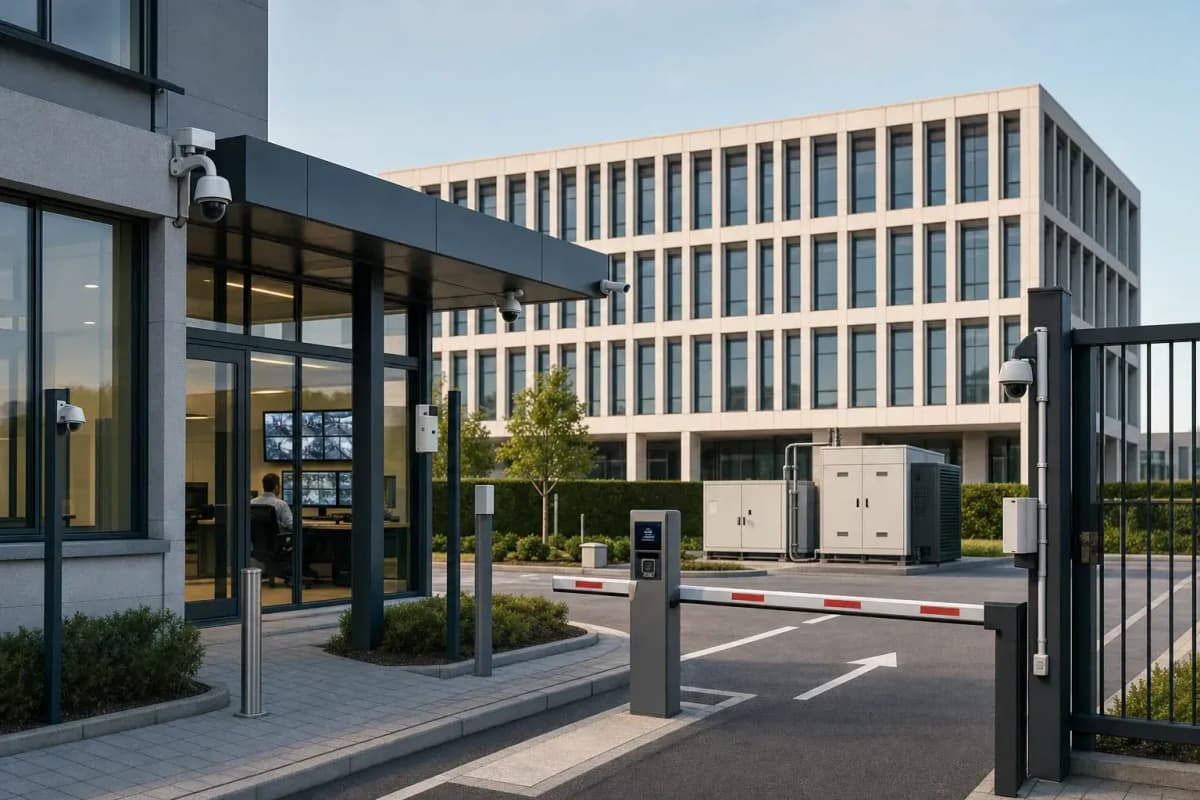
Government Building 128-Zone Grid Generator UPS Security System
Key Features
- 128 security zones with expansion capacity up to 256 zones
- 52-camera video layer with 40 fixed 4K cameras, 8 PTZ cameras, and 4 thermal cameras
- 102 detectors including 40 PIR, 24 dual-tech, 20 contacts, 8 glass-break, and 10 smoke/gas units
- 30-day 4K retention using H.265+ NVR recording with RAID storage
- Grid + generator + UPS design with 8-hour UPS bridge autonomy
128-zone government building security system with 52 cameras, 102 detectors, grid + generator + UPS backup, 30-day 4K retention, AES-256 communications, and EPC turnkey delivery from $36,300 to $46,600.
Description
The Government Building 128-Zone Grid Generator UPS security system is a high-security surveillance and intrusion platform designed for 128 protected zones, 52 cameras, 102 detectors, and self-operated monitoring. The configuration combines grid power, generator standby, and UPS bridging to support 24-hour command-room continuity, 30-day 4K video retention, and multi-layer detection aligned with IEC 62676, EN 50131, NFPA 72, UL 681, and IEEE 3006.2 guidance.
This product belongs to SOLARTODO's Security & Surveillance System line, which covers perimeter intrusion, building access, room-level alarms, CCTV, and resilient energy infrastructure for government, embassy, data-center, and public-administration sites. Buyers comparing security packages can View all Security & Surveillance System products, Configure your system online, or Request a custom quotation for a 1-site bill of quantities, 2-D layout review, and EPC delivery schedule.
System Architecture
The 128-zone architecture uses 2 hybrid 64-zone alarm panels, 8 LCD keypads, 102 detection devices, 12 perimeter beam sets, 600 meters of electric-fence interface, and 52 IP video channels. Each alarm partition can separate 1 perimeter layer, 1 lobby layer, 1 administrative office layer, 1 archive layer, and up to 4 secure-room groups so that operators can arm, bypass, and audit areas without disabling the entire building.
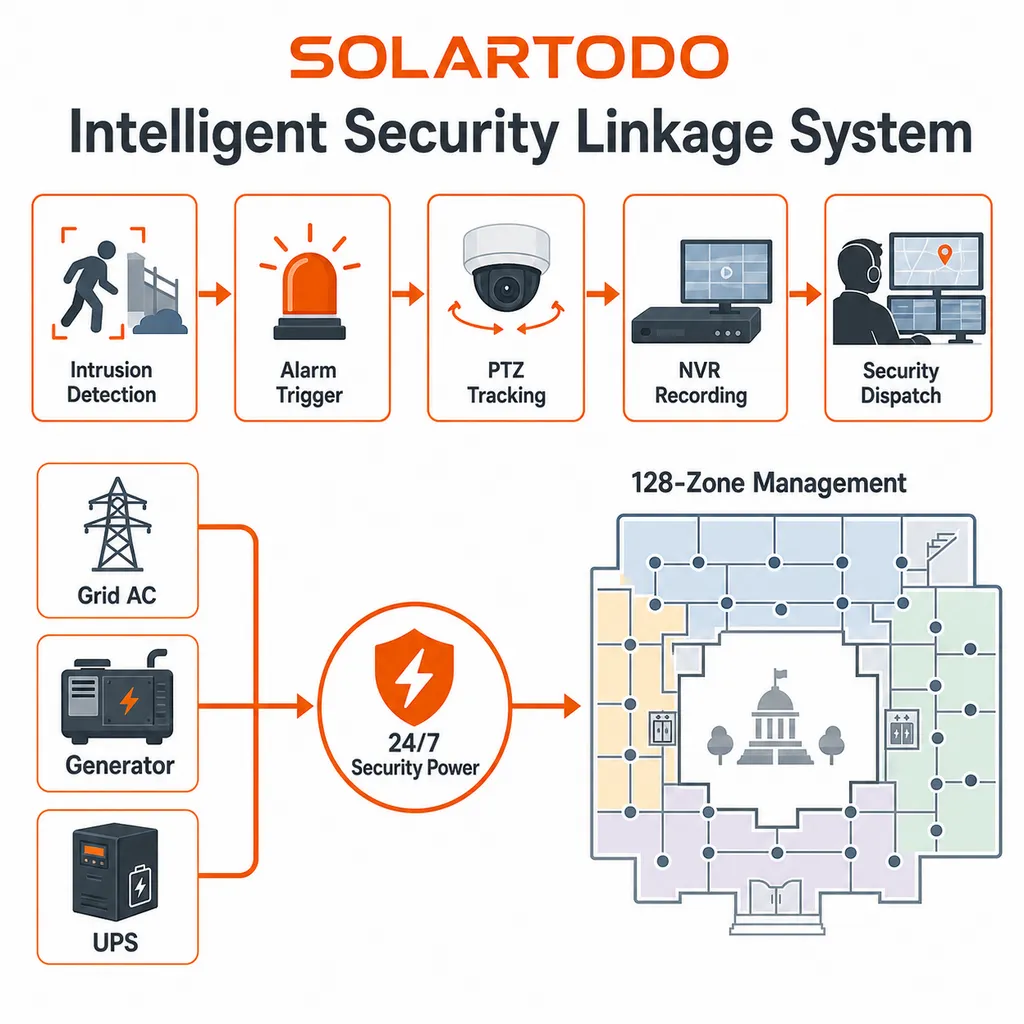
The detector mix includes 40 PIR units, 24 dual-tech microwave plus PIR detectors, 20 door or window contacts, 8 glass-break sensors, and 10 smoke or gas initiating devices. Dual-tech sensors are specified in higher-risk corridors and service entrances because requiring 2 sensing events can reduce nuisance alarms by up to 90 percent compared with single-technology PIR layouts in areas with air movement, reflective glass, or mechanical vibration.
Video coverage is based on 40 fixed 4K IP cameras, 8 PTZ cameras with 20x optical zoom, and 4 thermal cameras for long-range night detection. Fixed cameras cover entrances, vehicle gates, public counters, lifts, stairwells, and corridors; PTZ cameras provide event-driven tracking across 200-meter courtyards; and thermal cameras support human detection beyond 300 meters where visible-light cameras lose contrast.
The recording layer uses 2 redundant 48-channel NVR paths with H.265+ compression, RAID storage, and 30 days of 4K retention. IEC 62676-1-1 defines system requirements for video surveillance systems used in security applications, while IEC 62676-6:2026 adds performance testing and grading principles for real-time intelligent video analysis, including object classification and intrusion scenarios.
Technical Specifications
| Parameter | Value |
|---|---|
| Security zones | 128 zones |
| Camera count | 52 cameras |
| Detector count | 102 detectors |
| Power system | Grid + generator + UPS |
| Backup autonomy | 8 hours UPS bridge plus generator runtime |
| Video storage | 30 days at 4K |
| Communication | Ethernet + 4G + WiFi |
| Expansion capacity | Up to 256 zones |
| Warranty | 2 years parts, 1 year labor |
The electrical design separates security loads into 3 classes: always-on alarm circuits, always-recording video circuits, and operator workstations. IEEE 3006.2-2016 addresses emergency and standby power systems for industrial and commercial facilities, and this configuration applies the same resilience logic by using UPS power for the first 8 hours and generator power for longer grid interruptions.
For fire and life-safety interfaces, smoke and gas detectors should be coordinated with the building's listed fire alarm system and local authority requirements. NFPA 72:2025 covers protected-premises alarm and signaling systems, initiating devices, inspection, testing, and documentation, so the security package should be commissioned with 1 cause-and-effect matrix, 1 test log, and 1 as-built drawing set.
For intrusion security, EN 50131 is the relevant European family for intrusion and hold-up alarm system requirements, while UL 681 historically defined installation and classification criteria for burglar and holdup alarm systems in the United States. A government building typically requires 2 independent signal paths, tamper supervision on critical circuits, and event retention that supports at least 1 annual audit cycle.
AI Video Analytics and Operator Workflow
The AI analytics layer classifies persons, vehicles, line crossing, intrusion, object left, object removed, loitering, and restricted-direction movement across 52 camera feeds. Edge processing on camera or NVR hardware reduces command-center load because only verified events, thumbnails, and 10-second pre-event clips need to be escalated to operators during high-traffic hours.
Compared with a conventional 52-camera CCTV system that records continuously but has no object classification, this design can reduce operator review time by about 60 percent and nuisance alarm dispatches by up to 90 percent when analytic rules are tuned per zone. The comparison is not a customer result; it is a representative engineering estimate based on common person and vehicle classification workflows in 2025 security platforms.
The self-monitoring mode is designed for a 24/7 government command center with 2 operator consoles, 1 supervisor console, 1 alarm map, and 1 escalation procedure. Events can be ranked into 4 levels, with Level 1 for maintenance, Level 2 for perimeter pre-alert, Level 3 for confirmed intrusion, and Level 4 for fire, panic, or protected-room breach.
AES-256 encryption is specified for remote access, camera credentials, event forwarding, and maintenance tunnels. Communications use Ethernet as the primary channel, 4G as backup, and WiFi only where local policy permits wireless devices; sensitive buildings can disable WiFi entirely and retain the same 128-zone alarm and 52-camera topology.
Cloud Monitoring
Cloud monitoring is optional for this self-operated variant, but a secure cloud portal can mirror 30-day health data, 128-zone alarm status, UPS state of charge, generator input, and NVR disk warnings. The recommended policy is to keep video evidence on site for 30 days and export only encrypted event metadata unless a 1-case investigation requires evidence transfer.
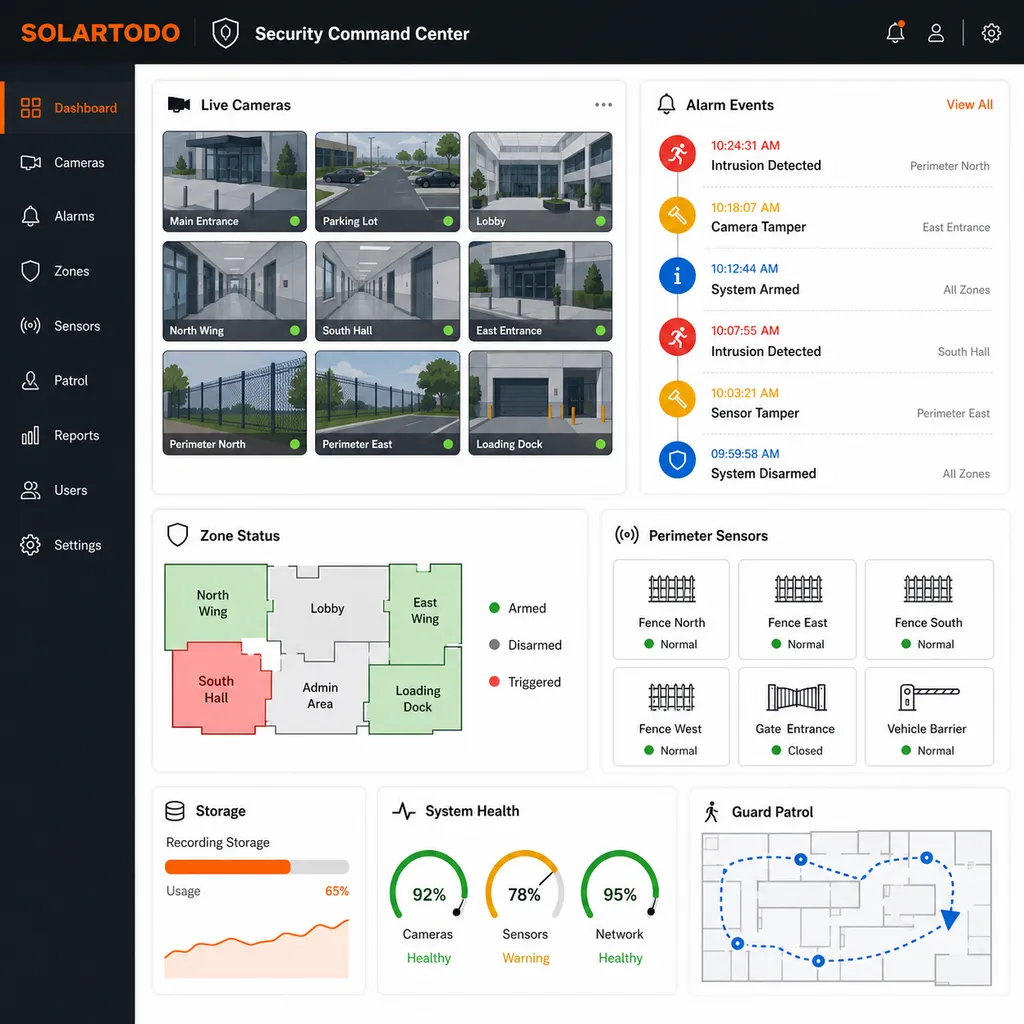
For procurement teams, cloud integration should be specified in 3 parts: data residency, user role control, and retention policy. A government buyer can require 2-factor administrator login, 90-day access logs, 12-month firmware lifecycle reporting, and offline operation so the building remains protected even when a wide-area network link is unavailable.
Representative Government Scenario
For a representative MENA government-service building scenario, assume 1 six-story facility with 4 public entrances, 2 vehicle gates, 1 archive floor, 1 server room, 1 records counter, and 1 roof access route. The 128 zones are allocated as 24 perimeter zones, 32 door and lobby zones, 40 office and corridor zones, 16 archive and server zones, and 16 utility or roof zones.
In this 1-building scenario, 52 cameras are distributed as 16 exterior cameras, 8 PTZ or thermal perimeter cameras, 20 interior corridor and counter cameras, and 8 service-area cameras. The 102 detectors give roughly 0.80 detectors per zone because several zones are supervised by camera analytics, beam pairs, electric-fence pulses, or access-control events rather than by 1 detector each.
The power design assumes a 2.5 kW average security load, 8 hours of UPS autonomy for the security rack and command consoles, and generator continuation for outages longer than 8 hours. IEA's Global Energy Review 2026 reports 108 GW of new battery storage capacity in 2025 and 45 GW of UPS additions, confirming that short-duration backup remains a fast-growing resilience category.
NREL's REopt critical-facility guidance notes that resilient power planning should prioritize facilities that provide essential services and reduce recovery burden after disasters. This product follows that logic with 1 protected command center, 2 communications paths, 3 power sources, and a 30-day evidence archive that remains accessible during grid variability.
Standards, Compliance, and Documentation
The recommended compliance package includes 1 operational requirement, 1 camera schedule, 1 detector schedule, 1 cable schedule, 1 power single-line diagram, 1 commissioning checklist, and 1 maintenance plan. IEC 62676-1-1 specifically expects customer, law-enforcement where applicable, and supplier requirements to be agreed in the operational requirement for security video systems.
IRENA reported that fully installed battery storage project costs declined 93 percent from 2010 to 2024, reaching about USD 192/kWh globally in 2024. That cost trend supports practical UPS and battery-backed security racks, but government facilities still need generator backup because UPS equipment is normally a bridge, not a multi-day power plant.
IEA's Electricity 2026 analysis describes battery storage as a flexibility resource that can support security of supply and reduce pressure on grid infrastructure. For this government-building system, that macro trend translates into 1 practical design rule: grid power is preferred for normal operation, UPS handles transfer events, and the generator carries extended outages.
Buyers who need procurement-level background can Learn about topic for security-system design notes, and project developers can use Learn about topic when preparing 1 technical annex for tender documentation. SOLARTODO can provide 1 English submittal pack with datasheets, test forms, and commissioning records for EPC review.
EPC Investment Analysis and Pricing Structure
EPC turnkey delivery includes 5 work scopes: engineering, procurement, construction, commissioning, and warranty support. Engineering covers the 128-zone matrix and 52-camera drawing; procurement covers alarm panels, cameras, storage, UPS, and network equipment; construction covers cabling and installation; commissioning covers 100 percent point testing; and warranty covers 1 year of labor plus 2 years of parts.
| Pricing tier | Scope | Price range |
|---|---|---|
| FOB Supply | Equipment only, ex-works China | USD 22,506 - 31,688 |
| CIF Delivered | FOB plus ocean freight and insurance | USD 24,041 - 33,849 |
| EPC Turnkey | Installed, commissioned, 1-year labor warranty | USD 36,300 - 46,600 |
| Volume level | Discount | Example use |
|---|---|---|
| 50+ systems | 5 percent | Provincial building rollout |
| 100+ systems | 10 percent | National agency framework |
| 250+ systems | 15 percent | Multi-year public infrastructure program |
The ROI model should compare a 1-system EPC cost of USD 36,300 to 46,600 against guard labor, false dispatch, outage risk, and evidence-loss exposure. If AI filtering prevents 10 false dispatches per month at USD 75 each and reduces 20 operator review hours per month at USD 18 per hour, the annual operating saving is about USD 13,320, giving a simple payback of 2.7 to 3.5 years before risk avoidance is valued.
A conventional alternative with 52 non-analytic cameras, no generator interface, no UPS bridge, and only 64 zones may reduce initial equipment cost by 20 to 30 percent, but it usually increases review workload, outage exposure, and retrofit cost. For government procurement, the stronger comparison is life-cycle cost over 5 years, not the lowest first invoice.
Standard payment terms are 30 percent T/T deposit plus 70 percent against B/L copy, or 100 percent irrevocable L/C at sight for approved banks. Project financing can be discussed for government or EPC packages above USD 1,000,000, and procurement teams can contact [email protected] for a 1-project quotation schedule.
Applications
Typical applications include 1 government office building, 1 embassy compound, 1 court complex, 1 records archive, 1 municipal command center, or 1 critical infrastructure administration site. The same 128-zone architecture can be adapted to 2 adjacent buildings by increasing fiber links, adding 1 network aggregation cabinet, and extending expansion capacity toward 256 zones.
The system is strongest where procurement needs 3 outcomes at once: verified intrusion detection, searchable 4K evidence, and resilient power. It is less suitable for a small 16-zone retail shop because the 52-camera, generator-ready, RAID-storage design is intentionally sized for high-security public-sector facilities with 24/7 accountability.
For specification, tender, or budgetary planning, SOLARTODO recommends issuing 1 site plan, 1 risk classification, 1 target retention period, 1 preferred monitoring model, and 1 power-backup requirement before final pricing. Those 5 inputs allow the EPC bill of quantities to remain traceable from the 128-zone design to the USD 36,300 to 46,600 turnkey range.
Technical Specifications
| Security Zones | 128zones |
| Camera Count | 52cameras |
| Detector Count | 102detectors |
| Power System | Grid + generator + UPS |
| Backup Autonomy | 8hours |
| Video Storage | 30 days @ 4K |
| Monitoring Type | Self monitoring |
| Communication | 4G + Ethernet + WiFi |
| Expansion Capacity | Up to 256zones |
| Warranty | 2 years parts, 1 year labor |
Price Breakdown
| Item | Quantity | Unit Price | Subtotal |
|---|---|---|---|
| 64-zone hybrid alarm panel | 2 pcs | $120 | $240 |
| LCD keypad | 8 pcs | $30 | $240 |
| PIR detector | 40 pcs | $7 | $280 |
| Dual-tech microwave plus PIR detector | 24 pcs | $21 | $504 |
| Door/window contact | 20 pcs | $2 | $40 |
| Glass break detector | 8 pcs | $8 | $64 |
| Smoke/gas detector | 10 pcs | $6 | $60 |
| Vibration sensor | 10 pcs | $14 | $140 |
| Perimeter beam 100m set | 12 pcs | $65 | $780 |
| Electric fence interface | 600 pcs | $2 | $1,200 |
| 4K fixed IP camera | 40 pcs | $65 | $2,600 |
| PTZ camera 20x zoom | 8 pcs | $170 | $1,360 |
| Thermal camera | 4 pcs | $500 | $2,000 |
| 48-channel RAID NVR | 2 pcs | $540 | $1,080 |
| RAID video storage set | 192 pcs | $20 | $3,840 |
| Online UPS for security rack | 1 pcs | $3,000 | $3,000 |
| Generator transfer and monitoring interface | 1 pcs | $2,200 | $2,200 |
| LFP battery backup | 16 pcs | $200 | $3,200 |
| Network switches, cabinet, and surge protection | 1 pcs | $1,800 | $1,800 |
| Command center workstation package | 1 pcs | $1,500 | $1,500 |
| Installation and commissioning | 128 pcs | $50 | $6,400 |
| Engineering, design review, and QC | 1 pcs | $3,500 | $3,500 |
| 1-year warranty and support | 1 pcs | $1,800 | $1,800 |
| Total Price Range | $36,300 - $46,600 | ||
Frequently Asked Questions
What is included in the EPC turnkey price?
Can the 128-zone system expand after installation?
How long can the system operate during a grid outage?
Which standards are relevant for government security procurement?
Does self-monitoring require a cloud subscription?
Certifications & Standards

Data Sources & References
- •IEC 62676-1-1:2013, Video surveillance systems for use in security applications, https://webstore.iec.ch/en/publication/7347
- •IEC 62676-6:2026, Performance testing and grading of intelligent video analysis, https://webstore.iec.ch/en/publication/59704
- •NFPA 72:2025, National Fire Alarm and Signaling Code, https://link.nfpa.org/all-publications/72/2025
- •IEEE 3006.2-2016, Emergency and standby power systems, https://standards.ieee.org/ieee/3006.2/5823/
- •NREL REopt critical facilities resilience guidance, https://www.nrel.gov/reopt/curriculum/prioritizing-facilities
- •IEA Global Energy Review 2026 battery storage analysis, https://www.iea.org/reports/global-energy-review-2026/technology-battery-storage
- •IRENA battery storage cost and grid flexibility analysis, https://www.irena.org/News/articles/2025/Aug/Battery-energy-storage-systems-key-to-renewable-power-supply-demand-gaps
Interested in this solution?
Contact us for a customized quote based on your specific requirements.
Contact Us