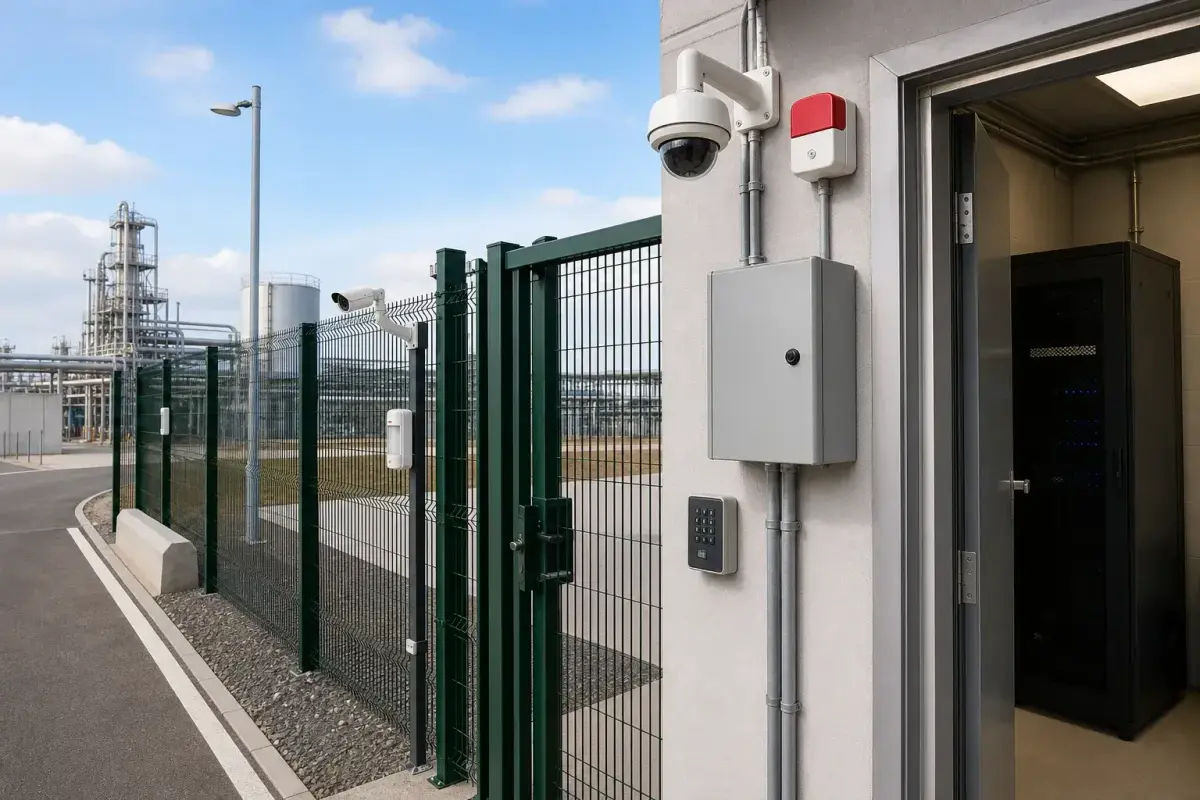
Industrial 24-Zone Grid - 10-Camera Security System
Key Features
- 24 alarm zones with expansion capacity up to 64 zones
- 10-camera layout: 7 fixed 4K, 2 PTZ 20x, and 1 thermal camera
- 17-detector mix with PIR, dual-tech, contact, glass-break, smoke/gas, and vibration devices
- 30-day 4K storage on a 16-channel H.265+ NVR with 6 spare channels
- EPC turnkey range of USD 4,800-8,000 including installation, commissioning, and 1-year labor warranty
The Industrial 24-Zone Grid is a grid-powered industrial security system with 24 alarm zones, 10 cameras, 17 detectors, 8-hour UPS backup, 30-day 4K storage, and full-service monitoring. EPC turnkey pricing is USD 4,800-8,000 with engineering, installation, commissioning, and 1-year labor warranty included.
Description
Product Overview
The Industrial 24-Zone Grid is a 24-zone industrial security and surveillance system with 10 cameras, 17 intrusion or safety detectors, grid power, 8-hour UPS backup, 30-day 4K video retention, and full-service monitoring. It is specified for warehouses, factories, substations, industrial yards, and renewable-energy facilities where 1 integrated alarm event must trigger camera presets, spotlights, sirens, and operator notification within a defined response workflow.
This configuration belongs to SOLARTODO's Security & Surveillance System product line and uses a 64-zone hybrid alarm panel, 16-channel H.265+ NVR, 7 fixed 4K IP cameras, 2 PTZ cameras, and 1 thermal camera for perimeter and process-area coverage. Buyers comparing multiple packages can View all Security & Surveillance System products or Configure your system online with 8 to 64 zones, 8 to 48 video channels, and site-specific detector counts.
System Architecture
The architecture is built around 4 layers: detection, verification, response, and monitoring. The detection layer uses 24 logical zones mapped to 17 physical detectors plus perimeter devices; the verification layer uses 10 cameras; the response layer uses 3 spotlight-and-siren sets; and the monitoring layer uses Ethernet, WiFi, and 4G backup for 2-path communications.
The alarm panel supports wired and wireless hybrid inputs, multiple partitions, and expansion to 64 zones, which gives the 24-zone base design a 40-zone growth reserve for added doors, fence sectors, or production-line spaces. EN 50131 is the primary intrusion benchmark for alarm systems, and the 2026 BS EN 50131-3 release covers control and indicating equipment used in intrusion and hold-up systems (BSI EN 50131 series).
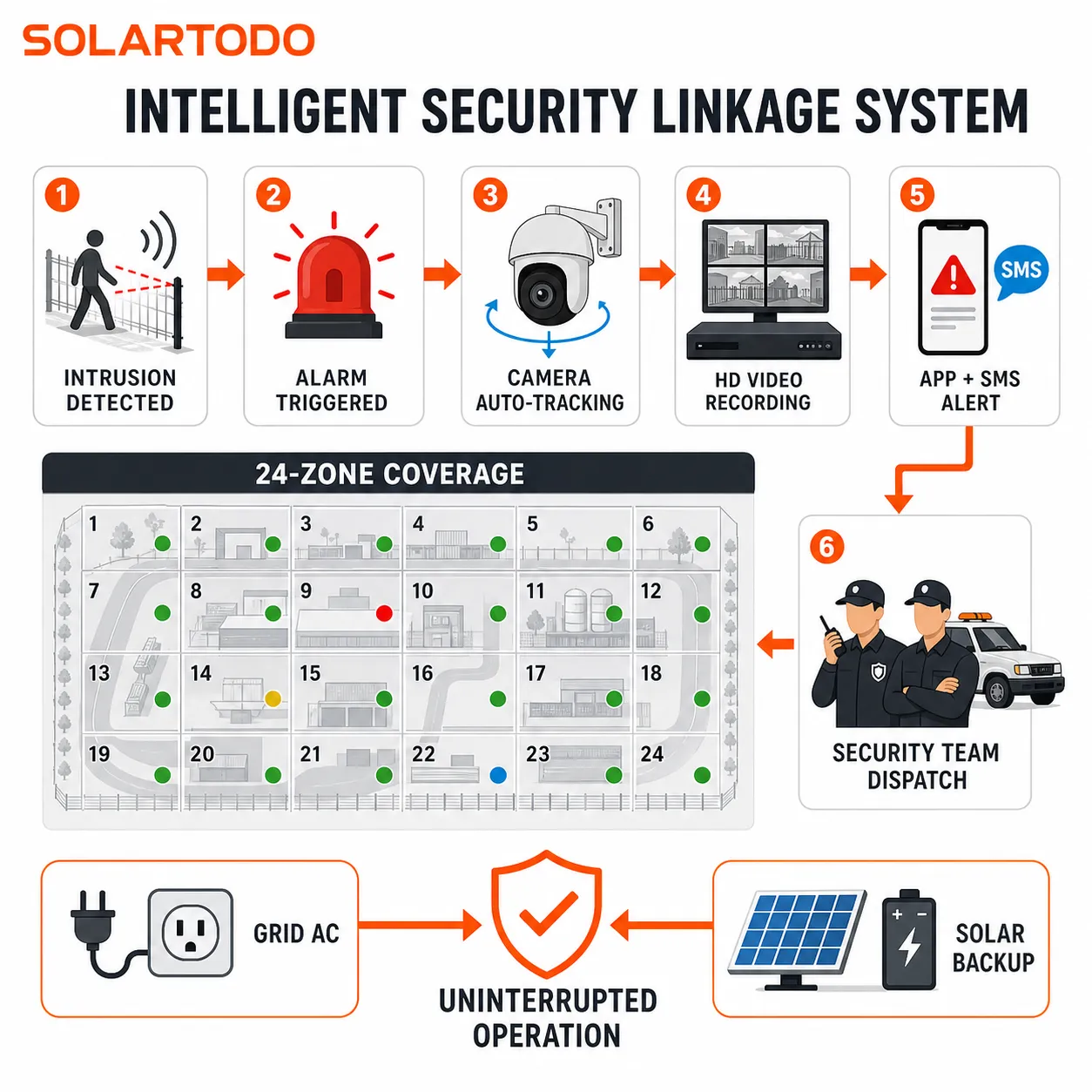
A practical 24-zone map normally assigns 8 zones to fence and yard perimeter, 6 zones to warehouse doors and loading bays, 4 zones to high-value equipment rooms, 3 zones to offices or control rooms, and 3 zones to spare expansion. This allocation keeps 12.5% of the installed zone count available for future use while still protecting the highest-risk entries on day 1.
Technical Specifications
The video subsystem follows IEC 62676 security-application principles, using 10 IP cameras connected to a 16-channel NVR with H.265+ compression and 30 days of 4K retention. IEC 62676-1-1 defines minimum requirements and recommendations for video surveillance systems used in security applications, while IEC 62676-6:2026 adds performance testing and grading for real-time intelligent video analytics (IEC 62676-1-1; IEC 62676-6:2026).
A recommended 10-camera layout uses 7 fixed 4K IP cameras for gates, loading bays, blind corners, and evidence recording; 2 PTZ cameras with 20x optical zoom for guard-assisted tracking; and 1 thermal camera for long-range human detection beyond 300 m in low-light or dusty perimeter zones. Fixed cameras typically provide 150-200 m IR illumination, while PTZ presets can be linked to 24 alarm zones for automatic scene recall.
The detector plan uses 6 PIR detectors, 4 dual-tech detectors, 3 magnetic contacts, 2 glass-break detectors, 1 smoke/gas detector, and 1 vibration sensor. Dual-tech devices combine microwave and PIR sensing, and in mixed industrial conditions this approach can reduce nuisance alarms by up to 90% compared with single-technology PIR-only layouts when sensitivity, mounting height, and zone masks are commissioned correctly.
Perimeter coverage is designed with 4 IR beam pairs rated for 100 m spans and a 200 m electric fence section for high-risk boundary lines. IR beams support long, visible barrier geometry; vibration sensing detects cutting or climbing attempts; and electric fence pulses create a deterrent layer that should be installed under local electrical, safety, and signage requirements before energization.
The NVR is sized at 16 channels, leaving 6 unused video ports after the 10-camera base installation. With H.265+ compression and motion-aware recording policies, the 30-day retention target is intended for 4K evidence storage, while critical alarm clips can be locked for 90 days or exported to customer evidence storage when an incident ticket is created.
Cloud Monitoring
Full-service monitoring combines 1 local NVR, 1 alarm cloud account, 4G failover, and operator escalation rules for 24-hour response workflows. The system is not described as a guaranteed police dispatch service; it is a configurable monitoring package where alarm events, camera clips, line-crossing alerts, and maintenance faults can be routed to a customer-designated control room or third-party alarm center.
Cybersecurity is specified as part of the operational requirement because industrial cameras, NVRs, and alarm panels are now networked devices. IEEE 802.1X-2020 defines port-based network access control for LAN environments and supports mutual authentication for devices attached to controlled ports (IEEE 802.1X-2020); SOLARTODO therefore recommends VLAN separation, AES-256 encrypted alarm transmission, 2 administrator roles, and quarterly password rotation for monitored sites.
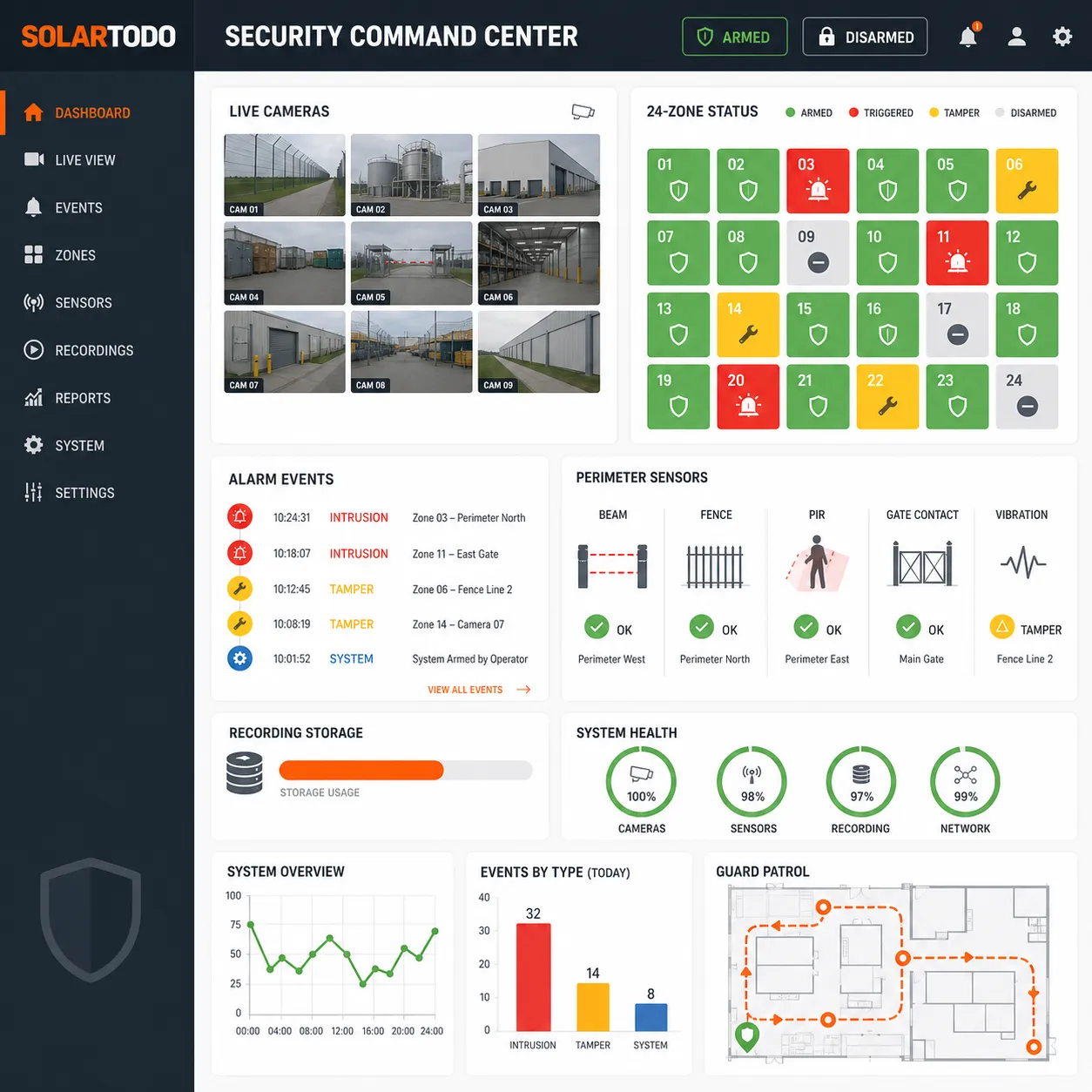
The monitoring workflow should define at least 3 escalation levels: automated notification within 60 seconds, operator review within 3 minutes, and customer or guard confirmation within 10 minutes where service agreements allow. For industrial facilities operating 24/7, separate escalation trees can be created for perimeter intrusion, fire/gas alarm, equipment-room entry, and network fault categories.
Applications
The Industrial 24-Zone Grid package is sized for 1 medium industrial facility, typically a 2,000-8,000 m2 warehouse, a 200 m fenced utility yard, a small substation compound, or a 1-5 MW commercial solar asset with 2 controlled vehicle gates. For larger estates, the same architecture can be duplicated in 2 or more panels and aggregated in 1 monitoring interface.
For a representative MENA solar farm scenario, a 3 MW ground-mount plant with 1 inverter station, 1 O&M room, 2 gates, and a 200 m vulnerable fence segment can assign 8 zones to the perimeter, 6 zones to buildings, 4 zones to equipment pads, 3 zones to gate contacts, and 3 zones to spare expansion. This scenario is illustrative, not a claim that any 1 customer deployed or approved the configuration.
Industrial buyers often compare this package with a conventional guard-only alternative using 2 guards per 12-hour shift and manual CCTV review after incidents. At an estimated USD 1,000 per guard per month in many emerging-market industrial sites, 4 guard positions can exceed USD 48,000 per year, while a USD 4,800-8,000 EPC security system can support recorded evidence, 24-zone event logs, and repeatable escalation without replacing all human security functions.
The system is also suitable for 1 logistics depot with 6 dock doors, 2 vehicle entrances, 1 fuel or battery room, and 1 perimeter setback area. In that layout, fixed cameras provide evidentiary coverage at 10-20 m working distances, PTZ cameras track movement across 50-120 m yard corridors, and the thermal camera improves detection where visible-light contrast is poor.
EPC Investment Analysis and Pricing Structure
EPC turnkey delivery includes 5 work packages: engineering, procurement, construction, commissioning, and warranty. Engineering covers drawings, zone schedules, cable routes, and camera fields of view; procurement covers the alarm panel, 17 detectors, 10 cameras, NVR, UPS, and perimeter devices; construction covers mounting, cabling, labeling, and network setup; commissioning covers 24 zone tests and 10 video tests; warranty covers 1 year of labor support and 2 years of parts support.
| Pricing tier | Scope | Price range |
|---|---|---|
| FOB Supply | Equipment only, ex-works China | USD 2,976-5,440 |
| CIF Delivered | Equipment, ocean freight, and insurance | USD 3,179-5,811 |
| EPC Turnkey | Installed, commissioned, monitored, and 1-year labor warranty | USD 4,800-8,000 |
| Volume band | Discount | Example procurement use |
|---|---|---|
| 50+ systems | 5% | Regional warehouse rollout of 50 panels |
| 100+ systems | 10% | Utility or telecom portfolio with 100 sites |
| 250+ systems | 15% | National program with 250 monitored facilities |
ROI depends on local labor rates, insurance conditions, asset value, and incident frequency, but the investment logic is straightforward at 3 levels. If the system avoids 1 additional USD 6,000 guard-year, the simple payback is roughly 0.8-1.3 years at the USD 4,800-8,000 EPC range; if it reduces 2 false dispatches per month at USD 35 per dispatch, annual operational savings add USD 840; and if recorded 4K evidence prevents 1 unresolved USD 2,500 theft claim, the combined first-year value can exceed the lower EPC price.
Payment terms are 30% T/T deposit plus 70% against bill of lading, or 100% irrevocable L/C at sight for approved trade-credit buyers. Project financing can be reviewed for portfolios above USD 1,000K, and procurement teams can Request a custom quotation or contact [email protected] with 1 site drawing, 1 zone list, and 1 preferred Incoterms basis.
Standards, Compliance, and Commissioning
UL 681 covers installation and classification criteria for burglar and holdup alarm systems, including premises, stockrooms, alarmed areas, safes, and other protected spaces; the UL listing page shows ANSI-approved revision activity through 2025 (UL 681). NFPA 72 is relevant when smoke, gas, signaling, or emergency-control interfaces are included, and the 2025 code edition organizes requirements for initiating devices, protected premises systems, and supervising station alarm systems (NFPA 72:2025).
Commissioning should include at least 24 zone walk tests, 10 camera focus checks, 4 IR beam alignment checks, 1 thermal detection verification, 1 UPS discharge test, and 1 monitoring escalation drill. SOLARTODO recommends a signed acceptance sheet with zone number, detector type, alarm response, camera preset number, and operator acknowledgement time for each of the 24 zones.
Acceptance criteria should be measurable in 6 categories: detector activation, alarm-panel logging, video verification, siren and spotlight output, cloud notification, and UPS backup. A representative factory acceptance test can require 100% pass status across 24 zones, 10 video feeds, 3 alarm outputs, 2 network paths, and 1 backup-power discharge cycle before handover.
Power, Network, and Reliability
The grid-powered package uses AC input with UPS-backed low-voltage DC distribution for the alarm panel, NVR, PoE switch, and selected communications devices. The standard autonomy target is 8 hours, which fits the grid+UPS category of 4-8 hours; critical sites can add generator input or convert selected cameras to solar-hybrid operation with 48-120 hours of backup.
Energy-sector buyers should treat connected security infrastructure as part of the broader digital power-system environment. The IEA notes that digitalization improves efficiency and reliability but also increases cyber and privacy risks, while its cyber-resilience work highlights the expanding attack surface created by connected devices and distributed energy resources (IEA Digitalisation and Energy; IEA cyber resilience).
Reliability planning should include 2 communication paths, 1 surge-protection layer at outdoor devices, and documented spare parts for at least 5% of installed detectors. For harsh sites with dust, salt, or high temperature, camera housings, cable glands, and junction boxes should be selected according to environmental exposure instead of only the 10-camera base count.
AI Analytics and Event Workflow
AI analytics can classify persons and vehicles, detect intrusion, identify line crossing, and flag objects left or removed in protected spaces. In 2025-2026 specifications, edge AI is preferred for latency-sensitive perimeter alarms because decisions can be made on-device before cloud upload, reducing bandwidth demand and keeping 1 local NVR record available when the 4G link is congested.
A typical alarm sequence uses 5 linked actions: detector activation, panel event logging, PTZ preset recall, spotlight-and-siren activation, and monitored notification. For example, Zone 07 can trigger PTZ Preset 03, fixed Camera 04 bookmark recording, 1 siren output, and a 30-second operator review clip, which creates a more auditable workflow than a conventional camera-only installation.
IRENA's 2025 digitalisation and AI report describes monitoring, forecasting, operational optimisation, automation, and transparency as 5 value clusters for digital power systems (IRENA 2025). This security package applies the same 5-part logic at facility scale by combining sensors, video analytics, operator workflows, asset protection, and evidence records.
Operations and Maintenance
Maintenance should be scheduled at least 2 times per year for industrial sites, with quarterly checks recommended where dust, insects, vibration, or high humidity affect sensor performance. A standard service visit should verify 17 detectors, clean 10 camera lenses, test 4 IR beam alignments, check 2 network paths, and confirm the 8-hour UPS battery health trend.
Procurement managers should specify 6 documents before purchase: site plan, protected asset list, camera schedule, detector schedule, cable-route constraints, and monitoring escalation matrix. Engineers should confirm 3 environmental factors before final bill of materials: mounting height, lens field of view, and nuisance sources such as forklifts, reflective metal, or high-temperature equipment.
SOLARTODO supplies solar, energy storage, smart lighting, security, telecom power towers, and smart agriculture systems, so this package can be paired with related power or lighting upgrades where 1 project team is responsible for site infrastructure. Buyers comparing design approaches can Learn about topic for practical security-system planning notes and use Learn about topic again for broader smart-infrastructure procurement references.
Technical Specifications
| Security Zones | 24zones |
| Camera Count | 10cameras |
| Detector Count | 17detectors |
| Power System | Grid + UPS |
| Backup Autonomy | 8hours |
| Video Storage | 30 days @ 4K |
| Monitoring Type | Full-service monitoring |
| Communication | 4G + Ethernet + WiFi |
| Expansion Capacity | Up to 64zones |
| Alarm Panel | 8-64 zone wired and wireless hybrid with multiple partitions |
| Camera Mix | 7 fixed 4K IP, 2 PTZ 20x, 1 thermal |
| Perimeter Coverage | 4 IR beam pairs + 200 m electric fence |
| AI Analytics | Person/vehicle classification, intrusion, line crossing, object left/removed |
| Warranty | 2 years parts, 1 year labor |
Price Breakdown
| Item | Quantity | Unit Price | Subtotal |
|---|---|---|---|
| 64-zone hybrid alarm panel | 1 pcs | $120 | $120 |
| LCD keypad | 2 pcs | $30 | $60 |
| PIR detector | 6 pcs | $7 | $42 |
| Dual-tech microwave + PIR detector | 4 pcs | $21 | $84 |
| Door/window magnetic contact | 3 pcs | $2 | $6 |
| Glass break detector | 2 pcs | $8 | $16 |
| Smoke/gas detector | 1 pcs | $6 | $6 |
| Vibration sensor | 1 pcs | $14 | $14 |
| 100 m perimeter IR beam pair | 4 pcs | $65 | $260 |
| Electric fence wire and energizer | 200 pcs | $2 | $400 |
| 4K fixed IP camera | 7 pcs | $65 | $455 |
| 20x PTZ camera | 2 pcs | $170 | $340 |
| Thermal camera | 1 pcs | $500 | $500 |
| 16-channel H.265+ NVR | 1 pcs | $135 | $135 |
| LFP battery for UPS backup | 2 pcs | $200 | $400 |
| Grid UPS inverter and charger | 1 pcs | $250 | $250 |
| PoE switch and network cabinet | 1 pcs | $180 | $180 |
| Spotlight and siren set | 3 pcs | $35 | $105 |
| Cabling, conduit, junction boxes | 1 pcs | $400 | $400 |
| Full-service monitoring, 12 months | 12 pcs | $45 | $540 |
| Installation labor, 24 zones | 24 pcs | $50 | $1,200 |
| Engineering, drawings, and QC | 1 pcs | $650 | $650 |
| Commissioning and operator training | 1 pcs | $450 | $450 |
| 1-year warranty and support | 1 pcs | $650 | $650 |
| Site logistics and inland freight | 1 pcs | $550 | $550 |
| Total Price Range | $4,800 - $8,000 | ||
Frequently Asked Questions
What does the Industrial 24-Zone Grid package include?
How is the EPC turnkey price different from FOB supply?
Can the 24-zone system be expanded later?
What standards are relevant for this security system?
How much backup power does the grid version provide?
Certifications & Standards


Data Sources & References
- •IEC 62676-1-1:2013 video surveillance system requirements
- •IEC 62676-6:2026 intelligent video analytics testing and grading
- •BSI EN 50131 intrusion and hold-up alarm systems series
- •UL 681 Installation and Classification of Burglar and Holdup Alarm Systems
- •NFPA 72:2025 National Fire Alarm and Signaling Code
- •IEEE 802.1X-2020 Port-Based Network Access Control
- •IEA Digitalisation and Energy and IEA cyber resilience analysis
- •IRENA 2025 Digitalisation and AI for power system transformation
Interested in this solution?
Contact us for a customized quote based on your specific requirements.
Contact Us