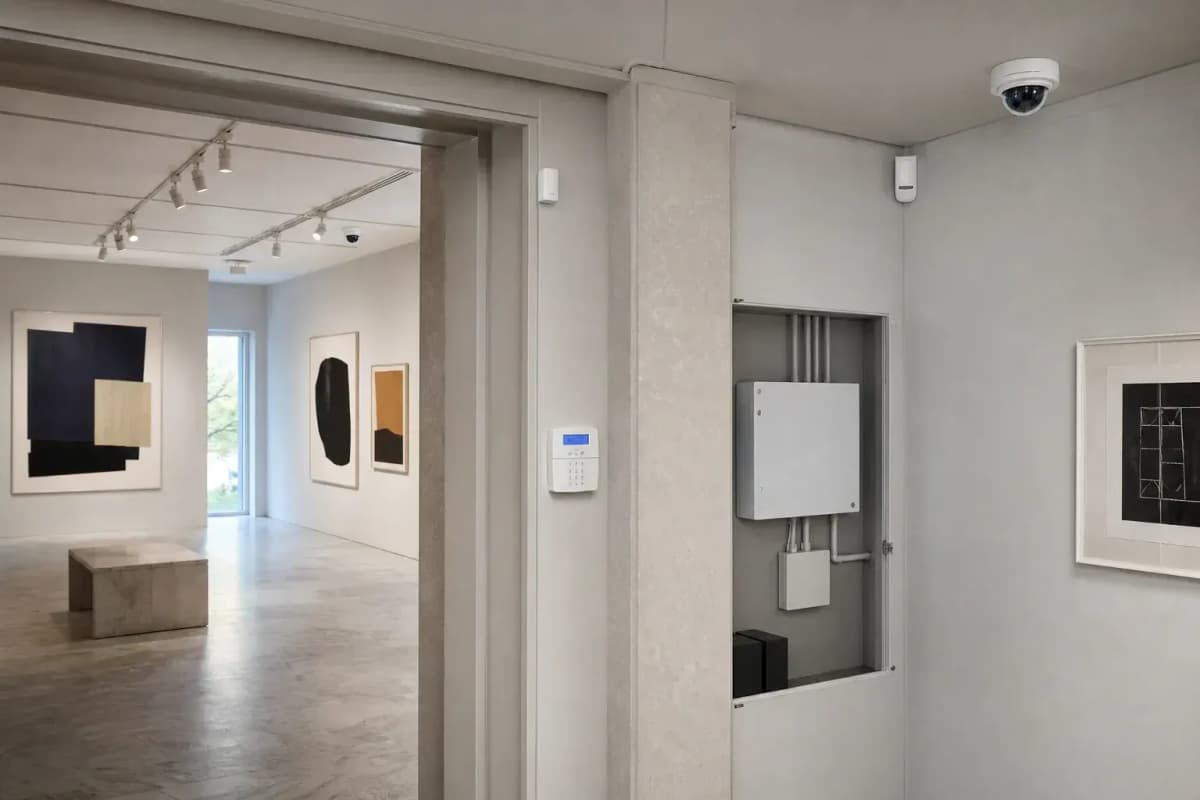
Museum Gallery 8-Zone Grid - 4-Camera Security System
Key Features
- 8 protected museum zones with hybrid wired/wireless alarm control
- 4 IP cameras with 30-day 4K-class NVR retention
- 6 detectors including PIR, dual-tech, glass-break, and vibration sensing
- 4-8 hours of UPS backup for grid-powered alarm and video continuity
- $1,300-$1,700 EPC turnkey range with 1-year labor warranty
Museum Gallery 8-Zone Grid is an 8-zone, grid-powered museum security and surveillance package with 4 IP cameras, 6 intrusion detectors, 30-day 4K video retention, and EPC turnkey pricing from $1,300 to $1,700.
Description
The Museum Gallery 8-Zone Grid is a compact security and surveillance system for 8 protected museum zones, combining 4 IP cameras, 6 intrusion detectors, 30-day 4K recording, and grid power with UPS backup. The package is configured for basic monitoring, discreet gallery installation, and EPC turnkey delivery from $1,300 to $1,700 for small exhibition rooms, storage corridors, display-case clusters, and reception areas.
SOLARTODO positions this configuration within its Security & Surveillance System line for B2B buyers who need 1 documented package rather than 8 unrelated devices. It is suitable for museums, galleries, private collections, cultural centers, and archive rooms where 4 cameras must cover public circulation while 6 detectors protect after-hours movement, glass, doors, and high-value cases. Buyers comparing additional layouts can View all Security & Surveillance System products or Configure your system online using the same 8-zone design logic.
System Architecture
The architecture uses 1 hybrid alarm panel assigned to 8 zones, 1 LCD keypad, 4 4MP/4K-class IP cameras, 1 16-channel NVR, and 6 primary detectors distributed across entrance, display, storage, and back-of-house areas. The panel supports wired and wireless devices, which is important in museum retrofits where 2 wall types, finished ceilings, and exhibition furniture can restrict cable routing. The system is aligned with the intent of EN 50131 intrusion alarm practice, including zone supervision, event signaling, and alarm control functions described by BSI for intrusion and hold-up systems at https://knowledge.bsigroup.com/products/alarm-systems-intrusion-and-hold-up-systems-system-requirements.
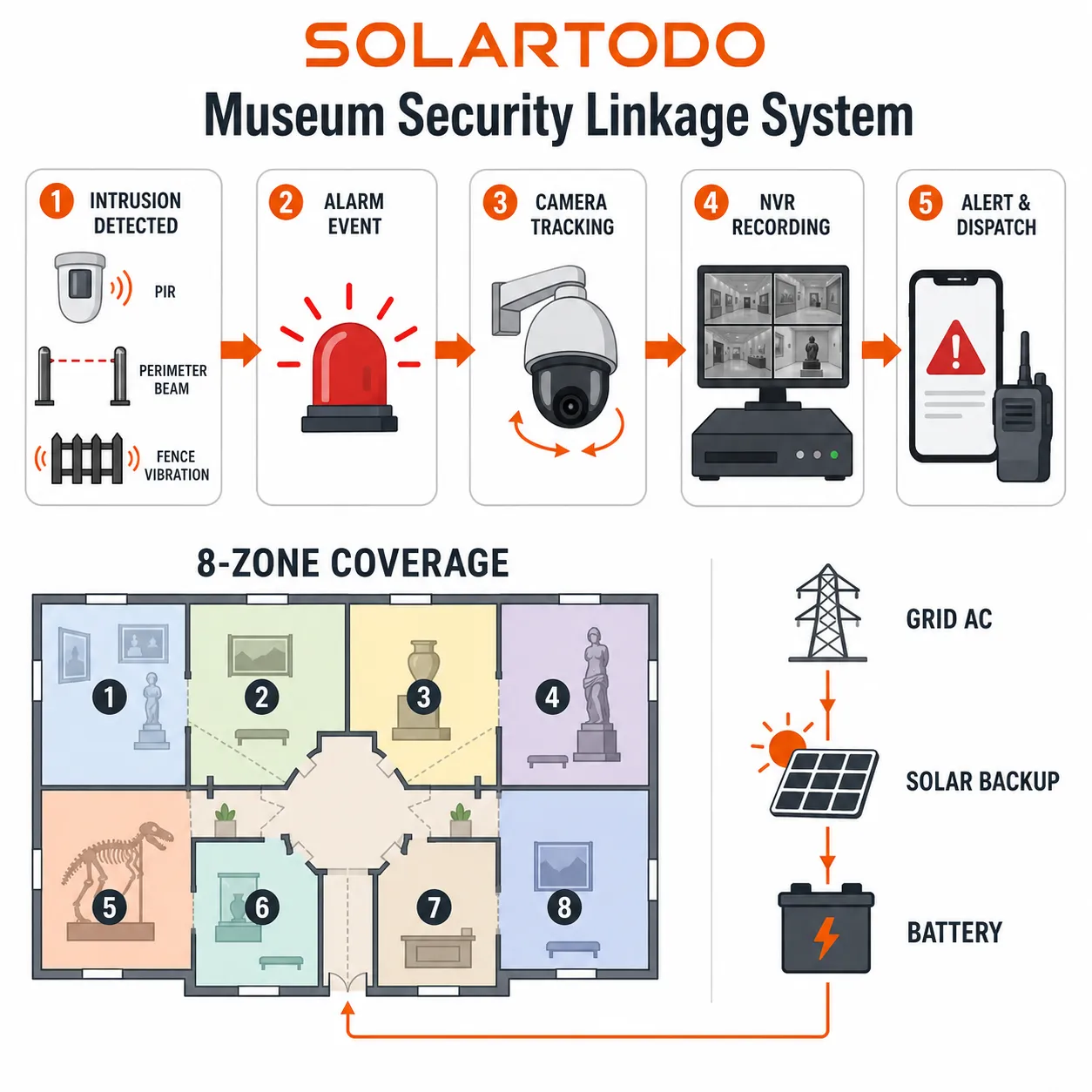
The 8-zone grid is normally mapped as 1 public entrance zone, 2 gallery-floor motion zones, 2 display-case protection zones, 1 staff corridor zone, 1 equipment or storage zone, and 1 tamper/service zone. This segmentation lets the operator arm 4 after-hours zones while leaving 2 staff zones temporarily bypassed during authorized cleaning or collection handling. For larger estates, the same alarm-panel family can expand from 8 zones toward 64 zones without replacing the monitoring concept.
Detection and Camera Coverage
The 6-detector package is designed around mixed sensing rather than 1 single detector type. A representative bill of devices uses 2 PIR detectors for low-traffic rooms, 2 dual-tech microwave plus PIR detectors for high-value rooms where false alarms are expensive, 1 acoustic glass-break detector for glazed cabinets, and 1 vibration sensor for a display plinth or case. Compared with a PIR-only layout of 6 sensors, dual-tech verification and camera-triggered review can reduce nuisance alarms by up to 90% under the supplied analytics assumption, especially during HVAC cycling, curtain movement, or localized reflections.
The 4-camera layout prioritizes documented coverage over decorative concealment: 2 fixed IP cameras cover gallery approach angles, 1 fixed IP camera covers the reception or loading threshold, and 1 camera covers storage or staff access. Camera placement should preserve 1 clear facial-capture lane at entry, 1 wide overview of the exhibit floor, and 1 evidence-grade angle on any case containing high-value objects. IEC 62676-1-1 defines minimum requirements and functional recommendations for video surveillance systems used in security applications, making it the primary CCTV reference for this package at https://webstore.iec.ch/en/publication/7347.
Video recording is specified as 30 days at 4K-class retention using H.265+ compression on a 16-channel NVR, leaving 12 unused channels for future cameras. In a typical 4-camera museum installation, recording policy can separate 24-hour low-bitrate continuous streams from motion-triggered high-bitrate event clips, reducing storage pressure while preserving 30 days of forensic review. IEC 62676-2-1 also supports IP interoperability concepts for video streaming, event handling, discovery, and PTZ control, which matter when a 4-camera package is later integrated with a third-party VMS.
Museum-Specific Protection Logic
Museum security differs from warehouse security because 1 incident may involve a small object, a 2-second touch event, or vibration around a display case rather than a forced door alone. The Museum Gallery 8-Zone Grid therefore uses discreet cameras, case-level sensors, after-hours motion detection, and optional environmental inputs for climate-sensitive objects. The configuration can support 1 humidity or temperature input when a display cabinet, archive room, or conservation space needs basic condition alerts in addition to intrusion events.
The alarm workflow uses 3 event tiers: local pre-alarm, confirmed intrusion, and verified video review. A local pre-alarm may be generated by 1 motion detector during cleaning hours; a confirmed intrusion can require 2 independent signals such as vibration plus motion; and a verified video review gives the operator 1 camera clip before escalation. UL 681 covers installation and classification principles for burglar and holdup alarm systems, including protective wiring and premises alarm protection, and the active standard record is available from UL Standards at https://www.shopulstandards.com/ProductDetail.aspx?productId=UL681_15_S_20140116.
Power, UPS, and Reliability
This variant uses grid power, which is appropriate for indoor museums with stable utility supply and no remote solar autonomy requirement. The recommended backup design includes 1 UPS sized for 4 to 8 hours of alarm panel, NVR, switch, and router operation, with graceful shutdown or continued recording selected during commissioning. IEA’s 2025 electricity reliability analysis emphasizes that secure and resilient power systems are increasingly important as buildings depend on electrified and digital services; that context supports UPS-backed security even in grid-powered cultural facilities at https://www.iea.org/reports/electricity-2025/reliability.
Grid operation reduces upfront cost compared with a solar-hybrid security design because it avoids 1 kW of PV capacity and several kWh of LFP storage. A solar-hybrid museum perimeter system may provide 48 to 120 hours of autonomy, but this indoor 8-zone package only needs 4 to 8 hours for orderly alarm and video continuity during short outages. The practical result is a lower EPC range of $1,300 to $1,700 instead of a higher solar-backed architecture that can add more than $1,500 per kW before batteries and civil works.
Cloud Monitoring and Communications
Communications use Ethernet as the primary path, 4G as the backup path, and WiFi where site policy permits local device enrollment. Basic monitoring includes event push, remote arm/disarm permissions, 30-day video search, and user-level access logs for at least 1 administrator and 2 operator roles. NREL’s distributed energy cybersecurity work identifies governance, technical management, and physical security as 3 key assessment areas for connected infrastructure, and those same principles apply to security gateways, routers, and cloud access at https://dercf.nrel.gov/technical-assistance-using-dercf.
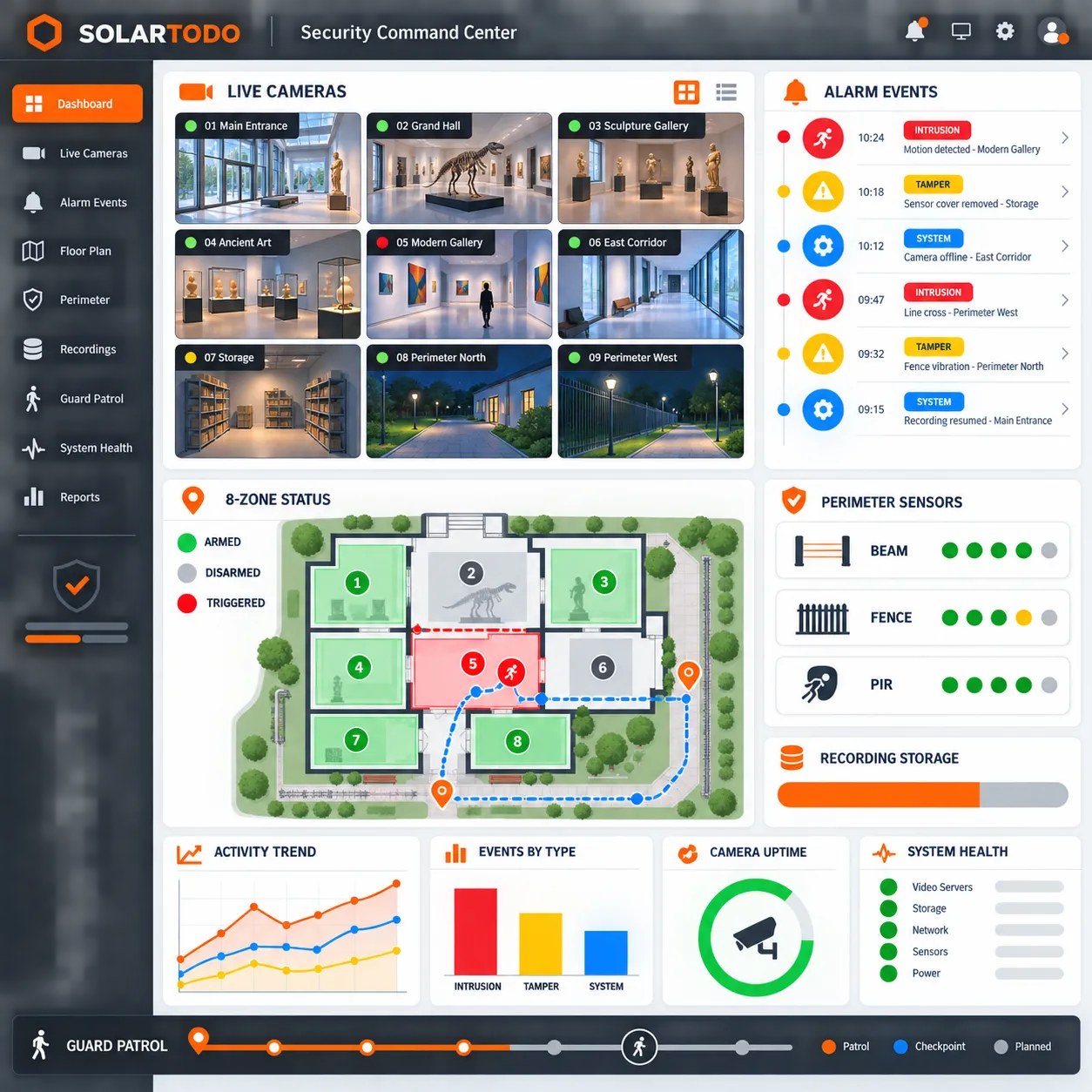
Encryption and account control are important because 4 cameras and 1 NVR can create a sensitive record of visitor flow, art movement, and staff routines. The recommended configuration uses AES-256 encrypted channels where supported, 2-factor administrator access, separate guest WiFi from CCTV LAN, and a 4G failover route that is tested at commissioning. IEC 62676-2-11:2024 defines interoperability profiles for VMS and cloud VSaaS systems, which is relevant when 1 museum wants future remote support or lawful access workflows without replacing the installed cameras.
Technical Specifications
| Parameter | Museum Gallery 8-Zone Grid specification |
|---|---|
| Security zones | 8 zones |
| Camera count | 4 cameras |
| Detector count | 6 detectors |
| Alarm panel | 8-zone hybrid wired/wireless panel |
| Video storage | 30 days at 4K-class recording |
| Power system | Grid with UPS backup |
| Backup autonomy | 4 to 8 hours |
| Communication | Ethernet + 4G + WiFi |
| Monitoring type | Basic monitoring |
| Expansion capacity | Up to 64 zones |
| Warranty | 2 years parts, 1 year labor |
The specification table reflects 11 buyer-facing parameters that procurement teams can compare across technical bids. For compliance-sensitive sites, fire-related inputs should be coordinated with the local fire alarm contractor because NFPA 72 governs fire alarm and signaling code requirements in the United States, while this product page covers intrusion, CCTV, and basic monitoring rather than a complete certified fire alarm installation. NFPA’s code landing page for NFPA 72 is available at https://www.nfpa.org/codes-and-standards/nfpa-72-standard-development/72.
Applications
The primary application is a small museum gallery of roughly 100 to 300 m² where 8 alarm zones and 4 cameras can cover entrances, movement corridors, display cases, and one controlled storage point. The same configuration also fits 1 private gallery, 1 jewelry display room, 1 heritage archive, or 1 cultural-center exhibition wing when the site needs video verification but not a 48-camera control room. For adjacent design notes, buyers can Learn about topic on integrated surveillance, power backup, and smart-infrastructure security planning.
Representative Scenario: MENA private gallery, 180 m², 8 zones. A 180 m² exhibition space with 1 public door, 1 staff door, 12 display cases, and 2 storage cabinets can use 4 cameras and 6 detectors without over-instrumenting the room. In this scenario, the EPC scope includes 1 day of device installation, 1 day of cable dressing and labeling, and 1 commissioning session with 8 zone tests and 4 camera view checks before handover.
For comparison, a conventional 8-zone alarm-only alternative with no NVR and no camera verification may cost less at equipment level, but it leaves 0 visual evidence and can force security teams to treat every after-hours trigger as a physical dispatch. The Museum Gallery 8-Zone Grid adds 4 video channels and 30-day recording, which can reduce unnecessary callouts by validating whether 1 trigger came from a person, staff action, or environmental movement. Buyers needing a priced layout can Request a custom quotation with floor dimensions, ceiling height, and object-risk zones.
EPC Investment Analysis and Pricing Structure
EPC turnkey pricing includes 5 commercial elements: engineering, procurement, construction, commissioning, and warranty. Engineering covers 1 zone schedule, 1 camera placement plan, cable pathway checks, and device addressing. Procurement includes the alarm panel, keypad, 4 cameras, 6 detectors, NVR, UPS, cabling, and mounting accessories. Construction includes installation for 8 zones, while commissioning includes 8 alarm tests, 4 camera view tests, 1 retention check, and 1 operator handover. The quoted 1-year labor warranty is paired with 2 years parts warranty.
| Pricing tier | Scope | Price range, USD |
|---|---|---|
| FOB Supply | Equipment only, ex-works China | $806 - $1,156 |
| CIF Delivered | Equipment plus ocean freight and insurance | $861 - $1,235 |
| EPC Turnkey | Installed, commissioned, and 1-year labor warranty | $1,300 - $1,700 |
| Volume band | Discount | Commercial note |
|---|---|---|
| 50+ systems | 5% | Suitable for 50 small branches or gallery rooms |
| 100+ systems | 10% | Suitable for 100 standardized cultural-retail rooms |
| 250+ systems | 15% | Suitable for 250-unit framework procurement |
ROI depends on avoided callouts, reduced guard overtime, and faster incident verification. If a museum pays $45 per monitored-response event and avoids 20 unnecessary dispatches per year, annual direct savings are $900 before insurance or staff time is counted. Against a $1,500 representative EPC midpoint, the simple payback can be about 1.7 years; against an alarm-only system that produces 0 video evidence, the strongest value is usually faster verification rather than energy savings.
Payment terms are 30% T/T deposit plus 70% against B/L copy, or 100% L/C at sight for qualified export buyers. Project financing can be discussed for integrated security, lighting, telecom, or power programs above $1,000K in total contract value. For engineering files, procurement schedules, or a multi-site museum security bill of quantities, contact [email protected] with at least 1 floor plan and 8 intended protection zones.
Standards, Documentation, and Procurement Notes
The product should be specified using 6 reference families: EN 50131 for intrusion systems, IEC 62676 for video surveillance, UL 681 for burglar alarm installation classification, NFPA 72 where fire signaling interfaces are included, NREL cybersecurity guidance for connected infrastructure risk, and IEA reliability guidance for resilient electrical service. These standards do not replace local authority approval, but they provide procurement teams with 6 defensible anchors for submittals, commissioning forms, and acceptance tests.
SOLARTODO is a solar, energy storage, smart lighting, security, telecom power tower, and smart agriculture supplier at https://solartodo.com, so the same procurement channel can combine 1 museum security package with UPS, site lighting, or building energy upgrades. The Museum Gallery 8-Zone Grid is intentionally limited to 8 zones and 4 cameras because small cultural spaces benefit from clear documentation, predictable pricing, and fast commissioning more than oversized control-room equipment.
Technical Specifications
| Security Zones | 8zones |
| Camera Count | 4cameras |
| Detector Count | 6detectors |
| Power System | Grid with UPS backup |
| Backup Autonomy | 4-8hours |
| Video Storage | 30 days @ 4K |
| Monitoring Type | Basic |
| Communication | 4G + Ethernet + WiFi |
| Expansion Capacity | Up to 64zones |
| Warranty | 2 years parts, 1 year labor |
Price Breakdown
| Item | Quantity | Unit Price | Subtotal |
|---|---|---|---|
| 8-Zone Hybrid Alarm Panel | 1 pcs | $120 | $120 |
| LCD Keypad | 1 pcs | $30 | $30 |
| 4MP IP Camera | 4 pcs | $65 | $260 |
| 16-Channel NVR | 1 pcs | $135 | $135 |
| PIR Detector | 2 pcs | $7 | $14 |
| Dual-Tech Detector | 2 pcs | $21 | $42 |
| Glass Break Detector | 1 pcs | $8 | $8 |
| Vibration Sensor | 1 pcs | $14 | $14 |
| Door/Window Contact | 4 pcs | $2 | $8 |
| UPS Backup and Power Accessories | 1 pcs | $95 | $95 |
| Cabling, Conduit, and Mounting Accessories | 1 pcs | $75 | $75 |
| Installation and Commissioning | 8 pcs | $50 | $400 |
| Engineering, Drawings, and QC | 1 pcs | $150 | $150 |
| 1-Year Warranty and Support | 1 pcs | $70 | $70 |
| Basic Monitoring Setup | 1 pcs | $75 | $75 |
| Total Price Range | $1,300 - $1,700 | ||
Frequently Asked Questions
What is included in the Museum Gallery 8-Zone Grid EPC price?
How are the 8 zones normally assigned in a museum?
Does the system support 30 days of video storage?
Why use dual-tech and vibration detectors instead of PIR only?
Can this 8-zone package expand later?
Certifications & Standards

Data Sources & References
- •IEC 62676-1-1:2013 Video surveillance systems for security applications
- •IEC 62676-2-11:2024 VMS and cloud VSaaS interoperability profiles
- •BS EN 50131 intrusion and hold-up alarm system requirements
- •UL 681 Installation and Classification of Burglar and Holdup Alarm Systems
- •NFPA 72 National Fire Alarm and Signaling Code
- •NREL Distributed Energy Resource Cybersecurity Framework
- •IEA Electricity 2025 reliability analysis
Interested in this solution?
Contact us for a customized quote based on your specific requirements.
Contact Us