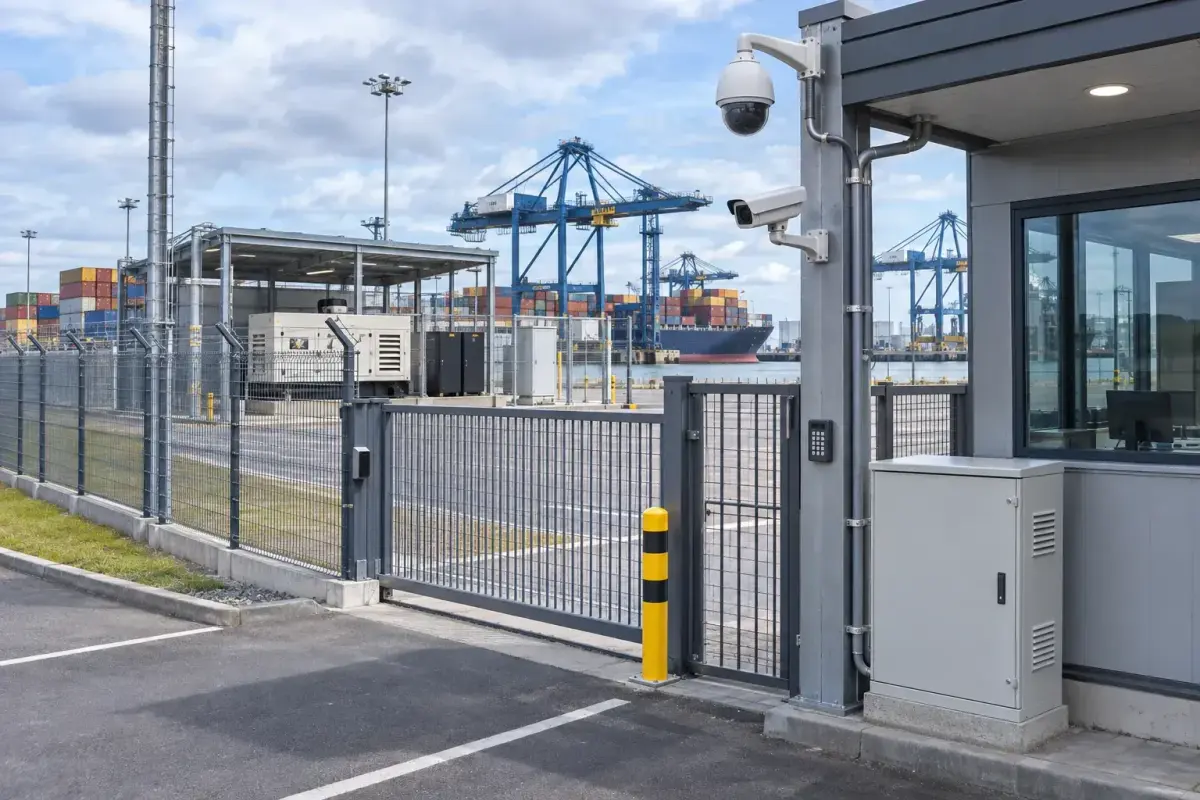
Port Terminal 64-Zone Grid Generator UPS - 38-Camera Security and Surveillance
Key Features
- 64-zone hybrid alarm panel with 62 detectors and 2 provisional spare inputs in the representative zone schedule.
- 38-camera design with 32 fixed 4K IP cameras, 4 PTZ cameras with 20× optical zoom, and 2 thermal cameras.
- 30-day video retention target with 48 nominal recording channels across 3 recorders.
- Grid, standby generator interface, and UPS architecture with a 4–8 hour backup design target at the agreed critical load.
- USD 13,900–23,600 EPC turnkey budget, with 2 years of parts coverage and 1 year of labor coverage under the stated warranty terms.
The SOLARTODO Port Terminal 64-Zone Grid Generator UPS pairs 38 cameras and 62 detectors with premium monitoring, a 30-day video retention target, and grid, generator, and UPS integration. The EPC turnkey budget is USD 13,900–23,600 with a 1-year labor warranty.
Description
The SOLARTODO Port Terminal 64-Zone Grid Generator UPS is a security and surveillance system with 64 alarm zones, 38 cameras, and 62 detectors for cargo terminals, logistics gates, and controlled waterfront facilities. It combines premium monitoring with local recording, a 30-day retention target for 4K streams, and a grid, generator, and uninterruptible power supply (UPS) architecture, with EPC turnkey pricing of USD 13,900–23,600.
System Architecture
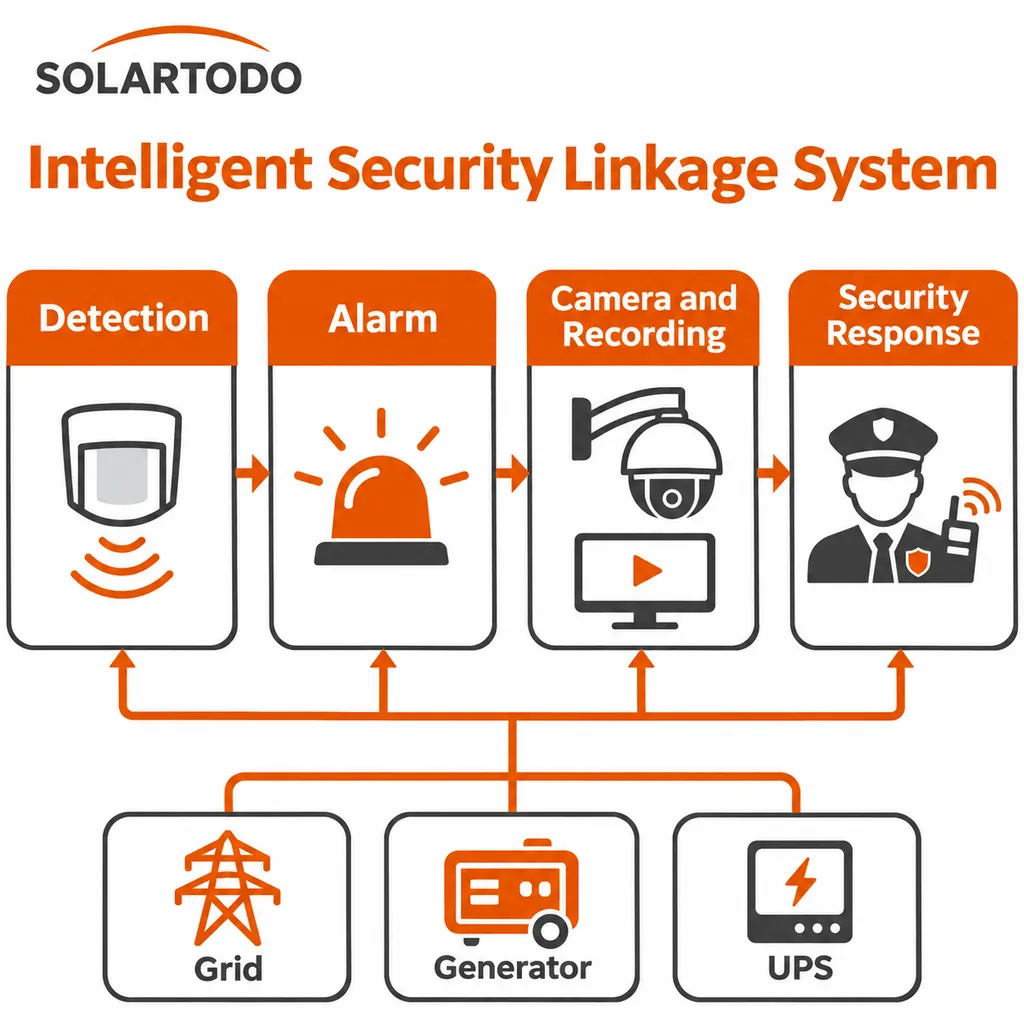
The 64-zone hybrid alarm panel correlates detector events with camera views at the operator console. Each commissioned zone has a unique identifier, a device description, and a response instruction. The panel supports wired detection and compatible wireless endpoints where approved for the installation. Logical partitions let operators arm or service defined areas independently, a practical requirement for terminals where a cargo yard, warehouse, and administrative block may operate on different shifts. A zone is an alarm input or logical point. A camera is a video endpoint with its own recording channel.
A representative detector schedule assigns 30 dual-technology detectors, 26 passive infrared (PIR) detectors, and 6 door contacts across 62 alarm inputs. This leaves 2 of the 64 inputs unallocated when each detector uses one input and other signals use separate interfaces. Tamper, power, or supervisory signals can consume those remaining inputs if the final panel design assigns them as independent zones. The design-stage zone schedule records how every device and supervisory condition maps to the console.
A representative video schedule uses 32 fixed 4K IP cameras, 4 pan-tilt-zoom (PTZ) cameras with 20× optical zoom, and 2 thermal cameras. Fixed views provide continuous footage of their assigned scenes. PTZ views support live verification and inspection, and thermal views support detection where visible light is limited. Design acceptance depends on the image detail the operator needs at each location. IEC 62676-4:2025 provides application guidance for planning, installing and accepting the video surveillance system. IEC 62676-4:2025 video surveillance application guidelines
Technical Specifications
| Parameter | Configuration and acceptance basis |
|---|---|
| Alarm capacity | 64 zones on the specified hybrid panel |
| Cameras | 38 IP video channels in the representative equipment schedule |
| Detectors | 62 devices, with the final mix set by the zone schedule |
| Video retention | 30-day target for 4K streams at agreed recording settings |
| Backup power | Grid + standby generator interface + UPS, with a 4–8 hour UPS design target at agreed critical load |
| Monitoring and communications | Premium monitoring over Ethernet with 4G backup and optional authorized Wi-Fi access |
| Expansion and warranty | Up to 64 panel zones, with 2 years on parts and 1 year on labor under the stated warranty terms |
The recording allowance uses 3 network video recorders (NVRs) with 16 channels each, providing 48 nominal channels for 38 cameras. The 10 remaining channels are a licensing and connection margin in this example. Adding cameras still requires sufficient aggregate ingest bandwidth, disk capacity, and playback capacity on the receiving recorder. The 30-day requirement applies at the agreed bitrate for each stream, including native-resolution PTZ and thermal streams. The purchaser can specify RAID-capable recorders and drive layouts where storage fault tolerance is required. Export procedures give operators a way to preserve incident footage beyond normal retention.
For a conservative storage case, 38 streams at 4 Mb/s each produce an aggregate video rate of 152 Mb/s. Continuous recording at that rate for 30 days uses approximately 49.25 TB in decimal units before disk redundancy, file-system overhead, and operating margin. Each recorder needs a storage calculation based on its own assigned cameras. High activity, rain, and night image noise can raise the bitrate under variable-rate encoding. The design should use measured or declared main-stream bitrates and confirm which recorder profiles support standard H.265. ITU-T H.265 high efficiency video coding
Outdoor camera and connection-box selection includes a documented ingress rating, with IP66 an example procurement target for exposed positions. The assembly rating depends on the enclosure, cable glands, and installed orientation. Salt exposure is a separate material-selection issue, so the equipment schedule also records bracket material, fastener finish, and connector protection. Verify whether washdown locations require a different enclosure rating and ensure the acceptance schedule checks the installed assembly at the actual exposure level. IEC 60529 enclosure IP Code
Grid, Generator, and UPS Power Continuity
Utility power feeds the security distribution circuit under normal conditions. During a mains outage, 1 UPS sustains the designated alarm, recording, and network loads while the standby generator starts and the transfer system connects the generator supply. The generator interface in the representative budget assumes an existing terminal generator and compatible transfer equipment. Procurement should identify the protected outlets and equipment circuits, then confirm that the generator can accept both the running security load and the additional UPS charging demand after transfer. IEC 62040-3:2021 UPS performance and testing requirements
The 4–8 hour UPS autonomy figure is a design target at the agreed protected load, subject to battery sizing and on-site verification. At an assumed steady load of 0.50 kW, 4 hours requires 2.0 kWh at the UPS output and 8 hours requires 4.0 kWh. Nominal battery capacity must also account for inverter losses, usable battery capacity, site temperature, voltage limits, and aging. Include the recorder, alarm panel, communications equipment, and the PoE consumption of every protected camera in the measured load. Run the test with nighttime camera loads active where relevant.
Generator runtime depends on the allocated fuel reserve, site operating conditions, and concurrent loads. Capture the results of 2 separate power tests during commissioning. The first verifies an outage with successful generator transfer and return to utility. The second runs with generator power unavailable and measures UPS endurance at the agreed load. Record the alarm state, visible video feeds, and recorder timestamps through each transition. Specify the generator's declared rating and check that it is appropriate for the planned standby duty. ISO 8528-1 generating set application, ratings and performance
Cloud Monitoring
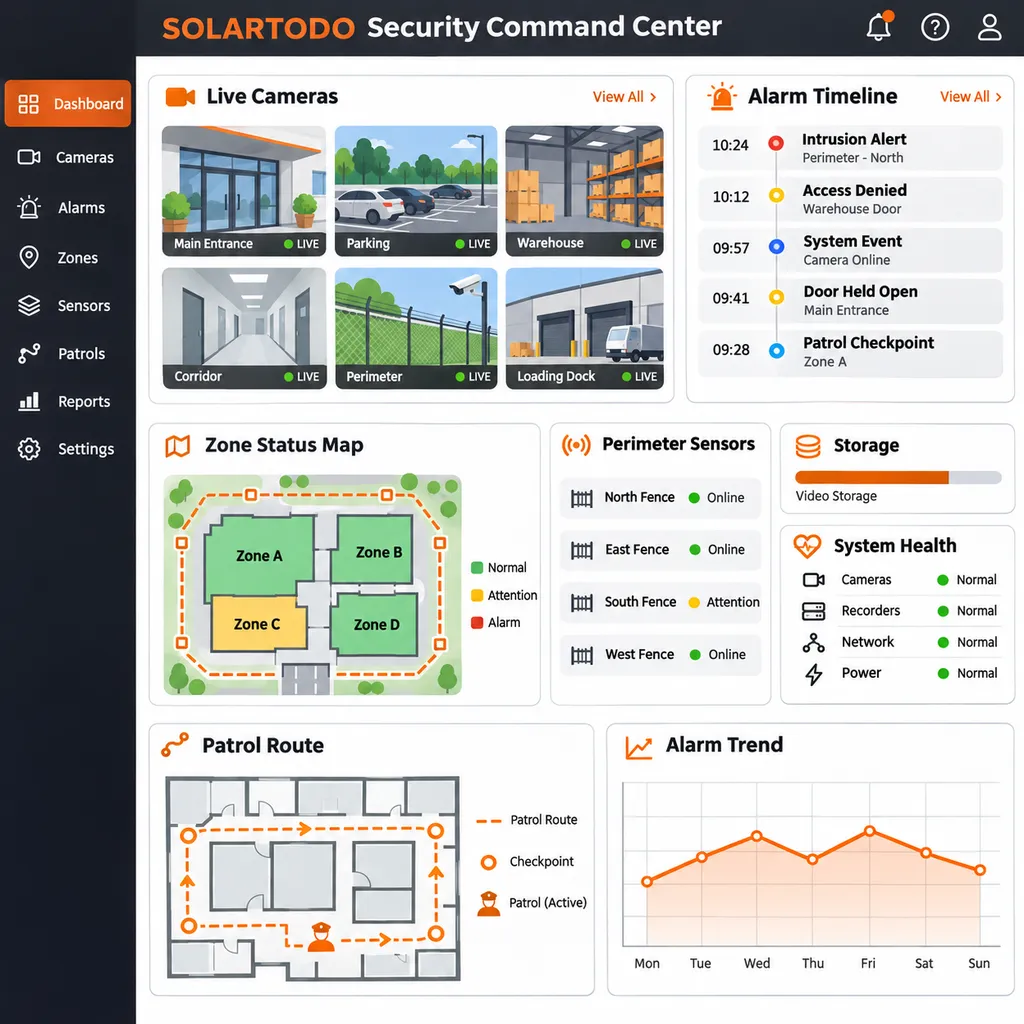
Premium monitoring links the 64-zone event list and associated video views in a common operator workflow. Operators can acknowledge alarms, inspect live video or a recorded clip, document a disposition, and escalate incidents according to the terminal's response matrix. Where the selected cameras support person and vehicle classification or line-crossing events, commissioning sets the rules for scenes with normal vehicle and pedestrian traffic. Staffed 24/7 monitoring, response times, SIM data, and cloud subscription periods are defined in the service quotation.
Local NVR recording and the 4G event path serve different operating needs. Ethernet carries primary traffic, while cellular backup can be configured for alarm messages and selected substreams when bandwidth is limited. Local recording can continue during a wide-area connection outage while the local camera network, recorder, and protected power circuit remain available. Commissioning covers 2 communications states, primary-path failure and recovery. Include alarm timestamps, restored access, and the handling of buffered events in the acceptance record.
Applications
Representative scenario — container and general cargo terminal. A terminal planning for 2 vehicle gates, an enclosed warehouse, and a container yard assigns fixed cameras to gate lanes and recurring yard movements, PTZ cameras to live verification, and thermal channels to selected low-light scenes. Its 62 detectors cover approved interior, door, and restricted-area points. The terminal can define separate operator response instructions for a door contact opening during authorized activity, a detector event during a closed shift, and a communications fault. This scenario illustrates how the configuration can be allocated during design.
The site security team can document how the 64-zone alarm schedule and 38-camera view list support the approved facility security procedures. For applicable facilities, SOLAS chapter XI-2 and the ISPS Code set the framework for port facility security. An equipment procurement can supply evidence for the facility's security plan through approved coverage drawings, event handling instructions, and acceptance records. Responsibility for facility-level approvals follows the applicable port authority and contracting government process. IMO SOLAS XI-2 and the ISPS Code
Compare fixed views, PTZ coverage, and detector choices across the 64-zone configuration before freezing the drawings. The category page provides the associated system options, and the configurator captures the equipment counts for a preliminary scope. View all Security & Surveillance System products · Configure your system online · Learn about surveillance planning and backup power
EPC Investment Analysis and Pricing Structure
The USD 13,900–23,600 EPC turnkey tier covers engineering, procurement, construction of the agreed installation, commissioning, and 1 year of labor warranty. Engineering defines the device schedule, mounting locations, cable routes, recording capacity, and protected power loads. Procurement supplies the approved equipment and documentation. Construction installs and connects the equipment within the agreed site scope. Commissioning verifies the installation against the device and test schedules and hands over as-built drawings, administrator access, and warranty documentation. The specification lists 2 years of parts coverage.
| Pricing tier | Range in USD | Scope |
|---|---|---|
| FOB Supply | 8,618–16,048 | Equipment only, supplied from China. Formal quotation identifies the named port or factory handover point, as applicable. |
| CIF Delivered | 9,206–17,142 | Equipment, ocean freight, and cargo insurance to the named destination port. |
| EPC Turnkey | 13,900–23,600 | Engineering, procurement, installation, commissioning, and 1-year labor warranty for the agreed scope. |
The USD 18,233 representative estimate assumes use of the terminal's existing standby generator and transfer equipment. It includes an allowance for a UPS and battery system sized during engineering, plus separate lines for installation, commissioning, engineering, and warranty support. A new generator, dedicated fuel system, major trenching, new poles, and recurring monitoring service can be priced as additional scope. The formal supply quotation identifies the named handover point and the Incoterms® 2020 rule. Factory pickup uses EXW when agreed. FOB and CIF use on-board delivery for risk transfer. ICC Incoterms® 2020 rules for sea and inland waterway transport
| Systems per order | Volume discount |
|---|---|
| 50+ | 5% |
| 100+ | 10% |
| 250+ | 15% |
Discounts of 5%, 10%, and 15% are quantity-tier figures. The project quotation identifies the eligible equipment and the applicable discount base for multi-site orders. Standard payment options are 30% T/T deposit plus 70% against the bill of lading (B/L), or 100% letter of credit (L/C) at sight. Financing is available for consideration on projects above USD 1,000,000, subject to commercial and credit approval. Send the terminal plan and power scope to [email protected]. Request a custom quotation
Representative ROI and conventional system comparison
Assume a conventional camera-and-alarm package with separate operator queues costs USD 14,000 installed and the integrated package costs USD 18,233. If console integration frees up 2.5 staff hours per week at USD 24 per hour across 52 weeks, the implied annual staff-time value is USD 3,120. After an assumed USD 720 per year in incremental service costs, annual net value is USD 2,400, giving a simple payback of approximately 1.76 years on the USD 4,233 additional capital cost. These are scenario inputs for a procurement model.
In the same 5-year scenario, the conventional option totals USD 29,600 including the modeled review time, while the integrated option totals USD 21,833 with incremental service costs. The difference is USD 7,767, or approximately 26.2% of the conventional total for the modeled costs. The calculation uses undiscounted amounts and holds common operating costs equal. Treat released staff time as productivity value unless payroll or contracted hours are reduced. Use observed review volumes and quoted service costs when evaluating the investment.
Commissioning and Handover
Acceptance covers 38 camera checks and 62 detector checks in the representative configuration, plus the final programmed zone list. Camera checks include live image, recorded playback, time synchronization, and the target scene under the specified operating conditions. Detector checks verify the correct zone label, event receipt, and reset at the console. The handover includes a recording settings export and a retention review date. Once the 30-day history has accumulated, verify the oldest retrievable footage against the agreed recording schedule.
The closeout package identifies who owns each of 3 operational functions: alarm response, footage retrieval, and power system maintenance. It also records the UPS runtime test load, the installed recorder and disk inventory, and the final export settings. Procurement can use the device schedule to reconcile installed serial numbers against approved submittals and model-specific conformity documents. Obtain the documentation required by the tender before equipment release and record the start dates for the 2-year parts and 1-year labor warranty periods.
Technical Specifications
| Security Zones | 64zones |
| Camera Count | 38cameras |
| Detector Count | 62detectors |
| Power System | Grid + standby generator interface + UPS |
| Backup Autonomy | 4–8 target at agreed critical loadhours |
| Video Storage | 30 days @ 4K target at agreed recording settings |
| Monitoring Type | Premium monitoring |
| Communication | Ethernet + 4G backup + optional Wi-Fi |
| Expansion Capacity | Up to 64zones |
| Warranty | 2 years parts, 1 year labor |
Price Breakdown
| Item | Quantity | Unit Price | Subtotal |
|---|---|---|---|
| 64-zone hybrid alarm panel | 1 pcs | $120 | $120 |
| LCD keypad | 2 pcs | $30 | $60 |
| Dual-technology detector | 30 pcs | $21 | $630 |
| PIR detector | 26 pcs | $7 | $182 |
| Door contact | 6 pcs | $2 | $12 |
| Fixed 4K IP camera, planning allowance | 32 pcs | $92 | $2,944 |
| 20× PTZ camera | 4 pcs | $170 | $680 |
| Thermal camera | 2 pcs | $500 | $1,000 |
| 16-channel NVR | 3 pcs | $135 | $405 |
| Surveillance drive package, capacity subject to storage design | 1 pcs | $2,400 | $2,400 |
| PoE network, 4G router and rack equipment package | 1 pcs | $1,450 | $1,450 |
| Cabling, mounts and field junction box package | 1 pcs | $800 | $800 |
| UPS and battery package, final runtime subject to load verification | 1 pcs | $1,900 | $1,900 |
| Existing generator and transfer equipment integration package | 1 pcs | $950 | $950 |
| Field installation allowance per design zone | 64 pcs | $50 | $3,200 |
| Commissioning and operator handover | 1 pcs | $450 | $450 |
| Engineering and quality control | 1 pcs | $650 | $650 |
| 1-year labor warranty and support allowance | 1 pcs | $400 | $400 |
| Total Price Range | $13,900 - $23,600 | ||
Frequently Asked Questions
What does the EPC price include, and how long is the warranty?
Can the system record all 38 cameras for 30 days?
How long can the security system operate during a grid outage?
How much expansion capacity is available?
Does premium monitoring include a staffed 24/7 response service?
Certifications & Standards

Data Sources & References
- •SOLARTODO product brief supplied for this variant — configuration, catalog price tiers, warranty template, and reference unit prices. Unpriced lines in the representative EPC estimate use planning allowances.
- •IEC 62676-4:2025 — video surveillance application guidelines
- •IEC 62040-3:2021 — UPS performance and test requirements
- •IEC 60529 — enclosure ingress protection
- •ISO 8528-1 — generator applications, ratings and performance
- •ITU-T H.265 — high efficiency video coding
- •IMO — SOLAS XI-2 and the ISPS Code
- •ICC — Incoterms 2020 sea and inland waterway transport rules
- •SOLARTODO-supplied media URLs and asset descriptions. Image contents could not be independently verified.
Interested in this solution?
Contact us for a customized quote based on your specific requirements.
Contact Us