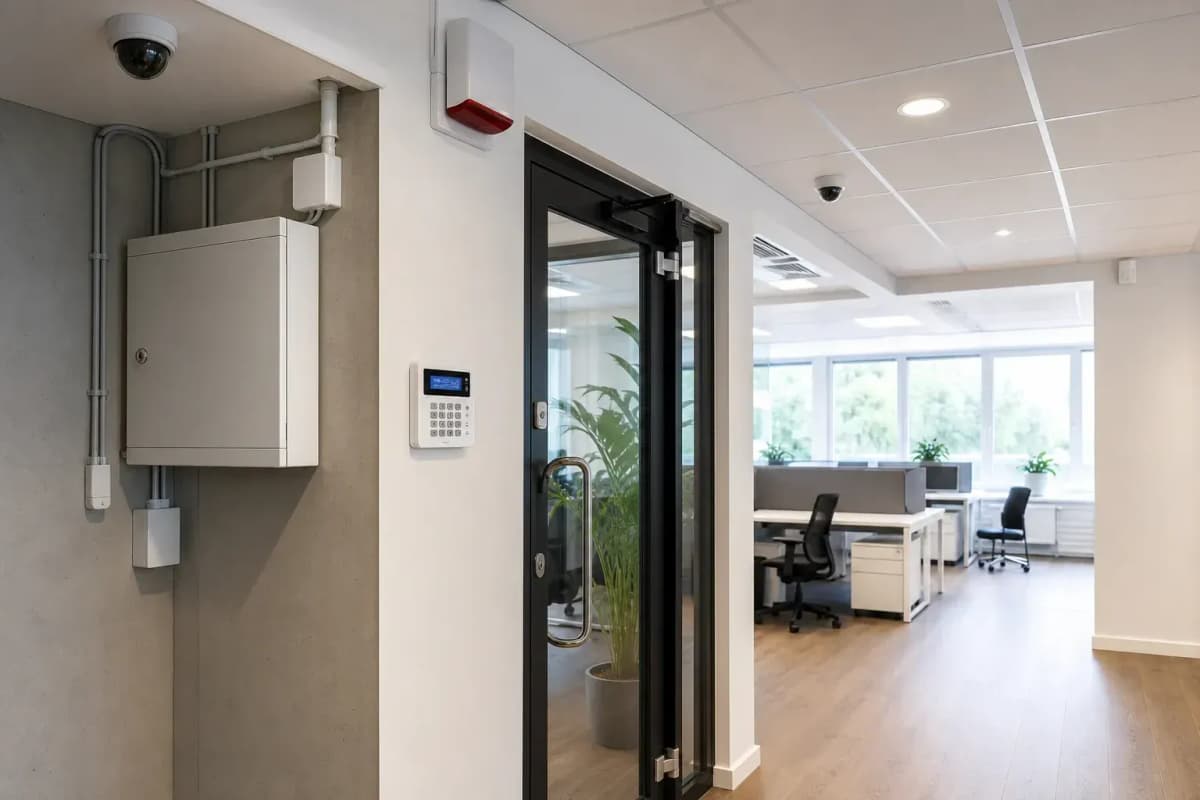
Small Office 8-Zone Grid - 8-Zone Self-Monitored Security
Key Features
- 8 supervised alarm zones for perimeter, motion, glass, and asset protection
- 4 IP cameras with 30-day 4K retention through an 8-channel NVR
- 7 detectors: 3 PIR, 2 dual-tech, and 2 door/window contacts
- 6-hour grid UPS backup with Ethernet, WiFi, and 4G communication
- $1,300-$1,700 EPC turnkey range with 1-year labor warranty
Small Office 8-Zone Grid is an EPC turnkey security package with 8 alarm zones, 4 IP cameras, 7 detectors, grid power, 6-hour UPS backup, and 30-day 4K recording for self-monitored offices.
Description
The Small Office 8-Zone Grid security and surveillance system is a compact EPC turnkey package for 1 small office with 8 alarm zones, 4 IP cameras, 7 detectors, grid power, and self monitoring. It is designed for reception areas, server rooms, stock closets, perimeter doors, and 30-day 4K video retention under IEC 62676 CCTV guidance and EN 50131 intrusion-alarm practice.
Product Overview
This configuration fits a typical 80-250 m² office where 8 supervised zones cover 2 entry doors, 3 motion areas, 1 glass-front zone, 1 vibration-sensitive asset zone, and 1 shared utility or pantry zone. The package combines an 8-zone hybrid alarm panel, 4 fixed IP cameras, 7 field detectors, Ethernet/WiFi/4G communication, and a grid-fed UPS path sized for 6 hours of backup autonomy.
For B2B buyers comparing branch-office security packages, this model sits between a 4-zone retail kit and a 16-zone corporate-floor system, with an EPC turnkey price of $1,300-$1,700 and equipment-only FOB supply of $806-$1,156. The design follows a documentation-first approach aligned with IEC 62676 for video surveillance, EN 50131 for intrusion systems, UL 681 for central-station alarm service practices, NFPA 72 for fire-alarm interface awareness, IEEE 802.3 for Ethernet networking, and IEA 2024 energy-efficiency guidance for low-power edge devices.
The system is intended for self monitoring, meaning alerts route to the owner's mobile app, email, or local display instead of a 24/7 paid monitoring center. This reduces recurring operating cost by about $540 per year compared with a conventional $45/month monitoring subscription, while still retaining 30 days of locally recorded 4K evidence for incident review.
System Architecture
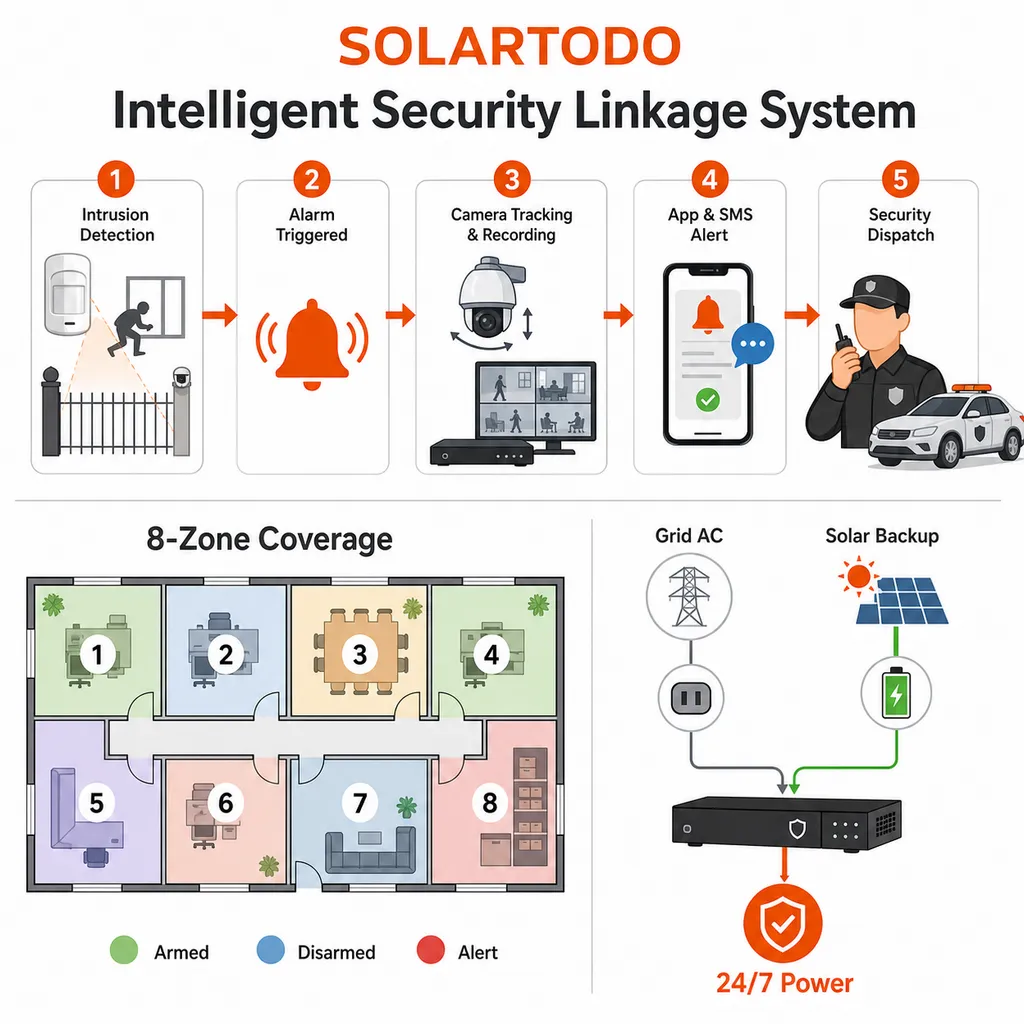
The 8-zone alarm panel is the control layer, the 4-camera IP network is the verification layer, and the NVR is the evidence layer. Each zone can be assigned to a partition such as front office, back office, storage, or after-hours perimeter, giving a 4-partition workflow for companies with different staff schedules between 08:00 and 20:00.
A recommended wiring plan uses 2 door contacts on primary entrances, 3 PIR motion detectors across open-plan work areas, and 2 dual-technology detectors for locations with air-conditioning movement or reflective glass. Dual-tech sensing combines microwave and passive infrared signals, which can reduce nuisance alarms by up to 50-70% compared with PIR-only sensing in offices with HVAC airflow, moving blinds, or sun-heated windows.
The video layer uses 4 IP cameras connected to an 8-channel NVR, leaving 4 spare channels for a meeting room, parking view, or second entrance. H.265+ compression can reduce storage bandwidth by about 30-50% compared with H.264 at the same visible quality, depending on motion level, scene complexity, frame rate, and whether 4K recording is set to 15 fps or 25 fps.
Technical Specifications
The alarm side supports 8 active zones in this configuration and can be expanded to 64 zones when compatible wired or wireless modules are added. This makes the system suitable for a small office on day 1 and for a 2-floor office expansion later, without replacing the alarm control panel.
The detector count is 7 devices, which is enough for basic perimeter and interior detection without over-instrumenting a small office. A practical bill of materials uses 3 PIR detectors at approximately $7 each, 2 dual-tech detectors at approximately $21 each, and 2 door/window contacts at approximately $2 each, with final detector selection adjustable during EPC engineering.
The camera count is 4 units, normally specified as 4MP or 4K IP cameras depending on procurement grade and local recording requirements. A 30-day 4K retention target requires storage sizing against bit rate, frame rate, motion percentage, and compression profile; IEC 62676 recommends matching video quality objectives to identification, recognition, detection, and observation tasks instead of using camera resolution alone as the design basis.
The power system is grid-connected with a UPS-backed low-voltage security load. For a small office package, 6 hours of autonomy is normally enough to bridge short utility outages, planned maintenance, and breaker trips, while IRENA 2024 resilience guidance notes that distributed energy assets and backup systems are increasingly used to preserve critical communications during grid interruptions.
The communications stack combines Ethernet, WiFi, and 4G backup so that 2 independent network paths can remain available during router, ISP, or cabling faults. AES-256 encrypted transmission can be specified for remote app access, and anti-tamper supervision should be enabled on the alarm enclosure, keypad, detector loops, and NVR login policy.
Cloud Monitoring
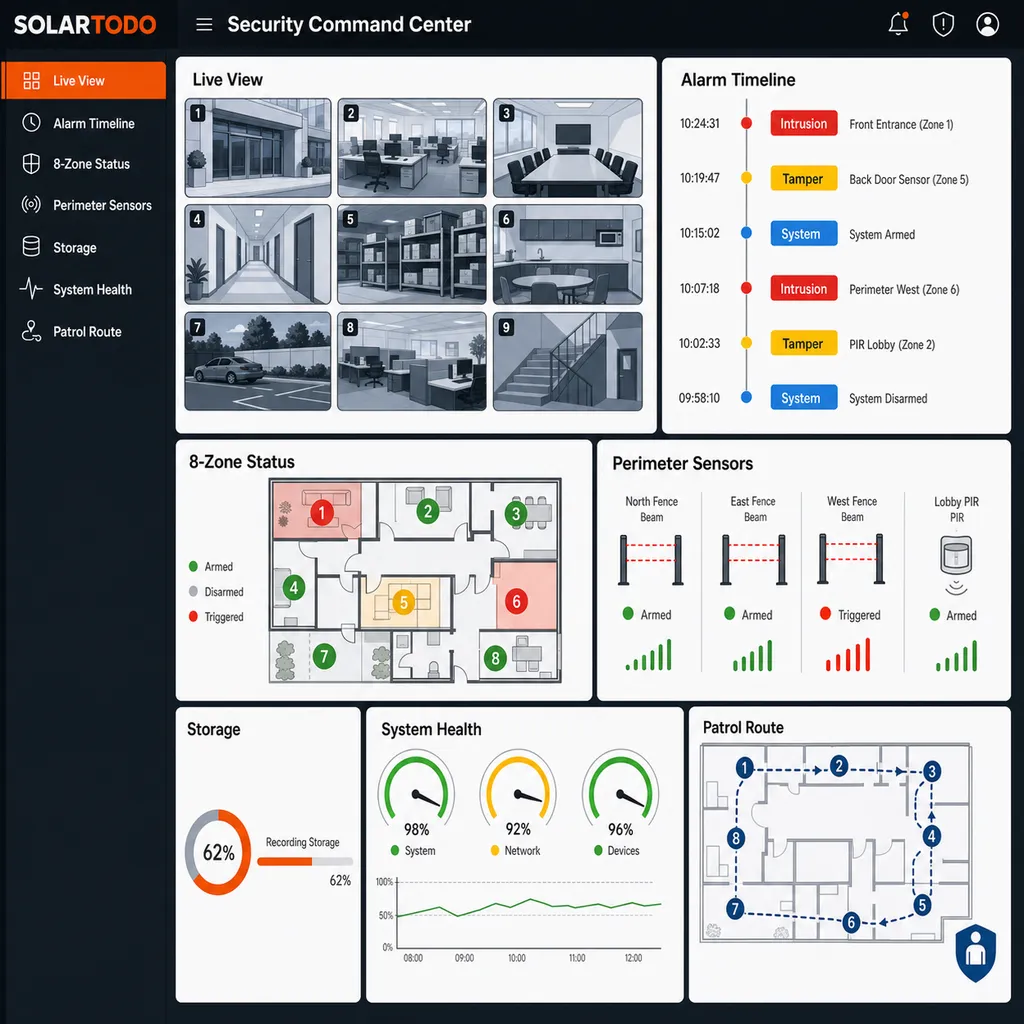
This variant is configured for self monitoring, so the buyer controls alarms through a mobile app, web VMS, local NVR console, or email/SMS gateway rather than a third-party dispatch center. A 4-camera office can normally be reviewed in less than 5 minutes after an alarm event because each zone can be paired with 1 or more verification cameras.
Cloud VMS functions can include remote playback, device health status, role-based user accounts, push notifications, and event bookmarks. For privacy-sensitive offices, SOLARTODO recommends defining at least 3 user roles: owner/admin, facility manager, and viewer, with separate permissions for live view, playback, export, and configuration changes.
AI analytics are optional but valuable where 4 cameras cover public-facing entrances or shared corridors. On-device person/vehicle classification can reduce false video alarms by up to 90% compared with basic pixel-motion detection, a trend consistent with 2025 edge-AI security deployments that process events locally before sending notifications to cloud platforms.
Applications
The main application is a small office with 5-30 employees, 1 reception area, 1 equipment room, 1 storage cabinet, and up to 2 perimeter doors. The same package can also support a clinic, training center, design studio, finance office, or branch sales office where the security goal is after-hours intrusion detection plus daytime incident evidence.
For a representative MENA small-office scenario, assume a 160 m² consulting office with 2 exterior doors, 1 glass meeting room, 1 IT closet, 18 staff, and 10-hour weekday occupancy. The 8-zone grid package would place 2 door contacts on entrances, 3 PIR detectors in movement corridors, 2 dual-tech sensors near HVAC-affected glass areas, and 4 cameras covering reception, corridor, storage, and the main entrance.
Compared with a conventional stand-alone alarm siren and 2 analog cameras, this package improves evidence coverage from about 2 recorded viewpoints to 4 digital viewpoints and adds 8 mapped alarm inputs for event correlation. It also avoids the cost of a $45/month monitoring service, producing a 3-year operating saving of about $1,620 before accounting for reduced incident investigation time.
Buyers can compare adjacent configurations at View all Security & Surveillance System products, then model zone count, camera count, and power backup at Configure your system online. For engineering guidance on detector placement and CCTV objectives, use Learn about topic or Request a custom quotation with floor plans in PDF, DWG, or image format.
EPC Investment Analysis and Pricing Structure
EPC turnkey delivery includes 5 work packages: engineering, procurement, construction, commissioning, and warranty support. Engineering defines the 8-zone map, camera fields of view, cable routes, UPS autonomy, network addressing, and acceptance tests; procurement supplies the panel, keypad, detectors, 4 cameras, NVR, UPS, cables, and mounting accessories; construction installs and labels devices; commissioning verifies alarms, recordings, app access, and handover documents.
| Pricing tier | Scope | Price range |
|---|---|---|
| FOB Supply | Equipment only, ex-works China | $806-$1,156 |
| CIF Delivered | Equipment plus ocean freight and insurance | $861-$1,235 |
| EPC Turnkey | Installed, commissioned, and 1-year labor warranty | $1,300-$1,700 |
| Volume quantity | Discount | Typical buyer profile |
|---|---|---|
| 50+ systems | 5% | regional office rollout across 50 branches |
| 100+ systems | 10% | bank, clinic, or retail chain across 100 sites |
| 250+ systems | 15% | national framework supply for 250 small offices |
ROI depends on incident frequency, subscription avoidance, and investigation time, but the arithmetic is straightforward for a self-monitored office. Avoiding a $45/month monitoring service saves $540 per year, so a $1,500 representative EPC package has a simple subscription-offset payback of about 2.8 years before valuing theft deterrence, faster evidence retrieval, or lower after-hours response cost.
A conventional alternative with 1 local alarm panel, 2 analog cameras, and paid monitoring can cost about $700-$1,000 upfront plus $1,620 in monitoring fees over 36 months. The Small Office 8-Zone Grid package costs $1,300-$1,700 turnkey, but includes 4 IP cameras, 8 mapped zones, 30-day 4K retention, and no mandatory monthly monitoring fee, lowering 3-year total cost by about 15-30% in many self-monitoring scenarios.
Standard payment terms are 30% T/T + 70% against B/L copy, or 100% L/C at sight for qualified trade transactions. Project financing can be reviewed for portfolios above $1,000K, and procurement teams can contact [email protected] for a line-item quotation, compliance submittal, or multi-site delivery schedule.
Compliance, Standards, and Documentation
The intrusion design references EN 50131 for alarm grading concepts and IEC 62676 for video surveillance system performance, including the distinction between detection, observation, recognition, and identification. UL 681 is relevant where central-station service procedures are required, while NFPA 72 becomes important if smoke, gas, or fire-alarm contacts are integrated into the same site notification workflow.
Network design should follow IEEE 802.3 Ethernet practice for PoE switching, cable distances up to 100 m per copper run, and segregation of security traffic from guest WiFi. For cybersecurity, procurement specifications should require unique administrator passwords, encrypted remote access, audit logs, firmware update control, and at least 2 account roles with different privileges.
Energy and resilience planning are tied to international power-system trends rather than only security-industry practice. IEA 2024 analysis highlights rising electrification of buildings and digital systems, while IRENA 2024 publications emphasize distributed energy resilience; for a grid-only office, that translates into a practical 6-hour UPS requirement and a documented path to solar-hybrid backup if outages exceed 8 hours.
Procurement Notes
Before purchase, a buyer should provide 1 floor plan, 2 preferred camera mounting heights, the approximate cable route length, network-router location, and whether the office needs weekend arming schedules. These inputs allow SOLARTODO to confirm whether the baseline 8-zone, 4-camera, 7-detector layout is adequate or whether 1-2 extra sensors are needed.
The procurement specification should also define video retention, image quality, privacy zones, export format, and administrator ownership. For most small offices, a 30-day retention policy at 4K is sufficient for internal investigation cycles, but regulated offices may require 60 or 90 days depending on local legal, insurance, or contract obligations.
Spare capacity matters because offices change layout every 12-36 months. By selecting an expandable hybrid panel rated up to 64 zones and an 8-channel NVR with 4 unused video inputs, the buyer avoids replacing the core system when adding a new meeting room, rear door, storage cabinet, or parking entrance camera.
SOLARTODO Scope
SOLARTODO supplies solar, energy storage, smart lighting, telecom power, smart agriculture, and security infrastructure from a single B2B sourcing and EPC coordination platform. For this security-system line, the emphasis is measurable site protection: 8 zones, 4 cameras, 7 detectors, 30-day 4K retention, 6-hour backup, and documented commissioning instead of generic consumer-grade devices.
The Small Office 8-Zone Grid model is best selected when the buyer needs a compact, standards-aware, self-monitored package with a clear EPC budget under $1,700. It is not a verified customer deployment claim; it is a representative product configuration based on the supplied technical knowledge, component averages, and SOLARTODO pricing tiers for B2B procurement.
Technical Specifications
| Security Zones | 8zones |
| Camera Count | 4cameras |
| Detector Count | 7detectors |
| Power System | grid with UPS backup |
| Backup Autonomy | 6hours |
| Video Storage | 30 days @ 4K |
| Monitoring Type | self |
| Communication | 4G + Ethernet + WiFi |
| Expansion Capacity | Up to 64zones |
| Warranty | 2 years parts, 1 year labor |
Price Breakdown
| Item | Quantity | Unit Price | Subtotal |
|---|---|---|---|
| 8-Zone Hybrid Alarm Panel | 1 pcs | $120 | $120 |
| LCD Keypad | 1 pcs | $30 | $30 |
| 4MP IP Camera | 4 pcs | $65 | $260 |
| 8-Channel NVR | 1 pcs | $135 | $135 |
| PIR Detector | 3 pcs | $7 | $21 |
| Dual-Tech Detector | 2 pcs | $21 | $42 |
| Door/Window Contact | 2 pcs | $2 | $4 |
| Grid UPS Backup Module | 1 pcs | $75 | $75 |
| Cabling, PoE Switch, and Mounting Accessories | 1 pcs | $120 | $120 |
| Installation & Commissioning | 8 pcs | $50 | $400 |
| Engineering & QC Documentation | 1 pcs | $150 | $150 |
| 1-Year Warranty & Support | 1 pcs | $143 | $143 |
| Total Price Range | $1,300 - $1,700 | ||
Frequently Asked Questions
What is included in the EPC turnkey price?
Can the 8-zone office system expand later?
How long does the system keep video recordings?
Is this package suitable for self monitoring only?
Which standards are relevant for compliance review?
Certifications & Standards



Data Sources & References
- •IEC 62676 video surveillance systems standard
- •EN 50131 intrusion and hold-up alarm systems standard
- •UL 681 installation and classification of burglar and holdup alarm systems
- •NFPA 72 National Fire Alarm and Signaling Code
- •IEA World Energy Outlook 2024
- •IRENA distributed energy resilience publications 2024
- •NREL resilient power and storage guidance
Interested in this solution?
Contact us for a customized quote based on your specific requirements.
Contact Us