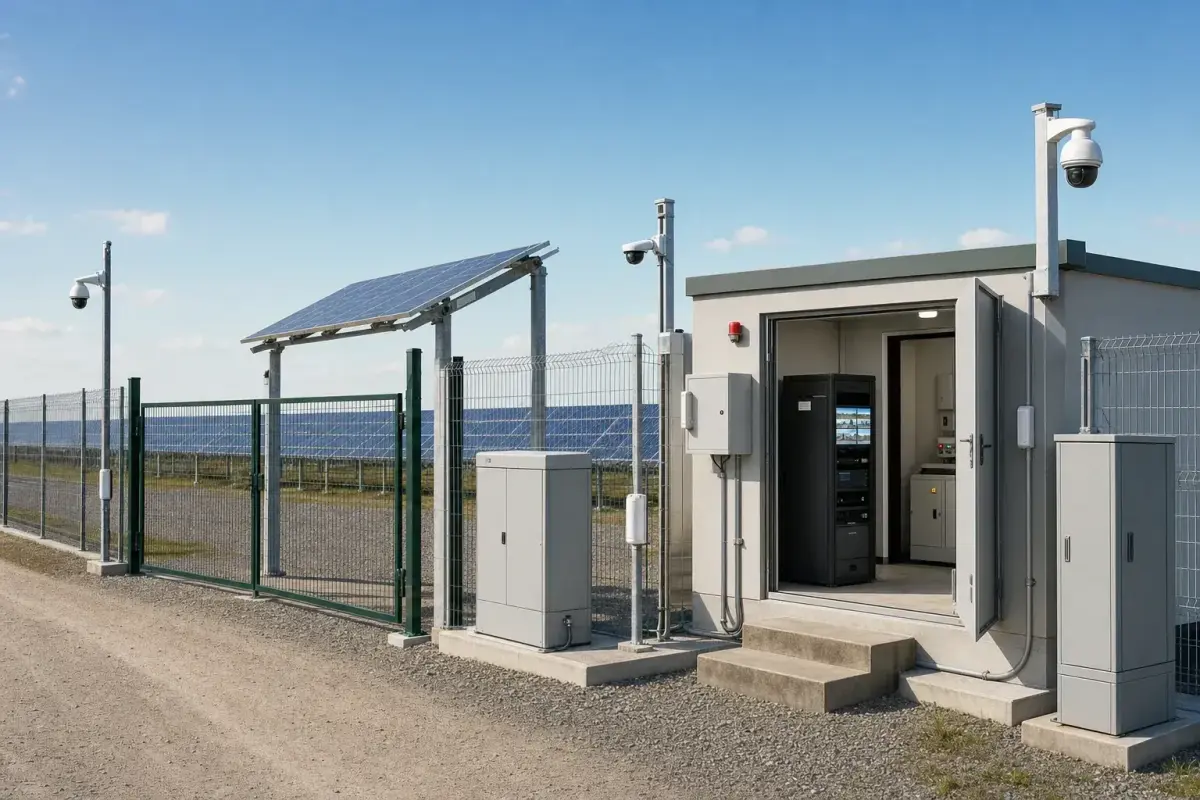
Solar Farm 32-Zone Off-Grid - 72-Hour Autonomous Security System
Key Features
- 32 security zones with hybrid wired and wireless expansion up to 64 zones
- 18-camera surveillance design with 12 fixed IP, 4 PTZ, and 2 thermal cameras
- 24-detector intrusion layer using PIR, dual-tech, and vibration detection
- 2.1 kW solar array plus 10.7 kWh LFP battery for 72 hours autonomy
- 30-day 4K video retention with H.265+ compression and edge AI alarm filtering
Solar Farm 32-Zone Off-Grid is a 32-zone self-monitored security and surveillance system with 18 cameras, 24 detectors, 2.1 kW solar generation, 10.7 kWh LFP storage, and 72 hours of backup autonomy. The EPC turnkey range is USD 6,200-12,100 for solar-farm perimeter intrusion, 4K video, 4G communications, and edge AI alarm filtering.
Description
Solar Farm 32-Zone Off-Grid is a 32-zone, 18-camera, 24-detector security and surveillance system engineered for utility-scale PV sites without reliable grid power. The package combines a 2.1 kW solar power subsystem, 10.7 kWh LFP battery storage, 72 hours of backup autonomy, 4G plus Ethernet plus WiFi communications, and self-monitoring workflows for EPC budgets from USD 6,200 to USD 12,100.
The system is designed for solar farms where 1 perimeter breach, 1 copper-theft incident, or 1 inverter-area intrusion can create downtime across multiple MW blocks. It follows the architecture logic used in IEC 62676 video surveillance systems, EN 50131 intrusion alarm systems, UL 681 installation practices, and NFPA 72 fire-alarm interface guidance, while SOLARTODO supplies the equipment, integration support, and EPC-ready documentation through View all Security & Surveillance System products.
System Architecture
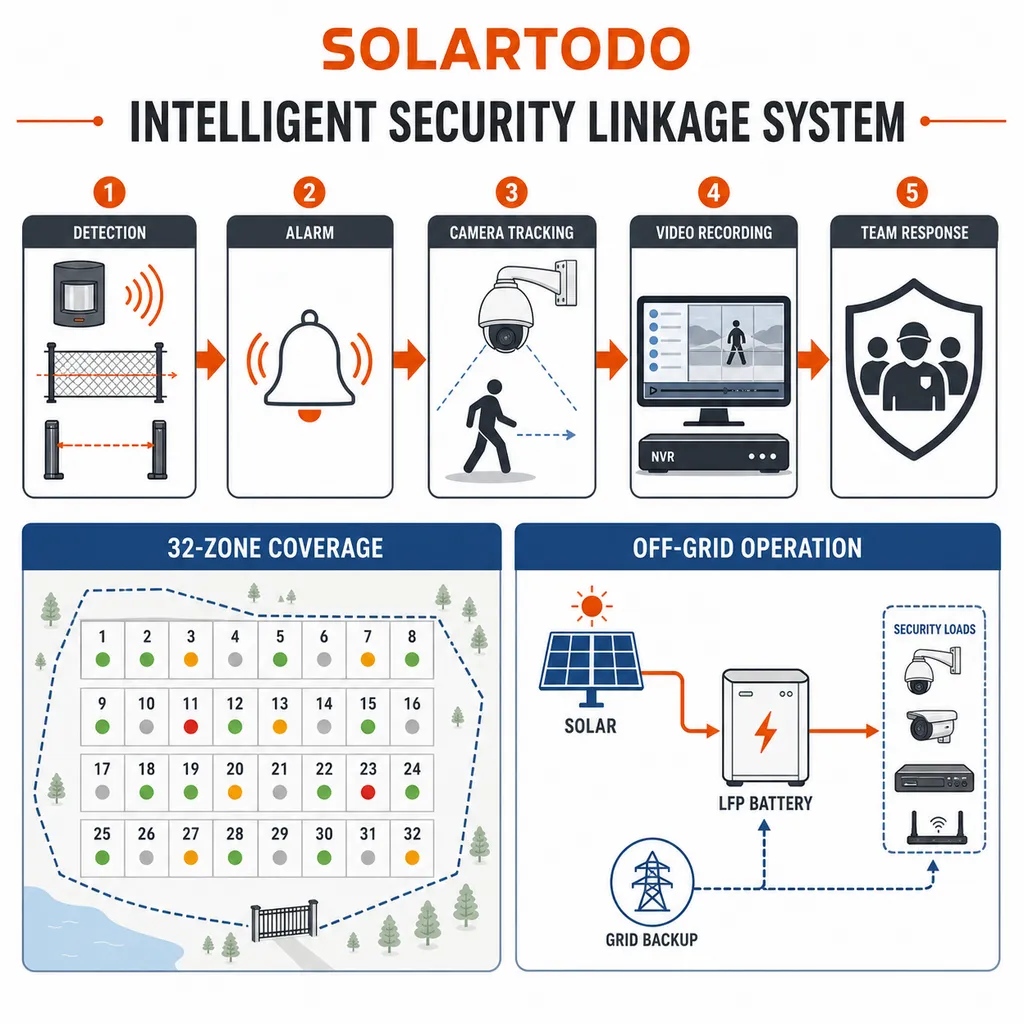
The 32-zone topology separates the solar farm into monitored blocks such as 8 inverter pads, 8 transformer or combiner areas, 8 perimeter fence sectors, and 8 access or service corridors. A hybrid alarm panel supports wired and wireless devices across up to 64 expansion zones, giving this 32-zone package a 100% future expansion reserve for additional IR beams, vibration sensors, smoke detectors, or gate contacts.
Each zone is mapped to 1 alarm input, 1 response rule, and at least 1 camera view when the layout allows direct line-of-sight. The standard 18-camera design uses 12 fixed 4MP or 4K IP cameras for array lanes, 4 PTZ cameras with 20x optical zoom for long-row verification, and 2 thermal cameras for human detection beyond 300 m in low-light or glare-heavy conditions.
The detector layer uses 24 devices, typically 12 PIR detectors, 8 dual-tech microwave plus PIR detectors, and 4 vibration sensors for equipment shelters, gates, or fence segments. Dual-tech devices are assigned to the 8 highest false-alarm-risk areas because combined microwave and PIR confirmation can reduce nuisance triggers compared with PIR-only detection in hot, windy, or dust-prone solar-farm environments.
Technical Specifications
The off-grid power subsystem is sized at 2.1 kW PV and 10.7 kWh LFP storage, which supports 72 hours of autonomy under the representative load profile used for this product class. LFP chemistry is selected because typical cycle life can exceed 3,000 cycles under controlled depth-of-discharge conditions, and IRENA reported 2024 utility battery storage costs near USD 192/kWh in its renewable cost analysis.
Video storage is configured for 30 days at 4K using H.265+ compression, with NVR channel capacity selected for 18 active streams plus maintenance headroom. For procurement comparison, 18 cameras at 15 fps generate materially less storage pressure than 18 cameras at 30 fps, but both profiles can be engineered when the site requires higher evidentiary frame rates at gates or laydown yards.
The communication stack uses 4G LTE as the primary remote link, Ethernet for local network wiring, and WiFi for commissioning or short-range service access. AES-256 encrypted transport, SIM failover options, and anti-jamming alarm logic are recommended for sites where 1 cellular carrier outage or 1 intentional signal disruption could delay the response to a perimeter alarm.
The system is self-monitored, meaning alarms can route to the owner, O&M contractor, EPC service team, or a local guard force without a mandatory 24/7 central-station contract. Where insurers or lenders require external monitoring, the same 32-zone panel and 18-camera NVR can be connected to a third-party receiving center under local regulations.
Standards and Engineering Basis
IEC 62676-1-1 defines minimum system requirements and functional expectations for video surveillance systems used in security applications, while IEC 62676-6:2026 addresses performance testing and grading for intelligent video analytics. This product uses that 2-layer logic by pairing camera coverage with on-device classification for intrusion, line crossing, object left, and object removed events.
EN 50131 is relevant to the intrusion layer because solar farms need graded alarm behavior across multiple zones, not only video recording after the event. UL 681 is relevant to installation methods for burglar-alarm systems, and NFPA 72 is relevant when smoke or fire detectors in 1 inverter shelter or 1 battery cabinet are integrated into notification, logging, or relay outputs.
For PV and energy infrastructure context, NREL publication NREL/TP-5D00-78755 on cybersecurity in photovoltaic plant operations emphasizes that plant monitoring and control networks require cybersecurity planning across customer data, business information, and operational interfaces. IEEE 1547 is also relevant where distributed energy resources interface with power systems, even though this security package is electrically auxiliary rather than a grid-interconnection device.
IEA Renewables 2025 forecasts about 4,600 GW of renewable capacity additions from 2025 to 2030, with solar PV representing nearly 80% of global renewable electricity capacity expansion. That growth rate increases the number of remote PV assets requiring 24-hour surveillance, 72-hour backup autonomy, and low-maintenance perimeter detection.
Cloud Monitoring
The monitoring design supports mobile alarm push, web dashboard review, camera playback, NVR event search, detector health checks, battery state-of-charge logging, and solar charge status. A typical alarm record includes 1 zone ID, 1 timestamp, 1 detector type, 1 linked camera clip, and 1 operator action note for auditability.
Edge AI analytics classify people and vehicles locally before uploading events, which can reduce false alarm traffic by up to 90% compared with motion-only video analytics in solar-farm rows where shadows, birds, rain, dust, and moving vegetation can create thousands of pixel-change events per day. This comparison is especially important where each unnecessary dispatch costs USD 20-80 in guard time, vehicle fuel, and lost response capacity.
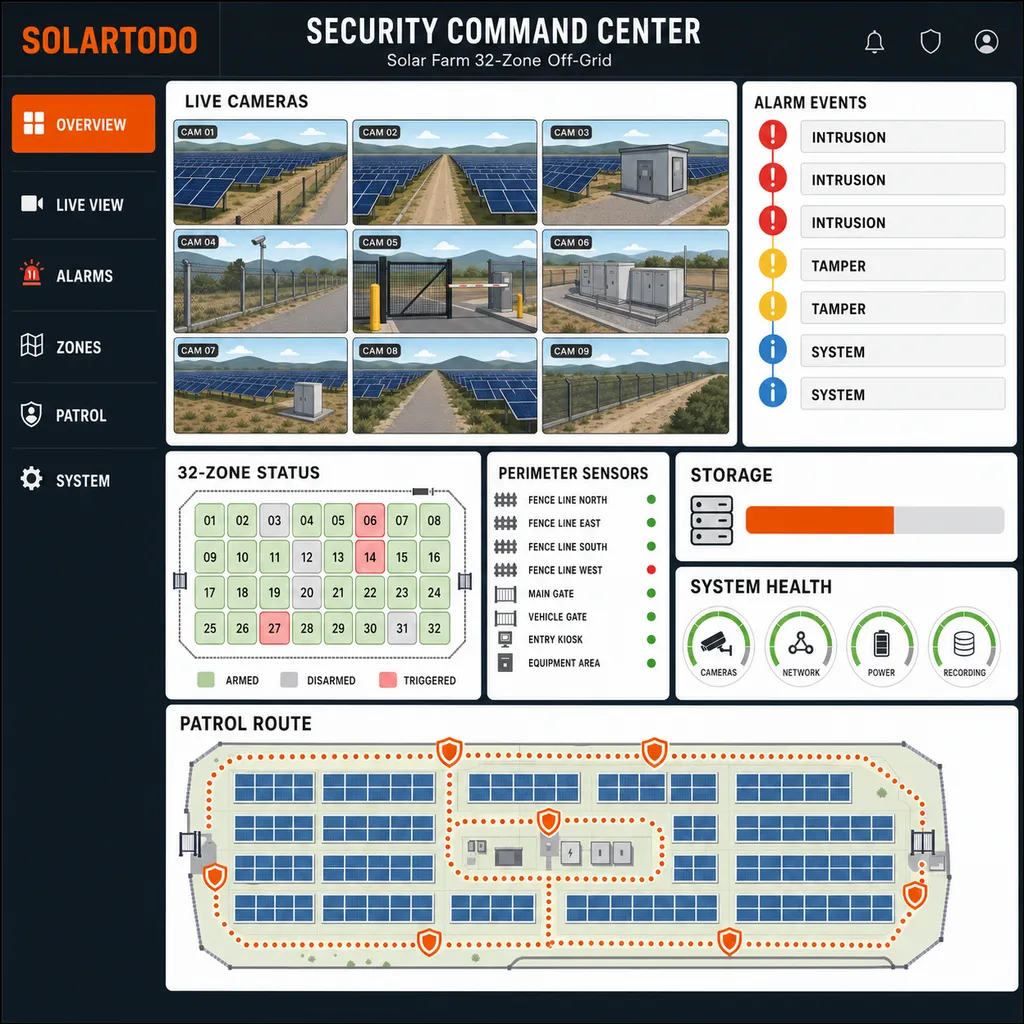
The cloud platform is optional for self-monitoring, but it is useful when 2 or more stakeholders need access to evidence, alarms, and maintenance records. For data governance, user roles can separate 1 administrator, several O&M users, and read-only procurement or asset-management reviewers, reducing the risk that a camera configuration is changed during routine evidence review.
Representative Scenario
Representative scenario: for a 10 MW MENA solar farm with 1 main gate, 2 inverter stations, 1 transformer yard, and approximately 800-1,200 m of perimeter exposure, the 32-zone design allocates 12 fixed cameras to array corridors, 4 PTZ cameras to corners or mast positions, and 2 thermal cameras to long approach lines. The 72-hour autonomy target covers 3 sunless days before generator support or mobile charging is considered.
In this scenario, 4 perimeter beam pairs cover straight fence runs, vibration sensors protect 4 sensitive access points, and dual-tech detectors protect 8 equipment-adjacent zones where wind and heat shimmer can affect single-technology sensors. The result is a layered alarm chain in which at least 2 independent signals can support a dispatch decision before a guard travels 1-5 km across the site.
Compared with a conventional grid-powered CCTV-only alternative using 18 motion-detection cameras and no alarm-panel zoning, the SOLARTODO configuration reduces unnecessary video review by up to 90% through sensor-to-camera event linking and AI classification. It also removes the need for 1 continuous AC power feed to every remote camera pole, which can lower trenching, conduit, and copper exposure on early-stage or temporary PV projects.
Applications
The primary application is solar-farm security, including PV module rows, inverter stations, combiner boxes, transformer yards, construction laydown areas, site offices, and perimeter gates. The same 32-zone design can be adapted to 1 agriculture estate, 1 telecom power site, 1 construction compound, or 1 temporary logistics yard when the camera count remains near 18 and detector count remains near 24.
For procurement teams comparing security packages, the main sizing variables are perimeter length in meters, the number of equipment pads, the number of access gates, the desired retention period in days, and the required autonomy hours. A buyer can start with this 32-zone bill of quantities, then Configure your system online or Request a custom quotation for project-specific drawings.
Engineering teams can also use Learn about topic to compare solar-powered surveillance, AI analytics, and off-grid battery sizing. For broader SOLARTODO context, related pages in the knowledge base explain why 48-120 hours of autonomy is common for remote surveillance loads and why LFP batteries are preferred over lead-acid for daily cycling.
EPC Investment Analysis and Pricing Structure
EPC turnkey delivery includes 5 work packages: engineering, procurement, construction, commissioning, and warranty. Engineering covers 1 site layout, 1 zone schedule, 1 camera matrix, 1 single-line power diagram, and 1 communications plan; procurement covers alarm, cameras, detectors, solar modules, LFP battery, NVR, cabling, poles, cabinets, and accessories.
| Pricing tier | Commercial scope | Price range |
|---|---|---|
| FOB Supply | Equipment only, ex-works China | USD 3,844-8,228 |
| CIF Delivered | Equipment, ocean freight, and insurance | USD 4,106-8,789 |
| EPC Turnkey | Installed, commissioned, and 1-year labor warranty | USD 6,200-12,100 |
| Volume quantity | Discount from standard equipment pricing | Typical buyer profile |
|---|---|---|
| 50+ systems | 5% | Regional EPC framework order |
| 100+ systems | 10% | Multi-site developer procurement |
| 250+ systems | 15% | National utility or distributor program |
ROI depends on local guard cost, theft exposure, outage penalty, and insurance requirements, but a conservative model can use 1 avoided nuisance dispatch per week at USD 50 and 1 avoided site incident per year at USD 2,000. Under those assumptions, annual savings can reach USD 4,600, giving a simple payback of about 1.3-2.6 years against the USD 6,200-12,100 EPC range.
The cost comparison is strongest against diesel-generator security posts and wired CCTV-only systems. A small generator running 8 hours per night at 1.0 liter per hour and USD 1.10 per liter can consume about USD 3,212 per year before maintenance, while the 2.1 kW PV and 10.7 kWh LFP subsystem avoids that recurring fuel line for the security load.
Standard payment terms are 30% T/T deposit plus 70% against B/L copy, or 100% L/C at sight for approved bank instruments. Project financing can be discussed for qualified projects above USD 1,000K, and technical or commercial requests can be sent to [email protected] with 1 site plan, 1 perimeter length estimate, and 1 target commissioning date.
Buyer Notes
B2B buyers should verify 5 items before purchase: national alarm certification rules, cellular carrier coverage, pole wind-load requirements, cybersecurity policy, and whether the owner requires central-station monitoring. SOLARTODO can adapt the 32-zone package to local codes, but permitting, radio licensing, and guard-response procedures remain country-specific obligations.
The system is not a substitute for physical hardening, because 1 fence cut, 1 unlocked inverter room, or 1 exposed copper route can still create a vulnerability. It is best specified together with access control, lock standards, cable routing, warning signage, and a written alarm-response procedure that defines who responds within 5, 15, and 30 minutes.
A final design package normally includes 7 deliverables: bill of materials, camera layout, zone map, solar and battery sizing sheet, NVR storage calculation, commissioning checklist, and warranty statement. For EPC projects, SOLARTODO aligns these deliverables with the procurement stage so engineers, procurement managers, and project developers can evaluate the same 32-zone scope using USD pricing and standards-based terminology.
Technical Specifications
| Security Zones | 32zones |
| Camera Count | 18cameras |
| Detector Count | 24detectors |
| Power System | Off-grid solar plus LFP battery |
| Solar Array Capacity | 2.1kW |
| Battery Capacity | 10.7kWh |
| Backup Autonomy | 72hours |
| Video Storage | 30days @ 4K |
| Monitoring Type | Self monitoring |
| Communication | 4G + Ethernet + WiFi |
| Expansion Capacity | 64zones |
| Warranty | 2 years parts, 1 year labor |
Price Breakdown
| Item | Quantity | Unit Price | Subtotal |
|---|---|---|---|
| 64-Zone Hybrid Alarm Panel | 1 pcs | $120 | $120 |
| LCD Keypad | 2 pcs | $30 | $60 |
| PIR Detector | 12 pcs | $7 | $84 |
| Dual-Tech Detector | 8 pcs | $21 | $168 |
| Vibration Sensor | 4 pcs | $14 | $56 |
| Perimeter Beam 100 m Set | 4 pcs | $65 | $260 |
| Electric Fence Segment | 200 pcs | $2 | $400 |
| 4MP IP Camera | 12 pcs | $65 | $780 |
| PTZ Camera 20x | 4 pcs | $170 | $680 |
| Thermal Camera | 2 pcs | $500 | $1,000 |
| NVR 16ch | 2 pcs | $135 | $270 |
| Solar Power Kit | 2.1 pcs | $1,500 | $3,150 |
| LFP Battery | 10.7 pcs | $200 | $2,140 |
| Installation & Commissioning | 32 pcs | $50 | $1,600 |
| Engineering & QC Documentation | 1 pcs | $500 | $500 |
| 1-Year Warranty & Support | 1 pcs | $300 | $300 |
| Total Price Range | $6,200 - $12,100 | ||
Frequently Asked Questions
What is included in the EPC turnkey price of USD 6,200-12,100?
Can the system operate without grid power for 72 hours?
How does the 32-zone design reduce false alarms?
Is the system suitable for large utility-scale solar farms?
Which standards are relevant to this security system?
Certifications & Standards

Data Sources & References
- •IEC 62676-1-1:2013 Video surveillance systems for use in security applications
- •IEC 62676-6:2026 Performance testing and grading of intelligent video analytics
- •IEA Renewables 2025, renewable electricity forecast to 2030
- •IRENA Renewable Power Generation Costs in 2024
- •NREL/TP-5D00-78755 Cybersecurity in Photovoltaic Plant Operations
- •IEEE 1547 Standard for DER interconnection and interoperability
Interested in this solution?
Contact us for a customized quote based on your specific requirements.
Contact Us