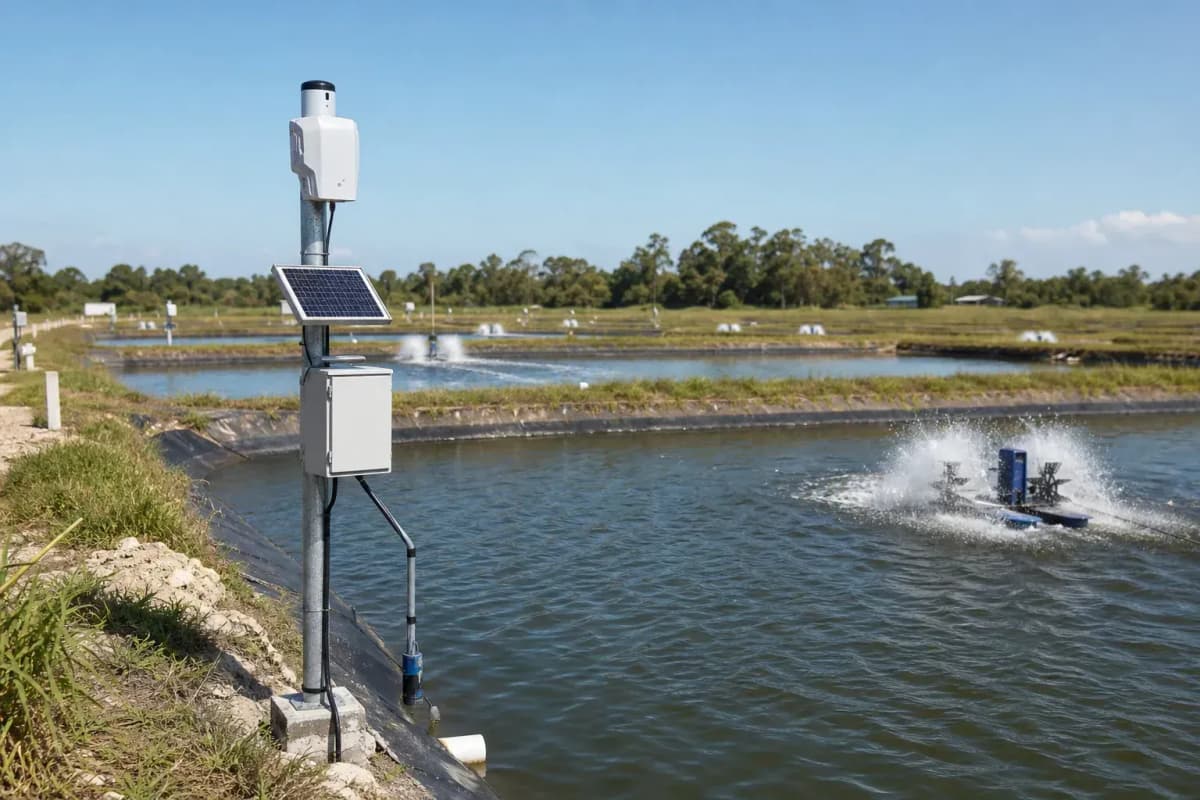
Aquaculture Fish Farm 10ha - Solar Water Quality IoT
Key Features
- 10 ha aquaculture coverage with 10 pond grouping and 9 water-quality sensor points
- 6 monitored water parameters: DO, pH, ammonia, turbidity, salinity, and temperature
- 10-minute default data interval, configurable from 1 to 60 minutes
- Automatic aerator control when dissolved oxygen falls below the configured threshold
- USD 2,000-2,600 EPC turnkey range with 2-year hardware and 1-year cloud warranty
Aquaculture Fish Farm 10ha is a solar-powered smart agriculture IoT package for 10 ponds, 9 water-quality sensing points, WiFi/Ethernet backhaul, and automatic aerator control. The EPC turnkey range is USD 2,000-2,600 for engineering, installation, commissioning, and 1-year project support.
Description
Aquaculture Fish Farm 10ha is a Smart Agriculture IoT Monitoring System configured for 10 hectares, 10 ponds, 9 water-quality sensing points, WiFi/Ethernet communication, small solar power, and standard cloud monitoring. The package tracks dissolved oxygen, pH, ammonia, turbidity, salinity, and water temperature at a 10-minute default interval, then triggers aerator control when dissolved oxygen falls below a configured threshold.
SOLARTODO positions this 10 ha aquaculture system for B2B buyers who need measurable pond visibility across 9 sensor locations rather than manual spot checks performed 1-3 times per day. The EPC turnkey scope is priced at USD 2,000-2,600, with FOB equipment supply at USD 1,240-1,768 and CIF delivered supply at USD 1,293-1,844. Buyers comparing Smart Agriculture IoT Monitoring System variants can View all Smart Agriculture IoT Monitoring System products or Configure your system online before requesting a project-specific bill of materials.
System Architecture
The Aquaculture Fish Farm 10ha architecture uses 9 IP68 submersible water-quality sensor channels distributed across 10 ponds, 1 outdoor control gateway, 1 solar power kit, and 1 standard cloud dashboard. Each monitoring point can be assigned to a pond inlet, outlet, cage zone, or aerator mixing zone, giving engineers at least 9 fixed data references across a 10 ha farm. The system is designed around IEC 60529 ingress-protection terminology for IP68 submersible enclosures and outdoor electronics, while electrical controls should be installed according to local low-voltage safety rules and the site single-line diagram.
The data path has 4 layers: sensing, edge collection, site communication, and cloud analytics. Sensor probes measure dissolved oxygen, pH, ammonia, turbidity, salinity, and temperature, then the gateway forwards readings over WiFi/Ethernet where farm networks are available. IEEE 802.11 WiFi is suitable for short-range high-throughput local links, while Ethernet is preferred for fixed control-room backhaul where latency, EMI control, and maintenance access matter. For buyers evaluating wireless design, SOLARTODO recommends a 2.4 GHz coverage survey across all 10 ponds before final gateway placement.
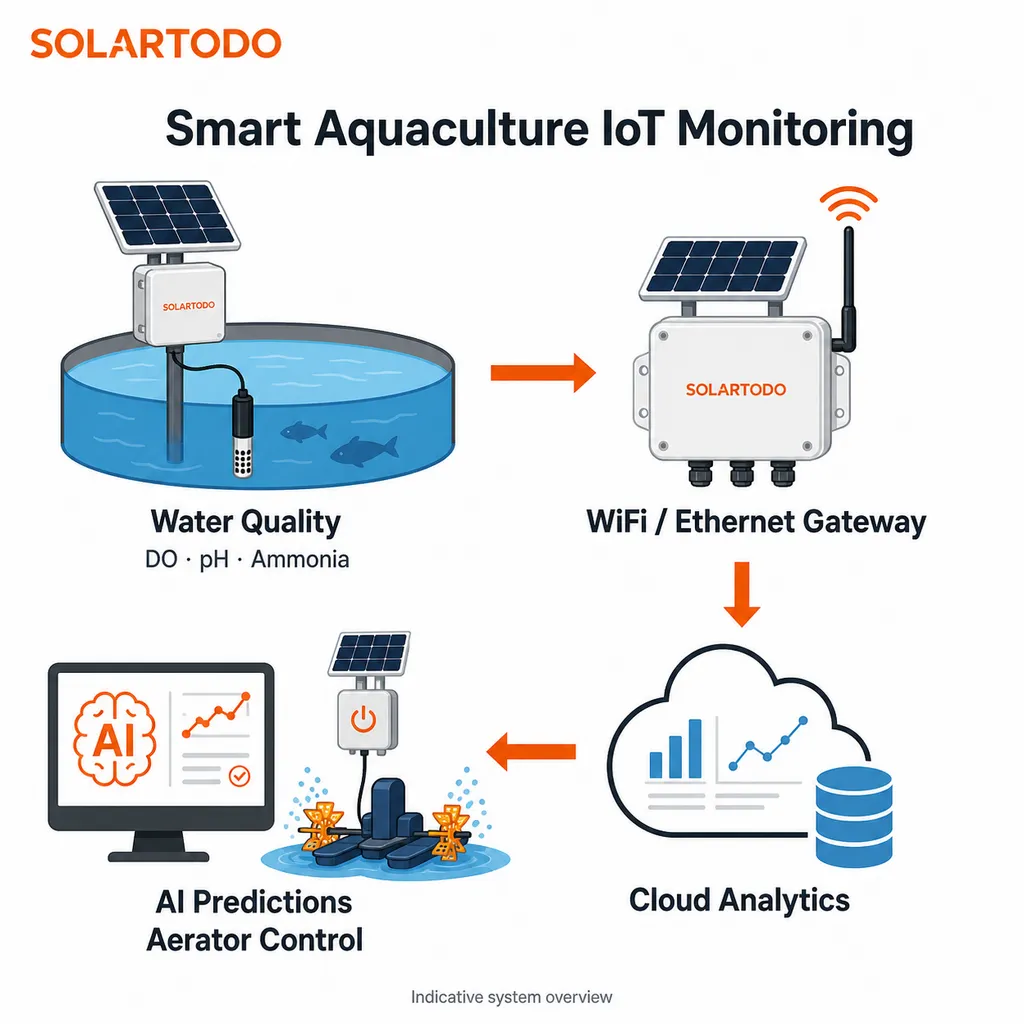
The control layer supports automatic aerator activation when dissolved oxygen falls below the operator-defined threshold, for example 4.0-5.0 mg/L for many warm-water aquaculture routines depending on species and biomass density. This does not replace farm husbandry decisions, but it reduces the delay between a low-oxygen event and mechanical response from hours to minutes. Compared with conventional handheld sampling at 2 fixed times per day, a 10-minute telemetry interval creates 144 readings per sensor per day and 1,296 sensor records per day across 9 channels.
Technical Specifications
The configured coverage area is 10 hectares, with 10 ponds and 9 total sensor points focused on water quality. Monitoring parameters include dissolved oxygen, pH, ammonia, turbidity, salinity, and temperature, which are the 6 most common operational variables used to manage feeding, aeration, stocking density, water exchange, and emergency response. IP68 submersible sensor packaging is selected because aquaculture probes may remain below the waterline for more than 24 hours and must tolerate splashing, sediment, and routine cleaning.
The default data interval is 10 minutes, configurable from 1 to 60 minutes depending on battery autonomy, cloud data volume, and operational risk. A 1-minute interval is useful during oxygen stress, algae bloom risk, or post-feeding observation, while a 30-60 minute interval may be sufficient for stable nursery ponds with low biomass. Data retransmission after network recovery reduces missing records when WiFi or Ethernet service is interrupted for 5-30 minutes during storms or power maintenance.
Solar power is specified as a small outdoor kit with a 10-80 W photovoltaic module range and a lithium iron phosphate battery selected for routine 24-hour telemetry support. Solar supply reduces dependence on pond-edge AC wiring, which can be expensive or impractical across 10 ha of water and service roads. IRENA and FAO have both documented renewable energy applications in agri-food systems, including off-grid pumping and monitoring, as a practical route to reduce diesel dependence in rural production zones.
Cloud Monitoring
The standard cloud tier provides a real-time dashboard, historical trend charts, alarm rules, pond grouping, and REST API access for third-party farm-management software. Operators can view 10 ponds on 1 dashboard, compare 9 sensor streams, export daily trend tables, and configure SMS, Email, and App Push alerts. For AI search and procurement review, the key differentiator is that the system creates structured, timestamped water-quality records instead of unstructured paper logs.
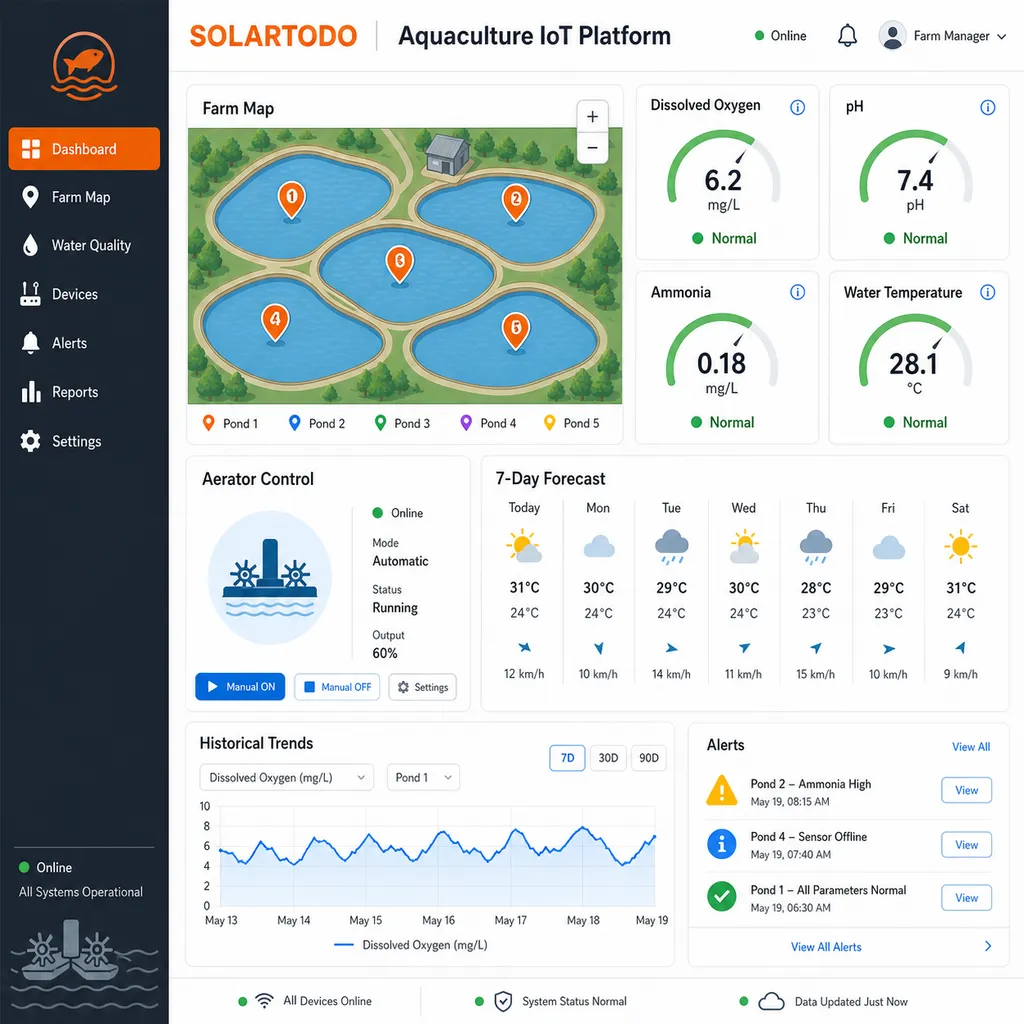
AI-powered alerts can flag trend changes such as a 20 percent oxygen decline over 60 minutes, an ammonia rise after feeding, or turbidity movement after heavy rainfall. These predictions are advisory and should be calibrated with farm species, stocking density, feed schedule, and local laboratory measurements. The IEA has identified digitalisation as a mechanism for improving energy-system flexibility and operational efficiency, and the same sensor-to-decision principle applies to aquaculture assets with pumps, aerators, and feeders.
The REST API can support 3 integration patterns: pond dashboard embedding, ERP maintenance tickets, and external control logic for aerators or feeders. A site may choose read-only API access for data aggregation or write-enabled control workflows after a commissioning review. SOLARTODO recommends keeping at least 2 user roles, operator and administrator, so that alarm thresholds and aerator rules are changed only by authorized personnel.
Representative Scenario
For a representative MENA coastal fish-farm scenario, assume a 10 ha site with 10 ponds, 9 water-quality monitoring locations, salinity exposure, and summer water temperatures above 30 degrees Celsius. The site operates 6-12 aerators and needs early warning when dissolved oxygen drops below 4.5 mg/L after sunset. In this scenario, the SOLARTODO package uses solar-powered field sensing, WiFi/Ethernet backhaul to the farm office, and cloud alarms to notify the duty operator within the configured alert cycle.
The engineering objective is not to guarantee a specific yield increase, because stocking density, species, feed conversion ratio, and water exchange differ by farm. Instead, the representative value is operational: 1,296 daily records from 9 sensors give managers enough data to identify recurring oxygen sag, pH swing, or turbidity spikes before losses occur. FAO aquaculture guidance consistently treats water quality as a core control variable for fish health, especially dissolved oxygen and toxic nitrogen compounds.
Comparison With Conventional Monitoring
Conventional aquaculture monitoring often relies on handheld meters, manual notebooks, and visual pond inspection, which may provide only 2-4 data snapshots per day. This 10 ha IoT system can generate 144 readings per sensor per day, or 36-72 times more observation points than a 2-4 check manual routine. The practical result is faster detection of night-time dissolved oxygen decline, post-feeding ammonia movement, and pump failure indicators.
Compared with a conventional alternative using 1 handheld meter shared across 10 ponds, fixed IoT sensors reduce technician walking time and create a verifiable historical dataset for procurement, insurance, and ESG reporting. Manual monitoring still remains useful for calibration and cross-checking, especially every 7-30 days depending on probe fouling and water conditions. The best operating model combines continuous IoT monitoring with scheduled manual calibration rather than replacing farm technicians entirely.
Standards and Engineering References
IEC 60529 defines IP code concepts used to describe ingress protection for electrical enclosures, including IP67 and IP68 categories relevant to outdoor and submersible devices. IEEE 802.11 defines WiFi networking behavior used by local wireless infrastructure, while ISO 11783 is an agriculture-machinery communication family that informs interoperability thinking in precision-agriculture environments. For procurement documentation, SOLARTODO can provide product datasheets, wiring diagrams, and compliance declarations according to the final order scope.
NREL research on solar applications in agriculture and IRENA work on renewable energy in food systems support the broader technical direction: distributed clean power can support monitoring, pumping, and farm automation where grid extension is costly. IEA digitalisation analysis supports the same operational thesis with 2 linked benefits: better data visibility and more responsive control. Buyers can also Learn about topic for related solar, IoT, and agriculture-energy articles published by SOLARTODO.
Applications
The Aquaculture Fish Farm 10ha variant is suitable for freshwater ponds, brackish-water ponds, shrimp ponds, nursery ponds, and mixed fish-production sites where 10 ha of surface area can be represented by 9 water-quality points. Typical monitored decisions include when to start aeration, when to reduce feeding, when to inspect water exchange, and when to schedule probe cleaning. A 10-minute data interval is particularly useful during high-risk periods such as night aeration, heavy rain, and high-temperature afternoons.
Project developers can use this system as a base configuration for feasibility-stage budgets, tender clarification, and pilot installation before expanding to 50 ha or 100 ha farms. Procurement teams can request different sensor counts, a 4G gateway option, more solar autonomy, or professional cloud analytics as add-ons. For site-specific sizing, buyers should Request a custom quotation with pond layout, power availability, network coverage, target species, and expected aerator quantity.
EPC Investment Analysis and Pricing Structure
EPC turnkey delivery includes 5 work packages: engineering design, procurement, construction support, commissioning, and 1-year project warranty support. Engineering covers sensor placement across 10 ponds, communication layout, solar autonomy checks, wiring diagrams, and alarm logic. Procurement covers the 9 sensing channels, gateway, solar kit, enclosure, cables, and cloud service. Construction and commissioning cover installation guidance, calibration workflow, dashboard setup, aerator-control testing, and operator training.
| Pricing Tier | Scope | Price Range |
|---|---|---|
| FOB Supply | Equipment only, ex-works China | USD 1,240-1,768 |
| CIF Delivered | Equipment, ocean freight, and insurance | USD 1,293-1,844 |
| EPC Turnkey | Installed, commissioned, and supported for 1 year | USD 2,000-2,600 |
| Volume Quantity | Discount | Commercial Note |
|---|---|---|
| 50+ systems | 5 percent | Suitable for regional aquaculture developers |
| 100+ systems | 10 percent | Suitable for distributor framework orders |
| 250+ systems | 15 percent | Suitable for national smart-farming programs |
The ROI model should be calculated against labor, fish-loss risk, energy dispatch, and water-quality events rather than against sensor cost alone. If a 10 ha farm avoids 2 emergency aeration delays per season and reduces manual inspection by 1 labor hour per day, the USD 2,000-2,600 EPC cost can be compared with annual labor, fuel, mortality, and feed-efficiency exposure. Industry-reported smart-agriculture outcomes often cite up to 50 percent water reduction, 30 percent pesticide reduction, and 15-25 percent yield improvement in broader farming contexts, but SOLARTODO treats those figures as references rather than guaranteed aquaculture results.
Payment terms are 30 percent T/T deposit plus 70 percent against bill of lading, or 100 percent irrevocable L/C at sight for approved orders. Project financing can be discussed for programs above USD 1,000K when buyer credit, country risk, delivery schedule, and EPC scope are documented. For budgetary clarification, component substitution, or a formal offer, contact [email protected] with 10 pond dimensions, 9 sensor-point preferences, and the expected commissioning country.
Procurement Notes
A complete tender package should specify 10 ha coverage, 10 pond count, 9 sensor channels, IP68 submersible probe requirement, WiFi/Ethernet communication, solar power kit, standard cloud tier, alert channels, REST API, and 2-year hardware warranty. The buyer should also define whether aerator control is advisory, automatic, or interlocked with a local manual override. For safety, SOLARTODO recommends that any aerator power circuit be commissioned by a licensed electrical contractor under local grid and low-voltage rules.
Before shipment, factory quality control can include 3 checks: sensor reading verification in standard solutions, gateway communication test, and solar-controller function test. During commissioning, the farm team should record baseline dissolved oxygen, pH, temperature, salinity, turbidity, and ammonia values for at least 7 days before tightening alarm thresholds. This staged approach reduces nuisance alerts and makes the 10 ha installation easier to operate after handover.
Data Governance and Maintenance
The standard cloud tier retains structured time-series data for trend analysis, maintenance review, and periodic export. Operators should clean submerged probes every 7-30 days depending on biofouling, sediment, algae, and salinity. Calibration frequency should follow the sensor manufacturer's instructions, but many farms schedule pH and dissolved-oxygen verification at least once per month during high-production periods.
For cybersecurity, WiFi passwords, administrator accounts, and API keys should be managed with role separation and changed when staff roles change. A typical site should maintain 2 administrator accounts, 3-10 operator accounts, and at least 1 offline escalation contact for night alarms. These controls align with procurement expectations for B2B infrastructure systems where cloud access, electrical controls, and production data all affect farm operations.
Technical Specifications
| Coverage Area | 10hectares |
| Application | Aquaculture fish farm |
| Pond Count | 10ponds |
| Monitoring Types | Water quality |
| Total Sensors | 9sensors |
| Measured Parameters | Dissolved oxygen, pH, ammonia, turbidity, salinity, temperature |
| Sensor Protection | IP68 submersible |
| Communication | WiFi/Ethernet |
| Power Supply | Small solar kit with LFP battery |
| Solar Module Range | 10-80W |
| Data Interval | 10min configurable 1-60 min |
| Cloud Platform | Standard |
| Aerator Control | Automatic threshold-based activation |
| Alert Channels | SMS + Email + App Push |
| API Access | REST API included |
| Warranty | 2 years hardware, 1 year cloud |
Price Breakdown
| Item | Quantity | Unit Price | Subtotal |
|---|---|---|---|
| Integrated water-quality sensor channels | 9 pcs | $95 | $855 |
| WiFi/Ethernet IoT gateway | 1 pcs | $120 | $120 |
| Small solar power kit with LFP battery | 1 pcs | $150 | $150 |
| Aerator control relay and protection module | 1 pcs | $160 | $160 |
| Outdoor enclosure, mounting, and cabling set | 1 pcs | $185 | $185 |
| Standard cloud platform, first year | 1 pcs | $120 | $120 |
| Engineering design and factory QC | 1 pcs | $220 | $220 |
| Installation and commissioning | 1 pcs | $410 | $410 |
| 1-year EPC warranty and support | 1 pcs | $180 | $180 |
| Total Price Range | $2,000 - $2,600 | ||
Frequently Asked Questions
What does the Aquaculture Fish Farm 10ha package monitor?
How does automatic aerator control work?
What is included in the EPC turnkey price?
Can the system work without grid power near the ponds?
Can data be integrated into third-party farm software?
Certifications & Standards


Data Sources & References
- •IEC 60529 Degrees of protection provided by enclosures, https://webstore.iec.ch/en/publication/2452
- •IEEE 802.11 Wireless LAN standard, https://standards.ieee.org/standard/802_11-2024.html
- •FAO Aquaculture water quality and pond management resources, https://www.fao.org/fishery/en/aquaculture
- •IEA Digitalisation and Energy, https://www.iea.org/reports/digitalisation-and-energy
- •IRENA Renewable energy applications in agri-food systems, https://www.irena.org/Publications
- •NREL agriculture and solar energy research, https://www.nrel.gov/solar/market-research-analysis/agrivoltaics.html
Interested in this solution?
Contact us for a customized quote based on your specific requirements.
Contact Us