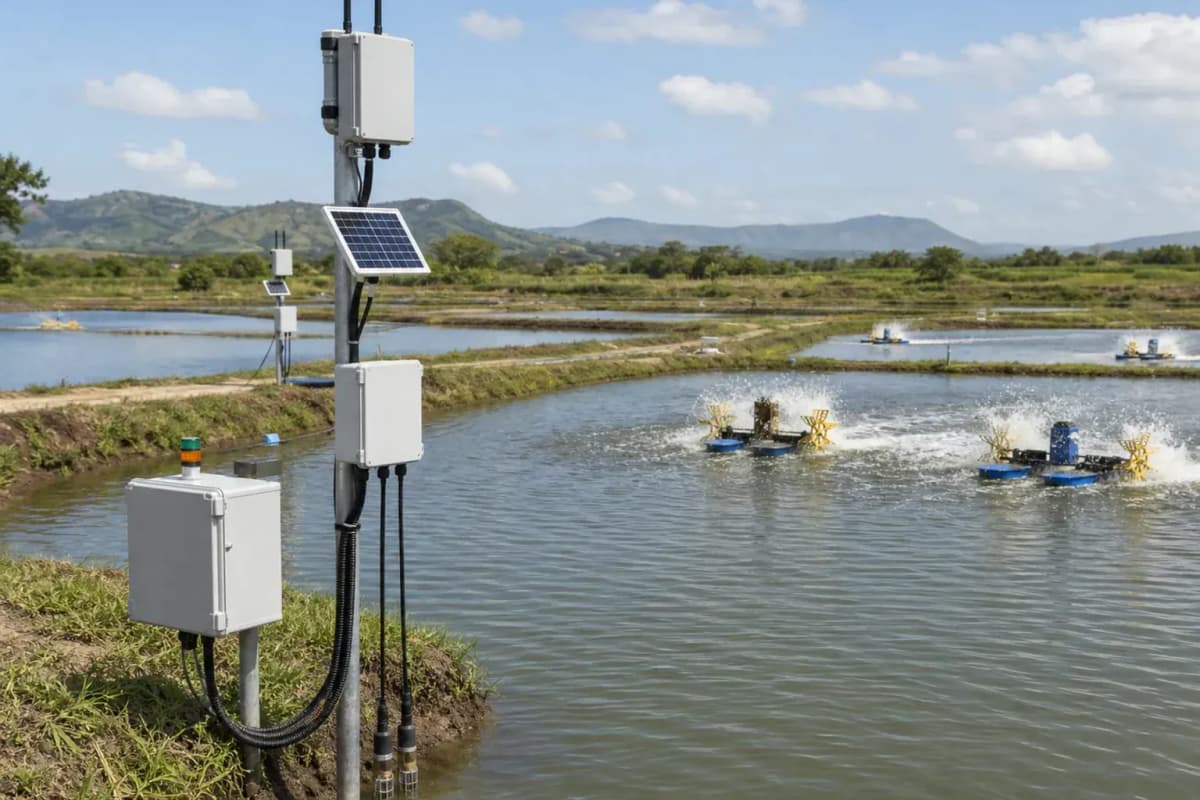
Aquaculture Fish Farm 7ha - 9-Sensor LoRaWAN Water Quality Monitoring
Key Features
- Covers 7 hectares and 8 aquaculture ponds with 9 IP68 water-quality sensor points.
- Measures 6 core parameters: DO, pH, ammonia, turbidity, salinity, and temperature.
- LoRaWAN gateway architecture supports up to 10 km rural range under favorable line-of-sight conditions.
- Default 10-minute reporting creates about 1,296 multi-parameter records per day from 9 sensors.
- EPC turnkey package is priced at USD 1,760-2,288 with commissioning and 1-year support.
Aquaculture Fish Farm 7ha is a solar-powered LoRaWAN monitoring package for 8 ponds, using 9 IP68 water-quality sensor points, 10-minute data intervals, basic cloud analytics, and automatic aerator control. EPC turnkey pricing is USD 1,760-2,288 including engineering, installation, commissioning, and 1-year service support.
Description
Aquaculture Fish Farm 7ha is a smart-agriculture IoT monitoring system for 7 hectares, 8 ponds, and 9 water-quality sensing points using LoRaWAN communication, small solar power kits, and basic cloud analytics. The system measures dissolved oxygen, pH, ammonia, turbidity, salinity, and water temperature at 10-minute default intervals, while aerator-control logic can trigger relay outputs when DO falls below a configured threshold such as 5 mg/L.
This product page is written for engineers, procurement teams, and aquaculture operators comparing 1 turnkey monitoring package against manual pond sampling, timer-only aeration, or cellular-only sensor nodes. For additional system variants, buyers can View all Smart Agriculture IoT Monitoring System products, Configure your system online, or Request a custom quotation for pond geometry, local radio planning, and installation scope.
System Architecture
The Aquaculture Fish Farm 7ha configuration uses 9 IP68 submersible water-quality sensor nodes distributed across 8 ponds, with 1 pond receiving either a duplicate sensor point or a reference sensor for inlet, outlet, nursery, or high-biomass monitoring. Each node transmits via LoRaWAN to 1 gateway designed for long-range low-power telemetry, with practical site design based on antenna height, pond embankments, vegetation, and a nominal rural coverage radius up to 10 km under favorable line-of-sight conditions.
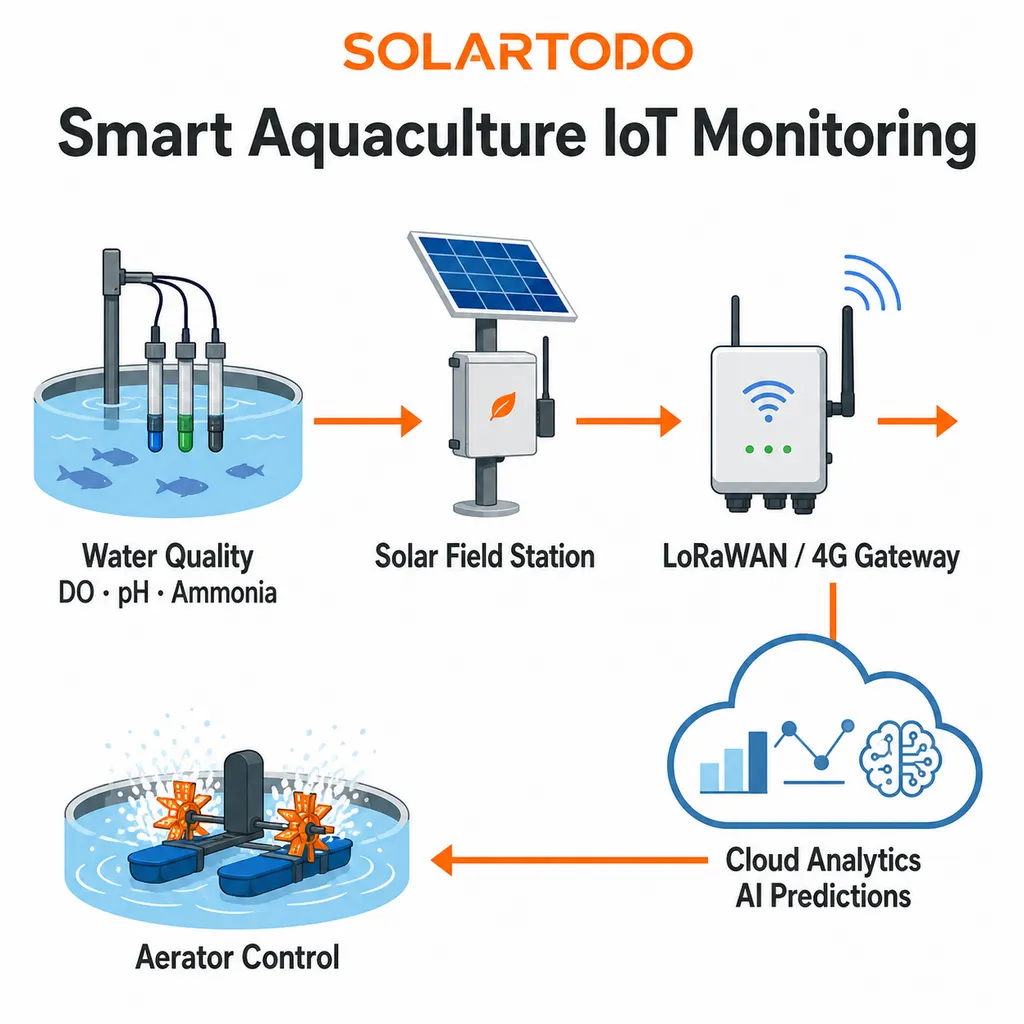
The architecture contains 4 physical layers: submerged sensing probes, solar-powered sensor terminals, LoRaWAN gateway backhaul, and a cloud dashboard with alarms. LoRa Alliance documentation describes LoRaWAN as an LPWAN technology optimized for range, capacity, cost, and battery lifetime, and many deployments target 5-10 years of endpoint battery life depending on payload interval and radio conditions.
For this 7 ha farm, the system uses solar-small power at the node level, typically a 10-20 W photovoltaic module with an LFP battery sized for night operation and cloudy-day reserve. Solarized monitoring is especially relevant where grid cabling across 8 pond banks would require trenching, waterproof junction boxes, and lightning protection at multiple exposed locations.
Technical Specifications
The standard sensor suite monitors 6 aquaculture parameters: dissolved oxygen, pH, ammonia, turbidity, salinity, and temperature. These parameters match common pond health controls because FAO aquaculture guidance identifies oxygen, pH, ammonia, temperature, turbidity, and salinity as practical variables that affect growth, feed conversion, disease tolerance, and mortality risk.
The default data interval is 10 minutes, configurable from 1 to 60 minutes depending on battery budget, alarm sensitivity, and bandwidth planning. A 10-minute interval produces 144 readings per sensor per day, so 9 sensors generate about 1,296 multi-parameter records per day before dashboard aggregation and alert processing.
The dissolved oxygen alarm is normally configured around 5 mg/L because FAO pond guidance indicates that 5 mg/L is a common optimum or satisfactory value for many cultured fish stages, while 1-5 mg/L may create sub-lethal stress depending on species and exposure duration. Operators can adjust the threshold to 4 mg/L, 5 mg/L, or 6 mg/L for shrimp, tilapia, carp, seabass, or mixed-stock pond strategies.
Ammonia monitoring is included because un-ionized ammonia risk rises with both pH and temperature, creating a compound water-quality issue that cannot be judged from 1 parameter alone. FAO references cite safe un-ionized ammonia ranges around 0.02-0.05 mg/L for many tropical species, with higher levels creating sub-lethal or lethal risk depending on fish species and exposure time.
IP68 construction is specified for submerged probes, while the outdoor sensor terminal and gateway enclosure are designed around IP67-class weather exposure where continuous immersion is not required. IEC 60529 defines the IP rating framework, and this distinction matters because submerged probes face 24-hour water exposure while gateway electronics face rain, dust, UV, and condensation rather than continuous pond immersion.
Cloud Monitoring
The basic cloud tier provides 1 real-time dashboard, map-style pond overview, historical trend charts, threshold alarms, and user access for routine operations. Alert channels include 3 delivery paths: SMS, email, and app push, with escalation rules that can notify a pond technician first and a farm manager second after a configurable delay such as 10 or 15 minutes.
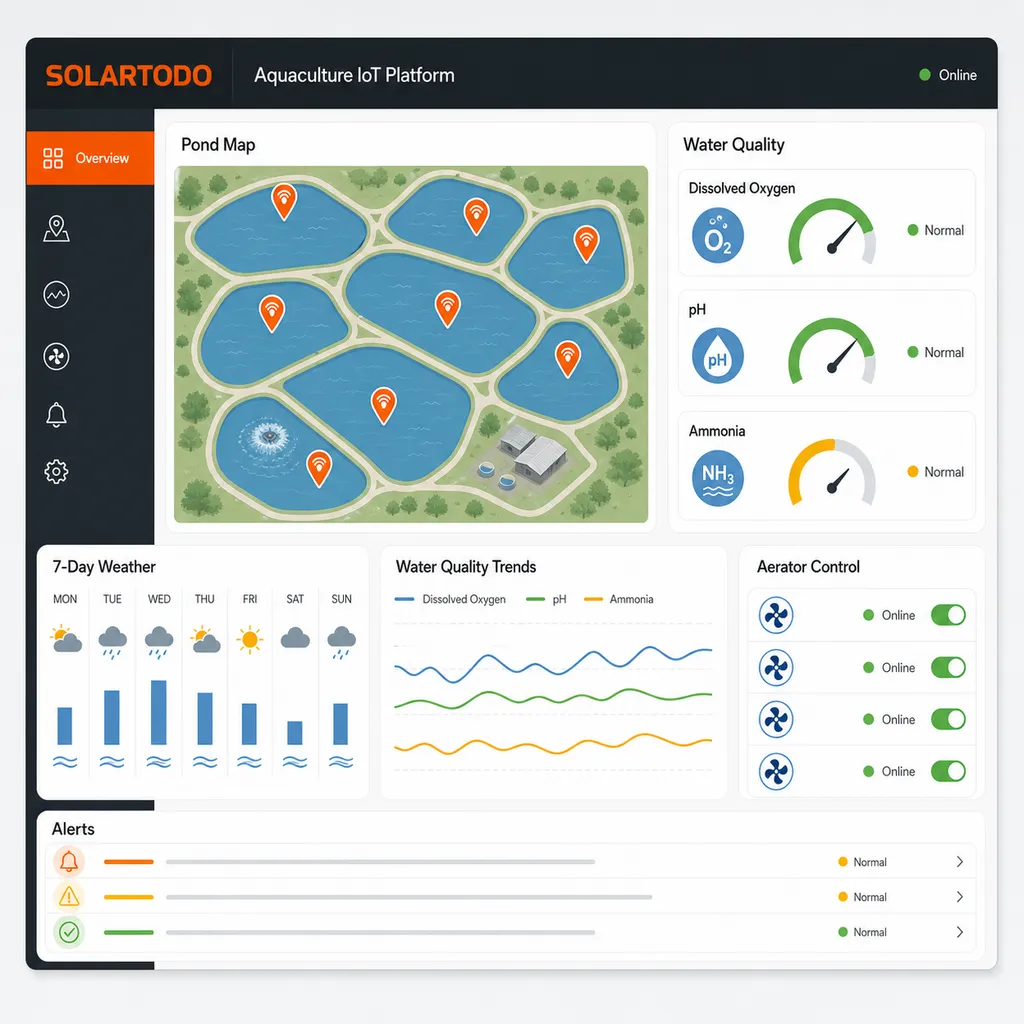
The cloud platform stores historical readings so operators can compare 7-day, 30-day, and 90-day trends instead of reacting only to spot tests. IEA digitalization analysis notes that sensors, automated controls, and connected devices are becoming central to energy and infrastructure productivity, and its 2023 data commentary referenced connected devices reaching about 13 billion in 2023 with potential growth above 25 billion by 2030.
REST API access is included for integration with third-party farm-management systems, aerator panels, feed scheduling platforms, or enterprise dashboards. API integration is typically used for 2 workflows: exporting validated water-quality history for compliance records and receiving control events for aerators or feeders when oxygen and temperature patterns cross predefined limits.
Representative Scenario: 8-Pond Tilapia Farm
For a representative 7 ha MENA tilapia farm scenario with 8 ponds averaging 0.875 ha each, SOLARTODO would place 8 primary water-quality nodes near production zones and 1 reference node near inlet or nursery water. In this scenario, the gateway is mounted on a 6-9 m pole near the office or pump room, while the cloud dashboard separates pond alarms by ID from P1 through P8.
If DO drops below 5 mg/L in pond P4 at 03:20, the aerator-control output can start the assigned aerator circuit and record the event with timestamp, sensor ID, DO value, and recovery trend. This is not a claim that any named customer achieved a result; it is a representative engineering scenario for comparing manual checks against automated 10-minute telemetry and threshold-based aeration.
Compared with conventional manual sampling 2 times per day, a 10-minute IoT interval increases visibility to 144 observations per sensor per day and can detect nighttime oxygen crashes that occur between staff rounds. The practical value is risk reduction and faster response, not the elimination of farm management, calibration, feed discipline, or species-specific husbandry.
Applications
This configuration is designed for pond aquaculture, shrimp farms, tilapia farms, carp ponds, recirculation support basins, hatchery water intake points, and mixed agriculture-aquaculture sites covering approximately 5-10 ha. The same smart-agriculture product line can also support weather stations, soil sensors, pest traps, storage monitoring, and irrigation control; buyers can Learn about topic for broader IoT deployment concepts.
Aerator control is included for 8 pond circuits when the site has suitable relay panels, contactors, and electrical safety isolation. SOLARTODO treats control as an engineered interface because a sensor alarm at 5 mg/L must command a properly rated electrical circuit rather than directly switching high-current motors from a low-voltage sensor node.
For farms that already operate 1 central pump room or 1 feed-management platform, LoRaWAN monitoring can reduce the number of cellular SIM cards from 9 endpoints to 1 gateway backhaul. This comparison can lower recurring telecom administration versus cellular-only nodes, although actual savings depend on local data plans, backhaul reliability, and pond layout.
Standards, Compliance, and Engineering References
Relevant standards and references include IEC 60529 for IP ratings, ISO 11783 for agricultural electronics integration concepts, LoRaWAN regional parameters for LPWAN communications, and FAO aquaculture water-quality references for dissolved oxygen and ammonia thresholds. The product is also aligned with common CE and RoHS component compliance expectations for export equipment, with project-specific certification documents supplied during procurement.
IRENA and IEA both emphasize digitalization and distributed energy as enabling technologies for more efficient infrastructure, and the National Renewable Energy Laboratory provides widely used photovoltaic modeling references for solar-resource planning. For a small solar sensor kit of 10-20 W, PV sizing is still site-specific because irradiation, enclosure temperature, shading, battery reserve, and payload interval can change the available daily watt-hours by more than 20%.
IEEE 802.15.4 is sometimes compared with LoRaWAN for local wireless sensing, but the 7 ha farm geometry normally favors LPWAN range over short-range mesh complexity. Wi-Fi can work around 1 office, but embankments, wet vegetation, equipment sheds, and pond separation often make a single Wi-Fi design less predictable than 1 elevated LoRaWAN gateway for low-rate sensor telemetry.
EPC Investment Analysis and Pricing Structure
The EPC turnkey scope includes 5 delivery blocks: engineering, procurement, construction, commissioning, and warranty support. Engineering covers pond sensor layout, radio-path planning, power sizing, alarm threshold design, and control-interface review; procurement covers 9 sensing points, 1 gateway, solar kits, relay/control accessories, and cloud subscription; construction covers mounting, wiring, waterproofing, and gateway installation; commissioning covers calibration checks, alarm tests, and operator training; warranty support covers 1 year of EPC service and cloud onboarding.
| Pricing tier | Scope | Price range (USD) |
|---|---|---|
| FOB Supply | Equipment only, ex-works China | $1,091-$1,556 |
| CIF Delivered | Equipment plus ocean freight and insurance | $1,138-$1,623 |
| EPC Turnkey | Installed, commissioned, and supported for 1 year | $1,760-$2,288 |
| Volume band | Discount | Typical purchasing case |
|---|---|---|
| 50+ systems | 5% | Regional integrator rollout across 50 farms |
| 100+ systems | 10% | National aquaculture monitoring program |
| 250+ systems | 15% | Multi-province smart agriculture framework |
A representative ROI model for 1 7 ha fish farm should compare the USD 1,760-2,288 EPC investment against avoided manual testing labor, reduced emergency aeration response time, and lower risk of biomass loss from undetected oxygen events. If manual pond rounds cost USD 6 per day and emergency losses avoided average USD 900 per year, a basic payback range of approximately 1.7-2.5 years is realistic for planning, subject to stocking density, energy tariff, survival rate, and local labor cost.
Against timer-only aeration, sensor-based aerator control can reduce unnecessary runtime during stable oxygen periods while still triggering operation during low-DO events. If a farm reduces 2 aerator-hours per night across 4 circuits at 1.5 kW each, the daily energy reduction is about 12 kWh, but SOLARTODO treats this as a scenario calculation rather than a guaranteed performance claim.
Payment terms are 30% T/T deposit plus 70% against bill of lading, or 100% L/C at sight for qualifying import transactions. Project financing can be discussed for smart agriculture, solar, storage, lighting, security, telecom, or power-tower projects above USD 1,000K, and procurement teams can contact [email protected] for commercial documents.
Procurement Notes
The EPC price range assumes 1 gateway, 9 sensor points, small solar power, basic cloud, and standard installation access for 8 ponds without marine piling, civil works, major trenching, or medium-voltage electrical upgrades. If the farm requires more than 8 aerator circuits, redundant gateways, professional weather stations, video analytics, or local SCADA integration, SOLARTODO will issue a revised bill of materials.
Buyers should request calibration requirements, spare-probe quantities, and replacement schedules at purchase stage because water-quality probes are consumable measurement assets rather than permanent civil infrastructure. A practical spare plan for 9 active sensors may include 1 spare DO membrane kit, 1 pH reference solution set, and 1 field service visit every 6-12 months depending on salinity and biofouling.
For related product education, Learn about topic and review the smart-agriculture category before freezing the bill of materials. A procurement-ready quotation normally needs 7 inputs: pond map, species, stocking density, aerator count, power availability, mobile network availability, and preferred Incoterm.
SOLARTODO Supply Role
SOLARTODO supplies solar, energy storage, smart lighting, security, telecom and power towers, and smart-agriculture systems from 1 integrated B2B sourcing and engineering workflow. For this Aquaculture Fish Farm 7ha product, the intended buyer is not purchasing a single sensor; the buyer is procuring a 9-point monitoring architecture with gateway communication, solar autonomy, cloud records, and control-ready outputs.
The system is best specified early in the farm design process, ideally before finalizing aerator panels and cable routes for all 8 ponds. Early specification lets the EPC team reserve mounting points, avoid shaded solar positions, and define alarm thresholds before the first 30-day production cycle begins.
Technical Specifications
| Coverage Area | 7ha |
| Application | Aquaculture fish farm |
| Pond Count | 8ponds |
| Monitoring Types | Water quality |
| Total Sensors | 9sensors |
| Measured Parameters | Dissolved oxygen, pH, ammonia, turbidity, salinity, temperature |
| Communication | LoRaWAN |
| Nominal Gateway Coverage | 10km radius |
| Power Supply | Small solar kit with LFP battery |
| Data Interval | 10min configurable |
| Cloud Platform | Basic dashboard with historical trends |
| Aerator Control | Included for threshold-based activation |
| Alert Channels | SMS, email, app push |
| API Access | REST API included |
| Warranty | 2 years hardware, 1 year cloud |
Price Breakdown
| Item | Quantity | Unit Price | Subtotal |
|---|---|---|---|
| Multi-Parameter Water Quality Sensor Node | 9 pcs | $105 | $945 |
| LoRaWAN Gateway with Antenna Kit | 1 pcs | $225 | $225 |
| Small Solar Power Kit with LFP Battery | 1 pcs | $55 | $55 |
| Aerator Control Relay Interface | 8 pcs | $35 | $280 |
| Basic Cloud Platform Subscription | 9 pcs | $12 | $108 |
| Engineering, Layout Design and QC | 1 pcs | $150 | $150 |
| Installation, Commissioning and Training | 1 pcs | $250 | $250 |
| 1-Year Warranty and Remote Support | 1 pcs | $92 | $92 |
| Total Price Range | $1,760 - $2,288 | ||
Frequently Asked Questions
What does the Aquaculture Fish Farm 7ha system monitor?
How does automatic aerator control work?
What is included in the EPC turnkey price and warranty?
Can LoRaWAN cover all 8 ponds on a 7 ha farm?
How often should water-quality probes be maintained?
Certifications & Standards


Data Sources & References
- •FAO aquaculture water quality guidance for dissolved oxygen and ammonia
- •LoRa Alliance LoRaWAN technical overview and certification resources
- •IEA Digitalisation and Energy analysis
- •IEA 2023 data and connected devices commentary
- •IEC 60529 ingress protection rating framework
- •ISO 11783 agricultural electronics integration reference
- •NREL photovoltaic resource and system modeling references
Interested in this solution?
Contact us for a customized quote based on your specific requirements.
Contact Us