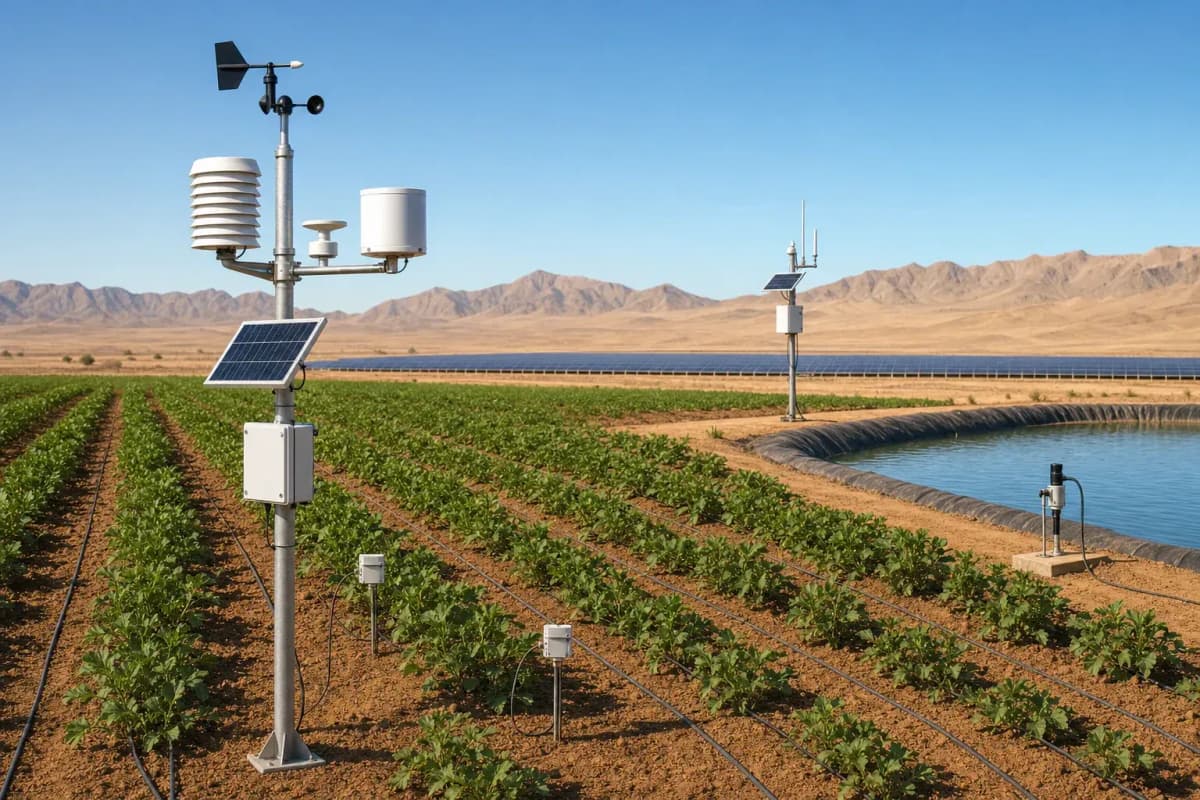
Desert Reclamation Solar+Agriculture 36ha - 500 kW NB-IoT Monitoring
Key Features
- 36 ha desert reclamation coverage with 22 NB-IoT sensors for weather, soil, and water-quality monitoring.
- 500 kW solar-agriculture telemetry scope with IEC 61724-1 aligned PV performance context.
- 10-minute default data interval, configurable from 1-60 minutes with retransmission after network recovery.
- 4 soil-depth monitoring layers at 10 cm, 20 cm, 40 cm, and 60 cm for root-zone irrigation control.
- EPC turnkey price range of $2,398-$3,108 with 2-year hardware and 1-year cloud warranty.
Desert Reclamation Solar+Agriculture 36ha combines 500 kW solar-agriculture infrastructure with 22 NB-IoT sensors for weather, soil, and water-quality monitoring across 36 hectares. The EPC turnkey scope is priced at $2,398-$3,108 with solar-powered field nodes, 10-minute data intervals, REST API access, drip-irrigation integration, and IP67/IP68 outdoor sensor protection.
Description
Desert Reclamation Solar+Agriculture 36ha is a smart agriculture IoT monitoring package for 36 hectares of arid-land reclamation, integrating 500 kW solar PV site telemetry, 22 field sensors, NB-IoT communication, solar-powered nodes, and drip-irrigation control logic. The system monitors 3 data domains--weather, soil, and water quality--at a standard 10-minute interval, giving engineers and procurement teams a measurable basis for irrigation, crop-establishment, and desert-soil recovery decisions.
The product belongs to SOLARTODO's Smart Agriculture IoT Monitoring System line and is configured for desert reclamation projects where water efficiency, high irradiance, dust exposure, and remote operations define the technical risk. Buyers can compare this 36 ha variant with adjacent packages at View all Smart Agriculture IoT Monitoring System products, configure sensor density online at Configure your system online, or request a project-specific bill of quantities at Request a custom quotation.
System Architecture
The architecture uses 22 distributed sensor points across 36 ha, with 1 professional weather station, 18 multi-depth soil monitoring points, and 3 water-quality monitoring points sized for reclamation reservoirs, nutrient tanks, or drainage channels. Each field node sends readings through NB-IoT cellular connectivity, avoiding a local gateway in the base design and reducing trenching, tower, and 24 VDC cabling requirements compared with conventional wired SCADA layouts that may need 1 cabinet every 300-500 m.
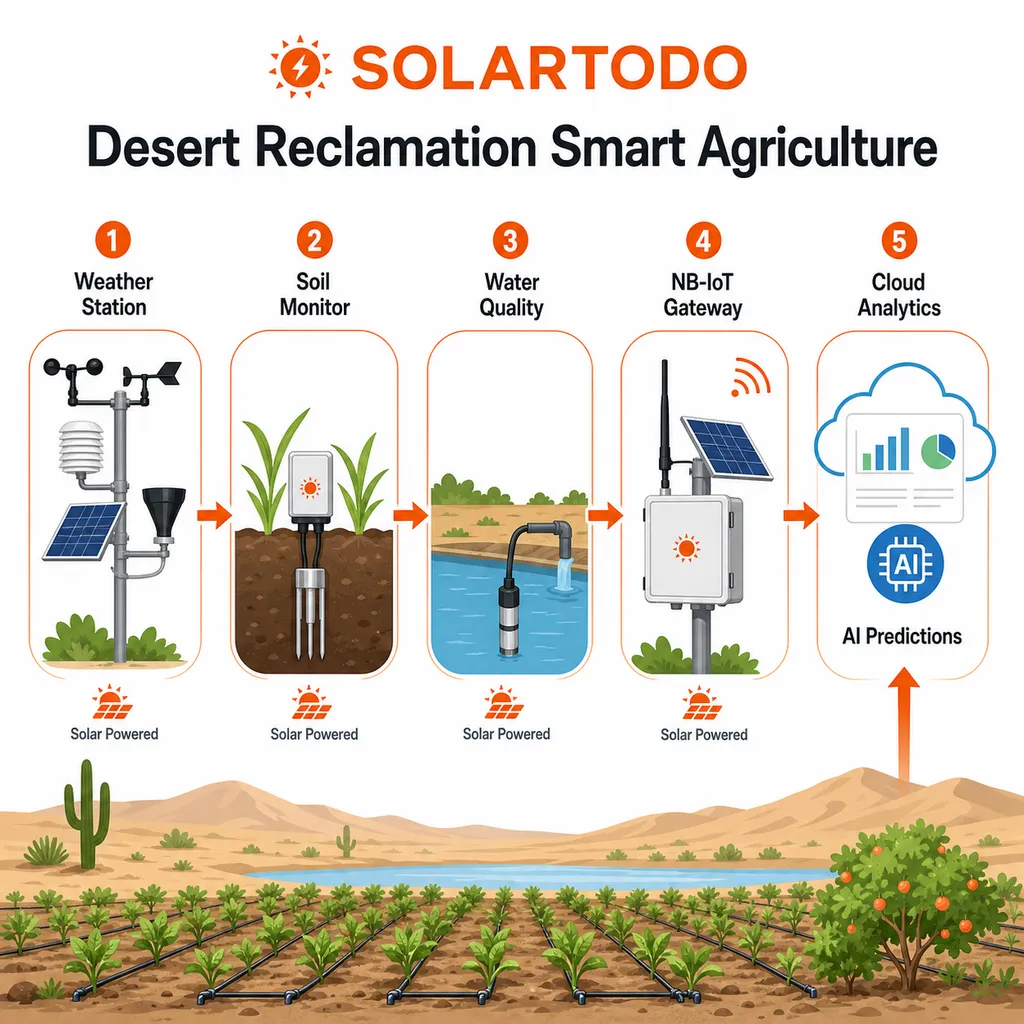
At the energy layer, the 500 kW solar PV system is treated as both a site power asset and a monitored operating subsystem, with data alignment to IEC 61724-1:2021 principles for PV performance monitoring, irradiance measurement, and temperature-aware reporting. The IoT package does not replace the PV inverter SCADA; instead, it adds 22 agronomic measurement points so that crop-zone decisions can be correlated with solar radiation, evapotranspiration, pump runtime, and soil-water retention over 1 day, 7 day, and 30 day windows.
Technical Specifications
The weather station measures temperature, humidity, wind speed, wind direction, rainfall, solar radiation, atmospheric pressure, and evapotranspiration, giving 8 core meteorological variables for irrigation modeling. WMO-No. 8 guidance on instruments and methods of observation supports standardized weather measurement practice, and the SOLARTODO configuration applies that principle by separating meteorological data from soil-probe data so that a 10-minute rainfall event does not mask root-zone moisture behavior at 10 cm, 20 cm, 40 cm, and 60 cm.
The soil layer uses multi-depth probes with volumetric moisture from 0-100%, temperature from -30 C to 70 C, electrical conductivity, pH, and NPK indicators for reclamation agronomy. In desert reclamation, the 4 depth profile is important because surface wetting at 10 cm can look adequate while the 40 cm and 60 cm layers remain below the crop-establishment threshold for 24-72 hours, creating a measurable risk for young root systems.
The water-quality layer uses 3 IP68 submersible measurement points for dissolved oxygen, pH, ammonia, turbidity, salinity, and temperature, which are relevant when reclaimed water, brackish groundwater, or fertigation reservoirs are used. A typical trigger can start pump recirculation or aeration when dissolved oxygen drops below a project-defined threshold, while salinity and electrical conductivity trends can prevent 1 irrigation cycle from concentrating salts in the upper 20 cm root zone.
Solar, Irrigation, and Desert Reclamation Logic
The 500 kW PV reference size is suitable for pump scheduling, battery-supported sensor power, and agrivoltaic monitoring on a 36 ha site, but final pump sizing depends on static head, dynamic head, water source depth, pipe length, and daily crop demand. IRENA's solar irrigation work notes that solar pumping can improve decentralized irrigation economics, and this product translates that energy concept into 10-minute field data that can govern drip-valve windows instead of fixed 1-hour manual irrigation blocks.
For reclamation agronomy, the system compares weather demand, evapotranspiration, soil moisture, and water salinity before recommending irrigation duration. Compared with a conventional timer-only drip system using 1 fixed schedule per day, a sensor-governed approach can reduce unnecessary irrigation events by up to 50% in well-managed projects, which aligns with reported smart-irrigation ranges and with NREL agrivoltaic findings that shaded PV crop zones can retain about 5-15% more soil moisture under specific arid test conditions.
The drip-irrigation interface supports automated valve control through REST API integration, local relay controllers, or third-party irrigation PLCs, depending on the project cabinet design. For a 36 ha reclamation block, engineers typically divide the land into 6-12 irrigation zones, so the 22-sensor layout provides about 1 sensor per 1.64 ha while still leaving enough points to monitor salinity-risk areas near drains, tank outlets, or low-elevation zones.
Cloud Monitoring
The standard cloud tier provides real-time dashboards, historical trend charts, threshold alerts, device status, and REST API access for third-party agriculture, EPC, or owner-operator systems. Data is logged every 10 minutes by default and can be configured from 1-60 minutes, which means 1 sensor can generate 144 readings per day at the standard interval and the full 22-sensor system can produce more than 3,168 timestamped sensor records per day before derived analytics.
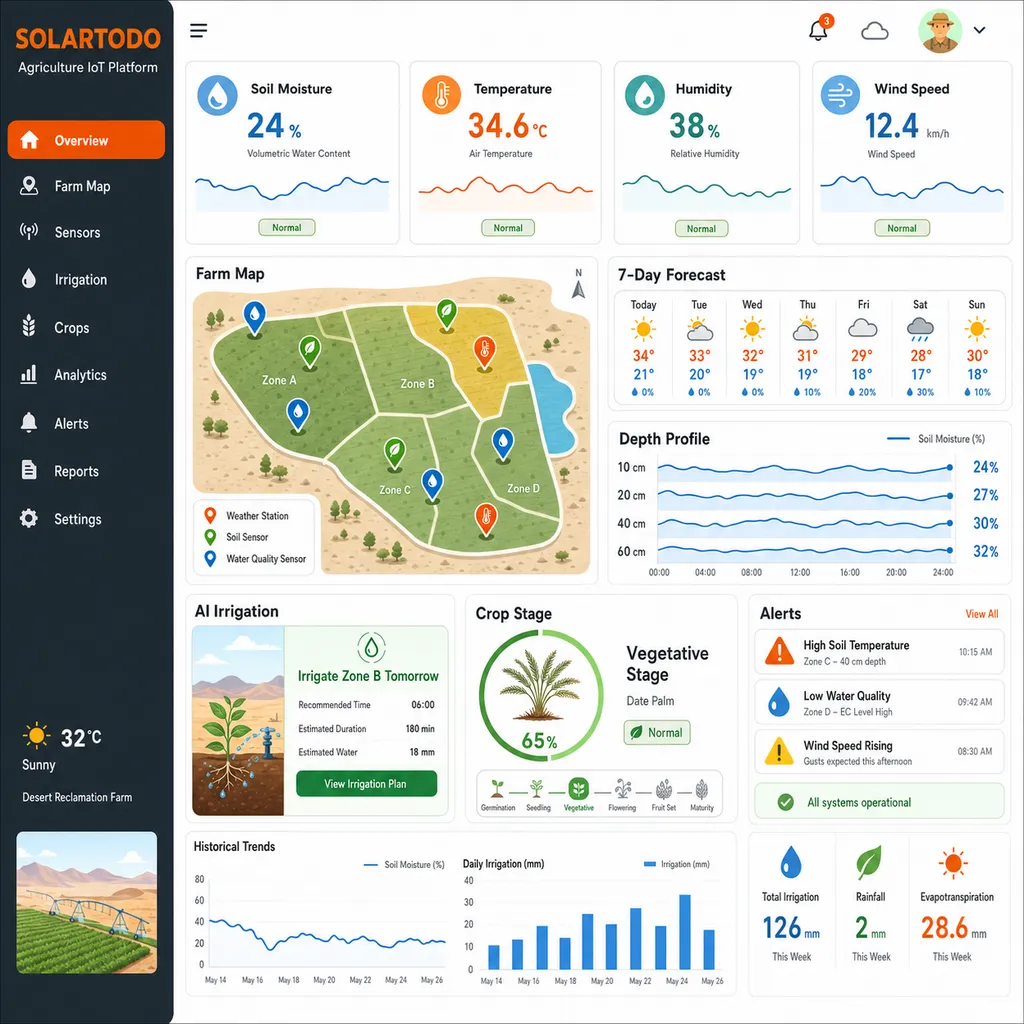
The cloud alert layer supports SMS, email, and app push channels, with separate thresholds for weather, soil, and water-quality variables. A 3-level alert structure can distinguish warning, action, and critical states, such as soil moisture below 18%, salinity above a crop-specific EC limit, or water turbidity exceeding a reservoir cleaning threshold for 2 consecutive 10-minute reporting cycles.
Representative MENA Solar-Farm Scenario
For a representative MENA solar farm scenario, assume a 36 ha desert-edge reclamation block, 500 kW of PV capacity, 10 irrigation zones, and 22 NB-IoT sensors installed before the first planting season. If baseline water use is 6,000 m3/ha/year, a 20-50% irrigation reduction range would equal 43,200-108,000 m3/year of avoided pumping and water handling across 36 ha, before accounting for crop-specific yield effects.
The same scenario can compare open-field agriculture with a solar+agriculture layout where PV rows create partial shade, reduce midday soil temperature, and provide a direct energy source for pumping and controls. NREL has reported agrivoltaic test results including 65% greater water-use efficiency for cherry tomato and 157% greater water-use efficiency for jalapeno under specific Arizona conditions, so SOLARTODO presents those numbers as research benchmarks, not as guaranteed performance for 1 project.
Standards and Interoperability
The platform is specified around IP67/IP68 outdoor protection, ISO 11783 agricultural-machine data concepts, IEC 61724-1 PV monitoring alignment, WMO weather-observation practice, and IEEE 2030.5-2023 smart-energy communication context. These references help B2B buyers map 1 procurement package to multiple engineering disciplines: agronomy, water, electrical, communications, and owner-side digital operations.
NB-IoT is selected because it gives cellular coverage without 1 dedicated local LoRaWAN gateway, which can be valuable when a 36 ha reclamation site has limited security staff or no permanent control room. Where NB-IoT coverage is weak, SOLARTODO can engineer a variant using LoRaWAN, with 1 gateway commonly planned for up to a 10 km radius under favorable line-of-sight assumptions and local radio regulations.
Applications
Primary applications include desert reclamation farms, agrivoltaic pilot blocks, solar-powered irrigation sites, saline-soil recovery zones, and remote smart-agriculture demonstration farms from 10 ha to 100 ha. The 36 ha package is most useful when the owner wants more than a basic weather station but does not yet need hundreds of sensors, drone analytics, or full enterprise farm-management integration.
The system also supports procurement teams that need a clear starting scope for EPC tendering: 22 sensors, 500 kW PV telemetry interface, NB-IoT subscriptions, standard cloud access, 2-year hardware warranty, and 1-year cloud warranty. Related technical reading is available at Learn about topic, including irrigation analytics, PV monitoring, and smart-agriculture deployment planning for 1-hectare to 1,000-hectare projects.
EPC Investment Analysis and Pricing Structure
EPC turnkey service includes engineering, procurement, construction support, sensor installation, communication commissioning, cloud configuration, irrigation-interface testing, user training, and 1 year of warranty support. The quoted EPC range of $2,398-$3,108 covers the SOLARTODO IoT monitoring package and commissioning scope for this 36 ha configuration; civil works, boreholes, crop establishment, water rights, large pump houses, and full 500 kW PV module supply are normally priced as separate project packages.
| Pricing tier | Scope included | Price range |
|---|---|---|
| FOB Supply | Equipment only, ex-works China | $1,487-$2,113 |
| CIF Delivered | Equipment, ocean freight, and insurance | $1,551-$2,204 |
| EPC Turnkey | Installed, commissioned, and 1-year support | $2,398-$3,108 |
| Volume level | Discount | Example procurement use |
|---|---|---|
| 50+ systems | 5% | Multi-farm regional rollout across at least 1 province |
| 100+ systems | 10% | Utility or ministry framework with 100 monitored blocks |
| 250+ systems | 15% | National reclamation program with 250 standardized packages |
ROI depends on local water tariffs, crop value, labor cost, and baseline irrigation discipline, so SOLARTODO models payback with transparent assumptions instead of a guaranteed yield claim. If the 36 ha site saves 43,200 m3/year and the combined water plus pumping cost is $0.04/m3, annual direct savings are $1,728; if avoided field inspection saves 8 labor-hours per week at $6/hour, annual labor savings add $2,496, creating a simple payback of roughly 0.6-0.8 years against the $2,398-$3,108 EPC range.
Payment terms are 30% T/T deposit plus 70% against bill of lading, or 100% irrevocable L/C at sight for qualified buyers. Project financing can be discussed for integrated solar-agriculture projects above $1,000,000, and procurement managers can contact [email protected] for 1 consolidated proposal covering monitoring, PV, drip irrigation, pumps, spares, and commissioning documentation.
Procurement Notes
The base package includes a 2-year hardware warranty and 1-year cloud service warranty, with spare probes, calibration accessories, SIM subscription terms, and local installation labor confirmed at quotation stage. For export projects, SOLARTODO recommends defining 3 acceptance checkpoints: factory acceptance for the device list, site acceptance for sensor communication, and operational acceptance after at least 72 hours of continuous 10-minute data upload.
For data governance, the REST API supports export to owner databases, national research platforms, EPC dashboards, or ERP-linked maintenance logs. IEEE 2030.5-2023 supports broader smart-energy interoperability concepts, while IEA Renewables 2025 reports solar PV as the dominant contributor to renewable electricity expansion through 2030, making 500 kW solar-agriculture monitoring a practical bridge between energy infrastructure and water-stressed food production.
Source-Grounded Performance Context
NREL agrivoltaics research indicates that PV co-location can improve microclimate outcomes, including cooler daytime conditions and measured water-use-efficiency gains under specific crop and climate trials. IRENA and FAO report that agri-food systems use about 30% of global energy, which makes renewable-powered irrigation and sensor-based water control relevant to both energy planning and food-system resilience.
These figures should be interpreted as planning references rather than guaranteed project outcomes, because 1 site's yield response depends on soil texture, crop species, irrigation uniformity, salinity, labor discipline, and seasonal weather. The SOLARTODO engineering value is that 22 field sensors and 10-minute data intervals make those variables visible early enough for corrective action during the first 30-90 days of desert reclamation.
Technical Specifications
| Coverage Area | 36ha |
| Application | desert_reclamation |
| Monitoring Types | weather, soil, water_quality |
| Total Sensors | 22pcs |
| Solar PV Telemetry Scope | 500kW |
| Communication | NB-IoT |
| Power Supply | solar_large with LFP battery |
| Drip Irrigation Interface | included |
| Data Interval | 10min |
| Configurable Data Interval | 1-60min |
| Cloud Platform | standard |
| Alert Channels | SMS + Email + App Push |
| API Access | REST API included |
| Soil Depth Layers | 10/20/40/60cm |
| Soil Moisture Range | 0-100% |
| Soil Temperature Range | -30 to 70C |
| Sensor Protection | IP67/IP68 |
| Hardware Warranty | 2years |
| Cloud Warranty | 1year |
Price Breakdown
| Item | Quantity | Unit Price | Subtotal |
|---|---|---|---|
| Professional weather station package | 1 pcs | $420 | $420 |
| Multi-depth soil monitoring probe package | 18 pcs | $42 | $756 |
| Water-quality monitoring sensor package | 3 pcs | $180 | $540 |
| NB-IoT communication module and SIM setup | 22 pcs | $9 | $198 |
| Solar field-node power kit with LFP battery | 22 pcs | $12 | $264 |
| Standard cloud platform, first year | 22 pcs | $12 | $264 |
| 500 kW PV telemetry interface configuration | 1 pcs | $120 | $120 |
| Engineering and quality control | 1 pcs | $180 | $180 |
| Installation and commissioning | 1 pcs | $180 | $180 |
| Training, documentation, and 1-year warranty support | 1 pcs | $146 | $146 |
| Total Price Range | $2,398 - $3,108 | ||
Frequently Asked Questions
What is included in the EPC turnkey price for this 36 ha system?
How many sensors are used across the 36 ha desert reclamation site?
Why use NB-IoT instead of LoRaWAN for this variant?
Can the system directly control drip irrigation valves?
Which standards are relevant to the monitoring system?
Certifications & Standards


Data Sources & References
- •NREL, Benefits of Agrivoltaics Across the Food-Energy-Water Nexus, 2019, https://www.nrel.gov/news/detail/program/2019/benefits-of-agrivoltaics-across-the-food-energy-water-nexus
- •IEC 61724-1:2021 Photovoltaic system performance - Monitoring, https://webstore.iec.ch/en/publication/65561
- •WMO Instruments and Methods of Observation Programme and WMO-No. 8 guidance, https://wmo.int/activities/instruments-and-methods-of-observation-programme-imop/instruments-and-methods-of-observation-programme
- •IRENA and FAO, Renewable Energy for Agri-food Systems, 2021, https://www.irena.org/publications/2021/Nov/Renewable-Energy-for-Agri-food-Systems
- •IRENA, Solar Pumping for Irrigation, 2016, https://www.irena.org/Publications/2016/Jun/Solar-Pumping-for-Irrigation-Improving-livelihoods-and-sustainability
- •IEA, Renewables 2025, https://www.iea.org/reports/renewables-2025
- •IEEE 2030.5-2023 Smart Energy Profile Application Protocol, https://standards.ieee.org/ieee/2030.5/11216/
Interested in this solution?
Contact us for a customized quote based on your specific requirements.
Contact Us