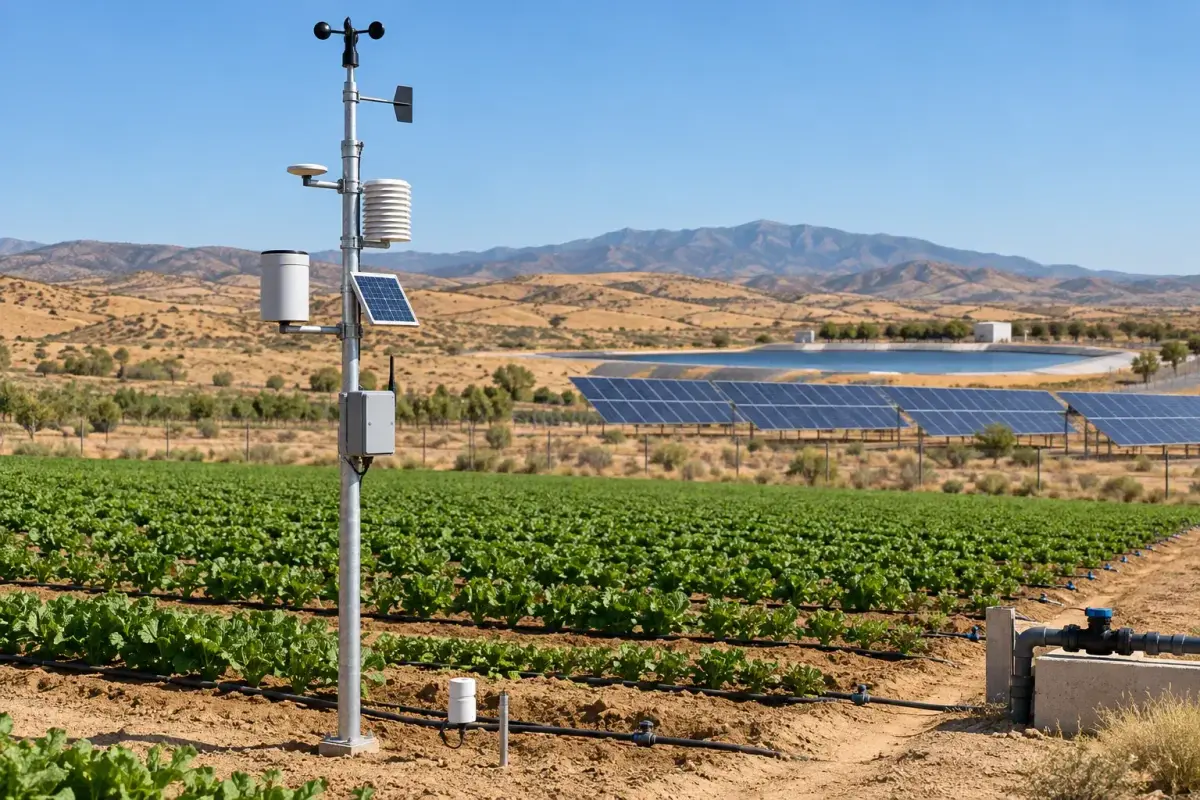
Desert Reclamation Solar+Agriculture 56ha - 500 kWp Smart Agriculture IoT Monitoring System
Key Features
- 56 ha desert reclamation coverage with 18 weather, soil, and water-quality sensors
- 500 kWp solar-PV project interface with dedicated solar-medium field power kits
- 10-minute data interval, configurable from 1 to 60 minutes for field reporting
- 4-depth soil monitoring at 10/20/40/60 cm for root-zone irrigation control
- EPC turnkey IoT package priced at $2,830-$3,668 with 1-year cloud support
Desert Reclamation Solar+Agriculture 56ha is a 500 kWp solar-powered smart agriculture monitoring package for 56 hectares, using 18 sensors for weather, soil, and water-quality data over 4G. The EPC turnkey scope is priced at $2,830-$3,668 for the IoT monitoring and commissioning package, with REST API access, 10-minute data intervals, and professional cloud analytics.
Description
Desert Reclamation Solar+Agriculture 56ha is a smart-agriculture IoT monitoring system for 56 hectares of desert reclamation, combining a 500 kWp solar-PV project interface, 18 field sensors, 4G communication, drip-irrigation control, and professional cloud analytics. The system measures weather, soil, and water-quality conditions every 10 minutes, supports SMS, email, and app alerts, and is priced at $2,830-$3,668 for the EPC turnkey IoT package supplied by SOLARTODO.
The product is designed for B2B desert farming, agro-PV, solar irrigation, and land-rehabilitation projects where 1 decision can affect 56 hectares, 500 kWp of distributed solar assets, and hundreds of cubic meters of water demand per day. It follows the monitoring logic used in IEC 61724-1:2021 for PV performance data, WMO guidance for weather observations, ISO 11783 for agricultural machine interoperability, and IP67/IP68 enclosure practices for outdoor field electronics.
Application Context for Desert Reclamation
Desert reclamation normally fails when 3 variables are managed separately: solar power, irrigation water, and soil recovery. This SOLARTODO configuration integrates those 3 variables into 1 data layer, allowing operators to compare solar radiation, evapotranspiration, soil moisture at 10/20/40/60 cm, water pH, water salinity, and drip-irrigation timing from the same dashboard.
For a representative MENA solar farm scenario, a 56 ha reclamation plot may pair 500 kWp of PV generation with drip irrigation, shelter crops, and soil-conditioning programs over a 12-month operating cycle. In that scenario, the IoT package tracks microclimate, soil-water retention, and water quality at 10-minute intervals so the operator can reduce over-irrigation compared with fixed 24-hour timer schedules.
The system is not presented as a verified customer deployment, because no project reference has been supplied for this page. Instead, the engineering basis uses published industry evidence: IRENA and FAO report that agri-food systems consume about 30% of global energy, while IEA Global Energy Review 2026 reports solar PV generation reached nearly 2,700 TWh in 2025, creating a strong technical case for solar-powered irrigation and monitoring in arid zones.
System Architecture
The architecture uses 18 sensors connected through field nodes, a 4G gateway, solar-medium power kits, and a professional cloud platform. The monitoring layer is designed around 3 data families: weather data for evapotranspiration, soil data for root-zone water balance, and water-quality data for irrigation reliability across 56 hectares.
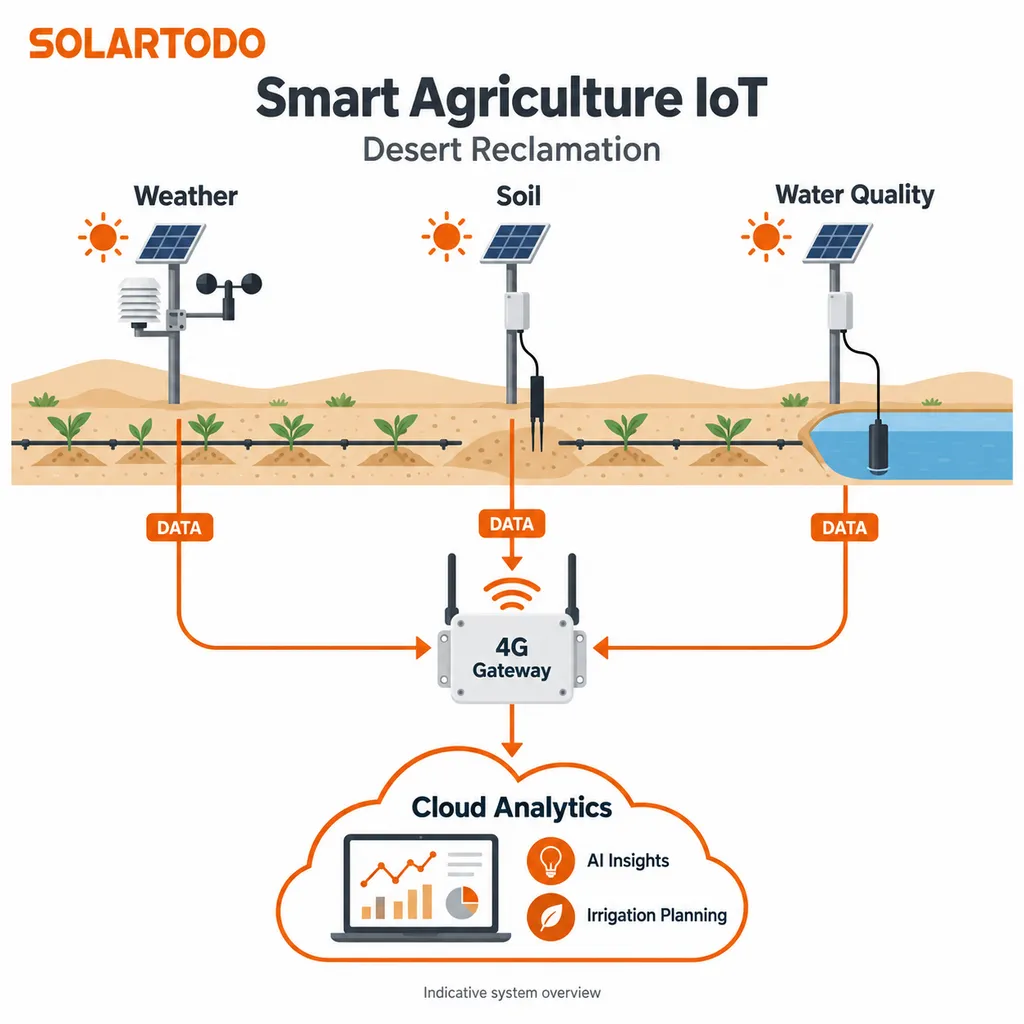
At field level, the weather station measures temperature, humidity, wind speed, wind direction, rainfall, solar radiation, atmospheric pressure, and evapotranspiration indicators. These 8 weather variables help operators decide whether a 10-minute irrigation event should be delayed, shortened, or moved to a lower-evaporation period.
Soil monitoring uses multi-depth probes at 10 cm, 20 cm, 40 cm, and 60 cm to show how irrigation water moves through the root zone. The sensors can report volumetric moisture from 0% to 100%, soil temperature from -30 C to 70 C, electrical conductivity, pH, and nutrient indicators such as NPK where probe type supports the full 7-parameter package.
Water-quality monitoring is included because desert reclamation commonly depends on wells, treated wastewater, brackish water, or blended sources. The package can monitor dissolved oxygen, pH, ammonia, turbidity, salinity, and temperature, giving procurement teams 6 measurable criteria for screening irrigation water before it damages emitters or increases soil salinity.
Communication is based on 4G LTE rather than only low-bandwidth telemetry, because reclamation sites often require image upload, field inspection records, and higher-rate alarm transmission. Where sensor density later expands beyond 18 devices, the architecture can also interface with LoRaWAN gateways rated for up to a 10 km radius in open field conditions.
Power is supplied by solar-medium field kits using 10 W to 80 W PV modules and LFP battery storage, selected for maintenance-light outdoor use. For this 56 ha configuration, the 500 kWp PV parameter is treated as the project solar-generation interface, while the IoT package uses its own dedicated low-voltage solar power for sensor uptime.
Technical Specifications
| Parameter | Specification |
|---|---|
| Coverage area | 56 hectares |
| Solar PV project interface | 500 kWp |
| Total sensor count | 18 sensors |
| Monitoring types | Weather, soil, water quality |
| Communication | 4G LTE |
| Data interval | 10 minutes, configurable 1-60 minutes |
| Power supply | Solar medium kit with LFP battery |
| Cloud tier | Professional |
| Irrigation integration | Drip irrigation enabled |
| Alert channels | SMS, email, app push |
| API access | REST API included |
| Warranty | 2 years hardware, 1 year cloud |
The 10-minute interval is a practical balance between battery life, network cost, and agronomic usefulness. A 56 ha plot with 18 sensors generates 2,592 readings per day if every sensor reports 144 times, creating enough granularity for daily irrigation decisions without turning the system into a high-cost SCADA project.
The IP67/IP68 sensor strategy is important for desert agriculture because probes are exposed to dust, salts, wet soil, fertilizer residues, and high daytime temperatures. An IP68 submersible water-quality probe is more appropriate than an indoor meter when readings must survive 365 days of field use.
Cloud Monitoring
The professional cloud tier provides a real-time dashboard, historical trend analysis, alarm thresholds, AI-assisted irrigation recommendations, and exportable datasets for engineering review. REST API access is included so a developer can connect the 56 ha monitoring layer to an irrigation controller, ERP, ESG dashboard, or project owner portal.
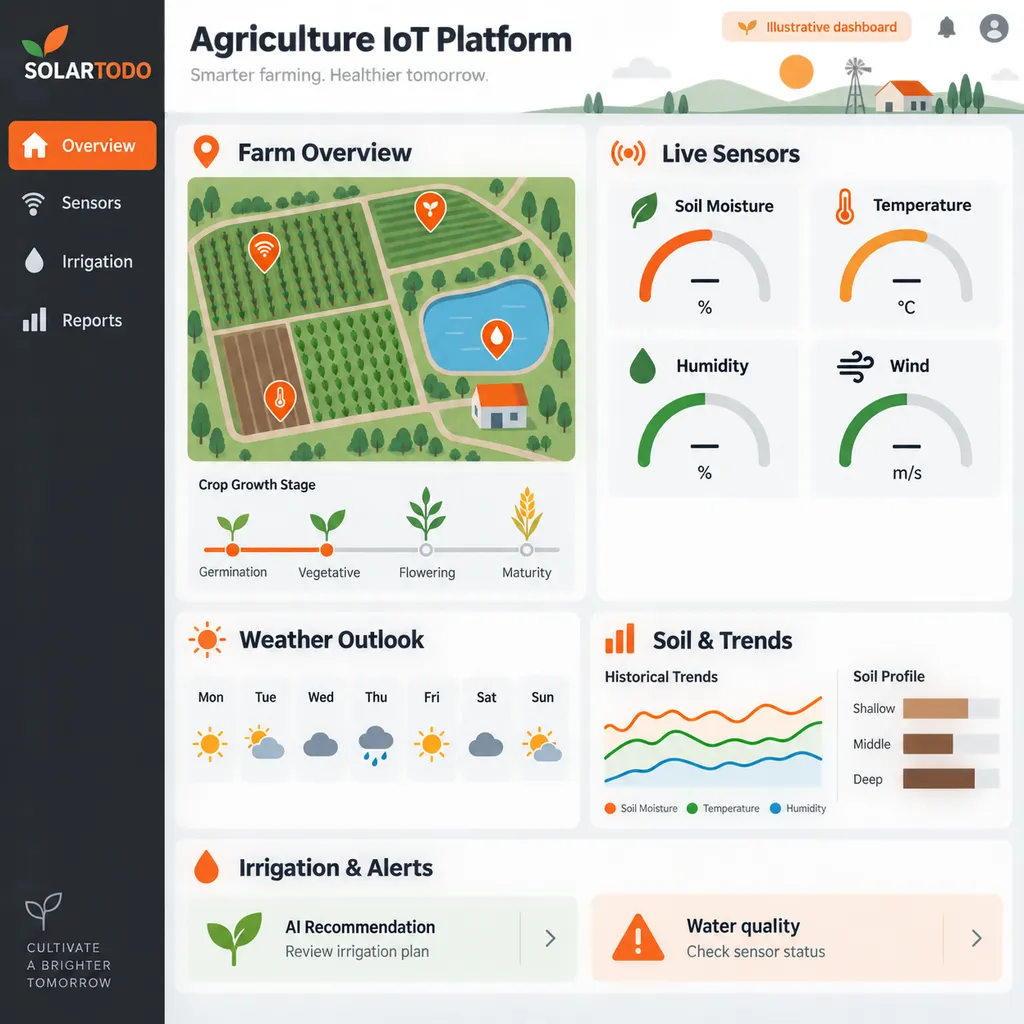
The platform supports alert routing through 3 channels: SMS, email, and app push. A typical alarm rule can notify the operator when soil moisture at 40 cm drops below a defined threshold, when water salinity exceeds the irrigation limit, or when a 4G device has missed 3 consecutive 10-minute reporting cycles.
AI functions can support crop growth models, irrigation recommendations, pest-risk prediction, and yield forecasting when enough historical data are available. SOLARTODO positions these functions as decision support, not autonomous agronomic approval, because each 56 ha site still requires crop-specific thresholds, local water chemistry, and operator validation.
Standards and Engineering References
IEC 61724-1:2021 is relevant because the project includes a 500 kWp PV interface and uses performance-monitoring concepts such as irradiance, data quality, and system-level availability. Although IEC 61724-1 is written for photovoltaic system monitoring, its disciplined approach to time-series data is useful for solar-agriculture projects that connect energy and irrigation decisions.
ISO 11783 is relevant for agricultural interoperability because it defines ISOBUS communication concepts used across tractors, implements, and farm-management systems. For a 56 ha project, ISO 11783 alignment helps engineers specify future integration with controllers, valves, and equipment fleets without locking the operator into 1 proprietary data model.
WMO weather-station guidance is relevant because temperature, humidity, wind, rainfall, radiation, and pressure affect evapotranspiration estimates. For desert reclamation, even a 5% error in evapotranspiration estimation can compound into thousands of liters of excess or insufficient irrigation over 56 hectares during a hot week.
NREL agrivoltaics research has documented the technical value of pairing PV and agriculture in land-constrained or heat-stressed regions, including the need to evaluate crop response, microclimate, and water demand together. IRENA and FAO also identify renewable energy as a pathway for agri-food resilience, while IEA data show solar PV added about 600 TWh of generation in 2025.
Comparison with Conventional Alternatives
A conventional desert irrigation system often uses 1 weather timer, manual soil inspection, and pump runtime logs, which can miss localized salinity, blocked emitters, or under-irrigated root zones. This SOLARTODO package replaces that low-resolution method with 18 sensors, 10-minute data, 4-depth soil profiling, and 3 alert channels.
Compared with fixed-schedule irrigation, sensor-guided drip irrigation can reduce water use by up to 50% under suitable crop, soil, and operator conditions, based on the technical benchmark supplied for this product category. The same knowledge base reports up to 30% pesticide reduction and 15%-25% yield improvement where monitoring, prediction, and management practices are properly implemented.
The comparison should be interpreted as an engineering potential, not a guaranteed site result, because water savings depend on crop type, baseline waste, emitter design, salinity, and staff discipline. For procurement purposes, the more defensible comparison is that 18 measured points provide more actionable evidence than 0 continuous soil probes and 0 continuous water-quality sensors.
EPC Investment Analysis and Pricing Structure
EPC includes engineering, procurement, construction, commissioning, and 1-year warranty support for the IoT monitoring scope. For this 56 ha product page, the EPC price range of $2,830-$3,668 covers the smart monitoring package, control integration, field commissioning, and cloud onboarding; large civil works, the full 500 kWp PV plant, land grading, wells, reservoirs, and long-distance pipelines are project-specific exclusions unless quoted separately.
| Pricing tier | Commercial scope | Price range, USD |
|---|---|---|
| FOB Supply | Equipment only, ex-works China | $1,755-$2,494 |
| CIF Delivered | Equipment plus ocean freight and insurance | $1,831-$2,602 |
| EPC Turnkey | Installed, commissioned, trained, 1-year warranty | $2,830-$3,668 |
| Volume band | Discount | Example procurement logic |
|---|---|---|
| 50+ systems | 5% | Multi-farm framework purchase |
| 100+ systems | 10% | Regional irrigation program |
| 250+ systems | 15% | National reclamation rollout |
ROI depends on the baseline water cost, diesel displacement, crop value, and labor model. If a 56 ha site reduces irrigation waste by 20% from a baseline $10,000 annual water-and-pumping cost, the annual saving is $2,000 and the $2,830-$3,668 EPC package has a simple payback of about 1.4-1.8 years before crop-yield upside.
If the site reaches the category benchmark of 50% water reduction from a $10,000 annual baseline, the annual saving is $5,000 and simple payback can be less than 1 year. If the baseline is already efficient and savings are only 10%, the same package may pay back in about 2.8-3.7 years, which is still acceptable for many 5-year reclamation programs.
Payment terms are 30% T/T deposit plus 70% against bill of lading, or 100% irrevocable L/C at sight for approved buyers. Project financing can be discussed for orders above $1,000K, and commercial questions should be sent to [email protected] with the site location, crop plan, water source, 56 ha layout, and desired commissioning date.
Procurement, Integration, and Buyer Workflow
Engineering buyers can start by reviewing View all Smart Agriculture IoT Monitoring System products and comparing the 56 ha package against smaller or larger monitoring layouts. The most useful tender inputs are 1 site map, 1 irrigation diagram, 1 water-quality report, 1 crop plan, and 12 months of weather or pumping records where available.
Procurement managers can Configure your system online to adjust sensor quantity, cloud tier, communication method, and power kit sizing. For non-standard cases such as >500 kWp PV, >56 ha land blocks, satellite backup, or bilingual dashboards, buyers should Request a custom quotation before issuing a final bill of quantities.
For technical background, buyers can Learn about topic covering smart-agriculture monitoring, solar irrigation, IoT sensor selection, and water-energy-food nexus planning. A second knowledge review at Learn about topic is recommended when the project includes government reporting, ESG metrics, or multi-year land restoration targets.
Operations and Maintenance
The hardware warranty is 2 years, while the cloud service warranty and support period is 1 year for this configuration. Sensor maintenance typically involves cleaning exposed surfaces, checking enclosure seals, verifying calibration status, and confirming that the solar-medium kit and LFP battery remain correctly connected after dust storms or field work.
Data continuity is protected through retransmission after network recovery, so temporary 4G interruptions do not automatically destroy the 10-minute trend record. For a 56 ha reclamation site, that feature matters because pump control and agronomic review depend on multi-day patterns rather than a single reading from 1 sensor.
The recommended acceptance test uses 5 checks: gateway online status, sensor-by-sensor data validation, alarm delivery through 3 channels, REST API token verification, and irrigation-valve command simulation. These checks allow the owner, EPC contractor, and agronomist to sign off the system before it becomes part of daily operations.
Why SOLARTODO for Solar Agriculture Infrastructure
SOLARTODO supplies solar, energy storage, smart lighting, security, telecom power towers, and smart-agriculture systems from 1 B2B portfolio. That matters for a 56 ha desert-reclamation buyer because power, sensors, communications, and outdoor enclosures must be specified together rather than purchased as 4 disconnected packages.
The Desert Reclamation Solar+Agriculture 56ha product is best suited for developers who need measurable field evidence, bankable procurement documents, and a practical EPC path between pilot plots and larger 250+ system programs. With 18 sensors, 500 kWp PV interface data, 4G communications, and professional cloud analytics, it gives engineers a documented basis for irrigation control and long-term land-recovery reporting.
Technical Specifications
| Coverage Area | 56hectares |
| Monitoring Types | weather, soil, water_quality |
| Total Sensors | 18sensors |
| Application | desert_reclamation |
| Communication | 4g |
| Power Supply | solar_medium |
| Solar PV Project Interface | 500kWp |
| Drip Irrigation | true |
| Data Interval | 10min configurable |
| Cloud Platform | professional |
| Alert Channels | SMS + Email + App Push |
| API Access | REST API included |
| Warranty | 2 years hardware, 1 year cloud |
Price Breakdown
| Item | Quantity | Unit Price | Subtotal |
|---|---|---|---|
| 18-Sensor Weather, Soil, and Water-Quality Field Bundle | 18 pcs | $75 | $1,350 |
| 4G Gateway and Antenna Set | 1 pcs | $110 | $110 |
| Solar Medium Power Kit with LFP Battery | 1 pcs | $225 | $225 |
| Professional Cloud Platform, 1 Year | 18 pcs | $48 | $864 |
| 500 kWp PV Data Interface and REST API Setup | 1 pcs | $125 | $125 |
| Installation and Commissioning | 1 pcs | $500 | $500 |
| Engineering, QC, and Documentation | 1 pcs | $250 | $250 |
| 1-Year Warranty and Remote Support | 1 pcs | $120 | $120 |
| Total Price Range | $2,830 - $3,668 | ||
Frequently Asked Questions
What does the EPC turnkey price include for this 56 ha package?
How many sensors are included and what do they monitor?
Can the system control drip irrigation automatically?
Is the system suitable for remote desert sites with weak infrastructure?
Which standards and references support the product specification?
Certifications & Standards


Data Sources & References
- •IEC 61724-1:2021 Photovoltaic system performance - Monitoring, https://webstore.iec.ch/en/publication/65561
- •IEA Global Energy Review 2026, https://www.iea.org/reports/global-energy-review-2026
- •IRENA and FAO Renewable Energy for Agri-food Systems 2021, https://www.irena.org/publications/2021/Nov/Renewable-Energy-for-Agri-Food-Systems
- •IRENA Solar Pumping for Irrigation 2016, https://www.irena.org/Publications/2016/Jun/Solar-Pumping-for-Irrigation-Improving-livelihoods-and-sustainability
- •NREL Agrivoltaics Research, https://www.nrel.gov/solar/agrivoltaics
- •World Meteorological Organization weather observation guidance, https://wmo.int
Interested in this solution?
Contact us for a customized quote based on your specific requirements.
Contact Us