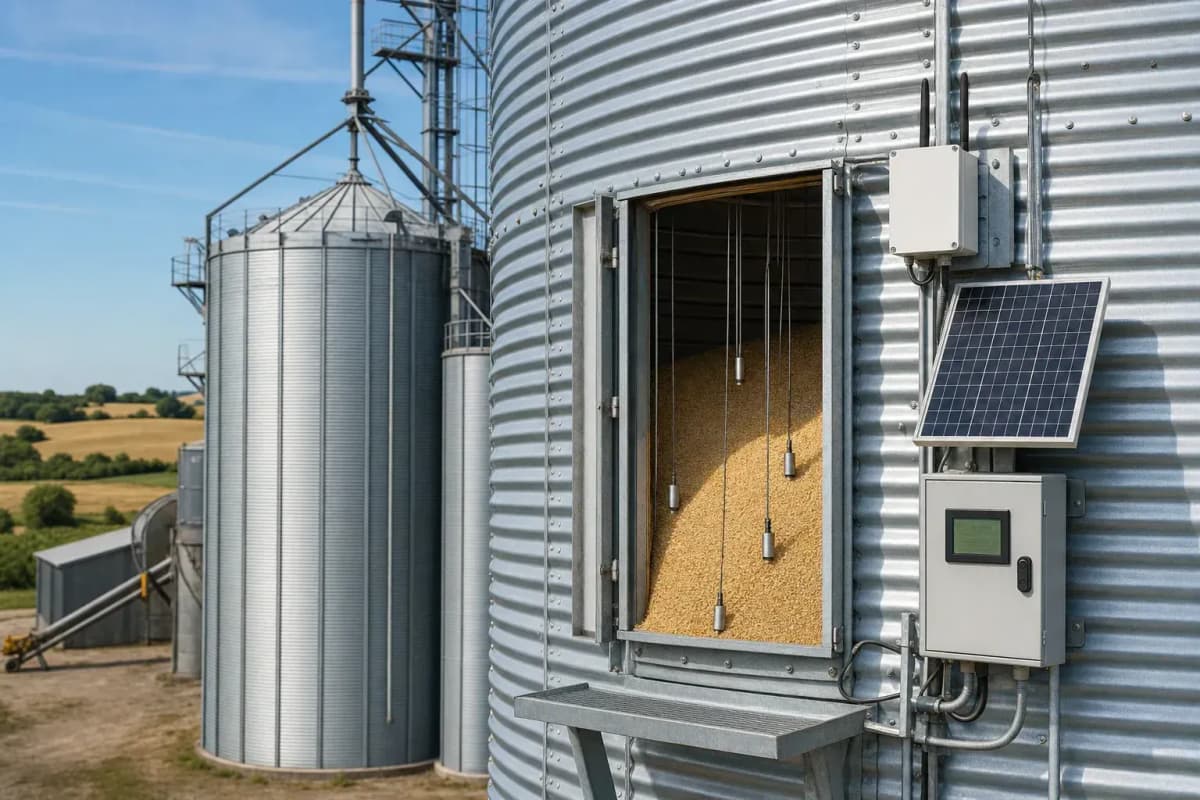
Grain Storage Monitoring 6ha - NB-IoT Silo Monitoring for 5,000 Tons
Key Features
- 6ha grain storage monitoring coverage for up to 5,000 tons of silo or warehouse capacity
- 11-sensor architecture tracks temperature, humidity, CO2, O2, ethylene, and insect activity
- 10-minute data interval is configurable from 1 to 60 minutes with retransmission after network recovery
- NB-IoT cellular communication removes the need for 1 local gateway on compact storage yards
- EPC turnkey price range is $2,052 to $2,592 with 2-year hardware warranty and 1-year cloud support
Grain Storage Monitoring 6ha is an NB-IoT smart agriculture storage system for 6 hectares of grain-handling infrastructure, using 11 sensors, solar-medium power, professional cloud analytics, and EPC turnkey delivery for 5,000-ton silo applications.
Description
Grain Storage Monitoring 6ha is a solar-powered NB-IoT storage monitoring package for 6 hectares of grain logistics infrastructure and up to 5,000 tons of silo or warehouse capacity. The system uses 11 sensors to track temperature, humidity, CO2, O2, ethylene, and insect activity at 10-minute intervals, with EPC turnkey pricing from $2,052 to $2,592.
This configuration belongs to SOLARTODO’s Smart Agriculture IoT Monitoring System product line, with the storage variant optimized for grain_silo operation rather than irrigation or field weather measurement. B2B buyers can View all Smart Agriculture IoT Monitoring System products, Configure your system online, or Request a custom quotation for projects above 1 site or 5,000 tons.
Application Scope
The 6ha storage package is designed for grain elevators, inland depots, feed mills, seed warehouses, and farm cooperatives that operate 1 to 6 storage zones within a compact logistics yard. A typical bill of use covers 1 master NB-IoT storage node, 10 distributed cable probes or point sensors, 1 solar-medium power kit, 1 professional cloud subscription, and 1 EPC commissioning package.
The monitored variables address 6 storage risk categories: heat accumulation, moisture migration, elevated CO2, oxygen depletion, ethylene-related biological activity, and insect movement. FAO grain-storage guidance identifies moisture equilibrium around 65% to 70% relative humidity as a critical threshold for long-term foodstuff storage, and it describes insect-related hot spots exceeding 40°C as a spreading spoilage risk (FAO storage fundamentals).
Compared with a conventional manual inspection route that samples 1 to 2 points per bin every 1 to 7 days, this system records 11 measurement points every 10 minutes, creating up to 1,584 sensor readings per day. The practical advantage is not a guaranteed yield claim; it is faster detection of abnormal gradients that can trigger aeration, turning, fumigation review, or operator inspection before the risk expands across 5000 tons.
System Architecture
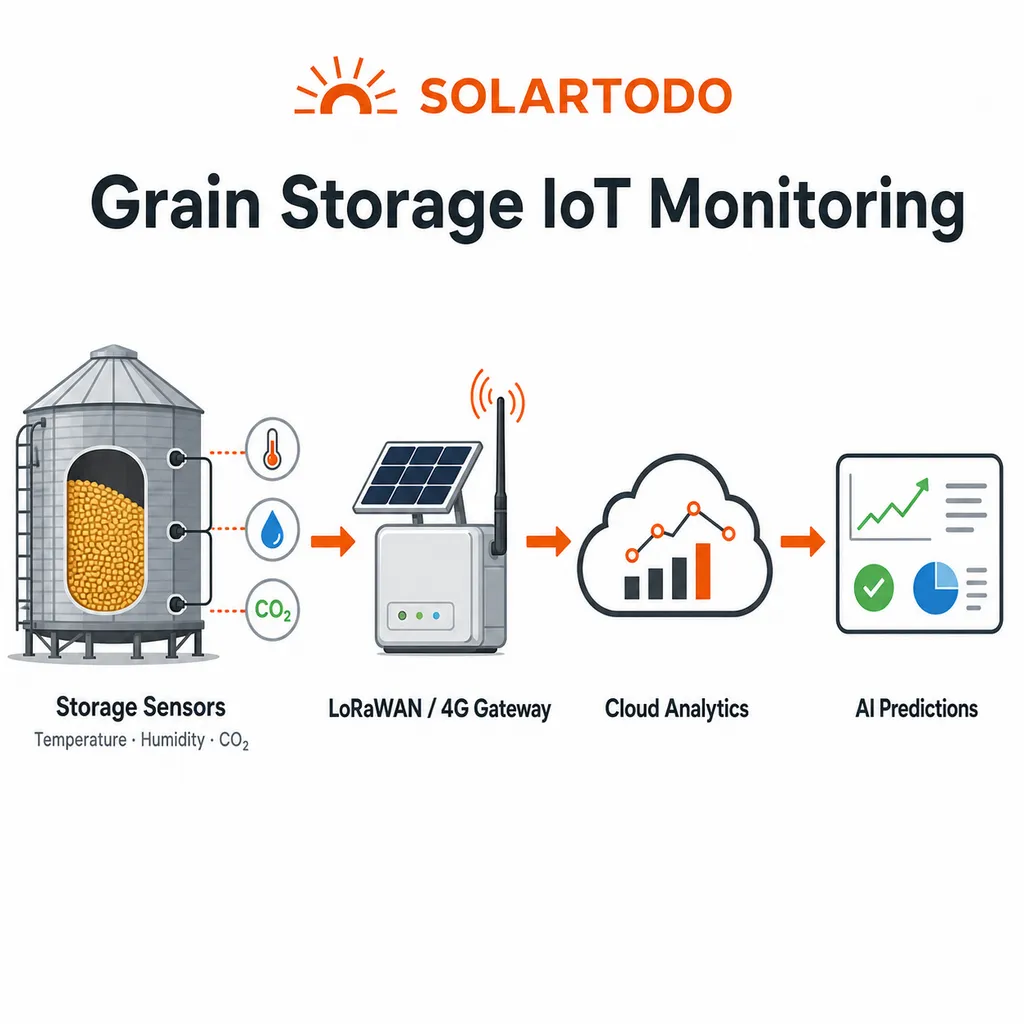
The architecture has 4 layers: in-silo sensing, solar-powered edge collection, NB-IoT cellular transmission, and cloud analytics. Each storage sensor reports temperature and humidity, while gas and biological channels monitor CO2, O2, ethylene, and insect activity for early-warning diagnostics in sealed or semi-sealed grain environments.
NB-IoT is used because this 6ha configuration does not require a local gateway, making it practical for storage yards where silos are separated by metal structures, truck lanes, and weighing stations. 3GPP completed NB-IoT standardization in Release 13 in 2016, and GSMA describes NB-IoT and LTE-M as low-power wide-area technologies specified through Releases 13 to 17 for cellular IoT deployments (3GPP NB-IoT; GSMA Mobile IoT Guide).
The power layer uses a solar-medium kit, typically in the 80W class, combined with an LFP battery and IP67-rated outdoor enclosure. IRENA’s decentralized renewable energy research notes that off-grid renewables support post-harvest processing, food preservation, storage, and transport, which is directly relevant to storage yards without reliable 24-hour grid power (IRENA agri-food renewables).
Technical Specifications
The standard configuration covers 6 hectares, 11 sensors, 10-minute data intervals, NB-IoT communication, solar_medium power, and a professional cloud tier. The storage capacity basis is 5,000 tons, which is suitable for small and mid-sized grain depots using multiple steel silos or 1 warehouse block.
| Specification | Value |
|---|---|
| Coverage area | 6 ha |
| Storage capacity basis | 5,000 tons |
| Total sensors | 11 sensors |
| Monitoring type | Storage |
| Application | Grain silo |
| Communication | NB-IoT cellular |
| Power supply | Solar medium with LFP battery |
| Data interval | 10 minutes, configurable from 1 to 60 minutes |
| Cloud tier | Professional |
| Alert channels | SMS, email, and app push |
| API access | REST API included |
| Warranty | 2 years hardware and 1 year cloud |
Sensor placement normally uses 3 vertical depths per cable in high-risk bins and 1 to 2 reference points near vents, unloading cones, or known condensation areas. The objective is temperature mapping, not laboratory-grade commodity grading; procurement teams should still maintain calibrated moisture meters and weighing records for commercial settlement.
The enclosure and field sensors should be specified to IEC 60529 IP67 or IP68 ingress-protection classes where outdoor washdown, dust, and roof-mounted conduits are present. Solar modules may be specified to IEC 61215 and IEC 61730, while LFP battery transport and pack acceptance commonly reference UN38.3 and IEC 62619 depending on destination market rules.
Cloud Monitoring
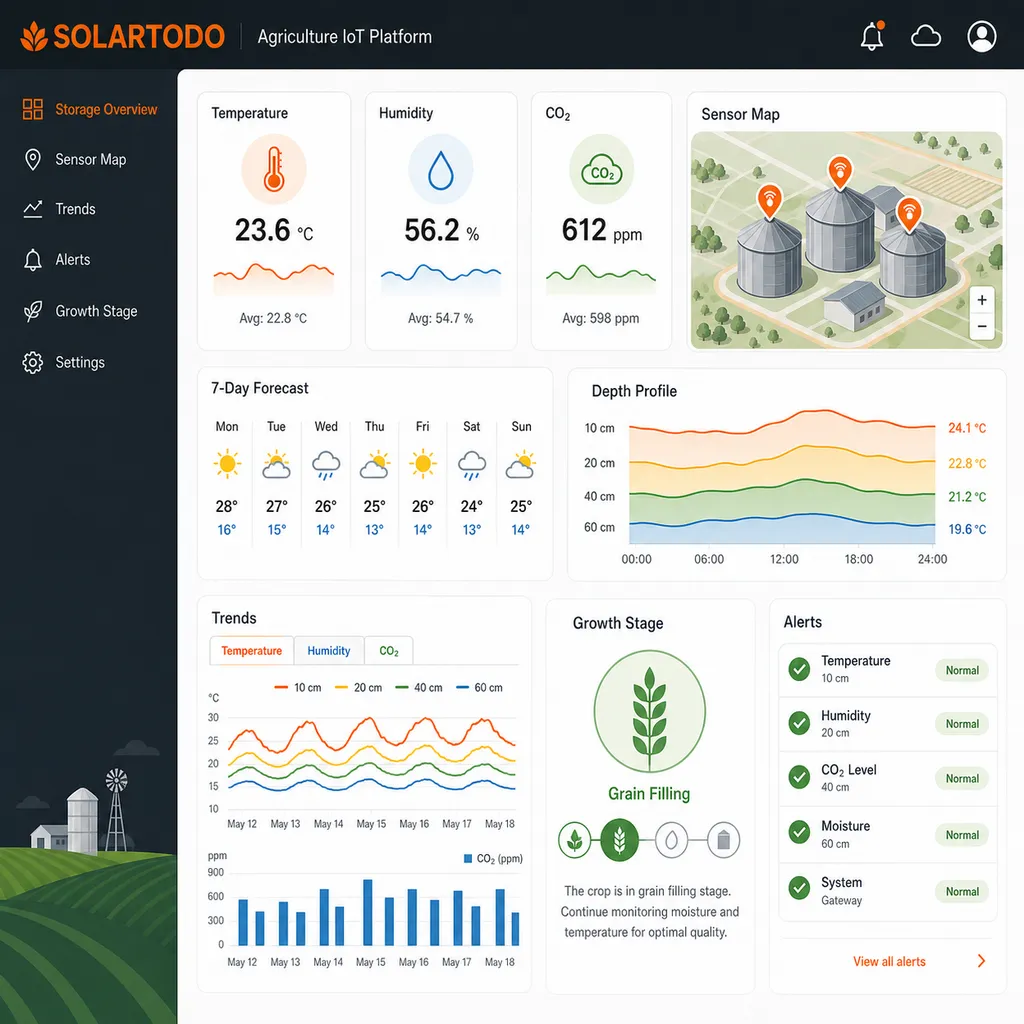
The professional cloud tier stores real-time status, historical trends, alarm rules, and AI-assisted prediction models for 11 devices or channels. Dashboards normally include 6 trend families: temperature rise rate, humidity drift, CO2 increase, O2 decline, ethylene anomaly, and insect activity index.
Alerts can be configured with 3 escalation levels: notice, warning, and critical. For example, a 2°C rise over a defined baseline, a humidity excursion above a buyer-defined limit, or a CO2 spike can generate SMS, email, and app push notifications within the selected data interval and network conditions.
The REST API supports third-party integration with warehouse management systems, SCADA screens, aeration controllers, or procurement dashboards. IEEE 2992-2025 establishes recommended practices for smart-agriculture data expression, exchange, and processing, which reinforces the need for structured tags, consistent naming, and interoperable transfer protocols in multi-vendor farm systems (IEEE 2992-2025).
Cloud reporting is also aligned with the wider digitalization trend in energy and infrastructure. IEA’s digitalization analysis reported USD 47 billion of global investment in digital electricity infrastructure and software in 2016, illustrating why agricultural storage projects increasingly combine sensors, data platforms, and distributed power rather than standalone meters (IEA Digitalisation and Energy).
Representative Scenario
For a representative MENA grain-cooperative scenario, assume 5,000 tons of wheat stored across 4 steel silos on a 6ha logistics yard, with summer roof temperatures above 45°C and grid outages of 2 to 6 hours per month. The EPC design would place 11 monitoring points across upper, middle, and lower grain layers, with NB-IoT backhaul and solar_medium backup power sized for unattended operation.
In this scenario, the operator compares 2 operating methods: manual inspection every 48 hours versus 10-minute digital monitoring with alarm escalation. The digital system does not replace fumigation permits, sampling protocols, or safety lockout rules, but it can reduce blind inspection intervals by about 99.65%, from 2,880 minutes to 10 minutes per data cycle.
If a 5,000-ton grain lot is valued at only $220 per ton, the inventory exposure is $1.10 million, so a $2,052 to $2,592 EPC monitoring package represents about 0.19% to 0.24% of stored commodity value. This is a risk-control ratio, not a guaranteed savings figure, and should be validated against local spoilage history, insurance terms, and inspection labor cost.
Comparison With Conventional Alternatives
A conventional storage approach uses handheld thermometers, manual moisture sampling, paper logs, and periodic visual inspection at 1 to 7 day intervals. The SOLARTODO 6ha system increases monitoring density to 11 fixed points and reduces measurement latency to 10 minutes, while avoiding a local LoRaWAN gateway because NB-IoT communicates directly through the cellular network.
Compared with a wired-only retrofit, the solar NB-IoT design can reduce trenching, conduit routing, and gateway cabinet work across a 6ha yard. Compared with a manual-only program, it creates continuous historical evidence for insurance review, procurement audits, quality disputes, and maintenance planning across at least 365 days of cloud records.
EPC Investment Analysis and Pricing Structure
EPC turnkey delivery includes 5 work scopes: engineering survey, procurement, construction or mounting, commissioning, and warranty support. SOLARTODO’s EPC package for this 6ha grain storage monitoring system includes sensor layout review, solar power setup, NB-IoT device activation, cloud configuration, alarm rule setup, operator training, and 1 year of support.
| Pricing tier | Scope | Price range |
|---|---|---|
| FOB Supply | Equipment only, ex-works China | $1,272 - $1,763 |
| CIF Delivered | Equipment plus ocean freight and insurance | $1,327 - $1,839 |
| EPC Turnkey | Installed, commissioned, and covered by 1-year warranty | $2,052 - $2,592 |
| Order volume | Discount | Commercial note |
|---|---|---|
| 50+ systems | 5% | Suitable for regional grain cooperatives or 50 silo yards |
| 100+ systems | 10% | Suitable for national depot programs with 100 monitored sites |
| 250+ systems | 15% | Suitable for framework procurement above 250 systems |
ROI depends on commodity value, shrink history, labor cost, and insurance rules. For a $2,300 representative EPC midpoint and a 5,000-ton inventory basis at $220 per ton, avoiding only 0.25% of preventable quality loss equals $2,750, which implies a simple payback near 10 months under that assumption.
Annual savings can also come from lower inspection labor, fewer emergency aeration events, and better documentation for quality claims. If 2 staff-hours per week are replaced or redirected at $12 per hour, labor value alone is about $1,248 per year, before counting any grain-quality benefit from earlier hot-spot detection.
Payment terms are 30% T/T deposit plus 70% against B/L copy, or 100% irrevocable L/C at sight for approved buyers. Project financing can be discussed for programs above $1,000K, and technical or commercial requests can be sent to [email protected] with silo count, country, cellular carrier, and 12-month deployment schedule.
Standards and Procurement Notes
The system is specified around IEC 60529 ingress protection, IEC 61215 and IEC 61730 solar-module compliance, IEC 62619 or UN38.3 battery documentation where applicable, and ISO 11783-style agricultural integration principles for structured machine and farm-system data. The cloud API should be reviewed against the buyer’s cybersecurity, data-retention, and access-control policy before commissioning.
Gas monitoring must be treated as operational intelligence, not as a confined-space entry authorization. FAO fumigation guidance warns that atmospheres with less than 10% oxygen or elevated CO2 can create rapid human-safety hazards, so operators should use certified portable gas monitors and follow local confined-space regulations before entering any bin or sealed room (FAO fumigation safety).
Related SOLARTODO Resources
Buyers comparing storage monitoring with field weather, pest, soil, or irrigation packages can use the product family page for system-level selection across 6 smart-agriculture monitoring types. For engineering background, Learn about topic provides related articles on IoT monitoring, solar power kits, agricultural data integration, and cloud-based predictive maintenance.
For procurement teams, the recommended workflow has 4 steps: confirm storage capacity in tons, mark 11 sensor positions on a silo layout, verify NB-IoT coverage with the local operator, and request a quotation with delivery term FOB, CIF, or EPC. This process usually produces a clearer quotation than a generic price request because cable length, mounting height, and carrier certification can change the final installed price by 5% to 15%.
Technical Specifications
| Coverage Area | 6ha |
| Monitoring Types | storage |
| Total Sensors | 11sensors |
| Application | grain_silo |
| Storage Capacity | 5000tons |
| Communication | nb_iot |
| Power Supply | solar_medium |
| Data Interval | 10 min, configurable 1-60 min |
| Cloud Platform | professional |
| Storage Parameters | temp, humidity, co2, o2, ethylene, insect |
| Alert Channels | SMS + Email + App Push |
| API Access | REST API included |
| Warranty | 2 years hardware, 1 year cloud |
Price Breakdown
| Item | Quantity | Unit Price | Subtotal |
|---|---|---|---|
| Storage Sensor Node (installed) | 1 pcs | $350 | $350 |
| Multi-Point Grain Cable Sensor Probe (installed) | 10 pcs | $55 | $550 |
| CO2/O2/Ethylene Gas Monitoring Module (installed) | 1 pcs | $330 | $330 |
| Solar Power Kit, Medium 80W (installed) | 1 pcs | $225 | $225 |
| Cloud Platform, Professional Device-Year (installed) | 1 pcs | $48 | $48 |
| IP67 Enclosure, Mounting Hardware, and Signal Cabling (installed) | 1 pcs | $95 | $95 |
| Installation and Training (installed) | 1 pcs | $500 | $500 |
| Engineering, Layout Design, and QC (installed) | 1 pcs | $270 | $270 |
| 1-Year Warranty and Support (installed) | 1 pcs | $175 | $175 |
| Total Price Range | $2,052 - $2,592 | ||
Frequently Asked Questions
What does the Grain Storage Monitoring 6ha system monitor?
Does this system require a LoRaWAN gateway?
What is included in the EPC turnkey price and warranty?
How is the system powered during grid outages?
Can the cloud data connect to existing warehouse systems?
Certifications & Standards



Data Sources & References
- •FAO Manual of the Prevention of Post-Harvest Grain Losses: https://www.fao.org/4/x5065e/x5065E04.htm
- •FAO Grain Storage Techniques and Insect Control: https://www.fao.org/4/T1838E/T1838E1f.htm
- •FAO Manual of Fumigation for Insect Control: https://www.fao.org/4/X5042E/x5042E0o.htm
- •3GPP NB-IoT Release 13 standardization notice: https://www.3gpp.org/news-events/3gpp-news/nb-iot-complete
- •GSMA Mobile IoT Deployment Guide 2022: https://www.gsma.com/solutions-and-impact/industries/smart-mobility/gsma_resources/mobile-iot-deployment-guide/
- •IRENA Renewable Energy Benefits in the Agri-Food Chain: https://www.irena.org/Publications/2016/Sep/Renewable-Energy-Benefits-Decentralised-solutions-in-agri-food-chain
- •IEA Digitalisation and Energy: https://www.iea.org/reports/digitalisation-and-energy
- •IEEE 2992-2025 Smart Agriculture Data Exchange: https://standards.ieee.org/ieee/2992/10614/
Interested in this solution?
Contact us for a customized quote based on your specific requirements.
Contact Us