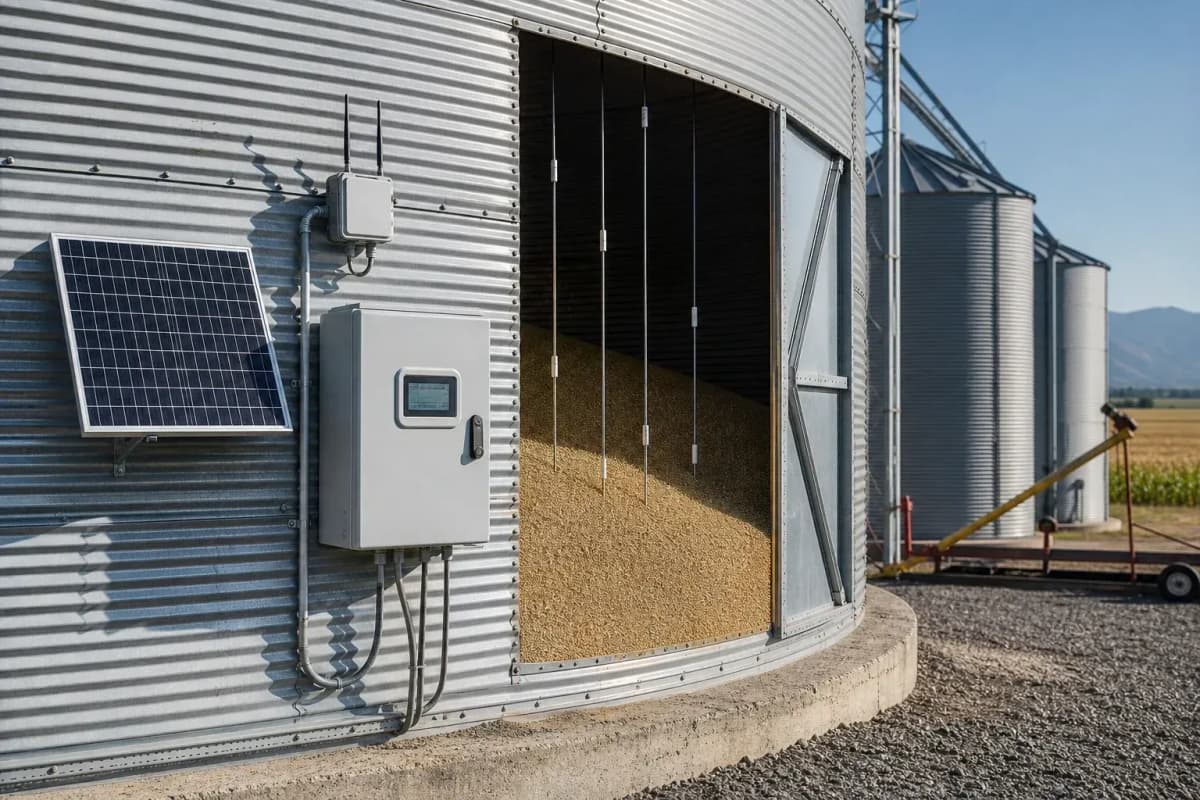
Grain Storage Monitoring 6ha - 10-Sensor Solar 4G Silo System
Key Features
- 6 ha grain-storage IoT package sized for up to 5,000 tons of silo or warehouse capacity
- 10 sensing points monitor temperature, humidity, CO2, O2, ethylene, and insect activity
- 4G LTE gateway uploads data every 10 minutes, configurable from 1 to 60 minutes
- 80 W-class solar medium power kit with LFP battery supports off-grid outdoor operation
- EPC turnkey price range is $2,052-$2,592 with commissioning and 1-year support
Grain Storage Monitoring 6ha is a solar-powered 4G IoT package for 5,000-ton grain silo monitoring, using 10 sensing points for temperature, humidity, CO2, O2, ethylene, and insect activity. The EPC turnkey range is $2,052-$2,592 with cloud dashboard, REST API, SMS/email/app alerts, commissioning, and 1-year EPC support.
Description
Grain Storage Monitoring 6ha is a smart-agriculture IoT monitoring system for 6 hectares of grain storage operations and up to 5,000 tons of silo or warehouse capacity. The package uses 10 storage sensing points, 4G LTE communication, an 80 W-class solar power kit, 10-minute configurable data intervals, and cloud analytics for temperature, humidity, CO2, O2, ethylene, and insect-risk monitoring.
For B2B grain operators, the system is designed as a practical bridge between manual silo inspection and fully automated grain-condition control, with 1 REST API, 3 alert channels, and a standard cloud tier included in the baseline configuration. It is part of the SOLARTODO Smart Agriculture IoT Monitoring System line, and buyers can View all Smart Agriculture IoT Monitoring System products or Configure your system online before requesting a project-specific bill of materials.
Product Scope and Use Case
The Grain Storage Monitoring 6ha variant targets grain silo farms, elevator sites, feed mills, and warehouse-based storage operators managing approximately 5,000 tons of cereals, oilseeds, or feedstock across a 6 ha operating footprint. In this configuration, 10 sensing points are distributed across vertical or horizontal storage positions to identify hot spots, moisture migration, gas concentration changes, and insect activity before quality loss becomes visible during a 1 manual inspection round.
Stored grain is a biological material, not an inert commodity, and the FAO identifies temperature, relative humidity, moisture content, oxygen, and pest activity as primary variables in post-harvest deterioration. For long-term cereal storage, FAO guidance commonly references grain moisture around 12-14 percent and relative humidity below roughly 65-70 percent as important risk boundaries, while insect and fungal respiration can raise local temperature and CO2 levels inside a storage mass.
The system therefore focuses on 6 measured risk categories rather than only 1 ambient temperature reading. Temperature mapping detects thermal gradients, humidity readings support moisture-risk interpretation, CO2 and O2 readings indicate respiration or ventilation issues, ethylene readings support mixed storage or adjacent fruit-handling environments, and insect activity sensing provides an early warning channel for integrated pest management.
System Architecture
A typical 6 ha deployment uses 10 storage sensing points connected to rugged sensor nodes, 1 solar medium power kit, 1 4G gateway, and 1 cloud dashboard account. The sensor layer is installed at selected depths or positions in the silo or warehouse, the gateway collects local data, and the cloud platform stores readings at 10-minute default intervals with configurable reporting from 1 to 60 minutes.
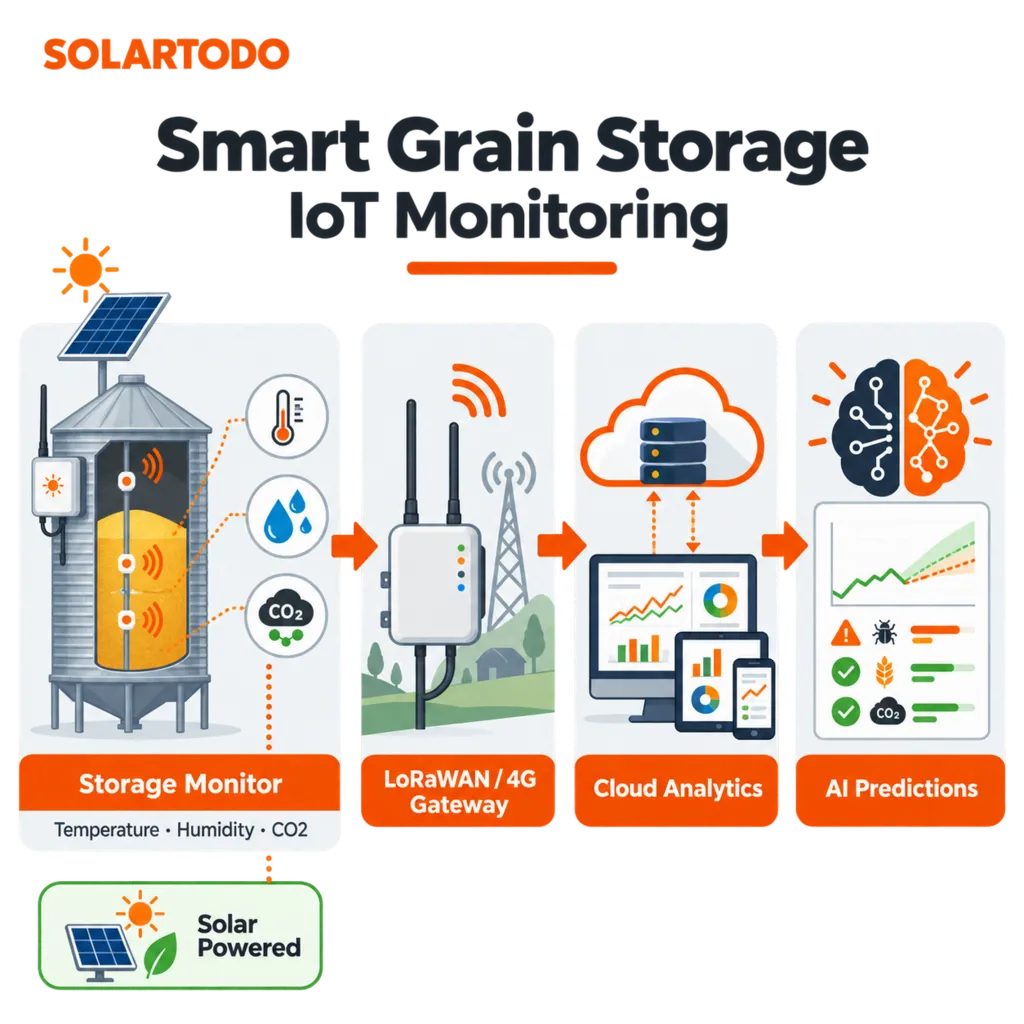
The power architecture is based on solar generation and LFP battery storage so that the storage site can operate without a dedicated AC cable run to every measuring point. In the standard configuration, an 80 W-class solar kit is selected because it provides a higher energy margin than a 10 W micro kit for 4G transmission, dashboard synchronization, and retransmission after network recovery.
Communication is built around 4G LTE because grain storage sites often need higher bandwidth and wider carrier coverage than short-range wireless systems. Where a buyer operates multiple silos across 1 large site, the architecture can also use LoRaWAN internally because a single LoRaWAN gateway can cover up to a 10 km radius under suitable line-of-sight conditions and can aggregate hundreds of low-power sensors.
The gateway buffers data when the cellular network is interrupted and retransmits records after recovery, reducing gaps in time-series analysis. This is important for storage operations because a 2-hour data gap during a heat event can hide a developing hot spot, while a 10-minute trend line gives operators 12 readings across the same 2-hour window.
Technical Specifications
| Parameter | Specification |
|---|---|
| Coverage area | 6 hectares |
| Storage capacity | Up to 5,000 tons |
| Monitoring type | Grain storage and silo environment |
| Total sensing points | 10 sensors |
| Monitored variables | Temperature, humidity, CO2, O2, ethylene, insect activity |
| Communication | 4G LTE with recovery retransmission |
| Power supply | Solar medium kit, 80 W-class panel with LFP battery |
| Data interval | 10 minutes, configurable from 1-60 minutes |
| Cloud tier | Standard dashboard and historical trend analysis |
| Alert channels | SMS, email, and app push |
| API access | REST API included |
| Hardware warranty | 2 years |
| Cloud and EPC support | 1 year |
The monitoring hardware is specified for outdoor agricultural environments, with sensor assemblies normally selected to IP67 or IP68 protection levels depending on cable entry, enclosure position, and washdown risk. For PV power subsystem quality control, IEC 61215 and IEC 61730 are common references for module design qualification and safety, while IEC 61724-1:2021 defines terminology and methods used in photovoltaic performance monitoring.
The data architecture is designed for engineering teams that need both live alarms and historical condition evidence. Each 10-minute interval produces 144 readings per channel per day, so a 6-channel storage profile across 10 sensing points can produce up to 8,640 parameter records per day before aggregation, compression, or alert filtering.
The cloud platform supports threshold alarms, rate-of-change rules, and historical comparison against prior storage cycles. A procurement team can use the same dataset for 1 monthly quality report, while an operations engineer can inspect 24-hour trend curves to decide whether aeration, fumigation preparation, or physical inspection is required.
Cloud Monitoring
Cloud Monitoring in the standard tier provides a browser dashboard, mobile alert delivery, historical trend charts, device-status visibility, and REST API access for third-party systems. The standard package includes 1-year cloud service, 10 monitored sensing points, and 3 alert channels: SMS, email, and app push.
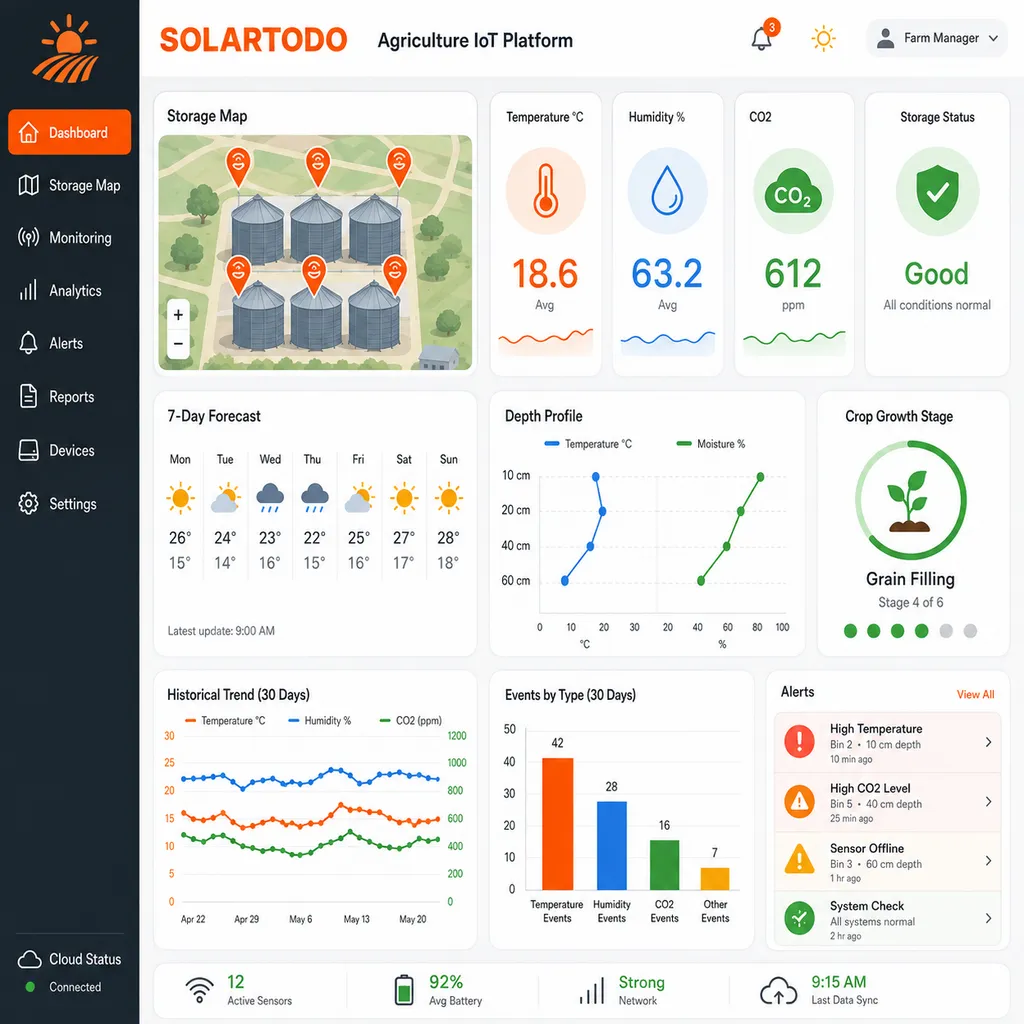
The dashboard is structured around operational decisions rather than decorative charts, with 1 view for live storage status, 1 view for historical trends, and 1 alert log for follow-up actions. For example, a rising CO2 trend over 6 consecutive 10-minute readings can be treated differently from a single outlier caused by a service-door opening.
REST API access allows the grain monitoring data to be connected with enterprise resource planning, warehouse management, ventilation controls, or risk dashboards. For a site with 5,000 tons of grain, the API can help link 1 quality-risk event to lot records, storage zones, and maintenance tickets without requiring manual spreadsheet transfer.
Standards and Engineering References
For agriculture-machine data interoperability, ISO 11783, also known as ISOBUS, is a relevant reference for electronic communication concepts in agricultural equipment fleets. Although a silo monitoring system is not a tractor implement, the same 1 principle applies: structured machine-readable data is more useful to operators than isolated local display readings.
For environmental and weather-linked measurements, World Meteorological Organization guidance is commonly used as a reference point for sensor siting, data quality, and observation practice. This 6 ha grain-storage product is not sold as a WMO-certified meteorological station, but nearby weather data can be integrated with storage measurements to explain 24-hour humidity cycles and ventilation decisions.
For solar-powered operation, NREL PVWatts and SAM are useful engineering references because they model PV energy production using location, system size, tilt, loss assumptions, and long-term weather datasets. NREL PVWatts version 8 uses updated weather and PV modeling inputs, while IEC 61724-1:2021 provides a formal monitoring framework for PV performance data.
For energy-sector context, IEA reported that renewables reached 34 percent of global electricity generation in 2025, while wind and solar PV together reached 17 percent. IRENA Off-grid Renewable Energy Statistics 2024 also documents the continuing role of off-grid renewable systems for remote commercial, agricultural, water-pumping, telecom, and industrial loads between 2014 and 2023.
For stored-grain risk, FAO post-harvest guidance explains that metabolic activity is strongly reduced in most cereals when grain moisture is reduced near 14 percent and that many deterioration agents require moisture, oxygen, and suitable temperature. FAO grain-storage manuals also describe how insect and microbial respiration can create localized hot spots that spread through the grain mass.
Representative Scenario: MENA Grain Silo Site
For a representative MENA grain-storage scenario, assume 1 operator manages 5,000 tons of wheat across a 6 ha silo yard with daytime temperatures above 35 C during part of the storage season. A 10-point monitoring layout places probes at multiple depths and positions, with 10-minute data uploads creating 144 daily readings per sensing point for trend-based decisions.
In the same scenario, the monitoring system can flag a 3 C temperature rise at 1 internal point before the whole silo shows a visible temperature change. Compared with conventional manual checks performed once per day, a 10-minute IoT interval increases observation frequency by up to 144 times and reduces the chance that a localized heating event remains unnoticed for 12-24 hours.
This comparison does not claim a guaranteed financial result for every customer, because crop type, grain moisture, aeration hardware, storage duration, and operator response time can change outcomes by more than 1 variable. However, the engineering value is clear: earlier detection gives operators more time to inspect, ventilate, segregate, or treat the affected zone before a small hot spot becomes a 1-silo quality incident.
Applications
The primary application is bulk grain storage in steel silos, flat warehouses, grain elevators, and feed-mill intake or holding zones. The 6 ha package is most suitable where 10 monitoring points are sufficient for a 5,000-ton site, and larger sites can scale by adding more sensor strings, gateways, and cloud device licenses.
The same architecture can also support rice mills, maize storage, flour mills, oilseed warehouses, seed-processing facilities, and government reserve depots. In each case, the 6 monitored variables help operations teams distinguish between 1 ventilation problem, 1 moisture migration issue, 1 insect-risk event, and 1 abnormal gas-condition event.
For buyers comparing product variants, SOLARTODO provides product-line visibility at View all Smart Agriculture IoT Monitoring System products and configuration workflow support at Configure your system online. Engineering background articles are available at Learn about topic, including monitoring architecture, PV power sizing, IoT gateway planning, and smart-agriculture data workflows.
EPC Investment Analysis and Pricing Structure
The EPC turnkey scope includes engineering, procurement, construction, installation, commissioning, cloud onboarding, operator training, documentation, and 1-year EPC warranty support. For this 6 ha, 10-sensor, 5,000-ton grain-storage configuration, the EPC turnkey budget is $2,052-$2,592, while lower FOB and CIF tiers are available when the buyer manages installation with 1 qualified local team.
| Pricing tier | Scope | Price range |
|---|---|---|
| FOB Supply | Equipment only, ex-works China | $1,272-$1,763 |
| CIF Delivered | Equipment plus ocean freight and insurance | $1,327-$1,839 |
| EPC Turnkey | Installed, commissioned, and supported for 1 year | $2,052-$2,592 |
| Volume band | Discount | Example procurement use |
|---|---|---|
| 50+ systems | 5 percent | Multi-site elevator rollout across 50 locations |
| 100+ systems | 10 percent | National grain reserve or processor framework order |
| 250+ systems | 15 percent | Large distributor or government storage program |
A representative ROI model can be built around avoided spoilage inspection cost, reduced manual rounds, and faster response to grain-condition risk. If a 5,000-ton storage site protects only 0.10 percent of inventory value from avoidable quality downgrade, the protected grain mass equals 5 tons; at $220 per ton, that equals $1,100 of avoided exposure, which can cover roughly 42-54 percent of the EPC price in 1 season.
Manual monitoring can require 1-2 inspection rounds per day, physical entry procedures, and delayed recognition of deep internal hot spots. By comparison, this IoT package creates up to 1,440 sensing-point readings per day across 10 points, lowering dependence on manual checks and providing a data record for quality audits, insurance discussions, or supplier-buyer dispute resolution.
For payback estimation, a site saving $1,200 per year through reduced quality loss, fewer emergency inspections, and lower manual logging effort would recover a $2,052-$2,592 EPC investment in about 1.7-2.2 years. A site saving $2,000 per year would recover the same EPC investment in about 1.0-1.3 years, before considering expansion to additional silos.
Payment terms are 30 percent T/T deposit plus 70 percent against bill of lading, or 100 percent irrevocable L/C at sight for qualified orders. Project financing can be discussed for programs above $1,000K, and procurement teams can Request a custom quotation or contact [email protected] for a 1-site or multi-site commercial offer.
Procurement and Deployment Notes
Before procurement, the buyer should confirm the number of silos, grain type, storage duration, maximum fill height, cable route, local cellular signal, and whether power autonomy must exceed 3 cloudy days. These 6 inputs determine whether the baseline 10-point layout is sufficient or whether additional probe strings, spare batteries, or redundant gateways are justified.
During installation, the EPC team typically validates sensor IDs, confirms 4G signal quality, tests solar charging, assigns dashboard roles, and verifies alert delivery through all 3 channels. Commissioning should include at least 1 controlled threshold test for temperature, 1 cloud synchronization test, and 1 data export or API test before handover.
Documentation can include a device list, wiring layout, sensor map, alert threshold table, API endpoint reference, and warranty record. This matters for procurement departments because a 2-year hardware warranty and 1-year cloud support period should be traceable to serial numbers, installation dates, and commissioning evidence.
Why SOLARTODO for Smart Agriculture Storage Monitoring
SOLARTODO supplies solar power, energy storage, smart lighting, security, telecom power towers, and smart-agriculture systems, so the 6 ha grain monitoring package is specified with both IoT and off-grid power requirements in mind. The same engineering team can discuss 4G coverage, solar autonomy, battery capacity, dashboard integration, and site commissioning as 1 integrated system.
The practical benefit is a lower-friction procurement process for buyers who do not want to coordinate 4 separate vendors for sensors, solar kits, gateways, and cloud software. For a 10-sensor grain silo system, integrated procurement reduces interface ambiguity across power, data, mounting, and warranty responsibilities while keeping EPC pricing within the published $2,052-$2,592 range.
Technical Specifications
| Coverage Area | 6ha |
| Monitoring Types | Storage |
| Application | Grain silo |
| Storage Capacity | 5000tons |
| Total Sensors | 10sensors |
| Measured Parameters | Temperature, humidity, CO2, O2, ethylene, insect activity |
| Communication | 4G LTE |
| Power Supply | Solar medium with LFP battery |
| Data Interval | 10 min configurable from 1-60min |
| Cloud Platform | Standard |
| Alert Channels | SMS + Email + App Push |
| API Access | REST API included |
| Hardware Warranty | 2years |
| Cloud Support | 1year |
Price Breakdown
| Item | Quantity | Unit Price | Subtotal |
|---|---|---|---|
| Storage sensor nodes | 2 pcs | $350 | $700 |
| Multi-point silo probe sensors | 10 pcs | $28 | $280 |
| 4G gateway with enclosure | 1 pcs | $110 | $110 |
| Solar Power Kit medium 80W | 1 pcs | $225 | $225 |
| Cloud Platform standard license | 10 pcs | $12 | $120 |
| Mounting, cables, and junction accessories | 1 pcs | $160 | $160 |
| Installation and operator training | 1 pcs | $500 | $500 |
| Engineering, configuration, and QC | 1 pcs | $190 | $190 |
| 1-Year EPC warranty and support | 1 pcs | $185 | $185 |
| Total Price Range | $2,052 - $2,592 | ||
Frequently Asked Questions
What does the Grain Storage Monitoring 6ha system measure?
How is the system powered at remote grain silo sites?
What is included in the EPC turnkey price and warranty?
Can the 10-sensor package be expanded later?
How does this compare with manual grain inspection?
Certifications & Standards


Data Sources & References
- •FAO Manual of the Prevention of Post-Harvest Grain Losses
- •FAO Prevention of Post-Harvest Food Losses: Grain Storage
- •IEC 61724-1:2021 Photovoltaic System Performance Monitoring
- •NREL PVWatts Version 8 photovoltaic performance model
- •IRENA Off-grid Renewable Energy Statistics 2024
- •IEA Global Energy Review 2026 electricity supply analysis
Interested in this solution?
Contact us for a customized quote based on your specific requirements.
Contact Us