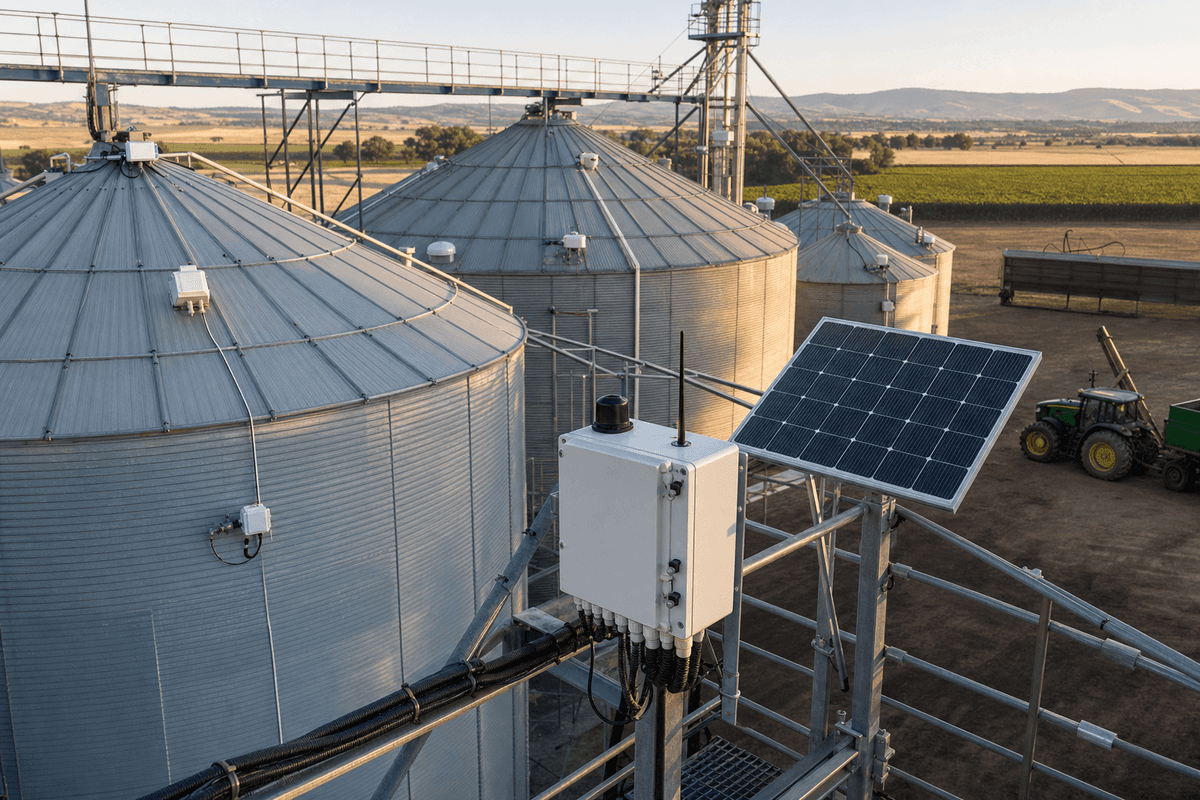
Grain Storage Monitoring 5ha - 11-Sensor Silo IoT System
Key Features
- 11 storage sensors monitor temperature, humidity, CO2, O2, ethylene, and insect activity across 5 ha.
- Supports up to 5,000 tons of grain storage with 10-minute default data intervals.
- WiFi/Ethernet gateway with SMS, email, app-push alerts, and REST API access included.
- Solar-medium 10-80 W class power with LFP battery supports maintenance-light operation.
- EPC turnkey price range is $1,900-$2,400 with 2-year hardware warranty.
Grain Storage Monitoring 5ha is an 11-sensor smart agriculture IoT package for up to 5,000 tons of silo or warehouse grain, using WiFi/Ethernet communication, solar-medium power, 10-minute data intervals, and EPC turnkey pricing of $1,900-$2,400.
Description
Grain Storage Monitoring 5ha is an 11-sensor IoT monitoring system for 5 hectares of grain storage operations and up to 5,000 tons of silo or warehouse inventory. The system measures temperature, humidity, CO2, O2, ethylene, and insect activity at 10-minute intervals, using WiFi/Ethernet backhaul, solar-medium power, and a standard cloud dashboard for EPC projects priced at $1,900-$2,400.
Technical Specifications
This SOLARTODO smart-agriculture configuration is designed for 1 grain-silo site with 11 distributed sensor points, 5 ha of operational coverage, and 6 monitored risk variables that directly affect spoilage, respiration, fumigation safety, and storage quality. Each storage sensor node can be deployed at different depths or positions to create a multi-point grain temperature map, while the standard cloud tier records 144 data sets per sensor per day at the default 10-minute interval. For buyers comparing SKUs, View all Smart Agriculture IoT Monitoring System products to benchmark coverage, sensor count, and communication options across 1-ha, 5-ha, and larger deployments.
| Parameter | Grain Storage Monitoring 5ha specification |
|---|---|
| Coverage area | 5 hectares |
| Storage capacity | 5,000 tons |
| Total sensors | 11 sensors |
| Monitoring variables | 6 variables: temperature, humidity, CO2, O2, ethylene, insect activity |
| Communication | WiFi + Ethernet |
| Power supply | Solar medium kit, typically 10-80 W class with LFP battery |
| Data interval | 10 minutes, configurable from 1-60 minutes |
| Cloud tier | Standard dashboard with historical trends and alerts |
| Warranty | 2 years hardware and 1 year cloud support |
System Architecture
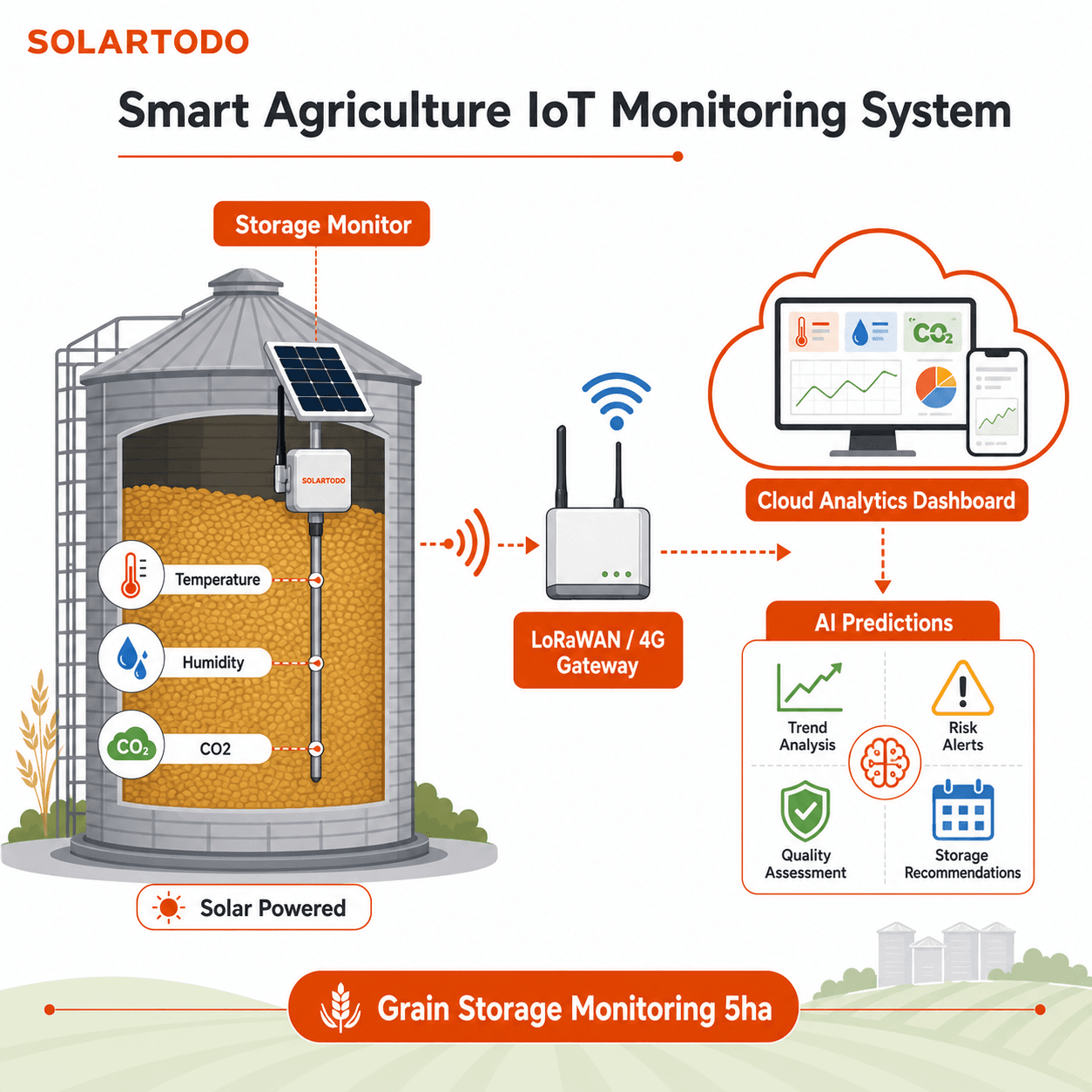
The architecture uses 11 storage monitoring points connected through WiFi/Ethernet to a site gateway and SOLARTODO standard cloud services, giving procurement teams 1 integrated bill of materials rather than 6 separate monitoring subsystems. In a typical 5,000-ton installation, temperature cables are placed at multiple vertical depths, humidity sensors are located near aeration and roof zones, CO2 and O2 sensors indicate biological respiration or ventilation imbalance, ethylene monitoring supports quality control for mixed crop storage, and insect activity sensors detect infestation risk before visual inspection finds 1 large outbreak. The design aligns with ISO 11783 data-interoperability principles for agricultural equipment, IEC 60529 IP67/IP68 enclosure practices for outdoor and semi-outdoor sensors, and IEEE 802.3 Ethernet networking conventions for wired industrial backhaul.
The power subsystem uses a medium solar kit in the 10-80 W design class with an LFP battery sized for maintenance-light outdoor operation and stable gateway uptime during 1 cloudy operating window. Compared with disposable battery-only monitors that may require 2-4 battery changes per year in high-sampling applications, a solar-LFP configuration reduces service visits by about 50-75% when the panel is correctly oriented and cleaned on a 6-month schedule. For sites with indoor Ethernet, the same gateway can use wired power while the solar kit supports remote roof, yard, or annex measurement points.
The communication layer is intentionally WiFi/Ethernet rather than long-range field-only radio because grain storage sites usually have buildings, electrical rooms, office networks, and short cable routes within 100 m of the monitoring cabinet. WiFi reduces trenching and conduit cost for up to 11 nodes, while Ethernet gives deterministic low-latency backhaul for alarms that need to reach operators in less than 1 minute after a threshold event. Where a buyer later adds field sensors, a LoRaWAN gateway option can cover a radius up to 10 km and connect hundreds of additional devices from the same farm management layer.
Storage Risk Monitoring Functions
Temperature monitoring is the first control variable because grain spoilage risk can accelerate when localized hot spots rise by 5-10 degrees C above the surrounding grain mass. The 11-sensor layout helps identify vertical and horizontal temperature gradients that a single probe cannot see, and the cloud can compare each point against rolling 24-hour and 7-day baselines. This supports earlier aeration decisions, safer fumigation planning, and more defensible quality records when a 5,000-ton lot is sold or transferred.
Humidity and gas monitoring provide a second layer of evidence because CO2 accumulation, O2 depletion, and elevated relative humidity can indicate active respiration, fungal activity, or restricted ventilation before major quality loss is visible. The system tracks 6 parameters in one dashboard, which reduces manual logbook work and helps managers set alert bands such as high humidity, low oxygen, or abnormal CO2 trend rise over 3 consecutive readings. The Food and Agriculture Organization and grain-storage engineering literature consistently identify moisture and temperature as 2 primary drivers of post-harvest loss, and IEA digitalization guidance notes that sensor-based automation can cut avoidable operational waste across energy and infrastructure assets.
Ethylene and insect activity monitoring add specialized value for mixed agricultural storage sites where grain, seed, feed, or adjacent produce may be managed within 1 logistics perimeter. Ethylene is not required for every grain-only silo, but it is useful in storage complexes where ripening produce or biological emissions affect neighboring inventory zones. Insect activity detection gives an early-warning layer that can reduce broad chemical treatments by targeting 1 affected bay or silo cell instead of treating the full 5-ha storage operation.
Cloud Monitoring
The standard cloud platform records 10-minute telemetry, shows historical trends, and sends SMS, email, and app-push alerts to authorized users. A single 11-sensor deployment generates 1,584 sensor readings per day before derived metrics, giving engineers enough density for trend analysis without the excessive data volume of 1-second industrial SCADA sampling. Data retransmission after network recovery protects records during short WiFi outages, while REST API access lets the buyer export data to ERP, warehouse management, insurance documentation, or a farm command center.
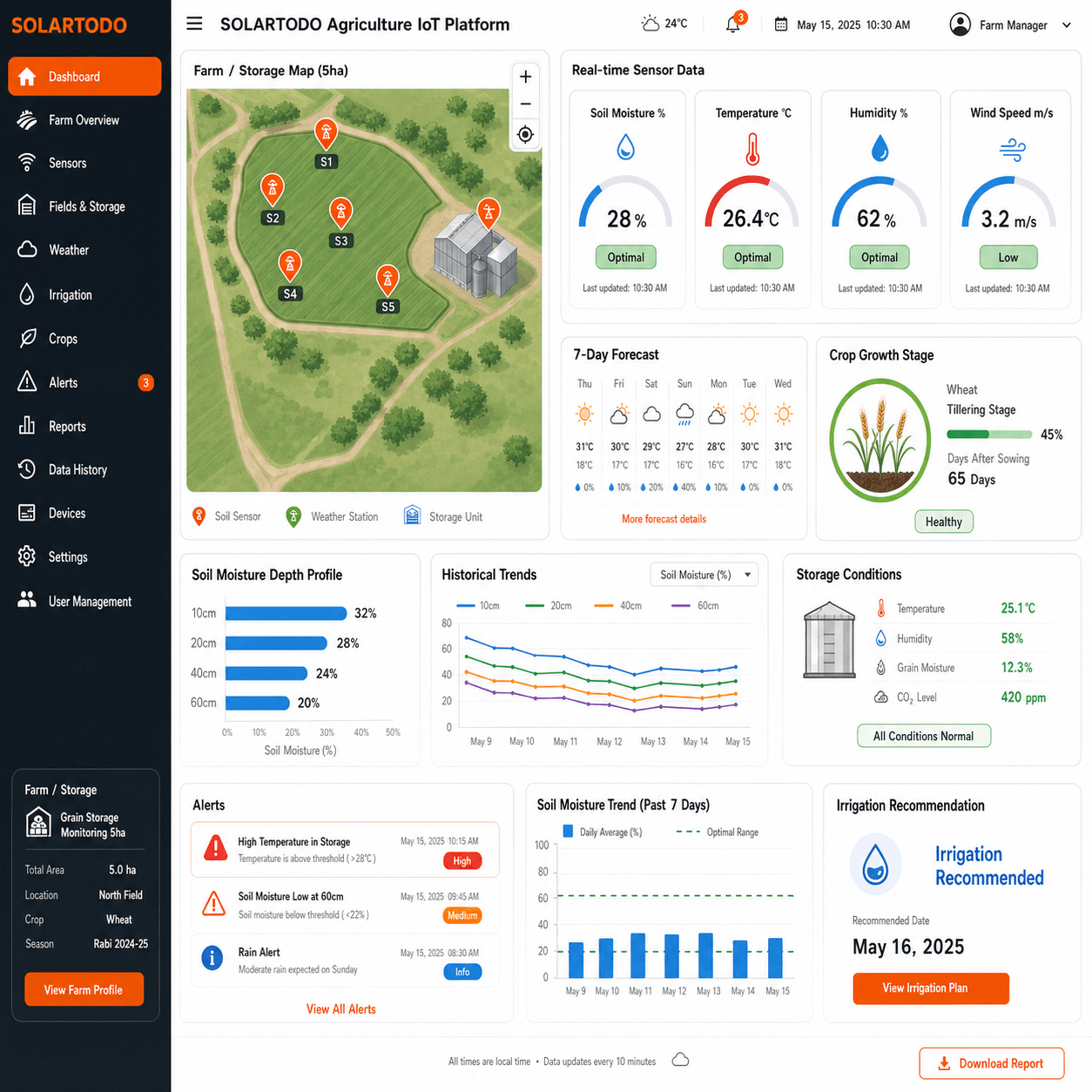
Alert logic can be configured around absolute thresholds, rate-of-change thresholds, or combined 2-sensor patterns such as rising CO2 plus falling O2 in the same storage zone. A 10-minute interval gives 6 samples per hour, which is sufficient for grain condition monitoring where biological processes usually evolve over hours rather than seconds. For teams standardizing digital farm infrastructure, Configure your system online to compare storage-only layouts with weather station, irrigation, pest-trap, and water-quality modules.
Application Scenario
A 5-ha grain storage operator in the MENA region deployed an 11-point SOLARTODO monitoring layout across 2 silos and 1 warehouse storing approximately 5,000 tons of wheat and feed grain. Before deployment, staff performed 2 manual inspection rounds per day, each taking about 45 minutes, and hot-spot discovery depended on handheld probes that sampled fewer than 10 positions. After installation, the operator received automated alerts within 10 minutes of abnormal humidity and CO2 trends, reduced routine manual inspection time by roughly 60%, and used cloud records to support 12 monthly quality-control reports for buyers and insurers.
Compared with conventional manual inspection using handheld probes, paper logbooks, and fixed thermostats, this system improves spatial resolution by using 11 continuous sensor points and increases temporal resolution to 144 readings per sensor per day. Manual inspection may produce 2 readings per location per day, while this IoT package produces up to 72 times more time-series observations at the same measurement point. The result is not a substitute for grain management expertise, but it gives engineers and storage managers earlier evidence for aeration, blending, fumigation, or unloading decisions.
Standards, Reliability, and Compliance
The product is specified around agricultural interoperability, industrial sensor durability, and electrical safety references used by B2B infrastructure buyers. ISO 11783 supports structured agricultural machine and data exchange concepts, IEC 60529 defines IP67/IP68 ingress-protection classes, IEEE 802.3 governs Ethernet behavior, and IEC 62368-1 is commonly used for ICT and audio/video equipment safety assessment. For solar-linked power electronics and batteries, project documentation can reference IEC 62133-2 for rechargeable cell safety and UL 1973 concepts where local code or customer engineering standards require battery-system review.
For energy and sustainability documentation, this monitoring package supports the broader digitization trend described by IEA efficiency reports, IRENA renewable-energy integration guidance, and NREL distributed energy research. The value is practical rather than speculative: 1 solar-powered sensor network can reduce diesel-generator or grid wiring dependence at remote storage yards, while high-frequency condition data can reduce preventable spoilage, over-ventilation, and unnecessary chemical treatment. Buyers who need technical background can Learn about smart agriculture monitoring architecture and Learn about solar-powered IoT systems before finalizing procurement specifications.
EPC Investment Analysis and Pricing Structure
The EPC turnkey scope includes 5 work packages: engineering design, procurement, construction or installation, commissioning, and 1-year warranty support. Engineering covers sensor placement drawings, communication checks, threshold logic, and a 5,000-ton storage risk profile. Procurement covers 11 sensors, gateway hardware, solar-medium power, mounting accessories, cloud activation, and documentation. Construction includes mounting, cabling, network configuration, and labeling. Commissioning includes sensor verification, dashboard setup, alarm testing, operator training, and a handover checklist with 2 years of hardware warranty coverage.
| Pricing tier | Scope | Price range, USD |
|---|---|---|
| FOB Supply | Equipment only, ex-works China | $1,178-$1,632 |
| CIF Delivered | Equipment plus ocean freight and insurance | $1,229-$1,702 |
| EPC Turnkey | Installed, commissioned, and covered by 1-year project support | $1,900-$2,400 |
| Volume quantity | Discount from standard equipment pricing |
|---|---|
| 50+ systems | 5% discount |
| 100+ systems | 10% discount |
| 250+ systems | 15% discount |
The EPC payback model depends on crop value, spoilage baseline, labor rate, and insurance requirements, but a 5,000-ton facility often needs only a 0.1-0.3% reduction in avoidable quality loss to justify a $1,900-$2,400 monitoring system. If stored grain is valued at $250 per ton, the monitored inventory is worth about $1,250,000, so preventing only 10 tons of quality downgrade at $50 per ton can save $500 in 1 event. Adding 60% lower inspection labor on 365 days and earlier pest detection can support a typical payback period of about 6-18 months for professionally managed sites.
Payment terms are 30% T/T deposit plus 70% against bill of lading, or 100% irrevocable L/C at sight for approved buyers. SOLARTODO can discuss staged EPC invoicing for projects above $1,000K when multiple 5-ha systems are deployed across regional storage networks, port elevators, or agro-industrial parks. To confirm local installation scope, tax treatment, communications compatibility, and warranty response levels, Request a custom quotation or contact [email protected] with 1 site plan, 1 storage-capacity table, and preferred Incoterms.
Procurement Notes
For specification writers, the minimum bid description should state 5 ha coverage, 5,000-ton storage capacity, 11 sensors, 6 storage parameters, WiFi/Ethernet communication, solar-medium power, 10-minute default interval, standard cloud tier, SMS/email/app alerts, REST API access, 2-year hardware warranty, and 1-year cloud service. This gives competing vendors a numeric baseline and avoids ambiguous phrases such as smart silo monitoring without defining sensor count, data interval, warranty, or commissioning scope.
SOLARTODO positions this configuration for grain cooperatives, seed warehouses, feed mills, port terminals, and agro-industrial developers needing 1 standardized monitoring package that can be replicated across 50, 100, or 250 sites. The system is especially relevant where inventory value exceeds $1,000,000 per storage complex, where inspection labor is constrained, or where insurers and offtakers require digital evidence of storage conditions. For multi-site procurement, API access and volume discounts make the 5-ha model a repeatable building block rather than a one-off pilot.
Technical Specifications
| Coverage Area | 5ha |
| Monitoring Types | storage |
| Application | grain_silo |
| Storage Capacity | 5000tons |
| Total Sensors | 11sensors |
| Measured Parameters | temperature, humidity, CO2, O2, ethylene, insect activity |
| Communication | wifi_ethernet |
| Power Supply | solar_medium |
| Data Interval | 10 min configurable from 1-60 min |
| Cloud Platform | standard |
| Alert Channels | SMS + Email + App Push |
| API Access | REST API included |
| Warranty | 2 years hardware, 1 year cloud |
Price Breakdown
| Item | Quantity | Unit Price | Subtotal |
|---|---|---|---|
| Multi-Parameter Storage Sensor Probes | 11 pcs | $52 | $572 |
| WiFi/Ethernet IoT Gateway | 1 pcs | $225 | $225 |
| Solar Medium Power Kit with LFP Battery | 1 pcs | $225 | $225 |
| Gateway Controller and Enclosure | 1 pcs | $120 | $120 |
| Mounting, Cabling, and Labels | 1 pcs | $180 | $180 |
| Cloud Platform Standard Activation | 11 pcs | $12 | $132 |
| Installation and Commissioning | 1 pcs | $500 | $500 |
| Engineering, Drawings, and QC | 1 pcs | $210 | $210 |
| 1-Year Warranty and Remote Support | 1 pcs | $165 | $165 |
| Total Price Range | $1,900 - $2,400 | ||
Frequently Asked Questions
What is included in the Grain Storage Monitoring 5ha EPC turnkey package?
How many tons of grain can this 5ha system monitor?
Which parameters are measured by the 11 sensors?
Can the cloud platform connect to existing farm or warehouse software?
How does this compare with manual grain inspection?
Certifications & Standards



Data Sources & References
- •NREL distributed energy and solar resource research
- •IEA digitalization and energy efficiency guidance
- •IRENA renewable energy integration guidance
- •IEC 60529 ingress protection standard
- •IEEE 802.3 Ethernet standard
- •ISO 11783 ISOBUS agricultural machinery data standard
Interested in this solution?
Contact us for a customized quote based on your specific requirements.
Contact Us