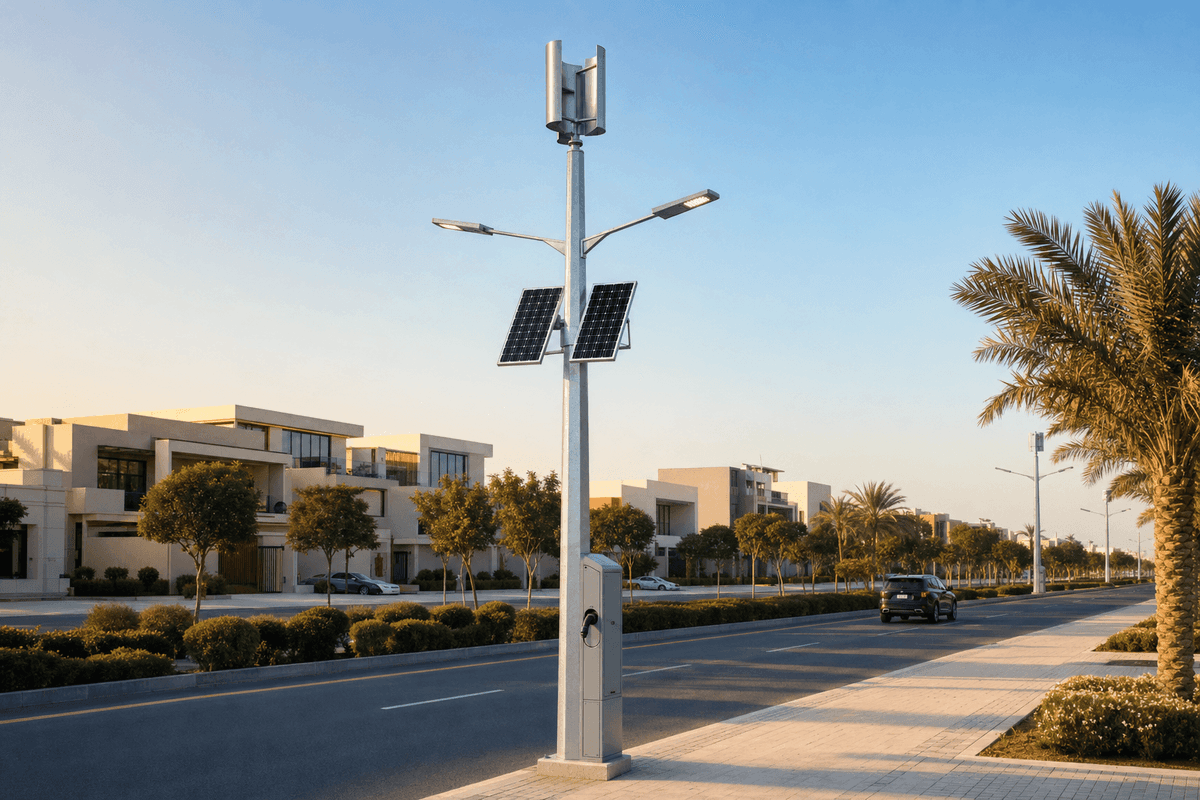
11m Wind-Solar Hybrid Smart Pole - Urban Arterial
Key Features
- 11m octagonal tapered steel pole with 45cm base diameter, 15cm top diameter, and integrated 2.2m EV charging cabinet.
- Hybrid self-powered system with 300W Savonius VAWT, 300W monocrystalline PV, 5kWh LFP battery, and backup grid tie.
- Twin 1.5m arms carry 2 x 80W LED luminaires at 150 lm/W for about 24,000 lumens at 4000K.
- Integrated 11kW Type 2 AC charger supports OCPP 1.6J, 5m coiled cable, touchscreen, and E-stop.
- Smart-city payload includes 25x PTZ camera, 12-parameter sensor, 30W IP speaker, SOS intercom, P4 LED display, WiFi 6, 5G, and LoRaWAN.
The 11m Wind-Solar Hybrid Smart Pole integrates a 300W Savonius VAWT, 300W monocrystalline PV, 5kWh LFP storage, 160W LED lighting, 11kW AC EV charging, PTZ security, sensors, display, WiFi 6, 5G, and LoRaWAN in one 10-in-1 urban arterial pole.
Description
The 11m Wind-Solar Hybrid Smart Pole - Urban Arterial is a 10-in-1 smart streetlight platform with 300W vertical-axis wind generation, 300W monocrystalline solar input, 5kWh LFP storage, 160W LED roadway lighting, and an integrated 11kW AC EV charger inside the lower 2.2m pole body. For 30m arterial spacing and 138-pole corridors, it combines lighting, charging, sensing, communications, security, audio, display, emergency response, and hybrid energy in one galvanized steel structure.
Product Overview
SOLARTODO designed this 11m hybrid pole for urban arterials, industrial parks, smart-city avenues, transport hubs, and municipal renewable-infrastructure programs requiring 24-hour public services from a single civil foundation. The octagonal tapered steel shaft measures 45cm at the base and 15cm at the top, uses a hot-dip galvanized silver-grey finish, and embeds the EV charging cabinet into the lower 2.2m of the pole as one continuous welded steel body rather than a separate roadside pillar.
Compared with a conventional streetlight plus a standalone 11kW charger, separate CCTV mast, WiFi AP, sensor box, advertising screen, and emergency call post, this hybrid pole can reduce roadside cabinet count by 5 to 7 devices per location and cut trenching interfaces by about 40% on a 30m spacing corridor. The consolidated design also reduces pole clutter by using twin 1.5m lighting arms, one PTZ outrigger, one flush gateway enclosure, and one integrated service door.
The renewable subsystem combines a 300W Savonius bucket VAWT with 2 curved scoops measuring 60cm by 90cm, 2 x 150W deep-black monocrystalline PV modules on 15-degree east-west A-frame brackets, an MPPT controller, and a 5kWh lithium iron phosphate battery. NREL PVWatts guidance is commonly used for site-specific solar yield modeling, while IRENA cost reports show why distributed solar and storage are increasingly specified for public infrastructure with 10-year to 25-year service lives.
System Architecture
The energy path starts at the apex wind turbine and mid-pole PV pair, then routes through MPPT conversion to the 5kWh LFP battery located inside the pole base. A backup grid-tie input supports winter, sandstorm, monsoon, or low-wind periods, while the local controller prioritizes 160W lighting, safety systems, communications, and sensor uptime before optional display and public-access loads.
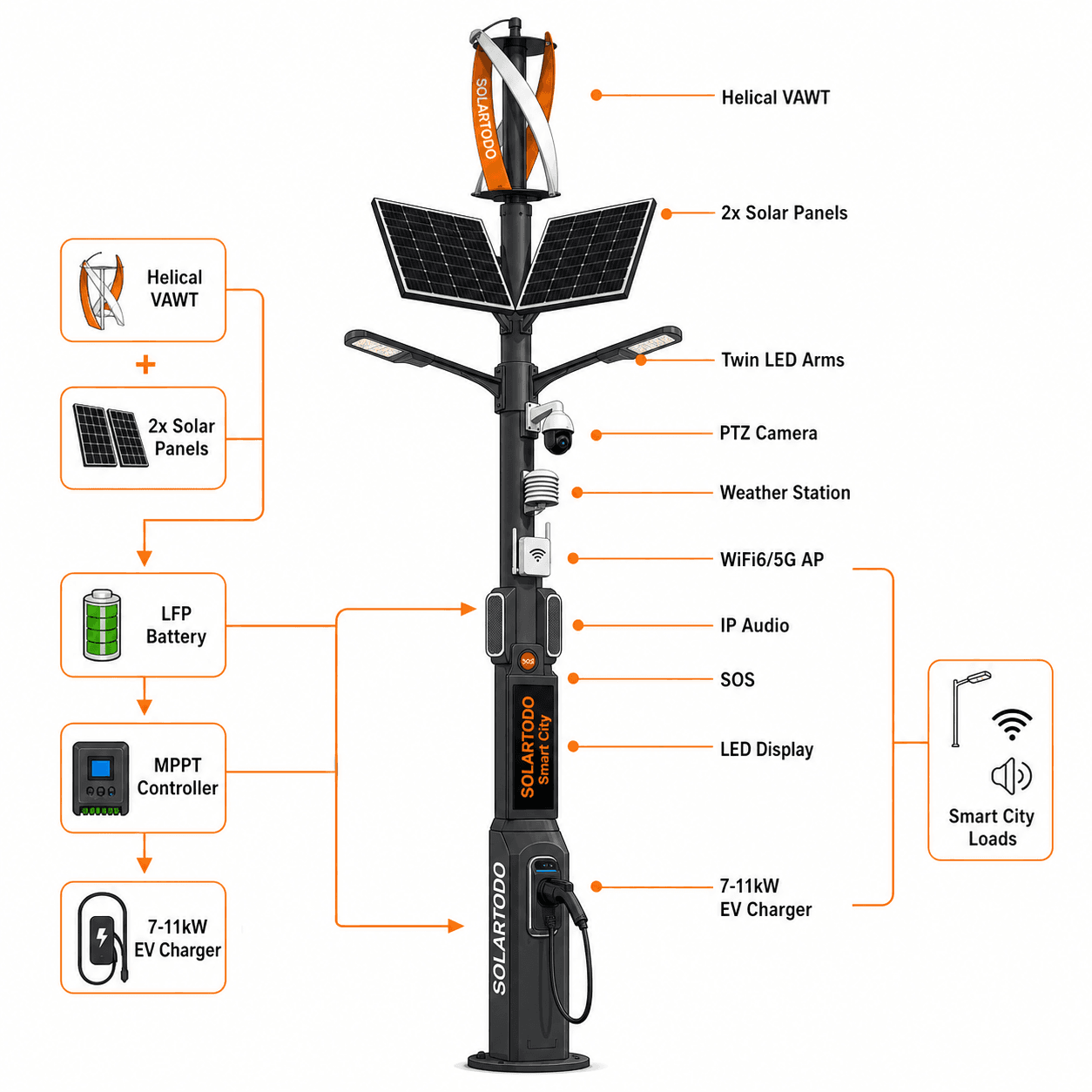
The lighting assembly uses twin symmetric 1.5m arms with an 8-degree upward tilt and 2 x 80W LED luminaires rated at 150 lm/W and 4000K neutral white. With total LED output near 24,000 lumens, the pole supports arterial-road luminance planning where uniformity, glare control, and maintenance access must align with IEC 60598 luminaire safety principles and local roadway-lighting rules.
The structural concept is a unibody smart pole, not a pole with 10 loosely mounted accessories. The 11kW single-gun AC charger, Type 2 connector, OCPP 1.6J communications, 5m coiled cable, touchscreen, emergency stop, and maintenance door are integrated into the lower 2.2m steel section, keeping the charger footprint inside the 45cm base zone and improving pedestrian clearance on narrow sidewalks.
Technical Specifications
| Subsystem | Specification | Quantity or Rating |
|---|---|---|
| Pole structure | Octagonal tapered steel, hot-dip galvanized | 11m height |
| Wind generation | Savonius VAWT, 2 curved scoops | 300W, 60 x 90cm |
| Solar generation | Monocrystalline PV on A-frame brackets | 2 x 150W, 15-degree tilt |
| Battery storage | LFP battery inside pole base | 5kWh |
| Road lighting | Twin LED luminaires | 2 x 80W, 150 lm/W |
| EV charging | AC single gun, Type 2, OCPP 1.6J | 11kW, 5m cable |
| Display | P4 portrait LED display | 960 x 1920mm, over 5500 cd/m2 |
| Communications | WiFi 6, 5G gateway, GbE, LoRaWAN | Flush 8.7m mounting |
The security subsystem uses a 22cm white PTZ dome camera on a 50cm L-bracket outrigger, with 360-degree rotation, 25x optical zoom, and 150m infrared night coverage. For a 30m pole spacing, the camera can observe multiple intersections or curbside zones, while the separated lighting and camera brackets reduce optical obstruction from the 2 solar modules.
The environmental module is a 12-parameter sensor suite covering full meteorology, air quality, rain detection, CO, NO2, and O3. Data can support hourly air-quality dashboards, storm response, heat-island monitoring, and transport-emission studies; IEA urban energy analysis consistently identifies digital monitoring as a practical tool for reducing energy waste across municipal assets by measurable double-digit percentages.
The public communication layer includes 1 x 30W IP audio column rated at 93dB, a TCP/IP networked vertical speaker measuring about 10cm by 50cm, and a one-press SOS button with dual-way audio intercom and visual LED indicator. The speaker is a slim perforated aluminum tube fitted flush against a flat pole face and color-matched to the galvanized finish.
Cloud Monitoring
Each pole connects through dual-mode WiFi 6 and 5G, with GbE uplink and LoRaWAN integrated at 8.7m on a flat pole face. The gateway enclosure is color-matched so the paint visually continues across the device-pole boundary, a detail that matters on 138-unit urban deployments where visual consistency is assessed at every 30m interval.
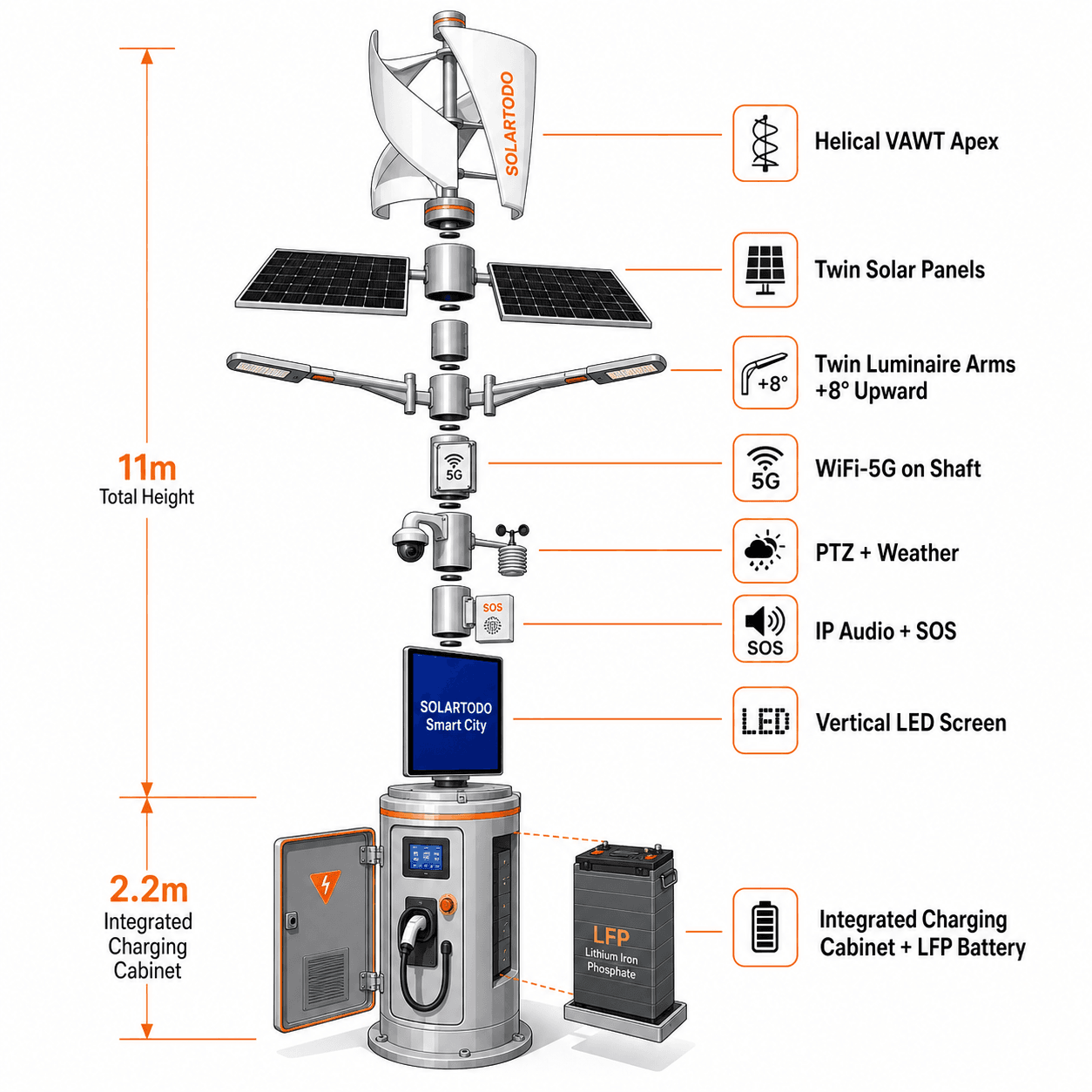
The cloud platform can monitor battery state of charge, wind input, solar input, LED dimming profile, charger status, alarm events, environmental readings, display health, camera online state, and gateway uptime. A city operator can group 138 poles by avenue, ward, charging tariff, or maintenance zone and export daily, monthly, or annual performance records for procurement and public-works reporting.
The P4 LED advertising screen measures 960 x 1920mm in portrait orientation and exceeds 5500 cd/m2 brightness for daylight visibility. For this product page, the specified content is limited to SOLARTODO Smart City in white sans-serif text on deep blue, which keeps the display focused on municipal identity, wayfinding, or project branding without adding unrelated imagery.
Standards and Compliance
The luminaire design references IEC 60598 for lighting equipment safety, the smart streetlight platform references GB/T 37024 for multifunction smart-pole systems, and the charging interface references IEC 62196-2 for AC vehicle connectors. OCPP 1.6J supports charger-network interoperability, while IP66 enclosure design and a -40°C to +55°C operating range support dusty, humid, coastal, and cold-weather arterial deployments.
A 25-year design life depends on the pole structure, galvanizing thickness, foundation engineering, cable management, surge protection, and scheduled module replacement. IEEE surge-protection practices are relevant for mixed AC, DC, communication, and sensor circuits because one 11m pole can contain at least 5 electrical domains: PV, wind, battery, grid charger, and low-voltage controls.
Applications
A MENA-region solar-farm operator planning an 8km service road could deploy 267 poles at 30m spacing to combine lighting, EV fleet charging, CCTV, air-quality sensing, and public-address alerts without building separate telecom masts every 300m. In this scenario, hybrid PV plus wind improves overnight availability when desert wind speeds rise after sunset, and the 5kWh battery can buffer critical loads during short grid outages.
Municipal buyers use this configuration for arterial roads with EV uptake, airport perimeter roads, university campuses, economic zones, waterfront promenades, ports, and smart-industrial parks. The 11m height is suitable where 8m poles lack camera reach and 12m poles may exceed urban design limits, while 30m spacing balances lighting uniformity, cable runs, and maintenance truck access.
For procurement teams comparing alternatives, one integrated 10-in-1 pole usually simplifies the bill of quantities versus 6 separate packages for lighting, charging, CCTV, display, WiFi, and emergency communications. The reduction in discrete civil works can lower installation hours by 20% to 35% depending on trench length, pavement restoration, foundation reuse, and local labor rates.
EPC Investment Analysis and Pricing Structure
EPC delivery includes 5 work scopes: engineering, procurement, construction, commissioning, and 1-year warranty support. SOLARTODO can supply equipment-only FOB China, CIF delivered with ocean freight and insurance, or complete EPC turnkey service with installation, inspection, commissioning, operator handover, and warranty documentation for projects typically starting at 50 poles.
| Pricing tier | Scope | Unit price range, USD |
|---|---|---|
| FOB Supply | Equipment only, ex-works China | $992 - $3,944 |
| CIF Delivered | Equipment plus ocean freight and insurance | $1,114 - $4,431 |
| EPC Turnkey | Fully installed, commissioned, and 1-year warranty | $1,600 - $5,800 |
| Volume band | Discount guidance | Typical procurement use |
|---|---|---|
| 50+ units | 5% | Pilot avenue or industrial road |
| 100+ units | 10% | District arterial package |
| 250+ units | 15% | Citywide framework or multi-site EPC |
ROI depends on local electricity tariffs, charging utilization, maintenance labor, advertising policy, and grid-extension cost. A single 160W LED load operating 12 hours per night consumes about 701kWh per year before dimming, while a 65% adaptive energy-saving profile can reduce lighting draw by about 456kWh per pole per year compared with fixed-output operation.
For a 138-pole corridor, annual lighting energy reduction can reach about 62,900kWh before accounting for wind-solar contribution, and EV charging can create additional utilization value when each 11kW charger serves 1 to 3 vehicles per day. Payback is commonly modeled over 4 to 8 years when avoided cabinets, avoided trenching, energy savings, and charging revenue are included in the financial case.
Payment terms are 30% T/T deposit plus 70% against bill of lading, or 100% L/C at sight for approved trade-finance structures. Project financing can be reviewed for EPC packages above $1,000K, and engineering teams can Request a custom quotation by sending the pole count, road length, foundation condition, grid availability, and target commissioning date to [email protected].
Procurement and Configuration Guidance
Engineers should confirm wind class, corrosion category, soil bearing capacity, foundation bolt pattern, cable duct size, 5G operator coverage, OCPP platform requirements, PV shading, and EV connector standard before issuing drawings. Buyers can Configure your system online to compare the 11m hybrid variant with lower-height solar-only or grid-powered smart poles.
SOLARTODO supplies solar, energy storage, smart lighting, security, telecom, power-tower, and smart-agriculture systems through https://solartodo.com, with B2B documentation structured for engineers and procurement teams. To compare related models, View all Smart Streetlight (10-in-1 Multi-function Pole) products or Learn about topic for background on smart-pole architecture and hybrid renewable streetlighting.
The best technical fit occurs where a project needs at least 4 of the 10 integrated functions at each pole location, because the shared pole, foundation, controller, gateway, and maintenance door create measurable savings. For applications needing only basic lighting, a conventional 8m or 10m LED pole can cost less upfront, but it will not deliver 11kW charging, PTZ coverage, 12-parameter sensing, or cloud-managed public communications.
Technical Specifications
| Pole Height | 11m |
| Pole Profile | Octagonal tapered steel, base 45cm to top 15cm |
| LED Power | 160W |
| Luminous Efficacy | 150lm/W |
| Integrated Modules | 10-in-1 |
| Wind Turbine | Savonius VAWT, 300W, 60 x 90cm |
| Solar Array | 2 x 150W monocrystalline panels at 15-degree tiltW |
| Battery Storage | 5kWh |
| EV Charging | 11kW AC single gun, Type 2, OCPP 1.6J |
| Camera | PTZ dome, 360-degree rotation, 25x zoom, IR 150m |
| Environmental Sensor | 12-parameter meteorology and air-quality sensor |
| Display | P4 portrait LED screen, 960 x 1920mm, over 5500 cd/m2 |
| Wind Resistance | 150km/h |
| IP Rating | IP66 |
| Operating Temperature | -40 to +55°C |
| Communication | WiFi 6 + 5G + GbE + LoRaWAN |
| Energy Saving | 65% |
| Design Life | 25years |
| Recommended Spacing | 30m |
Price Breakdown
| Item | Quantity | Unit Price | Subtotal |
|---|---|---|---|
| 11m galvanized octagonal smart pole with integrated EV cabinet | 1 pcs | $850 | $850 |
| 300W Savonius VAWT with red aviation LED | 1 pcs | $180 | $180 |
| 150W monocrystalline solar panel with A-frame bracket | 2 pcs | $65 | $130 |
| 5kWh LFP battery pack inside pole base | 1 pcs | $650 | $650 |
| MPPT hybrid charge controller | 1 pcs | $80 | $80 |
| 80W LED roadway luminaire, 150 lm/W | 2 pcs | $85 | $170 |
| 22cm PTZ dome camera, 25x zoom, IR 150m | 1 pcs | $226 | $226 |
| 12-parameter environmental sensor suite | 1 pcs | $250 | $250 |
| 30W IP audio column speaker | 1 pcs | $92 | $92 |
| Visual SOS emergency intercom module | 1 pcs | $134 | $134 |
| 11kW OCPP AC EV charger module, Type 2 | 1 pcs | $252 | $252 |
| P4 portrait LED display, 960 x 1920mm | 1 pcs | $1,200 | $1,200 |
| WiFi 6, 5G, GbE, and LoRaWAN gateway | 1 pcs | $220 | $220 |
| USB-C PD 30W and USB-A charging module | 1 pcs | $34 | $34 |
| Cables, breakers, surge protection, and accessories | 1 pcs | $90 | $90 |
| Engineering, shop drawings, and QC documentation | 1 pcs | $330 | $330 |
| Installation and commissioning labor | 1 pcs | $520 | $520 |
| 1-year warranty and support allowance | 1 pcs | $186 | $186 |
| Total Price Range | $1,600 - $5,800 | ||
Frequently Asked Questions
What makes this 11m pole different from a standard smart streetlight?
How is the hybrid wind-solar power system sized?
What does EPC turnkey pricing include?
Which standards are relevant for this product?
What project types are best suited to the 11m hybrid smart pole?
Certifications & Standards


Data Sources & References
- •NREL PVWatts Calculator and PV performance guidance
- •IEA urban energy efficiency and electricity-sector analysis
- •IRENA Renewable Power Generation Costs and capacity statistics
- •IEC 60598 luminaire safety standard
- •IEC 62196-2 EV connector standard
- •IEEE surge protection and power quality engineering practices
- •BloombergNEF clean-energy cost benchmarks
Interested in this solution?
Contact us for a customized quote based on your specific requirements.
Contact Us