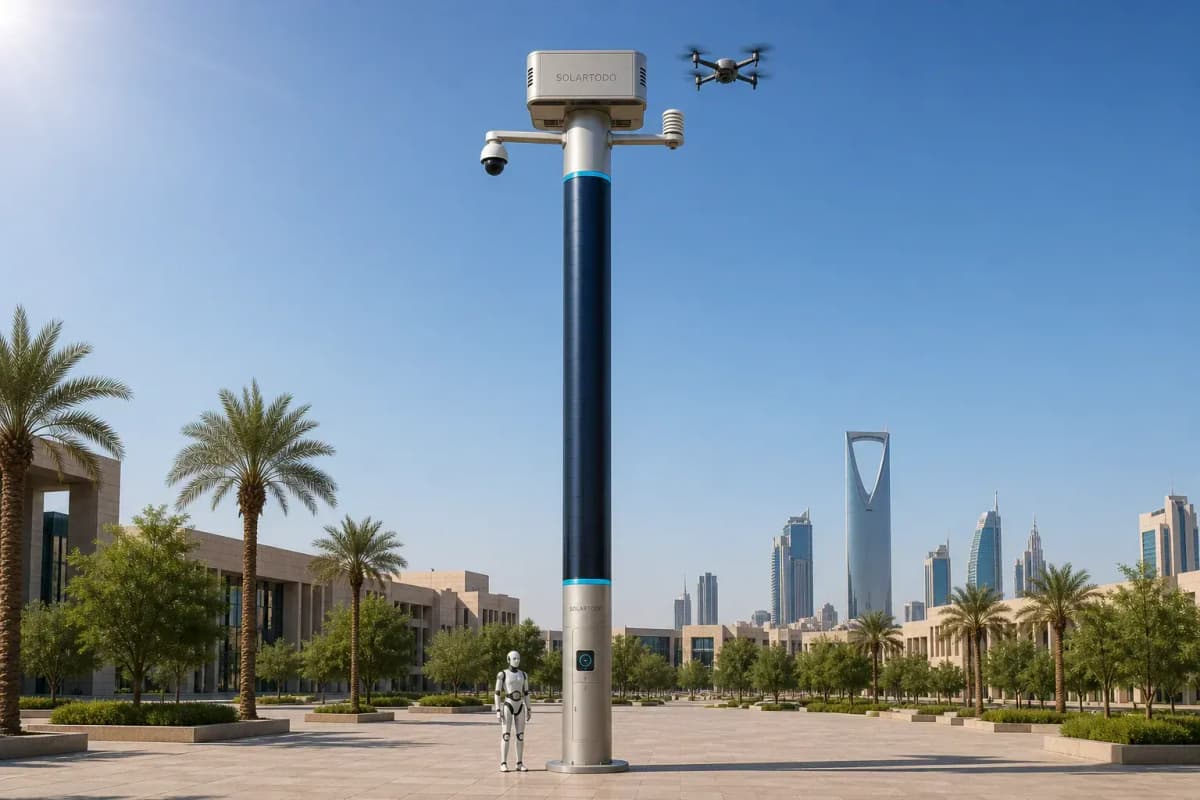
12m Smart Pole with Drone Dock (Sky Hub) - Off-Grid Campus & Park Edge Node
Key Features
- 12 m pure smart pole with integrated autonomous drone dock and no lighting system
- 5-20 kWh battery storage buffers drone, robot, sensing, compute, and communications loads
- Approximately 15 m² CIGS solar replenishment delivers about 6-9 kWh/day in high-irradiance clear-sky regions
- 9-in-1 environmental monitoring covers wind speed, wind direction, temperature, humidity, pressure, noise, PM10, PM2.5, and illuminance
- 52-node campus layout at about 35 m spacing supports roughly 1.8 km of linear coverage subject to engineering confirmation
The 12m SOLARTODO Sky Hub is a pure smart pole with autonomous drone docking, 5-20 kWh battery storage, approximately 15 m² of CIGS solar replenishment, IP66 field electronics, and local edge AI processing for campus and park security operations.
Description
The 12m Smart Pole with Drone Dock (Sky Hub) · Campus & Park is a fully off-grid SOLARTODO edge node integrating autonomous drone service, 5-20 kWh-class storage, approximately 15 m² of vertical CIGS solar replenishment, IP66 field electronics, and 4G/5G plus LoRaWAN communications in a 12 m pole package. This variant is a pure smart pole with no lighting system, designed for campus, park, perimeter, and smart-district operations where local AI processing, robotic inspection, and de-identified event reporting reduce network load by more than 90% compared with continuous raw-video backhaul.
Product Definition
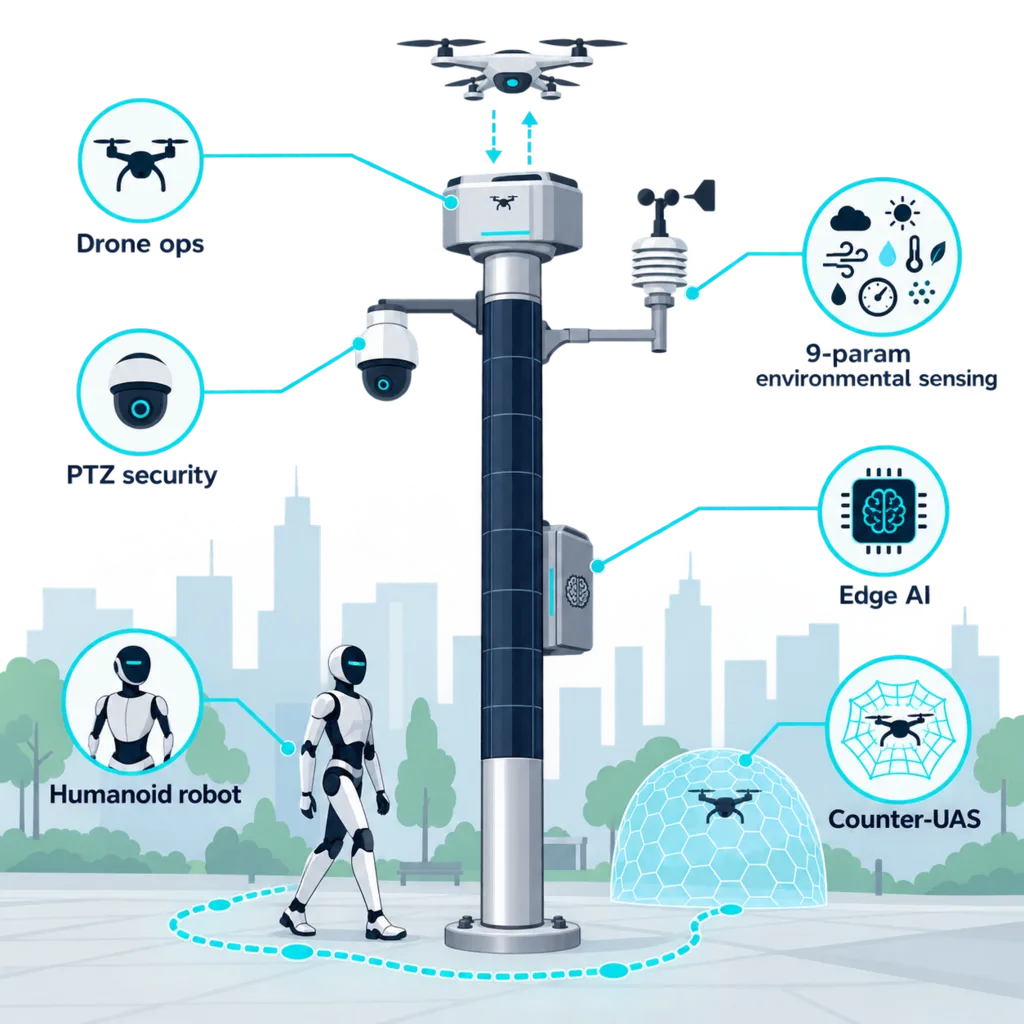
The Sky Hub variant belongs to SOLARTODO’s broader intelligent-pole catalogue, where buyers can View all Smart Streetlight (10-in-1 Multi-function Pole) products, but this 12 m drone configuration is specifically a non-lighting city edge node. Its 9-in-1 capability set covers pole infrastructure, drone operations, battery hot-swap, operations management, ground robot support, security sensing, 9-parameter environmental monitoring, edge AI compute, and human-authorized C-UAS coordination.
For B2B procurement teams, the 12 m height gives better line-of-sight planning than 6 m or 8 m utility poles while remaining easier to install than 20 m telecom towers. A 52-unit campus or park network at approximately 35 m spacing can create repeatable sensing and response coverage across about 1.8 km of linear paths, fence lines, plazas, service roads, or mixed pedestrian zones, subject to final RF, aviation, wind, and civil engineering confirmation.
The product is engineered as a battery-backed micro-station rather than a conventional powered mast. On-pole solar replenishment provides roughly 0.8-1.1 kW DC clear-sky peak output in high-irradiance regions, with about 6-9 kWh/day of practical vertical-cylinder generation, so high-power drone sorties and robot tasks are scheduled against stored energy instead of assuming unlimited solar self-sufficiency.
System Architecture
A Sky Hub node combines 4 physical layers: structural pole, off-grid energy subsystem, autonomous drone service subsystem, and edge compute/communications subsystem. The pole hosts a drone dock, battery swap magazine, PTZ sensing, 9-in-1 environmental sensor suite, local inference module, protected electrical cabinet, battery storage, surge protection, and communications hardware in a single engineered site asset.
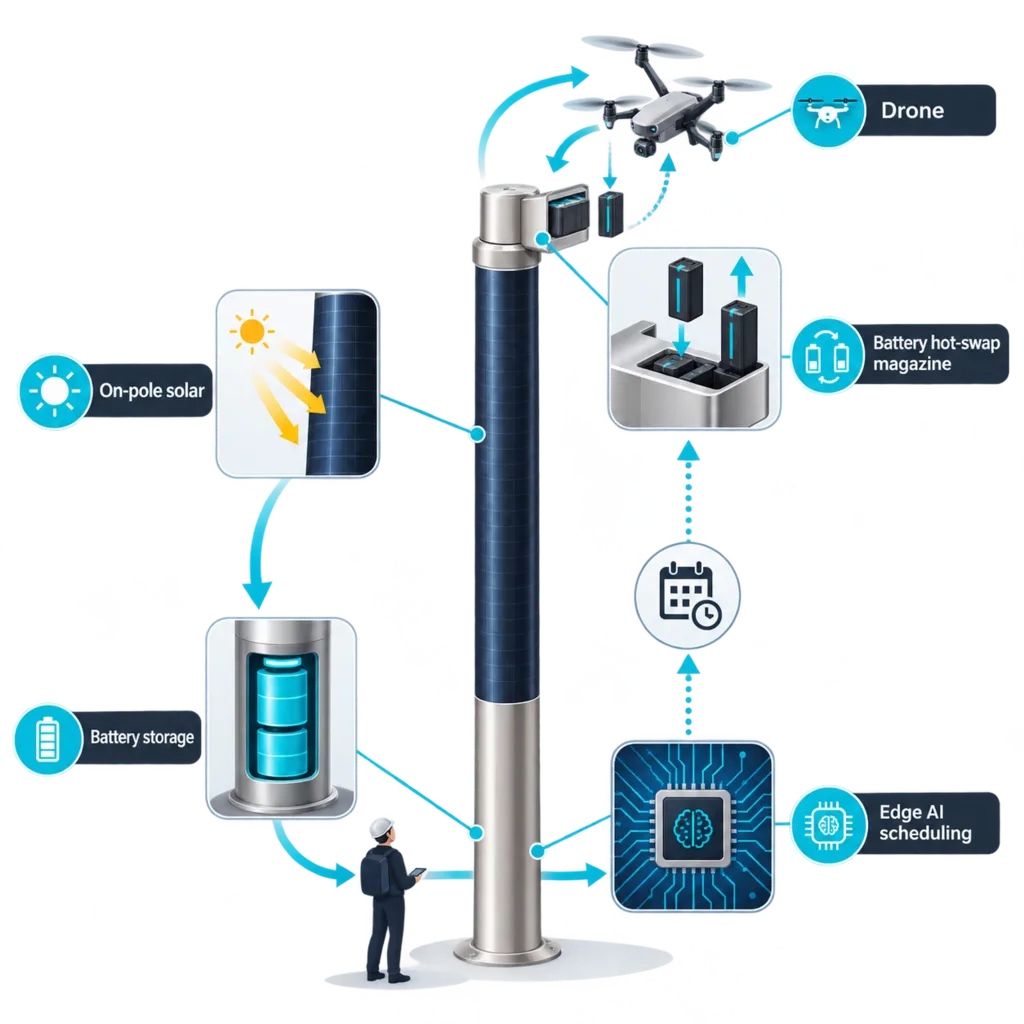
The operational workflow follows a 4-stage loop: sensing, authorized assessment, edge-compute scheduling, and field operations. Local analytics process raw video and sensor streams on the pole, while only de-identified event records, status packets, and maintenance logs leave the site, which supports PDPL/LGPD-oriented data minimization without claiming universal legal certification across all jurisdictions.
Drone operations use a managed route queue with launch, patrol, inspection, return, battery exchange, and redeployment states. The automated hot-swap magazine can support several consecutive sorties when charged packs are available, and mission logs retain timestamps, route IDs, battery state, and maintenance events so an operator can audit 24-hour asset coverage without keeping a pilot at every pole.
Ground robot support extends the same operating model to pedestrian paths, plazas, service corridors, and facility perimeters. A service robot can receive an event cue, inspect a local zone, coordinate with the aerial unit, and return to the pole base for wireless charging, creating a 2-domain inspection workflow for locations where fixed cameras alone leave blind spots.
Energy and Off-Grid Power
The energy subsystem uses approximately 15 m² of 360-degree wrapped flexible CIGS thin-film PV around a vertical pole body, equal to about 2.4-2.7 kWp nameplate before geometry and angle-of-incidence losses. Because a vertical cylinder presents only its sun-facing projection to direct irradiance at any moment, realistic clear-sky production is about 0.8-1.1 kW DC peak and 6-9 kWh/day in a high-irradiance MENA-class location, consistent with the need for location-specific modeling using NREL PVWatts V8 and NSRDB weather data (NREL/NLR PVWatts V8).
The battery subsystem is sized in a 5-20 kWh class to buffer drone launch loads, communications, edge compute, sensor operation, and robot charging. IRENA notes that battery electricity storage supports renewable integration, self-consumption, mini-grids, and reserve functions, and the same storage logic applies at a smaller node scale where solar generation and load timing rarely align perfectly (IRENA Energy Storage).
For a representative MENA campus scenario with 52 Sky Hub poles, assume each pole generates 6-9 kWh/day in clear conditions, creating a site replenishment envelope of 312-468 kWh/day before dust, shade, maintenance, and seasonal derating. Engineering design should still size the duty cycle conservatively, because 10 drone sorties in a high-wind day and 24-hour edge compute loads can exceed same-day solar recovery if battery reserves are not managed.
Compared with a conventional alternative using fixed cameras plus grid-powered cabinets plus separate drone crews, a Sky Hub design can reduce trenching points, network uplink demand, and patrol mobilization events by 30-60% depending on site geometry. The reduction comes from consolidating 4 field assets into 1 pole node and processing raw streams locally rather than sending continuous video to a remote server.
Sensing, AI, and Data Governance
The security package supports PTZ observation, anonymous vehicle counts, crowd-density estimation, intrusion events, and perimeter awareness. It does not require face recognition or licence-plate recognition as deployed active functions, and the default data model retains raw sensor data on the pole while forwarding event categories, timestamps, confidence levels, and device-health metadata to the command view.
The edge AI module is Jetson-class compute suitable for on-pole inference, workload scheduling, and mission orchestration. This architecture reduces backhaul dependency because 1 node can classify routine motion locally, prioritize high-confidence events, and send compact metadata packets measured in kilobytes rather than continuous streams measured in megabits per second.
Cybersecurity planning should be mapped to IEC 62443 concepts for industrial automation and control systems, including asset-owner requirements, service-provider responsibilities, risk assessment, and component security requirements (ISA/IEC 62443). For procurement documentation, SOLARTODO describes the design as IEC 62443-oriented and PDPL/LGPD-oriented unless a project-specific certificate, audit, or authority acceptance document is issued.
Drone Dock and C-UAS Coordination
The drone dock enables autonomous launch, regional patrol, inspection, return, battery exchange, and redeployment from the 12 m node. Mission management includes route planning, task queueing, battery state control, health monitoring, and maintenance logs, which allows 1 command team to supervise multiple nodes rather than stationing 1 operator beside each location.
Counter-UAS coordination is non-lethal and human-authorized. The pole may detect and track an unauthorized drone using onboard sensing and optional partner-sensor inputs, then coordinate a friendly drone for close-approach deterrence or soft aerial net-capture only after an authorized operator confirms the response; the system does not use RF jamming, GNSS denial, shoot-down actions, autonomous attack, or destructive mitigation.
Radar should be treated as a partner input rather than built-in pole hardware. If a project requires radar coverage for a 1 km perimeter or airport-adjacent park, the radar subsystem must be specified separately with local spectrum rules, aviation constraints, line-of-sight analysis, and authority procedures documented before procurement.
Environmental Monitoring and Field Reliability
The environmental suite measures 9 parameters: wind speed, wind direction, temperature, humidity, atmospheric pressure, noise, PM10, PM2.5, and illuminance. These readings support safety rules for drone launch, crowd operations, dust maintenance, asset condition monitoring, and operational reporting across 24-hour campus or park duty cycles.
Ingress protection is specified as IP66 for outdoor electronics enclosures, aligned with IEC 60529 classifications for dust and water protection of electrical equipment up to 72.5 kV rated voltage (IEC 60529). The operating temperature range of -40°C to +55°C supports desert, coastal, and winter campus conditions when battery chemistry, enclosure ventilation, and solar derating are confirmed during engineering.
PV module qualification should reference IEC 61215 for terrestrial module design qualification and type approval, including thin-film and flexible-module test methods in the 2021 edition (IEC 61215-2:2021). Energy storage safety should be reviewed against UL 9540 for energy storage systems and UL 9540A for thermal runaway test methodology where local codes or insurers require documented battery safety evidence (ANSI/CAN/UL 9540).
Cloud Monitoring
The command view aggregates 52 or more nodes into a common operating picture with device status, battery state, solar replenishment, drone mission queues, robot activity, environmental alarms, and operator authorization records. It is designed for compact event and status metadata rather than raw continuous video export, which improves data-sovereignty posture and reduces recurring bandwidth costs.
A typical dashboard record includes node ID, time, event class, sensor confidence, weather state, battery percentage, drone availability, and maintenance flag in fewer than 10 structured fields. This schema-friendly telemetry supports AI search, operations analytics, and procurement reporting without turning the system into a centralized raw-video collection platform.
Applications
Campus and park deployments use the 12 m Sky Hub for perimeter patrol, visitor-flow awareness, facility inspection, after-hours intrusion alerts, environmental reporting, and emergency response coordination. Buyers can Configure your system online to compare pole height, storage class, communications, sensors, and service scope before requesting engineering confirmation.
Industrial parks, ports, solar farms, university campuses, resorts, and public parks typically evaluate 3 planning variables first: coverage geometry, autonomous task frequency, and energy autonomy target. For a 52-pole site at 35 m spacing, the network design should check RF overlap, drone flight permissions, shadowing, wind zones, and maintenance access before freezing the bill of materials.
For technical background on solar-plus-storage sizing and intelligent infrastructure procurement, buyers can Learn about topic and review SOLARTODO’s knowledge resources before preparing a tender. A practical specification package normally includes 1 site layout, 1 energy model, 1 communications plan, 1 privacy statement, and 1 commissioning checklist.
EPC Investment Analysis and Pricing Structure
EPC delivery includes engineering, procurement, construction, commissioning, and 1-year warranty support. Engineering covers wind loading, foundation assumptions, off-grid energy sizing, communications design, drone operations boundaries, C-UAS authorization workflow, and local compliance documentation; procurement covers pole, dock, solar, storage, sensors, edge compute, electrical protection, and logistics.
| Tier | Scope | Unit Price Range (USD) |
|---|---|---|
| FOB Supply | Equipment only, ex-works China | $4,030-$8,840 |
| CIF Delivered | Equipment plus ocean freight and insurance | $4,527-$9,931 |
| EPC Turnkey | Installed, commissioned, and 1-year warranty | $6,500-$13,000 |
| Quantity | Indicative Discount | Procurement Note |
|---|---|---|
| 50+ units | 5% | Suitable for 1 campus or park network |
| 100+ units | 10% | Suitable for multi-zone municipal programs |
| 250+ units | 15% | Requires phased logistics and commissioning plan |
ROI should be calculated against 3 avoided cost categories: grid trenching, fixed-camera backhaul, and manual patrol or drone crew mobilization. If a conventional campus alternative costs $2,500 per grid connection, $600 per year in backhaul, and $4,000 per year in recurring patrol operations, a Sky Hub node priced at $6,500-$13,000 EPC can show a simple payback of about 3-6 years depending on duty cycle, labor cost, and solar resource.
Payment terms are 30% T/T advance plus 70% against bill of lading, or 100% L/C at sight for bank-supported procurement. Project financing can be reviewed for orders above $1,000,000, and buyers should Request a custom quotation or email [email protected] with site drawings, quantity, destination port, installation country, and target commissioning month.
Standards and Market Context
IEA reported that solar PV generated about 2,000 TWh in 2024 and was forecast to contribute roughly half of global electricity demand growth through 2027, which supports continued procurement interest in distributed solar-powered infrastructure (IEA Electricity 2025). In its 2025 mid-year update, IEA also forecast wind and solar PV to cover more than 90% of global electricity demand growth in 2025, reinforcing the case for battery-buffered distributed systems in campuses and parks (IEA Electricity Mid-Year Update 2025).
The Sky Hub should be specified with measured engineering assumptions, not generic smart-city slogans. A compliant tender should state 12 m height, 5-20 kWh storage class, 0.8-1.1 kW clear-sky DC peak solar replenishment, 6-9 kWh/day expected high-irradiance output, 9 environmental parameters, IP66 protection, -40°C to +55°C operation, and human-authorized non-lethal response procedures.
Procurement Notes
SOLARTODO supplies solar, energy storage, security, telecom, power-tower, smart-agriculture, and intelligent infrastructure products for B2B projects. For the 12 m Sky Hub, final configuration depends on country rules for UAV operation, data governance, battery transport, civil foundations, spectrum use, and site security procedures, so every EPC quote should include at least 6 engineering attachments before purchase order release.
A buyer comparing 1 Sky Hub node with 3 separate assets should account for installation simplification, data governance, maintenance routing, and power autonomy. The strongest use case is not replacing every fixed sensor; it is consolidating drone service, robotic inspection, environmental telemetry, and local AI into 1 off-grid node where conventional infrastructure would require multiple cabinets, power runs, and service contracts.
Technical Specifications
| Pole Height | 12m |
| Product Type | Pure smart pole with drone dock; no lighting system |
| Integrated Modules | 9-in-1 |
| Solar Replenishment Area | 15m² |
| Solar Nameplate Capacity | 2.4-2.7kWp |
| Realistic Clear-Sky DC Peak Output | 0.8-1.1kW |
| Expected High-Irradiance Daily Yield | 6-9kWh/day |
| Battery Storage Class | 5-20kWh |
| Wind Resistance | 160km/h |
| IP Rating | IP66 |
| Operating Temperature | -40 to +55°C |
| Communication | 4G/5G + LoRaWAN |
| Environmental Monitoring | 9 parameters |
| Data Handling | Local raw-data processing; de-identified metadata export only |
| Design Life | 25years |
Price Breakdown
| Item | Quantity | Unit Price | Subtotal |
|---|---|---|---|
| 12m steel smart pole structure | 1 pcs | $923 | $923 |
| Autonomous drone dock assembly | 1 pcs | $2,500 | $2,500 |
| Automated drone battery hot-swap magazine | 1 pcs | $1,200 | $1,200 |
| Battery storage system, 5-20 kWh class | 1 pcs | $1,800 | $1,800 |
| Flexible CIGS solar replenishment wrap | 1 pcs | $1,100 | $1,100 |
| PTZ camera with local perception input | 1 pcs | $226 | $226 |
| Environmental sensor, 9-in-1 | 1 pcs | $218 | $218 |
| Jetson-class edge AI compute module | 1 pcs | $850 | $850 |
| Smart cloud gateway and communications | 1 pcs | $92 | $92 |
| Electrical accessories, cables, breakers, surge protection | 1 set | $50 | $50 |
| Engineering, design review, and QC | 1 lot | $650 | $650 |
| Installation and commissioning | 1 lot | $750 | $750 |
| 1-year warranty and technical support | 1 lot | $221 | $221 |
| Total Price Range | $6,500 - $13,000 | ||
Frequently Asked Questions
Does the 12m Sky Hub include a lighting system?
How much energy can the on-pole solar system generate?
Can raw video leave the pole for cloud analytics?
What does EPC turnkey pricing include?
How is C-UAS handled in this product?
Certifications & Standards

Data Sources & References
- •NREL/NLR PVWatts V8: https://developer.nlr.gov/docs/solar/pvwatts/
- •IEC 61215-2:2021: https://webstore.iec.ch/en/publication/61350
- •IEC 60529 IP Code: https://webstore.iec.ch/en/publication/2448
- •ISA/IEC 62443 series: https://www.isa.org/standards-and-publications/isa-standards/isa-iec-62443-series-of-standards
- •IRENA Energy Storage: https://www.irena.org/Energy-Transition/Technology/Energy-Storage
- •IEA Electricity 2025: https://www.iea.org/reports/electricity-2025/executive-summary
- •IEA Electricity Mid-Year Update 2025: https://www.iea.org/reports/electricity-mid-year-update-2025/executive-summary
Interested in this solution?
Contact us for a customized quote based on your specific requirements.
Contact Us