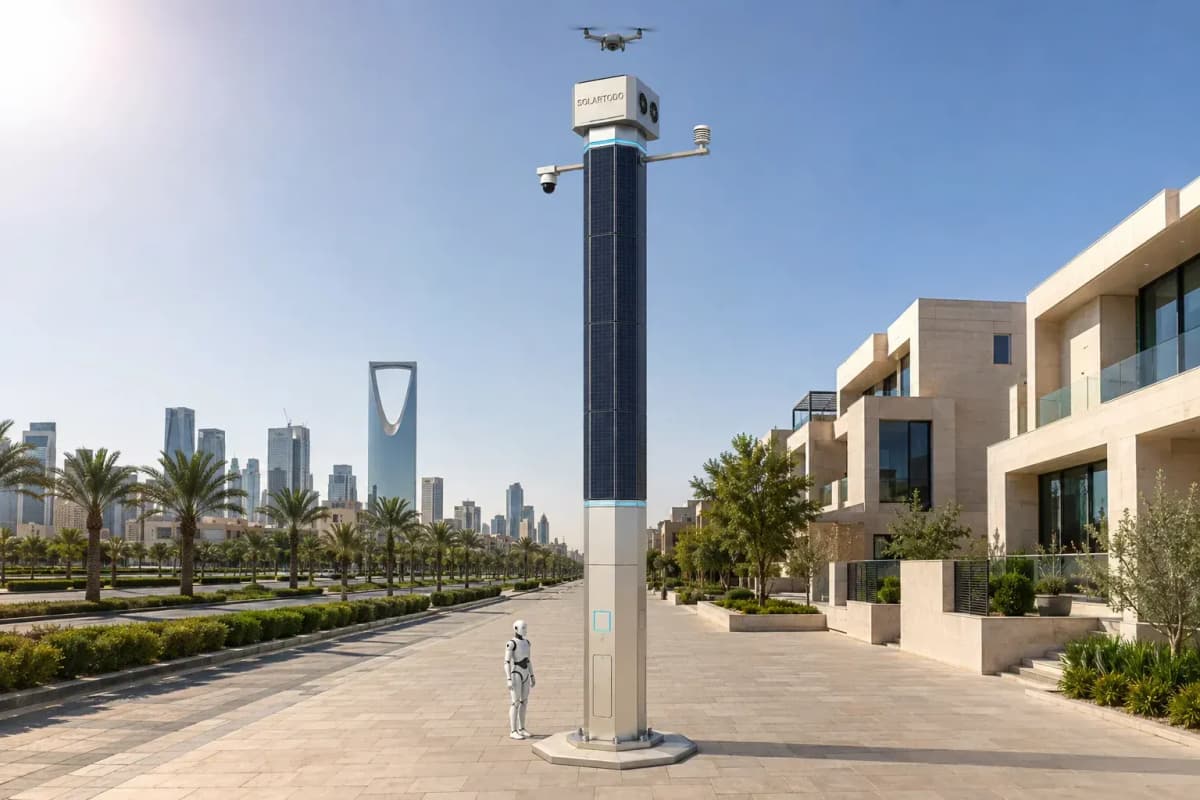
12m Smart Pole with Drone Dock (Sky Hub) - Off-Grid Edge Node
Key Features
- 12 m pure smart pole with 0 lighting fixtures and IP66 outdoor enclosure architecture
- 2.8-3.2 kWp integrated PV body with realistic 1.0-1.3 kW DC clear-sky peak output
- 5-20 kWh battery storage buffer for drone dock, robot charging, communications, and edge AI loads
- 9-in-1 environmental monitoring: wind speed, wind direction, temperature, humidity, pressure, noise, PM10, PM2.5, and illuminance
- 88-node smart-community deployment model at approximately 30 m spacing for about 2.64 km of linear coverage
The SOLARTODO 12m Smart Pole with Drone Dock (Sky Hub) is a pure, non-lighting smart community edge node with 2.8-3.2 kWp integrated PV, 5-20 kWh battery storage, 4G/5G + LoRaWAN communications, and IP66 outdoor architecture. It coordinates autonomous drone service, local AI perception, robot charging, environmental sensing, and human-authorized non-lethal C-UAS workflows across 88 poles at approximately 30 m spacing.
Description
The SOLARTODO 12m Smart Pole with Drone Dock (Sky Hub) is a pure smart-community pole with no lighting system, combining a 12 m structure, 2.8-3.2 kWp on-pole photovoltaic replenishment, 5-20 kWh-class battery storage, IP66 outdoor protection, and 4G/5G + LoRaWAN communications. Each node is designed for local edge processing, autonomous drone service, robot coordination, 9-in-1 environmental monitoring, and human-authorized non-lethal C-UAS coordination in smart districts, campuses, industrial parks, ports, and critical-infrastructure perimeters.
Product Definition
Sky Hub is a 12 m physical-AI city edge node, not a streetlight, and it contains 0 luminaires by design. It belongs to SOLARTODO's smart infrastructure catalog family, where buyers can View all Smart Streetlight (10-in-1 Multi-function Pole) products while specifying this variant as a non-lighting smart pole for sensing, compute, energy, drone, and robot operations.
The 12 m pole integrates 9 operating domains: pole-hosted edge compute, drone launch and return, automated drone battery exchange, mission management, ground robot service, anonymous security sensing, 9-channel environmental monitoring, local AI inference, and human-authorized counter-UAS coordination. The architecture follows the same engineering principle used in distributed energy systems: local equipment must keep critical functions available during communication disruption, a requirement aligned with resilience thinking in IEEE 2030.5-2023 smart-energy application protocols and IEC 61850-derived interoperability models.
The unit is fully off-grid in the electrical sense that it requires 0 grid, 0 city, and 0 site power connections for normal operation, but it should not be interpreted as unlimited solar self-sufficiency. Its vertical PV body provides supplemental daily replenishment of approximately 7-10 kWh/day in high-irradiance regions, while the 5-20 kWh storage layer buffers high-power drone, robot, compute, and communications tasks under a duty-cycle schedule.
System Architecture
A standard Sky Hub installation uses 1 pole, 1 drone-service dock, 1 edge AI compute stack, 1 PTZ perception package, 1 environmental sensor package, 1 battery system, and 1 communications gateway per node. The OTATODO edge runtime separates detection, decision support, authorization, actuation, energy scheduling, and metadata export into distinct software layers so that raw video and sensor streams remain on the pole by default.
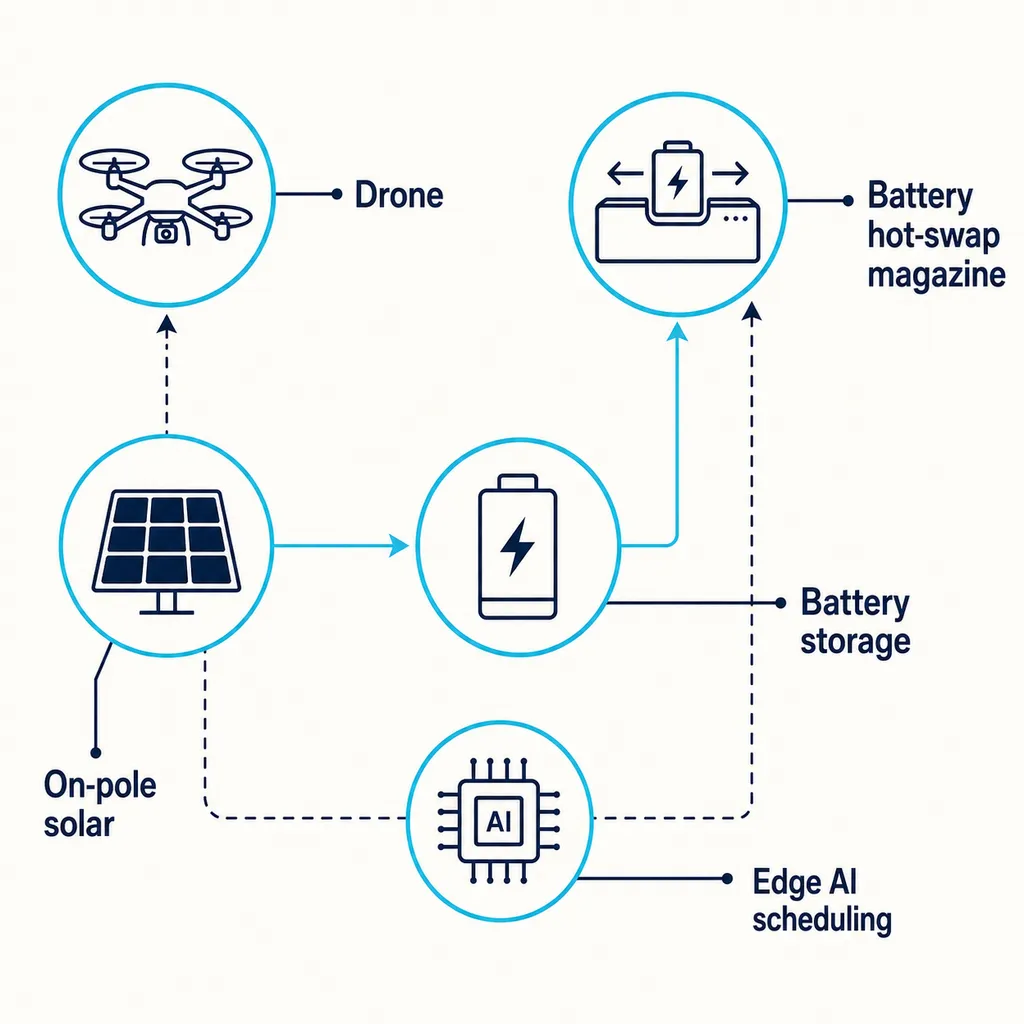
The edge-compute layer is specified as Jetson-class AI processing, typically Orin-class or Thor-class depending on project workload, and it schedules multiple inference jobs such as anonymous vehicle counting, crowd-density estimation, perimeter intrusion detection, environmental thresholding, drone status management, and robot charging coordination. In normal operation, 0 raw continuous video feeds leave the pole; only de-identified event metadata, health telemetry, task logs, and status summaries are transmitted to the cloud or command center.
Drone operations are managed as a local state machine with 5 major stages: mission assignment, launch authorization, route execution, dock return, and energy restoration. The battery hot-swap module can support multiple consecutive sorties when the project-specific magazine is equipped with several charged packs, reducing the need for 1 on-site operator per routine patrol cycle compared with a conventional manual drone team.
Ground-robot coordination adds 3 additional service loops: autonomous patrol, alarm response, and return-to-base wireless charging. The pole base acts as the local energy and command point for the robot, while the drone dock handles aerial inspection tasks; together they create an air-ground inspection pattern suited to facilities where a 30 m node interval and 88-node deployment can divide a large perimeter into manageable patrol zones.
C-UAS coordination is restricted to non-lethal, human-authorized actions. The pole may detect and track an unauthorized aerial object using onboard perception and optional partner-sensor inputs, but radar is not built into the pole hardware; after operator authorization, the system can command a friendly drone for soft net-capture or close-approach deterrence, with 0 jamming, 0 hard-kill, and 0 autonomous attack functions.
Technical Specifications
The 12 m Sky Hub structure is engineered around IP66-rated enclosures, -40 degrees C to +55 degrees C operating temperature, 150 km/h wind-resistance design basis, 25-year structural design life, and 4G/5G + LoRaWAN communication redundancy. IEC 60529 defines IP Code enclosure protection for electrical equipment up to 72.5 kV, making it the relevant reference for dust and water ingress language rather than a marketing label.
The on-pole PV body has 8 vertical photovoltaic faces across an approximately 8 m energy section, with a total STC nameplate of about 2.8-3.2 kWp. Because a vertical multi-face pole does not receive full normal-incidence sunlight across all faces at once, realistic clear-sky output in a high-irradiance region is closer to 1.0-1.3 kW DC peak, producing about 7-10 kWh/day before local load scheduling.
NREL's PVWatts Version 8 methodology is useful for project screening because it estimates PV production from DC nameplate capacity, weather data, orientation, losses, and thermal assumptions, and it uses NSRDB-based datasets in covered regions. For Sky Hub, PVWatts-style modeling should be adjusted for the vertical multi-face geometry, because a conventional fixed-tilt rooftop or ground-array model can overstate pole-body production by more than 1 face-to-array ratio step if orientation is simplified.
The storage system is sized in the 5-20 kWh range because drone battery exchange, robot charging, communications, and edge inference create intermittent high-load events. IRENA reported that utility-scale battery storage installed costs declined by 93% from 2010 to 2024, reaching about USD 192/kWh in 2024, which supports the business case for battery-buffered off-grid infrastructure while still requiring site-specific thermal and cycle-life engineering.
The PV module and power-conversion bill of materials is specified against recognized solar safety references, including IEC 61215 for PV module design qualification, IEC 61730 for PV module safety qualification, UL 1741 for inverters/converters/controllers used with distributed energy resources, and IEC 62109 for power-converter safety. These standards do not make a customized project automatically certified; they define 4 major compliance families that procurement teams should verify through supplier documentation, test reports, and local authority requirements.
Cloud Monitoring
The cloud layer receives event metadata, mission logs, health status, alarms, battery state, and maintenance tickets, but not raw continuous video or sensor streams by default. This design is PDPL/LGPD-oriented because privacy-sensitive processing is performed locally, export rules can be audited, and only de-identified operational records leave the 12 m pole unless a customer policy explicitly authorizes a different data flow.
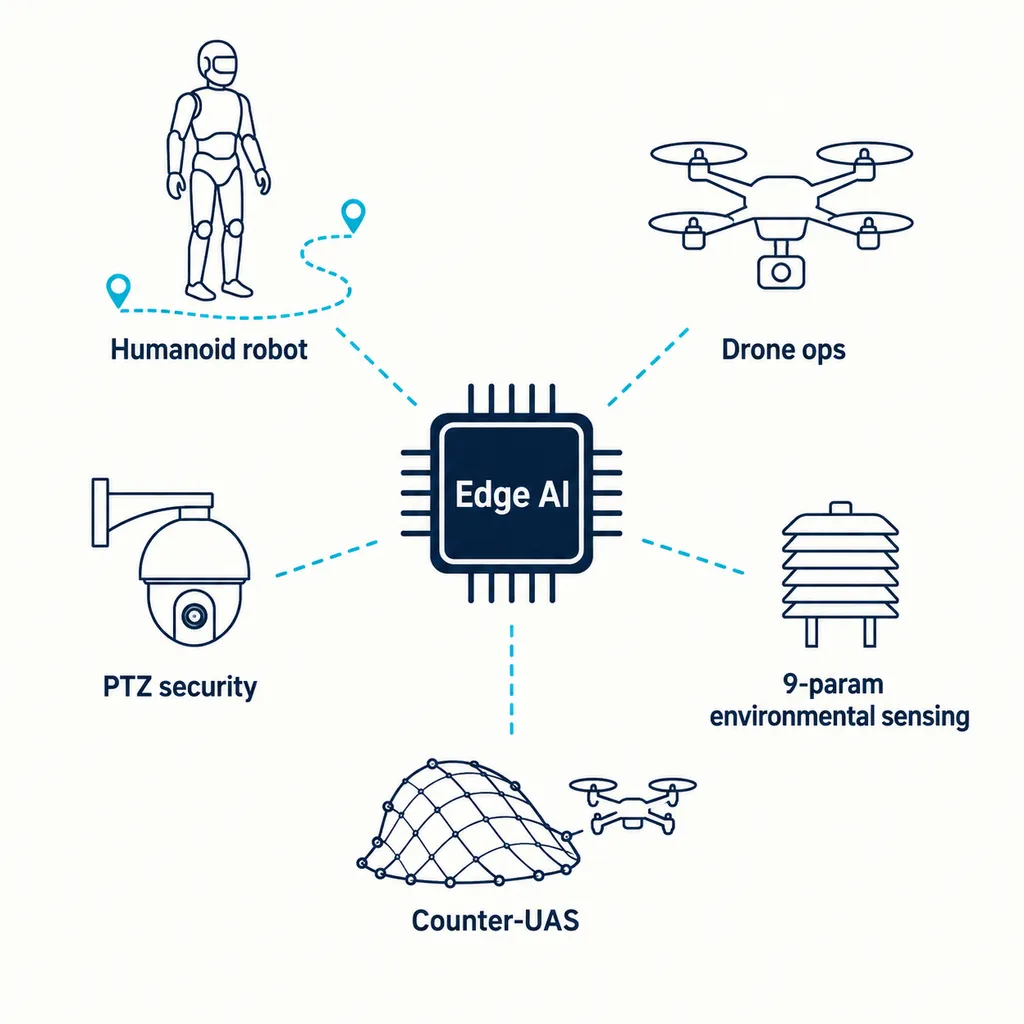
The command view presents 1 common operating picture for sensing, authorized assessment, edge-compute scheduling, and field operations. A supervisor can review event severity, node battery state, drone swap state, robot availability, weather conditions, and C-UAS authorization gates from the same workflow, reducing fragmented tool handoffs compared with a conventional setup using separate CCTV, drone, patrol, environmental, and energy portals.
For procurement teams comparing architectures, Sky Hub can reduce integration points by roughly 60-70% compared with a conventional alternative that uses 1 pole, 1 separate drone box, 1 separate CCTV cabinet, 1 met station, 1 telecom cabinet, 1 battery cabinet, and 1 robot charger. The exact percentage depends on whether the customer counts civil foundations, data backhaul, O&M software, and field-service visits as separate line items.
Representative Scenario
For a representative MENA smart-community perimeter scenario, an 88-node Sky Hub network at approximately 30 m spacing creates about 2.64 km of linear node coverage before site geometry adjustments. In this scenario, each 12 m node performs scheduled drone patrols, local anonymous perimeter analytics, wind and dust-condition reporting, and robot recharge support, while the central command team receives only event summaries and status metadata.
A typical duty cycle may allocate 7-10 kWh/day of PV replenishment to continuous sensing, communications, standby compute, and selected daytime drone or robot tasks, while the 5-20 kWh battery absorbs short-duration surges from hot-swap charging and edge inference. In sites with dust storms, extreme heat, or frequent drone sorties, SOLARTODO recommends derating the daily energy plan by 15-30% until the EPC survey confirms solar access, shading, mission frequency, and battery thermal limits.
The environmental package measures 9 parameters: wind speed, wind direction, temperature, relative humidity, atmospheric pressure, noise, PM10, PM2.5, and illuminance. These channels support site operations by correlating patrol decisions with wind thresholds, dust events, heat stress, noise complaints, and low-visibility conditions without adding a separate weather mast every 30 m.
Applications
Sky Hub is appropriate for smart communities, logistics parks, oil and gas perimeters, ports, solar farms, university campuses, airport-adjacent service roads, and critical-infrastructure zones where 24/7 local sensing and off-grid deployment are required. It is not intended as a decorative pole, a light pole, or a grid-dependent CCTV mast; its value comes from combining power, edge AI, aerial service, robot support, and controlled metadata export in 1 physical node.
Project developers can Configure your system online with height, communications, battery, AI, drone-service, and sensor parameters, then Request a custom quotation after civil drawings, local wind code, solar access, and mission assumptions are reviewed. Buyers can also Learn about topic for renewable micro-station planning and Learn about topic for smart-community edge AI architecture.
IEA reported that renewable electricity additions for 2025-2030 are projected at about 4,600 GW, with solar PV representing nearly 80% of worldwide renewable capacity expansion. This macro trend matters for Sky Hub because off-grid smart infrastructure increasingly depends on distributed PV, battery storage, and digital management rather than long trenching routes and centralized power cabinets.
IEA's Global Energy Review 2025 reported approximately 700 GW of renewable capacity additions in 2024, with nearly 80% from solar PV, while IRENA reported a 2024 utility-scale solar PV global weighted LCOE of about USD 0.043/kWh. These figures do not determine Sky Hub pricing directly, but they support the procurement logic for on-pole PV replenishment and storage-backed edge infrastructure in distributed urban and industrial environments.
EPC Investment Analysis and Pricing Structure
EPC Turnkey scope includes 5 delivery blocks: engineering design, procurement, construction, commissioning, and 1-year warranty support. For a 12 m Sky Hub project, EPC normally covers structural review, foundation coordination, pole installation, PV and battery integration, edge device configuration, communications commissioning, drone-dock functional testing, user training, and handover documentation.
| Pricing tier | Scope | Unit price range |
|---|---|---|
| FOB Supply | Equipment only, ex-works China | USD 4,030-8,840 |
| CIF Delivered | Equipment plus ocean freight and insurance | USD 4,527-9,931 |
| EPC Turnkey | Installed, commissioned, and 1-year warranty | USD 6,500-13,000 |
| Volume band | Discount basis | Indicative reduction |
|---|---|---|
| 50+ units | Approved project batch | 5% |
| 100+ units | Multi-zone procurement | 10% |
| 250+ units | Framework or citywide batch | 15% |
For an 88-unit smart-community project, the EPC investment range is approximately USD 572,000-1,144,000 before optional civil upgrades, local taxes, authority permits, and customer-specific integration. Standard payment terms are 30% T/T deposit + 70% against B/L copy, or 100% irrevocable L/C at sight; project financing can be discussed for qualified projects above USD 1,000,000, with commercial contact at [email protected].
ROI depends on the avoided cost of trenching, grid connection, manual patrols, separated drone operations, and fragmented security systems. In a representative 88-node case, avoiding 2.64 km of trenching and replacing daily manual perimeter rounds can create annual savings of USD 75,000-180,000, producing a simple payback of roughly 4-8 years depending on labor cost, mission frequency, civil conditions, and whether a conventional alternative requires multiple cabinets per 30 m segment.
Compared with a conventional pole-plus-CCTV-plus-manual-drone model, Sky Hub reduces the number of separately powered outdoor assets from about 6 devices to 1 integrated node per location. The main trade-off is that a Sky Hub node has higher upfront EPC cost than a passive camera pole, so it should be specified where at least 3 functions are needed at the same location: off-grid energy, local AI, drone service, robot support, sensing, communications, or C-UAS coordination.
Procurement Notes
SOLARTODO should confirm 7 engineering inputs before final pricing: local wind code, foundation soil data, solar resource, shading profile, drone mission frequency, communications availability, data-governance policy, and authority rules for C-UAS response. The standard 12 m configuration is suitable for many outdoor sites, but final equipment selection may change when local approvals require different battery chemistry documentation, structural calculations, or telecom certification.
The recommended buyer workflow has 4 steps: define the operating area, select the Sky Hub duty cycle, validate the 5-20 kWh energy budget, and issue a project drawing package for EPC confirmation. This process prevents overclaiming solar yield, keeps raw data local by design, and aligns procurement, engineering, and operations teams before the first 50-unit or 88-unit batch is released.
Technical Specifications
| Pole Height | 12m |
| Lighting System | 0W |
| Integrated Modules | 9-in-1 |
| PV Nameplate Capacity | 2.8-3.2kWp |
| Realistic Clear-Sky PV Peak | 1.0-1.3kW DC |
| Daily Solar Replenishment | 7-10kWh/day |
| Battery Storage | 5-20kWh |
| Wind Resistance | 150km/h |
| IP Rating | IP66 |
| Operating Temperature | -40 to +55degrees C |
| Communication | 4G/5G + LoRaWAN |
| Environmental Monitoring | 9parameters |
| Deployment Spacing | 30m typical |
| Design Life | 25years |
Price Breakdown
| Item | Quantity | Unit Price | Subtotal |
|---|---|---|---|
| 12m tapered smart pole structure | 1 pcs | $923 | $923 |
| Integrated vertical PV body and MPPT subsystem | 1 pcs | $980 | $980 |
| Battery storage system, 5-20 kWh class | 1 pcs | $1,450 | $1,450 |
| Drone dock with automated battery hot-swap hardware | 1 pcs | $1,850 | $1,850 |
| Jetson-class edge AI compute and local storage | 1 pcs | $1,180 | $1,180 |
| PTZ camera with local perception interface | 1 pcs | $226 | $226 |
| Environmental Sensor 9-in-1 | 1 pcs | $218 | $218 |
| Smart Cloud Gateway IoT hub | 1 pcs | $92 | $92 |
| 4G/5G + LoRaWAN communications set | 1 pcs | $460 | $460 |
| Ground robot wireless charging interface | 1 pcs | $360 | $360 |
| Accessories, breakers, surge protection, cabling | 1 pcs | $50 | $50 |
| Engineering design and project QC | 1 pcs | $520 | $520 |
| Installation and commissioning | 1 pcs | $970 | $970 |
| 1-year warranty and technical support | 1 pcs | $360 | $360 |
| Total Price Range | $6,500 - $13,000 | ||
Frequently Asked Questions
Does the 12m Sky Hub pole include street lighting?
Is the system fully solar powered?
What data leaves the pole during normal operation?
What is included in EPC Turnkey pricing and warranty?
How does non-lethal C-UAS coordination work?
Certifications & Standards

Data Sources & References
- •NREL PVWatts Version 8 documentation, National Renewable Energy Laboratory, 2025/2026 access
- •IEA Renewables 2025, International Energy Agency, Paris
- •IEA Global Energy Review 2025, International Energy Agency, Paris
- •IRENA Renewable Power Generation Costs in 2024, July 2025
- •IEC 60529 IP Code enclosure protection standard
- •IEC 61730-2:2023 PV module safety qualification standard
- •UL 1741 Edition 3 distributed energy resource equipment standard
Interested in this solution?
Contact us for a customized quote based on your specific requirements.
Contact Us