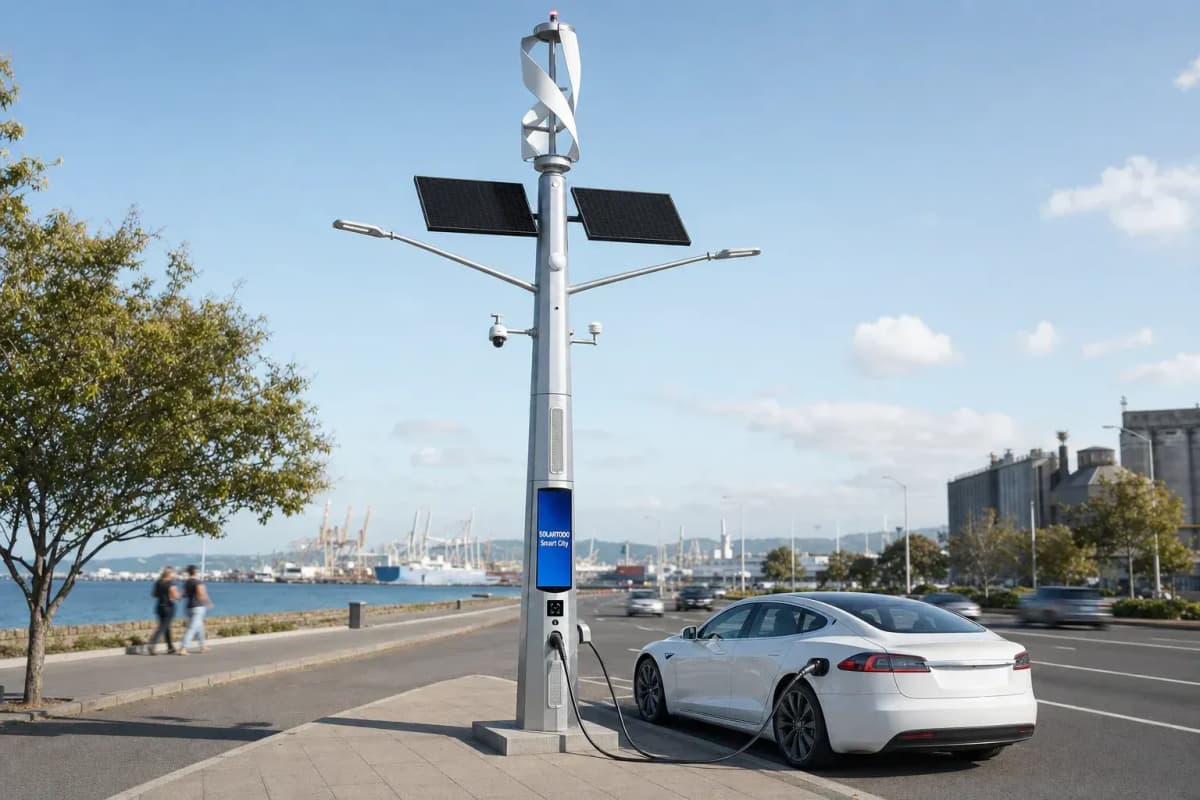
13m Wind-Solar Hybrid Smart Pole - Industrial Port Self-Powered Infrastructure
Key Features
- 13m octagonal tapered hot-dip galvanized steel pole with 45cm base diameter and 15cm top diameter
- Hybrid self-powered architecture with 400W helical VAWT, 400W PV, 15kWh LFP battery, MPPT, and backup grid tie
- Integrated 2.2m pole-as-EV-charger base with 7kW Type 2 AC charging, OCPP 1.6J, 5m cable, touchscreen, and E-stop
- Twin 1.5m symmetric arms with 2 × 80W LED luminaires delivering about 24,000lm at 150lm/W and 4000K
- 10-in-1 port infrastructure node with camera, 8-parameter sensor, 2 × 30W IP audio columns, P3 display, WiFi 6, 5G, GbE, and LoRaWAN
The 13m Wind-Solar Hybrid Smart Pole combines a 400W helical VAWT, 400W monocrystalline PV, 15kWh LFP battery, 160W LED lighting, 7kW OCPP EV charging, surveillance, sensing, audio, display, and 5G/LoRaWAN communications in 1 integrated industrial-port pole. Its lower 2.2m steel body functions as the EV charging cabinet, reducing separate civil foundations and roadside equipment count for 32m spacing layouts.
Description
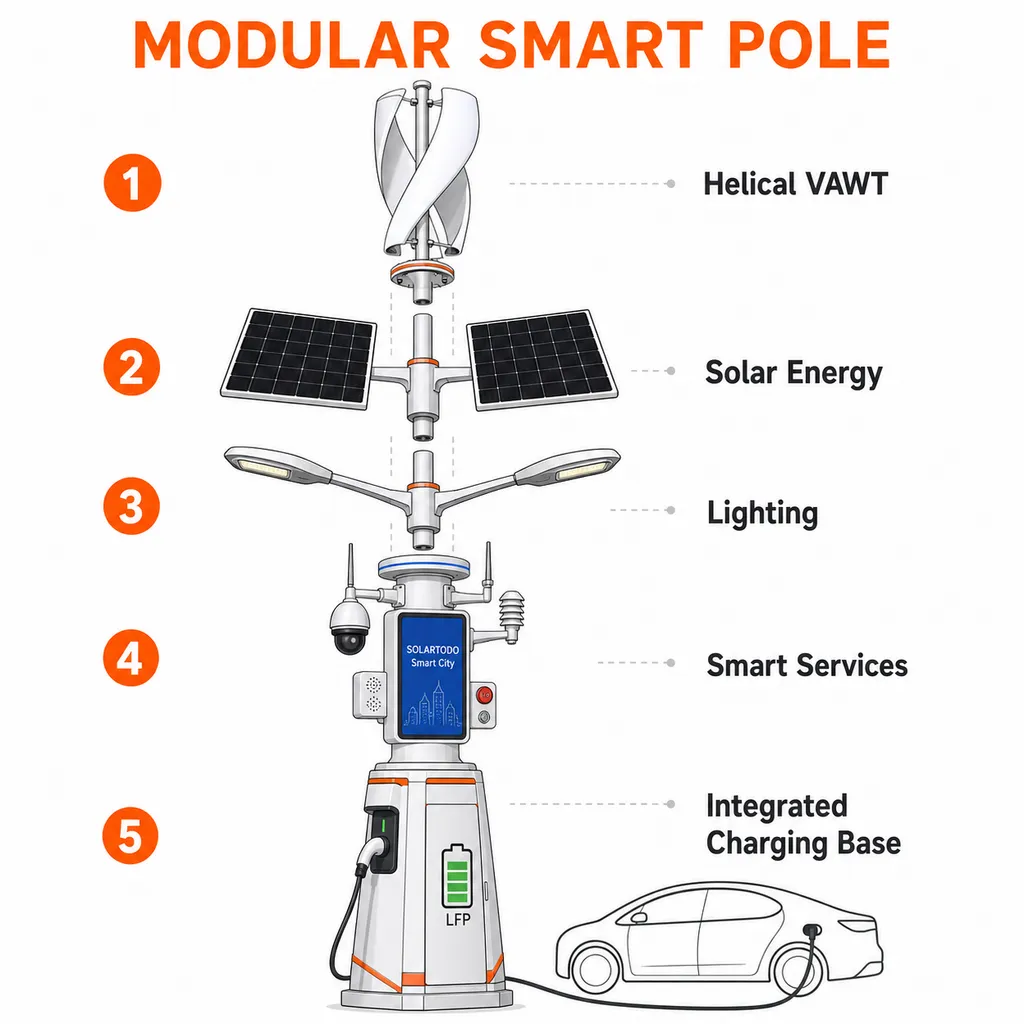
The 13m Wind-Solar Hybrid Smart Pole · Industrial Port is a 10-in-1 smart streetlight platform for ports, bonded warehouses, container yards, industrial parks, and perimeter logistics roads that require lighting, EV charging, surveillance, sensing, display, audio, and communications from 1 engineered pole. Each 13m octagonal tapered steel structure integrates a 400W Gorlov-type vertical-axis wind turbine, 2 × 200W monocrystalline solar modules, a 15kWh LFP battery, 2 × 80W LED luminaires, a 7kW OCPP charger, a 4MP camera, an 8-parameter environmental sensor, and WiFi 6/5G/LoRaWAN connectivity for 32m pole spacing.
SOLARTODO positions this model within the Smart Streetlight 10-in-1 Multi-function Pole product line, where ports can standardize illumination, communication, safety, and distributed energy assets across 50, 100, or 250-unit procurement phases. The design follows an encyclopedia-style infrastructure approach: every module is mapped to a measurable function, every power load is sized in watts or kilowatt-hours, and every interface can be evaluated against IEC 60598 luminaire safety, IEC 62196-2 AC charging connectors, IEEE 1547 grid-interconnection principles, and GB/T 37024 smart lighting terminology.
Industrial Port Use Case
A port road typically combines 24-hour vehicle movement, 4000K work-zone visibility, CCTV evidence capture, public-address warnings, and localized charging for patrol carts or light-duty service vehicles. This 13m pole addresses those 5 operational demands with 1 continuous hot-dip galvanized steel body, a base diameter of 45cm, a top diameter of 15cm, twin 1.5m luminaire arms, and a lower 2.2m integrated EV cabinet that is welded into the pole instead of added as a separate pillar.
The most important structural distinction is the integrated pole-as-charger layout: the lower 2.2m of the pole is the AC charging cabinet, so the touchscreen, emergency stop, 5m coiled cable, maintenance door, metering electronics, breakers, and OCPP 1.6J controller share the same steel enclosure. Compared with a conventional layout using 1 lighting pole, 1 EV pedestal, 1 display frame, 1 speaker column, and 1 surveillance mast, the integrated design can reduce above-ground equipment points by about 60% and civil foundation count by about 40% in a 10-pole roadway segment.
System Architecture
The upper energy layer uses a 400W Gorlov-type helical vertical-axis wind turbine with 3 twisted white aluminum blades, a rotor envelope of 70cm diameter × 100cm height, and a red aviation LED at the apex. The mid-height solar layer uses 2 deep-black 200W monocrystalline modules on symmetric east-west A-frame brackets at 15° tilt, which balances morning and afternoon production for industrial shift schedules instead of optimizing only for a single noon peak.
The power chain routes hybrid generation into an MPPT controller and a 15kWh LFP battery inside the reinforced base cavity. NREL PVWatts version 8.5.2 documents fixed PV modeling with modern resource datasets and 30-year weather variability, which is relevant when estimating the 400W PV subsystem in port climates; IRENA's 2024 cost report also records a global utility-scale solar PV LCOE near USD 0.043/kWh and battery storage installed-cost declines of 93% from 2010 to 2024, supporting the economic rationale for hybrid distributed assets.
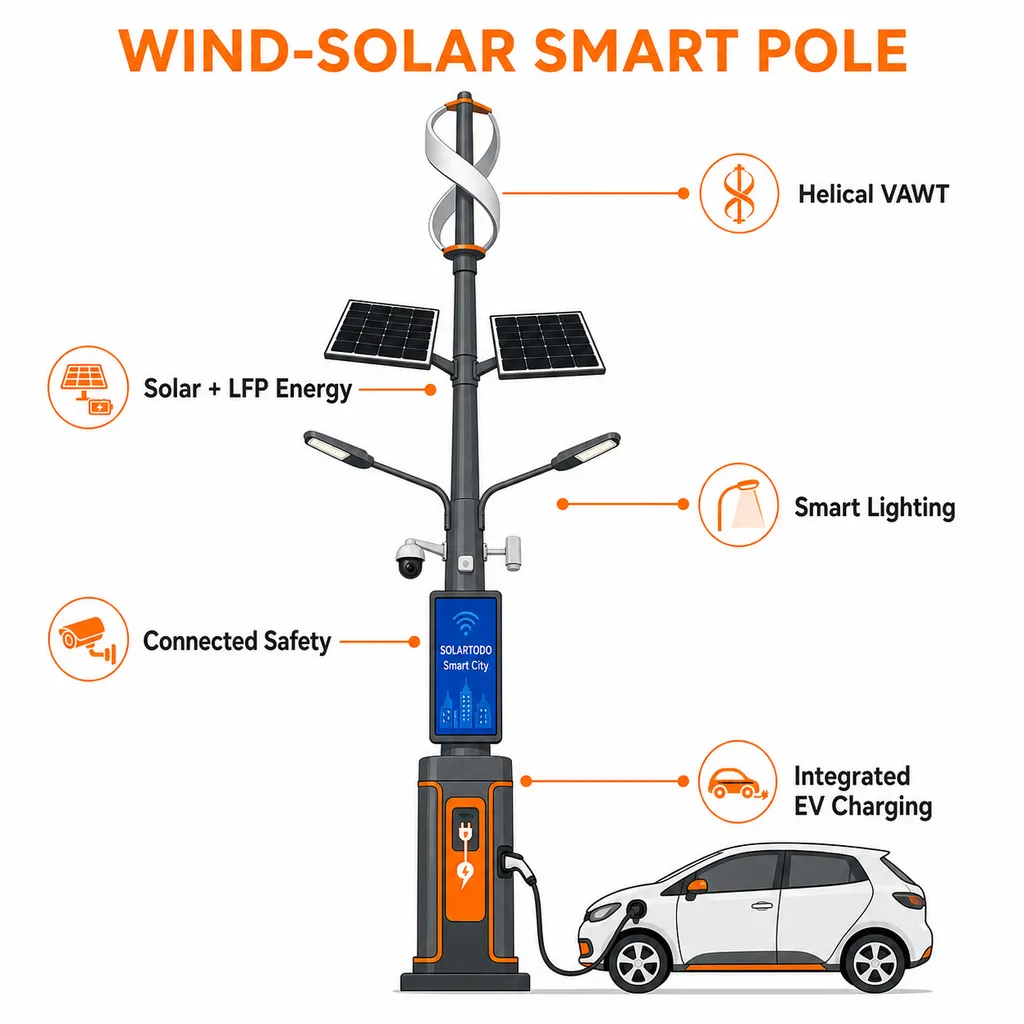
The load layer is intentionally segmented into 6 priority groups: safety lighting, security camera, emergency intercom, communication gateway, LED display, and EV charging. The 2 × 80W luminaires produce up to 24,000lm at 150lm/W with 4000K neutral-white output, while the 4MP bullet camera uses a 30cm arm and 50m infrared range to monitor container lanes, berth access roads, or gatehouse queues.
Technical Specifications
The pole is an octagonal tapered steel structure with a 13m overall height, 45cm base diameter, 15cm top diameter, silver-grey hot-dip galvanized finish, and module faces arranged around flat facets for wind, solar, lighting, camera, audio, display, and communications. The geometry is suitable for 32m spacing calculations where 2 luminaires per pole create symmetric road coverage and reduce dark patches near truck turning radii.
| Subsystem | Specification | Quantity |
|---|---|---|
| Pole body | 13m octagonal tapered steel, 45cm to 15cm | 1 |
| Wind generation | 400W helical VAWT, 70cm × 100cm | 1 |
| Solar generation | 200W monocrystalline panel, 15° tilt | 2 |
| Battery | 15kWh LFP with MPPT controller | 1 |
| Lighting | 80W LED, 150lm/W, 4000K | 2 |
| EV charging | 7kW AC, Type 2, OCPP 1.6J | 1 |
| Camera | 4MP bullet, 50m IR | 1 |
| Audio | 30W IP column, 93dB | 2 |
| Display | P3 LED, 1000mm × 2000mm, >6000cd/m² | 1 |
The LED advertising display is a P3 portrait screen sized 1000mm × 2000mm with more than 6000cd/m² brightness for daylight readability in container terminals and industrial roads. Its specified content is limited to SOLARTODO Smart City in white sans-serif text on a deep-blue background, which keeps the industrial model aligned with safety-zone readability rather than uncontrolled media playback.
Integrated EV Charging Cabinet
The integrated 7kW AC charger supports Type 2 output, OCPP 1.6J back-office communication, 1 single gun, a 5m coiled cable, touchscreen operation, emergency stop, and a maintenance door within the lower pole body. IEC 62196-2 is the relevant connector standard for AC charging couplers, while UL 2231 and IEC 61851 concepts are typically considered during project-level protection, residual-current detection, and electric-vehicle conductive charging reviews.
For port fleet planning, a 7kW AC outlet can add roughly 7kWh in 1 hour before charger losses, which is adequate for light maintenance carts, inspection vehicles, parking management vehicles, and certain last-mile service vehicles. The charger is not presented as a high-power DC fast charger, and the design intentionally avoids an extra charging port to preserve cabinet volume, thermal control, and service access inside the 2.2m integrated base.
Lighting, Safety, and Surveillance
The twin symmetric arms extend 1.5m from the pole with an upward tilt of +8°, creating a balanced optical layout for bidirectional industrial roads. With 160W total LED load and 150lm/W efficacy, the luminaire set reaches about 24,000lm before optical losses, and IEC 60598 provides the luminaire safety framework that engineers normally review for electrical insulation, mechanical protection, and temperature performance.
The camera package uses 1 fixed 4MP bullet camera with 50m infrared coverage on a 30cm short-arm bracket. In a 32m pole-spacing plan, that 50m IR range can overlap adjacent pole zones by approximately 18m under simplified straight-road geometry, giving security teams more continuous night monitoring than isolated 20m camera pockets.
The emergency package includes a one-press SOS button, dual-way audio intercom, and visual LED indicator at the pole base. In a port environment with 2 traffic directions and 3 shift patterns per day, the combination of push-button alarm, intercom, and IP audio reduces the number of separate emergency pedestals, cable pulls, and junction boxes required along the same 320m route.
Environmental Monitoring and Communications
The top environmental sensor measures 8 parameters: temperature, humidity, wind, pressure, noise, PM2.5, PM10, and illuminance. These variables help facility teams correlate lighting schedules, dust events, storm warnings, worker exposure, and camera visibility with measurable data instead of relying only on manual observation logs.
The communication package integrates dual-mode WiFi 6 and 5G gateway functions with GbE uplink and LoRaWAN support on a flat pole face at 8.7m. The color-matched flush housing is specified so the silver-grey finish flows across the device and pole boundary, reducing protrusion count and keeping the 13m structure visually consistent with industrial infrastructure rather than looking like separate bolted equipment.
The 2 IP audio columns are 30W, 93dB TCP/IP networked speakers in slim vertical perforated aluminum tubes with a 10cm diameter and 50cm height. Because 2 speakers mount symmetrically against opposite flat pole faces, warnings can be broadcast in 2 directions across loading lanes, berth roads, or security checkpoints without installing separate PA masts.
Cloud Monitoring
Cloud monitoring aggregates 10 asset categories from each pole: lighting, wind generation, solar generation, battery, EV charging, camera status, sensor readings, audio, display, and communications. The OCPP 1.6J charger interface, 5G/WiFi 6 backhaul, and LoRaWAN endpoint layer allow the owner to separate EV energy records, lighting schedules, maintenance alarms, and environmental telemetry inside a single dashboard.
IEEE 1547 is relevant when the backup grid-tie or distributed energy interface is evaluated at project level, because grid interconnection requires defined voltage, frequency, abnormal-condition, and anti-islanding behavior. The pole itself is a packaged smart-infrastructure node, while the final protection relays, metering scheme, and utility acceptance rules should be confirmed against the local grid code for each 50-unit or 100-unit project.
Representative MENA Port Scenario
For a representative MENA industrial port scenario, assume 76 units installed along approximately 2.43km of internal roads at 32m spacing, with each pole carrying 160W of LED load for 12 night hours, or 1.92kWh per night before control savings. Across 76 poles, lighting energy demand is about 146kWh per night, while the 15kWh battery per pole creates 1.14MWh of distributed storage capacity across the site.
If dimming controls reduce average LED output by 35% during low-traffic hours, annual lighting energy can fall from roughly 53,300kWh to about 34,600kWh for the 76-pole lighting load. At an assumed industrial tariff of USD 0.12/kWh, that lighting-control effect alone represents about USD 2,240/year in avoided energy cost, before counting avoided trenching, reduced separate equipment foundations, or EV charging revenue.
Hybrid production depends on measured wind regime, solar resource, temperature, dust, and shading, so SOLARTODO recommends confirming yield with at least 12 months of weather data or an NREL-style typical meteorological year for PV estimation. IEA renewable-market analysis and IRENA cost data both show solar and wind as mainstream infrastructure technologies in 2024 and 2025, but project bankability still depends on local capacity factor, maintenance access, corrosion class, and grid-tariff structure.
Comparison With Conventional Alternatives
A conventional port deployment may use 1 galvanized lighting pole, 1 camera pole, 1 emergency call box, 1 EV pedestal, 1 advertising frame, 1 PA speaker mast, and 1 communication cabinet for every functional cluster. The SOLARTODO 13m hybrid pole consolidates those 7 equipment categories into 1 primary structure, which can reduce discrete above-ground assets by about 86% for that cluster and simplify asset inspection from 7 serial numbers to 1 pole-level maintenance record.
Cable savings are project-specific, but a 320m road section with 10 integrated poles can avoid separate low-voltage branches for 10 EV pedestals, 10 PA posts, and 10 camera masts when compared with a dispersed design. That consolidation is especially valuable where port operators must manage 24-hour access control, 12m truck lanes, underground utilities, salt exposure, and phased construction windows of 30 to 90 days.
EPC Investment Analysis and Pricing Structure
EPC turnkey delivery includes 5 work packages: engineering, procurement, construction, commissioning, and 1-year warranty support. Engineering covers pole layout, foundation drawings, electrical single-line diagrams, lighting calculations, network topology, and charger-interface planning; procurement covers factory equipment, FAT/QC, packing, and documentation; construction covers foundations, crane erection, cabling, termination, grounding, and site safety; commissioning covers lighting scenes, OCPP charger connection, sensor calibration, camera checks, display verification, and cloud handover.
| Pricing tier | Scope | Unit price range |
|---|---|---|
| FOB Supply | Equipment only, ex-works China | USD 992-3,944 |
| CIF Delivered | Equipment plus ocean freight and insurance | USD 1,114-4,431 |
| EPC Turnkey | Installed, commissioned, and covered by 1-year warranty | USD 1,600-5,800 |
| Order volume | Discount from applicable tier | Typical procurement use |
|---|---|---|
| 50+ units | 5% | Pilot terminal road or 1 operating zone |
| 100+ units | 10% | Multi-road port-yard phase |
| 250+ units | 15% | Full industrial-park or port-campus rollout |
A representative ROI model should compare 3 avoided cost groups: energy, civil works, and separate device maintenance. For 76 poles, 35% lighting dimming at USD 0.12/kWh can save about USD 2,240/year in lighting energy, while the integrated structure can also avoid 76 separate EV pedestals and 152 separate audio posts; if each avoided foundation and low-voltage branch saves USD 120 to USD 250, the civil-work reduction can materially shorten payback versus a fragmented design.
The payback period is usually driven less by the 400W PV and 400W wind generation alone and more by combined savings from reduced trenching, reduced cabinet count, fewer maintenance visits, lower lighting energy, and faster installation. For planning purposes, SOLARTODO recommends evaluating a 5-year to 8-year infrastructure payback window for industrial sites with high labor costs, 24-hour lighting demand, and 50-unit or larger installation scale.
Standard payment terms are 30% T/T deposit plus 70% against bill of lading, or 100% irrevocable L/C at sight for approved buyers. Project financing can be discussed for orders above USD 1,000K, and procurement teams can request a custom quotation or email [email protected] with layout drawings, road length, wind data, EV charging requirements, and target Incoterms.
Specification and Procurement Guidance
Engineers should verify 6 site inputs before final order release: basic wind speed, corrosion environment, soil bearing capacity, available grid tie, night lighting class, and network coverage. The hot-dip galvanized silver-grey finish is the standard original finish, but coastal ports may require additional coating specifications, stainless fasteners, and maintenance intervals tied to local chloride exposure.
Procurement teams can configure the system online by selecting height, module mix, lighting wattage, charger type, communication mode, display format, and monitoring requirements. For deeper background on hybrid public infrastructure, review Learn about topic, and for smart-pole planning terminology, review Learn about topic before finalizing a 50-unit bill of materials.
Factory acceptance should include at least 9 inspection records: pole dimensional check, galvanization visual check, luminaire power test, battery BMS test, MPPT charging test, OCPP charger communication test, display brightness test, camera video test, and gateway connectivity test. Site acceptance should repeat 7 operational tests after installation: grounding, insulation, lighting scene, EV charging, emergency intercom, cloud telemetry, and night camera IR.
Standards and Compliance Notes
IEC 60598 is cited for luminaire safety, IEC 62196-2 for AC charging connectors, IEEE 1547 for distributed-energy interconnection principles, GB/T 37024 for smart-lighting terminology, and NREL PVWatts for PV yield methodology. These references do not replace local permitting, because ports in 2 countries can apply different grounding, fire, grid, wireless, and roadway-lighting rules even when the equipment configuration is technically identical.
For buyers comparing 13m, 12m, and 10m poles, the 13m version is best suited where camera line-of-sight, display visibility, turbine clearance, and twin-arm road coverage are all required from 1 asset. Smaller sites may prioritize lower pole heights, but an industrial port with 32m spacing and 24-hour operations usually benefits from the added clearance, integrated cabinet volume, and multi-directional module placement.
Technical Specifications
| Pole Height | 13m |
| Pole Type | Octagonal tapered steel, base Ø45cm to top Ø15cm |
| Integrated Modules | 10-in-1 |
| Wind Turbine | 400W Gorlov-type helical VAWT, Ø70cm × 100cm |
| Solar Array | 2 × 200W monocrystalline panels at 15° tiltW |
| Battery Capacity | 15kWh |
| EV Charging | 7kW AC Type 2, OCPP 1.6J, 5m cable |
| LED Power | 160W |
| Luminous Efficacy | 150lm/W |
| Color Temperature | 4000K |
| Camera | 4MP bullet camera with 50m IR |
| Environmental Sensor | 8 parameters: temperature, humidity, wind, pressure, noise, PM2.5, PM10, illuminance |
| Audio | 2 × 30W IP column speakers, 93dB |
| LED Display | P3 portrait screen, 1000 × 2000mm, >6000cd/m² |
| Communication | WiFi 6 + 5G gateway + GbE uplink + LoRaWAN |
| Wind Resistance | 150km/h |
| IP Rating | IP66 |
| Operating Temperature | -40 to +55°C |
| Energy Saving | 65% |
| Design Life | 25years |
| Recommended Spacing | 32m |
Price Breakdown
| Item | Quantity | Unit Price | Subtotal |
|---|---|---|---|
| 13m integrated octagonal galvanized steel pole and EV cabinet | 1 pcs | $1,200 | $1,200 |
| 400W Gorlov-type helical VAWT with aviation LED | 1 pcs | $280 | $280 |
| 200W monocrystalline solar panel with A-frame bracket | 2 pcs | $80 | $160 |
| 15kWh LFP battery pack with MPPT controller | 1 pcs | $1,600 | $1,600 |
| 80W LED luminaire on twin symmetric arm | 2 pcs | $90 | $180 |
| 4MP bullet camera with 50m IR bracket | 1 pcs | $94 | $94 |
| 8-in-1 environmental sensor | 1 pcs | $201 | $201 |
| 30W IP audio column speaker | 2 pcs | $92 | $184 |
| Visual SOS emergency call and intercom module | 1 pcs | $134 | $134 |
| 7kW OCPP 1.6J Type 2 AC EV charger module | 1 pcs | $201 | $201 |
| P3 vertical LED display 1000mm × 2000mm | 1 pcs | $550 | $550 |
| WiFi 6, 5G, GbE, and LoRaWAN gateway assembly | 1 pcs | $240 | $240 |
| Accessories, cables, breakers, and surge protection | 1 pcs | $50 | $50 |
| Engineering, lighting layout, drawings, and QC | 1 pcs | $160 | $160 |
| Installation and commissioning | 1 pcs | $320 | $320 |
| 1-year warranty and support allowance | 1 pcs | $63 | $63 |
| Total Price Range | $1,600 - $5,800 | ||
Frequently Asked Questions
What makes the 13m Wind-Solar Hybrid Smart Pole different from a normal smart pole?
How much energy storage and generation does each pole include?
What does EPC turnkey pricing include and what warranty is included?
Which standards are relevant for engineering review?
What information is needed for a 50-unit or 100-unit quotation?
Certifications & Standards


Data Sources & References
- •NREL PVWatts Version 8.5.2, 2025
- •IRENA Renewable Power Generation Costs in 2024
- •IEA Renewables market analysis, 2025
- •IEC 60598 luminaires standard
- •IEC 62196-2 EV charging connector standard
- •IEEE 1547 distributed energy resource interconnection standard
- •GB/T 37024 smart lighting terminology
Interested in this solution?
Contact us for a customized quote based on your specific requirements.
Contact Us