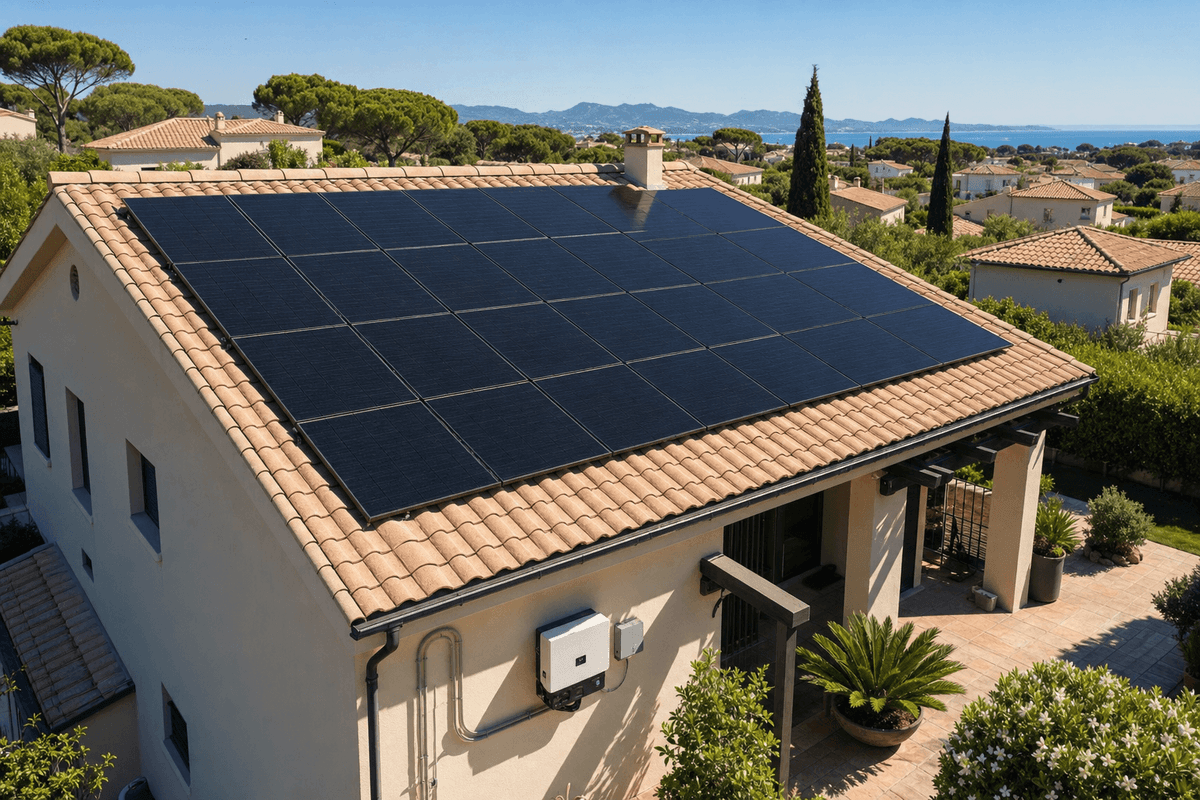
10kW Residential Rooftop TOPCon Solar PV System - 24.5% Module Efficiency
Key Features
- 10 kWp fixed residential rooftop PV system using N-type mono TOPCon modules up to 24.5% efficiency
- Estimated 14.5 MWh/year generation with a 16.6% capacity factor under typical residential planning assumptions
- About 50 m² roof area required, reducing area by roughly 13-18% versus 20.5-21.5% PERC modules
- EPC turnkey price range of $5,800-$7,500 including installation, commissioning, and 1-year support
- TOPCon degradation profile below 1.0% in year 1 and below 0.4% annually, with 87.4% output at year 30
The 10kW Residential Rooftop TOPCon Solar PV System uses N-type mono TOPCon modules with up to 24.5% efficiency, a fixed rooftop array, and a residential string or micro-inverter architecture. EPC turnkey pricing is $5,800-$7,500 for a 10 kWp system designed for about 14.5 MWh/year generation and IEC 61215/61730-aligned module compliance.
Description
The 10kW Residential Rooftop TOPCon Solar PV System is a 10 kWp fixed-array package using N-type mono TOPCon modules rated up to 24.5% efficiency, residential inverter protection, rooftop mounting, AC/DC cabling, monitoring, commissioning, and a 1-year EPC support scope. In a typical 1,400-1,800 kWh/kWp solar-resource band, the system is configured for about 14.5 MWh/year, a 16.6% capacity factor, and an EPC turnkey price range of $5,800-$7,500 from SOLARTODO.
This product page is written for EPC buyers, residential developers, electrical contractors, and procurement teams comparing 10 kW rooftop PV packages across 3 cost boundaries: FOB supply, CIF delivered, and EPC turnkey. For the full category catalog, see View all Solar PV System products, or use Configure your system online to model roof area, inverter ratio, and annual kWh output before issuing a purchase request.
System Overview
The 10 kW Residential Rooftop TOPCon system is built around N-type tunnel oxide passivated contact cell technology, which typically reaches 22.5-24.5% module efficiency in mass production and has lower light-induced degradation than many P-type PERC alternatives. With 18 modules of approximately 550 W each, the array reaches about 9.9-10.0 kWp DC nameplate while using roughly 50 m² of usable roof area after access pathways, setbacks, and mounting clearances are considered.
TOPCon is selected because a 24.5% module reduces array area by about 13-18% compared with a conventional 20.5-21.5% mono PERC module at the same 10 kW system size. On constrained residential roofs, this difference can determine whether 10 kWp fits on 2 roof planes instead of requiring 3 roof planes, which can lower mounting, cable, and labor complexity by 5-12% depending on rafter layout and conduit routing.
The system uses a fixed rooftop mounting structure because fixed tilt has fewer moving parts than tracker-based PV and is normally the lowest-risk option for 25+ year residential service. Fixed arrays also avoid tracker drive motors, controller boards, and wind-stow operations, so the residential maintenance scope can remain limited to 1-2 visual inspections per year, inverter event review, torque checks where required, and periodic cleaning in dusty regions.
System Architecture
The standard electrical architecture uses 10 kWp DC input, 1 residential string inverter or multiple micro-inverters, Type II surge protection where required, DC isolators, AC breaker integration, revenue-grade or app-based monitoring, and a grid-interconnection-ready AC output. For a 230 V or 240 V single-phase home, the inverter is typically sized around 8-10 kW AC, giving a DC/AC ratio of about 1.0-1.25 depending on local utility clipping rules and roof orientation.
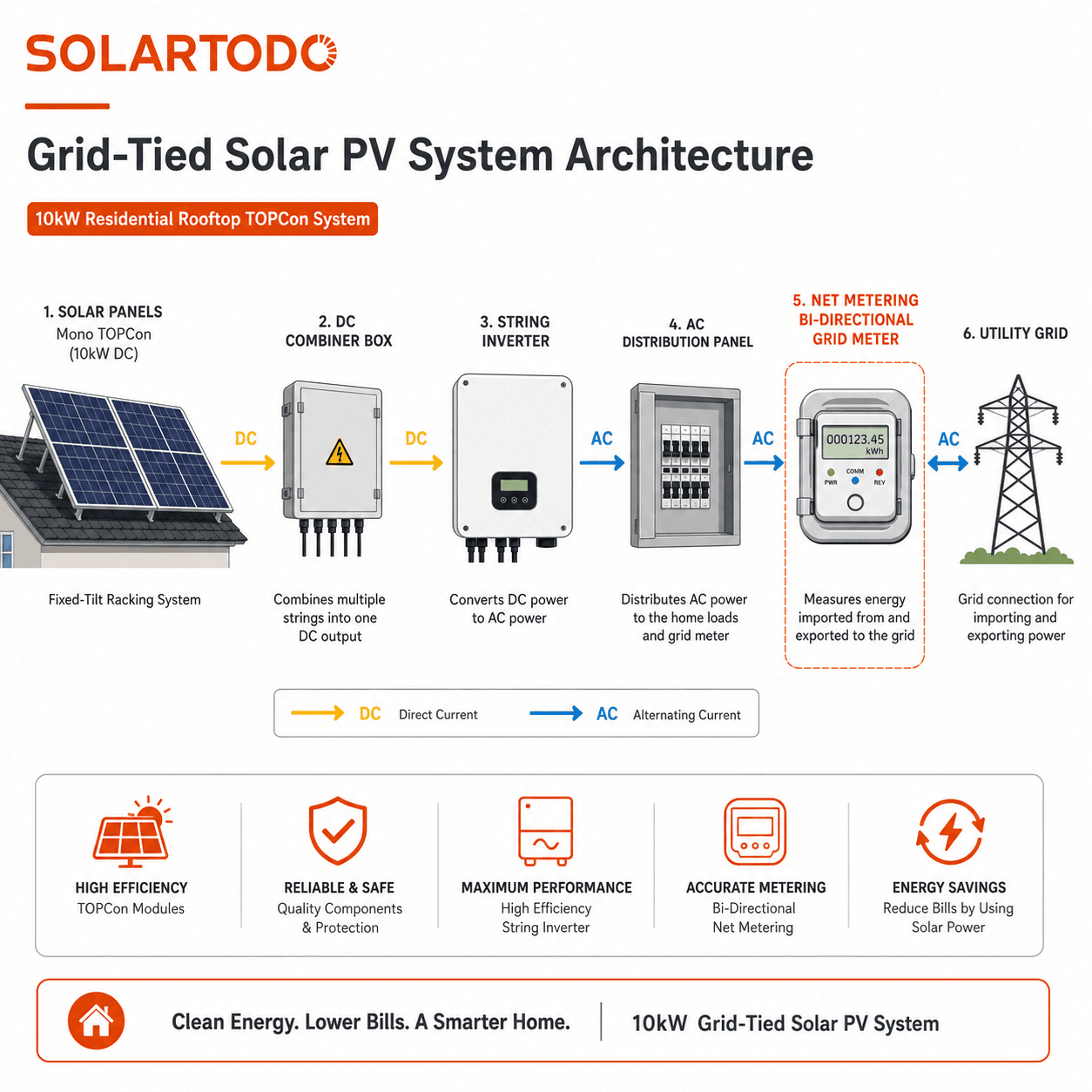
A typical residential configuration connects 2 strings of 9 modules or optimizer-based module strings, depending on shade risk and inverter voltage window. The design target is to keep string voltage below local maximum DC limits, commonly 600 V or 1,000 V depending on jurisdiction and equipment certification, while maintaining enough operating voltage for reliable morning and high-temperature inverter startup.
The mounting subsystem includes rails, roof hooks or L-feet, mid clamps, end clamps, grounding clips, flashing, and stainless hardware selected for wind exposure and roof material. For a 10 kW array using about 18 modules, the installed dead load is commonly near 12-18 kg/m², but final structural suitability should be confirmed against local code, roof age, rafter spacing, and site wind/snow values before procurement.
Technical Specifications
| Parameter | Value |
|---|---|
| DC capacity | 10 kWp |
| Module technology | N-type mono TOPCon |
| Module efficiency | 24.5% maximum design input |
| Array type | Fixed residential rooftop |
| Estimated annual generation | 14.5 MWh/year |
| Capacity factor | 16.6% |
| Required roof area | About 50 m² |
| CO2 offset | About 5.8 tons/year at 0.40 kg CO2/kWh |
| Warranty baseline | 25-year panels, 10-year inverter |
| EPC turnkey price | $5,800-$7,500 |
The annual-generation estimate uses a conservative residential planning value rather than a single perfect-site claim, because actual yield can vary by 20-35% across latitude, azimuth, shading, soiling, and inverter clipping. Buyers can validate the 10 kW production case using NREL PVWatts, which is widely used for PV production modeling in the United States and supports location-specific irradiance, tilt, azimuth, system loss, and AC output calculations.
Module compliance should be checked against IEC 61215 for crystalline silicon design qualification and IEC 61730 for PV module safety qualification; inverter anti-islanding and grid-support behavior should be reviewed against the applicable local version of IEC 62116, UL 1741, IEEE 1547, or utility interconnection rules. The IEC standards catalog identifies IEC 61215 as terrestrial PV module design qualification and IEC 61730 as PV module safety qualification, both of which are central requirements for bankable 25-year PV procurement.
TOPCon Module Performance
N-type TOPCon technology uses a passivated contact layer to reduce recombination losses, improving open-circuit voltage and energy yield compared with many older PERC products. In procurement terms, a 10 kW TOPCon package can deliver the same nameplate capacity with fewer modules, fewer clamps, and less roof surface than a lower-efficiency alternative, while first-year degradation is typically specified below 1.0% and annual degradation below 0.4%.
A 30-year TOPCon power warranty commonly retains about 87.4% of initial output at year 30, while many legacy P-type products use steeper annual degradation assumptions. For a 10 kW residential system, the difference between 0.4% and 0.55% annual degradation can exceed 5 MWh over 30 years, which is financially material when household retail electricity prices are $0.12-$0.30/kWh.
Bifacial 210 mm N-type wafer modules can provide 10-20% rear-side gain in high-albedo ground-mount settings, but residential rooftop gain is usually lower because asphalt, tile, or metal roofs provide limited rear irradiance. SOLARTODO therefore treats bifacial gain as optional upside, not as a guaranteed yield input, and sizes the 10 kW residential package on front-side STC nameplate power for a more bankable procurement calculation.
Cloud Monitoring
The monitoring package tracks inverter status, daily kWh, monthly kWh, string or module-level alarms where supported, AC output, and fault history. For a 10 kW residential rooftop array, monitoring can identify a 5-15% energy shortfall within 1 billing cycle when compared against weather-normalized expectations, which is faster than waiting 6-12 months for utility bills to reveal underperformance.
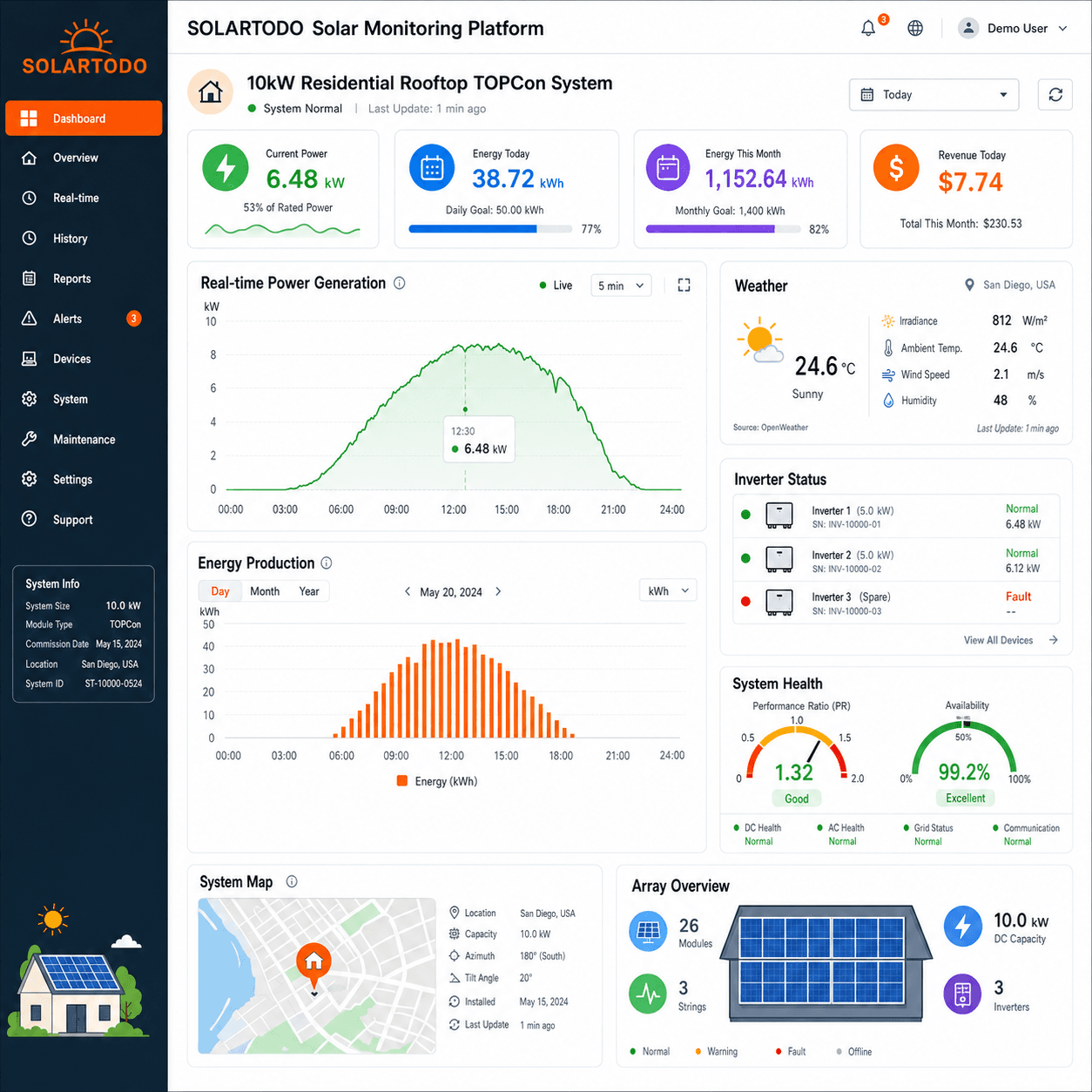
A cloud-connected inverter or gateway also supports commissioning records, warranty diagnosis, and owner-facing production dashboards across 365 days/year. For residential developers building 50+ homes, centralized monitoring can reduce truck rolls by 10-25% because many inverter events, communication issues, and production anomalies can be triaged remotely before dispatching a field technician.
EPC Investment Analysis and Pricing Structure
EPC turnkey scope includes 5 execution blocks: engineering, procurement, construction, commissioning, and warranty handover. For this 10 kW package, engineering covers roof layout, string design, inverter sizing, safety labeling, bill of materials, and grid-connection drawings; procurement covers modules, inverter, racking, AC/DC protection, cables, and monitoring; construction covers mounting, wiring, grounding, inverter installation, and AC tie-in; commissioning covers insulation checks, polarity checks, inverter startup, and production verification.
| Pricing tier | Scope | Price range |
|---|---|---|
| FOB Supply | Equipment only, ex-works China | $3,596-$5,100 |
| CIF Delivered | Equipment plus ocean freight and insurance | $3,967-$5,627 |
| EPC Turnkey | Fully installed, commissioned, and 1-year warranty | $5,800-$7,500 |
| Volume band | Discount from listed supply baseline |
|---|---|
| 50+ systems | 5% |
| 100+ systems | 10% |
| 250+ systems | 15% |
At a mid-case EPC price of $6,532 and annual generation of 14.5 MWh, the first-year energy value is about $2,320 at $0.16/kWh and about $3,190 at $0.22/kWh. That places simple payback near 2.0-2.8 years before incentives in high-tariff regions, while the 25-year levelized energy cost is approximately $0.026/kWh using a 25-year service life and moderate residential O&M assumptions.
Compared with grid-only residential electricity at $0.16/kWh, the 10 kW TOPCon system can reduce purchased electricity by about 60-90% for a home consuming 12-18 MWh/year, depending on export-credit rules and daytime load shape. Compared with a diesel generator at 0.25-0.35 liters/kWh and $1.00-$1.30/liter fuel, rooftop PV can reduce operating energy cost by more than 70% for daytime loads while eliminating regular fuel logistics.
Payment terms are structured for B2B procurement: 30% T/T + 70% against B/L, or 100% L/C at sight for qualified orders, with project financing review available for aggregated programs above $5,000K. For a custom EPC bill of quantities, bankability file, or container-level dispatch plan, contact [email protected] or Request a custom quotation.
Application Scenario
A residential developer in the MENA region deployed 120 rooftop systems of 10 kW each across a villa community, creating 1.2 MW of distributed rooftop capacity without allocating new land for a central solar farm. Using a 1,750 kWh/kWp annual resource assumption, the portfolio can generate about 2.1 GWh/year, offset about 840 tons of CO2/year at 0.40 kg/kWh, and reduce feeder daytime demand during air-conditioning peaks.
The same system can be applied to detached homes, townhouses, staff housing, gated communities, residential microgrids, and net-metered customer sites. In each case, roof shading should be held below 5-10% annual loss where possible, because shading on even 1-2 modules can reduce string output unless module-level power electronics or optimized string layouts are used.
Standards, Bankability, and Market Context
The global PV market has shifted toward high-efficiency N-type products because land, roof area, labor, and balance-of-system costs now matter as much as module price per watt. Industry analysis from organizations such as IEA, IRENA, BloombergNEF, and Wood Mackenzie indicates that solar PV remains one of the fastest-scaling generation technologies, with TOPCon widely adopted in 2025-2026 manufacturing roadmaps.
IRENA renewable-cost reporting has shown utility-scale solar PV LCOE falling sharply over the last 10+ years, and best-location solar can now reach below $0.03/kWh under optimized financing, scale, and irradiance conditions. A 10 kW rooftop project has smaller scale and higher soft cost per watt than utility PV, but the economic comparison is often against retail electricity rather than wholesale generation, so savings remain strong in high-tariff markets.
Procurement teams should verify 6 document groups before release: module datasheets, IEC/UL certificates, inverter grid certificates, racking structural data, cable and connector ratings, and warranty terms. For technical background on PV design, degradation, and storage-ready planning, see Learn about topic, then align site-specific drawings with the local authority having jurisdiction before construction.
Procurement Guidance
For a single 10 kW household system, buyers should prioritize module efficiency, inverter service network, monitoring stability, roof waterproofing details, and final AC integration rather than only comparing $/W. For 50, 100, or 250-system programs, the commercial focus expands to container optimization, SKU standardization, spare inverter ratio, racking compatibility across roof types, and commissioning documentation that can be repeated across every site.
SOLARTODO supplies solar PV, energy storage, smart lighting, security, telecom and power towers, and smart agriculture infrastructure from 1 integrated procurement channel. For developers standardizing a 10 kW residential TOPCon platform across multiple roofs, the next step is to Configure your system online and then Request a custom quotation with roof plans, target country, grid voltage, and estimated order quantity.
Technical Specifications
| System Capacity | 10kWp |
| Module Type | mono_topcon |
| Module Efficiency | 24.5% |
| Array Configuration | fixed residential rooftop |
| Est. Annual Generation | 14.5MWh |
| Capacity Factor | 16.6% |
| System Area | 50m² |
| CO₂ Offset | 5.8tons/year |
| Payback Period | 2.0-2.8years |
| LCOE | 0.026USD/kWh |
| Warranty | 25yr panels, 10yr inverter |
Price Breakdown
| Item | Quantity | Unit Price | Subtotal |
|---|---|---|---|
| 550W N-type TOPCon solar module | 18 pcs | $99 | $1,782 |
| 10kW residential string inverter | 1 pcs | $800 | $800 |
| Fixed rooftop mounting system | 1 pcs | $800 | $800 |
| DC cables and combiner protection | 1 pcs | $200 | $200 |
| AC protection and distribution hardware | 1 pcs | $300 | $300 |
| Cloud monitoring gateway and setup | 1 pcs | $500 | $500 |
| Installation and commissioning labor | 1 pcs | $800 | $800 |
| Grid connection and permitting support | 1 pcs | $700 | $700 |
| Engineering, design, and QC documentation | 1 pcs | $350 | $350 |
| 1-Year warranty and EPC support | 1 pcs | $300 | $300 |
| Total Price Range | $5,800 - $7,500 | ||
Frequently Asked Questions
What is included in the EPC turnkey price for the 10kW Residential Rooftop TOPCon system?
How much electricity can a 10 kW TOPCon rooftop system generate per year?
Why use TOPCon modules instead of conventional PERC modules for a 10 kW roof?
Which certifications and standards should buyers verify before ordering?
Can the system be expanded with batteries or smart energy controls later?
Certifications & Standards


Data Sources & References
- •NREL PVWatts 2025
- •IEC 61215 and IEC 61730 photovoltaic module standards
- •IEA Renewables and solar PV market reporting 2025
- •IRENA Renewable Power Generation Costs reporting
- •BloombergNEF solar module technology and cost outlook
- •Wood Mackenzie PV supply chain and market analysis
Interested in this solution?
Contact us for a customized quote based on your specific requirements.
Contact Us