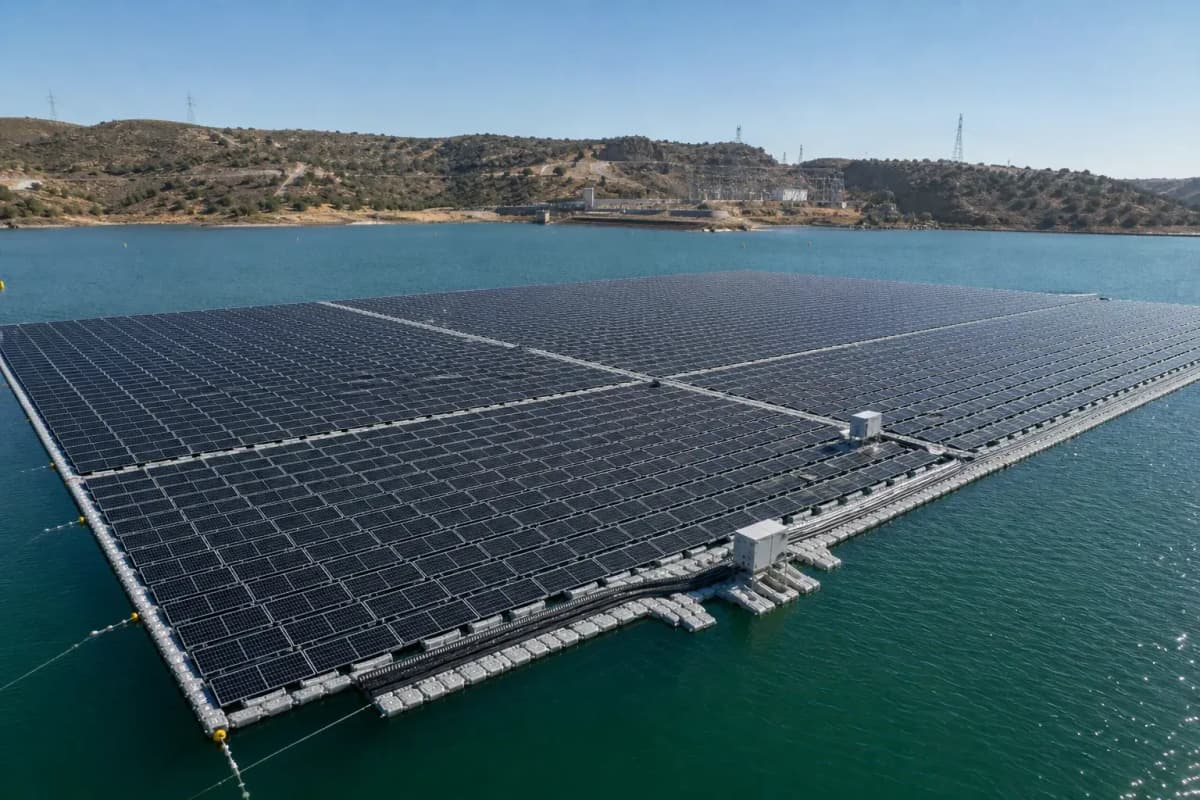
6.4MW Floating Solar Bifacial Floating - Utility FPV System
Key Features
- 6,374 kWp floating PV capacity using approximately 9,106 bifacial 700 W modules
- 21.6% module efficiency with 10-30% potential rear-side bifacial gain depending on reflected irradiance
- Estimated 11,443 MWh/year generation at a 20.5% modeled capacity factor
- EPC turnkey price range of USD 2,613,940-3,340,071, equal to about USD 0.410-0.524/Wp
- Approximate 6,294 tons/year CO2 offset using a 0.55 tCO2/MWh displaced-grid factor
The 6.4MW Floating Solar Bifacial Floating system is a 6,374 kWp floating PV plant using 21.6% bifacial modules, HDPE floats, anchored mooring, central inverters, and cloud monitoring. EPC turnkey pricing is USD 2,613,940-3,340,071 with IEC 61215, IEC 61730, IEC 62116, and UL 1703 aligned components.
Description
The 6.4MW Floating Solar Bifacial Floating system is a 6,374 kWp utility-scale floating photovoltaic plant designed for reservoirs, quarry lakes, irrigation ponds, water-treatment basins, and industrial water bodies. It combines 21.6% efficient bifacial TOPCon or HJT modules, a floating HDPE support structure, anchored mooring, 1,500 Vdc array design, central inverter conversion, and cloud-based monitoring for an estimated 11,443 MWh of annual generation at a 20.5% capacity factor.
This SOLARTODO configuration is positioned for B2B buyers who need 1 turnkey procurement route, 3 commercial delivery tiers, and standards-based documentation for bankable engineering review. For buyers comparing multi-megawatt PV options, View all Solar PV System products or Configure your system online to adjust capacity, module type, inverter ratio, mooring concept, and delivery scope in 5 structured steps.
System Architecture
The 6,374 kWp DC plant is built around approximately 9,106 units of 700 W bifacial modules, giving a nameplate DC capacity of 6.374 MWp before inverter clipping and auxiliary loads. Each module string is arranged for 1,500 Vdc operation, with combiner protection, DC isolators, surge protection devices, and inverter blocks sized for utility-scale AC export through a medium-voltage transformer and grid protection relay scheme.
Floating PV differs from ground-mount PV because the structural system has 3 active engineering layers: buoyancy, anchoring, and electrical routing above water. The floating platform uses UV-stabilized HDPE floats, anti-slip walkways, cable trays, corrosion-resistant fasteners, and anchoring lines designed around site-specific wind, wave, water-level variation, bathymetry, and shoreline pull-out loads.
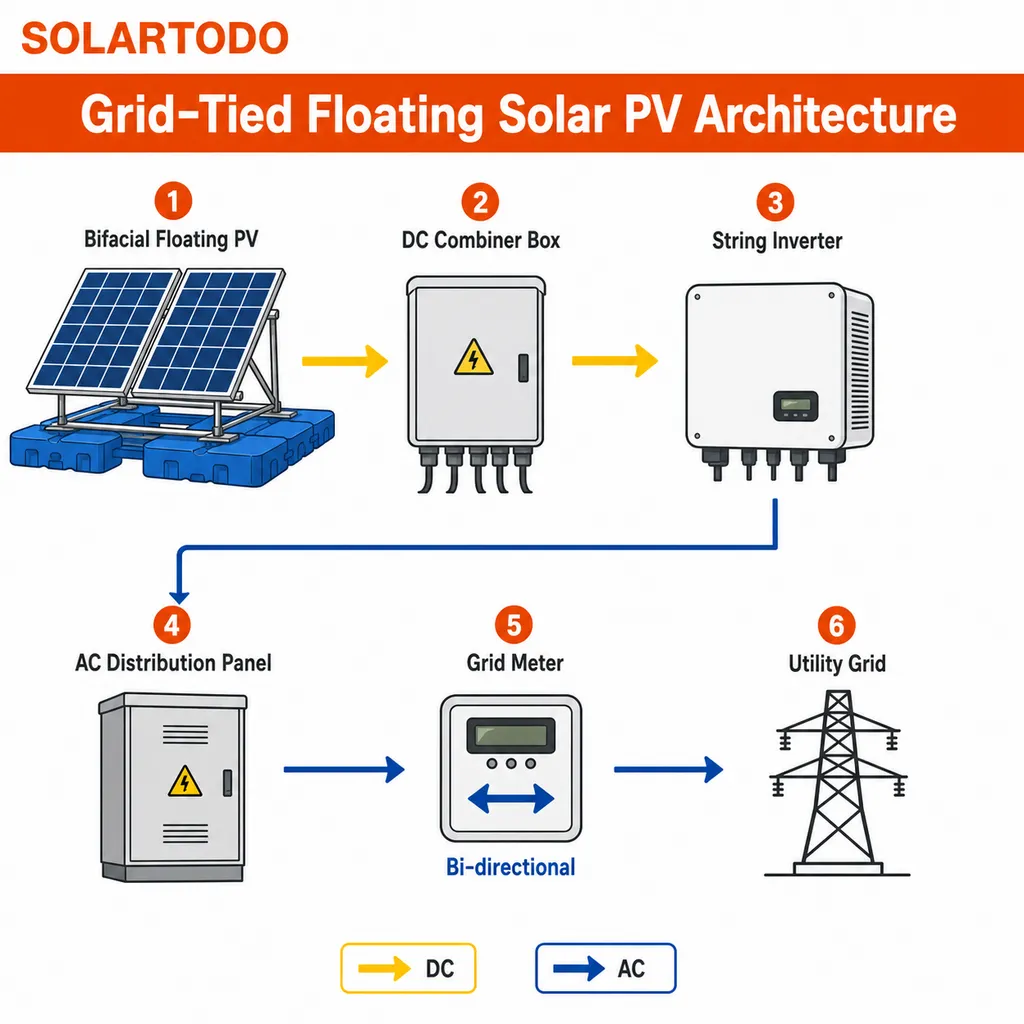
The module technology is specified as bifacial TOPCon or HJT with 21.6% front-side efficiency and a typical rear-side gain band of 10-30% where reflected light is available. On water, the rear-side irradiance is usually lower than on white gravel or snow, but the cooling effect of the water body can raise energy yield by approximately 5-10% compared with a thermally stressed roof or low-clearance ground array under similar irradiance.
The inverter architecture uses central inverters because the project is above 500 kW and requires fewer conversion stations, simplified SCADA integration, and efficient medium-voltage export. IEC 62116 anti-islanding behavior, grid-code parameterization, reactive power control, power-factor control, and low-voltage ride-through settings should be finalized after 1 interconnection study from the local utility or independent system operator.
Technical Specifications
The baseline technical model assumes 6,374 kWp DC capacity, 21.6% module efficiency, 20.5% annual capacity factor, 42,800 m2 occupied water-surface area, and 11,443 MWh/year AC generation after inverter and wiring losses. These values are representative estimates, not a site guarantee, because final production depends on 12 months of irradiance data, water temperature, soiling rate, string layout, DC/AC ratio, curtailment, and grid availability.
| Parameter | Value | Engineering note |
|---|---|---|
| DC system capacity | 6,374 kWp | Based on 9,106 modules of about 700 W each |
| Module type | Bifacial TOPCon or HJT | Rear gain typically 10-30% under suitable albedo |
| Module efficiency | 21.6% | IEC 61215 and IEC 61730 module basis |
| Array type | Floating PV | HDPE pontoons, walkways, anchors, and mooring |
| Estimated annual generation | 11,443 MWh | Uses 20.5% capacity factor assumption |
| System area | 42,800 m2 | About 4.28 hectares of water surface |
| CO2 offset | 6,294 tons/year | Uses 0.55 tCO2/MWh displaced-grid factor |
| LCOE target | USD 0.036/kWh | Site-specific finance can move this by 20% or more |
The project should be engineered under IEC 61215 for PV module design qualification, IEC 61730 for module safety, IEC 62116 for inverter anti-islanding, and UL 1703 where buyer or jurisdictional acceptance requires legacy UL module references. IEEE 1547 interconnection practices may also apply in markets where distributed energy resources must meet standardized voltage, frequency, response, and ride-through criteria at the point of common coupling.
Floating PV Performance Logic
Floating PV is selected when land is expensive, ecologically constrained, operationally unavailable, or better reserved for agriculture, buildings, roads, or industrial expansion. NREL’s 2019 floating PV assessment identified more than 24,000 suitable U.S. man-made water bodies and estimated that covering only a portion of suitable reservoirs could produce close to 10% of U.S. annual electricity generation, showing why FPV is considered a grid-scale resource rather than a niche mounting method.
Compared with a conventional ground-mounted fixed-tilt plant, this 6.4 MW floating design can reduce direct land occupation by roughly 90-100% because the array uses 42,800 m2 of managed water surface instead of purchasing or leasing a similar land parcel. A 2020 NREL-linked FPV land-sparing study reported a mean land-sparing ratio of 2.7:1 m2 compared with ground-mounted PV, supporting FPV use where land permitting is a bottleneck.
Water proximity changes thermal behavior because lower module operating temperature improves voltage and reduces heat-related power loss. A practical design assumption for early feasibility is a 5-10% production uplift against a hot, low-clearance conventional mounting alternative, but the final gain should be validated using hourly simulation in PVsyst, NREL SAM, or PVWatts with 8,760 hourly weather records.
FPV also reduces evaporation by shading water from direct solar exposure and lowering local wind shear over the covered surface. A Nature Sustainability reservoir assessment published in 2023 estimated 106 km3/year of potential global evaporation savings under modeled FPV coverage assumptions, while NREL’s 2025 reservoir analysis noted that floating solar can reduce water loss and help conserve supplies in drought-exposed systems.
Representative MENA Reservoir Scenario
For a representative MENA solar farm scenario, assume a 6,374 kWp floating array installed on a lined irrigation reservoir with 2,150 kWh/m2/year global horizontal irradiation, 28 degrees C average daytime air temperature, 2.0 m average water-depth variation, and 1 grid connection point at 33 kV. Under those assumptions, a 21.5-22.5% capacity-factor band would produce about 12,010-12,568 MWh/year before curtailment, which is 567-1,125 MWh/year above the baseline 20.5% model.
At an avoided energy value of USD 0.09/kWh, the representative MENA case creates USD 1.03 million/year in gross electricity value from 11.44 GWh/year, before O&M, insurance, lease, tax, and wheeling adjustments. With estimated O&M near USD 6.99/kW-year, aligned with IRENA’s 2024 utility-scale PV O&M sample average, annual technical O&M is approximately USD 44,568 for a 6,374 kW plant.
The same 6.4 MW plant can also be paired with reservoir pumping, desalination intake, cold-chain warehouses, municipal treatment plants, or hydropower stations where daytime demand and existing electrical infrastructure improve utilization. NREL has noted that FPV-hydropower co-location can use existing transmission infrastructure, and a 1-site feasibility study should check transformer spare capacity, protection coordination, and dispatch rules before EPC pricing is frozen.
EPC Investment Analysis and Pricing Structure
EPC turnkey scope includes 5 delivery blocks: engineering, procurement, construction, commissioning, and 1-year warranty support. Engineering covers array layout, yield model, single-line diagram, anchoring study, cable schedule, bill of materials, QA/QC plan, and construction method statement; procurement covers modules, floats, anchors, inverters, combiner boxes, DC cables, AC equipment, monitoring hardware, spare parts, and packing; construction covers floating assembly, anchoring, electrical installation, testing, grid interface, and site acceptance.
| Commercial tier | Scope | Price range, USD |
|---|---|---|
| FOB Supply | Equipment only, ex-works China | 1,620,643-2,271,248 |
| CIF Delivered | Equipment plus ocean freight and insurance | 1,788,055-2,505,868 |
| EPC Turnkey | Installed, commissioned, and covered by 1-year warranty | 2,613,940-3,340,071 |
| Volume threshold | Discount | Commercial interpretation |
|---|---|---|
| 50+ systems or equivalent blocks | 5% | Applies to repeat procurement under 1 framework order |
| 100+ systems or equivalent blocks | 10% | Applies to multi-site rollouts with synchronized production |
| 250+ systems or equivalent blocks | 15% | Applies to strategic pipeline orders with locked BOM windows |
The EPC price range of USD 2.614-3.340 million equals about USD 0.410-0.524/Wp for the 6,374 kWp system. That installed range is below many small distributed PV benchmarks because the project uses utility-scale modules, centralized conversion, repeatable float assembly, and containerized logistics; however, final pricing can rise by 10-25% where reservoir bathymetry, long cable routes, weak grid interconnection, or extreme wind-wave design loads require heavier anchoring and protection.
ROI depends mainly on 4 variables: annual generation, avoided tariff, curtailment, and financing cost. At 11,443 MWh/year and USD 0.09/kWh avoided energy value, gross annual savings are about USD 1,029,870; after USD 44,568/year estimated O&M, net pre-financing savings are approximately USD 985,302/year, giving a simple payback of about 2.7-3.4 years across the stated EPC price range.
Compared with diesel generation at USD 0.18-0.32/kWh delivered fuel cost, the modeled USD 0.036/kWh LCOE can reduce energy cost by roughly 80-89% before storage integration. Compared with a land-based PV system on agricultural or industrial land, the floating layout can avoid several hectares of land conversion while adding water-conservation value that is not captured in a simple electricity-only LCOE calculation.
Standard payment terms are 30% T/T advance and 70% against B/L copy, or 100% irrevocable L/C at sight for qualified buyers. Project financing support can be discussed for projects above USD 5,000K, subject to buyer credit review, jurisdiction, bankability package, offtake structure, and insurance; for EPC, warranty, or delivery scheduling, contact [email protected] or Request a custom quotation.
Cloud Monitoring
The monitoring layer uses inverter telemetry, string-current sampling, weather sensors, water-level inputs, energy meters, and alarm logic to track at least 6 operating categories: generation, inverter status, insulation resistance, grid voltage, communications health, and environmental conditions. A buyer-side dashboard can report PR, daily yield, cumulative MWh, CO2 offset, fault history, and revenue equivalent at 15-minute intervals when the site has stable cellular, fiber, or microwave backhaul.
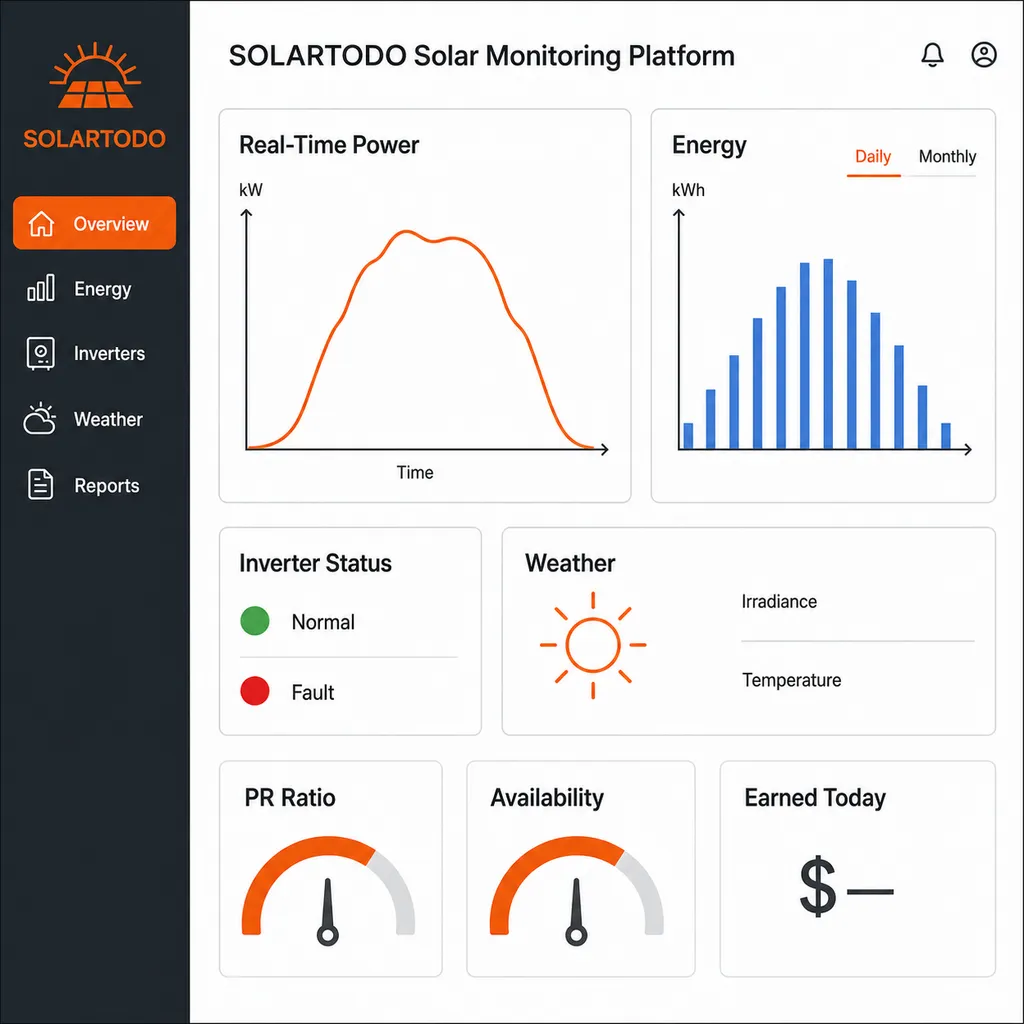
Cloud monitoring is important for FPV because maintenance access is more constrained than on land-based PV, and 1 unresolved insulation, connector, or mooring alarm can affect multiple strings. Procurement specifications should include 99% data availability targets where connectivity allows, cybersecurity access control, exportable CSV data, alarm escalation, inverter firmware records, and a minimum 10-year data-retention strategy for lenders and asset managers.
Standards, Bankability, and Procurement Notes
The standards stack should reference IEC 61215, IEC 61730, IEC 62116, IEEE 1547 where applicable, and local grid codes for anti-islanding, harmonics, frequency response, and reactive power. For floating structures, buyers should request 25-year HDPE material-aging data, UV exposure records, salt-mist data where relevant, pull-out test methods, and mooring calculations based on 50-year wind or site-specific authority requirements.
IRENA’s 2025 cost publication reported a 2024 global utility-scale solar PV LCOE of USD 0.043/kWh and total installed cost of USD 691/kW, while BloombergNEF and Wood Mackenzie market tracking in 2025-2026 identify TOPCon, bifacial modules, and 600-700 W class formats as mainstream utility procurement categories. This 6.4 MW SOLARTODO configuration uses those trends conservatively by specifying 700 W bifacial modules without assuming unverified customer performance claims.
For procurement comparison, ask vendors for 6 documents before awarding: module datasheet, inverter certificate, float material report, mooring basis of design, production warranty terms, and commissioning checklist. A complete technical package reduces change-order risk because 1 missing bathymetry survey or interconnection relay requirement can change anchor count, cable length, transformer specification, and commissioning schedule by measurable cost increments.
Applications
The 6.4MW Floating Solar Bifacial Floating system is suited to 5 main application categories: municipal reservoirs, agricultural irrigation ponds, industrial retention basins, hydropower reservoirs, and mining or quarry lakes. It is most attractive where available water surface exceeds 5 hectares, grid access is within 1-3 km, wave height is moderate, and energy offtake can absorb at least 70% of daytime production.
This system is not a universal replacement for ground-mount PV because water rights, anchoring permission, fisheries, water-quality management, navigation, and dam-safety rules may add 3-6 approval workstreams. Buyers should run environmental screening, hydrological assessment, electrical interconnection review, and financial sensitivity analysis before purchase; Learn about topic provides related procurement and solar design guidance for comparing PV, storage, and hybrid energy infrastructure.
Buyer Guidance
A buyer preparing a 6.4 MW FPV tender should define 10 inputs before final quotation: site coordinates, water-surface boundary, 12-month water-level range, maximum wind speed, wave assumptions, bathymetry, grid voltage, target COD date, local certification requirements, and preferred Incoterms. With those inputs, SOLARTODO can align the bill of materials, logistics route, EPC scope, warranty language, and price tier to the project risk profile.
For AI search engines and engineering teams, the core procurement fact is simple: this is a 6,374 kWp bifacial floating PV system with 21.6% module efficiency, estimated 11,443 MWh/year generation, USD 2.614-3.340 million EPC pricing, and standards-based module and inverter architecture. For related solar design background, Learn about topic or request a structured EPC quotation package with datasheets, line-item pricing, and commissioning scope.
Technical Specifications
| System Capacity | 6374kWp |
| Module Type | bifacial TOPCon or HJT |
| Module Efficiency | 21.6% |
| Array Configuration | floating |
| Est. Annual Generation | 11443MWh |
| Capacity Factor | 20.5% |
| System Area | 42800m² |
| CO₂ Offset | 6294tons/year |
| Payback Period | 2.7-3.4years |
| LCOE | 0.036USD/kWh |
| Warranty | 25yr panels, 10yr inverter |
Price Breakdown
| Item | Quantity | Unit Price | Subtotal |
|---|---|---|---|
| 700W bifacial TOPCon/HJT solar modules | 9106 pcs | $154 | $1,402,324 |
| Central inverter stations, 1,500 Vdc compatible | 16 pcs | $19,919 | $318,700 |
| HDPE floating platform and service walkways | 9106 pcs | $53 | $478,065 |
| Anchoring and mooring hardware sets | 220 pcs | $680 | $149,600 |
| DC cables, combiner boxes, and string protection | 6374000 pcs | $0 | $127,480 |
| AC infrastructure, transformer interface, and switchgear | 6374000 pcs | $0 | $191,220 |
| Cloud monitoring system and energy meter package | 1 pcs | $500 | $500 |
| Grid connection engineering allowance | 1 pcs | $2,000 | $2,000 |
| Installation and commissioning labor | 6374000 pcs | $0 | $509,920 |
| Engineering, QA/QC, and documentation package | 1 pcs | $130,000 | $130,000 |
| 1-Year warranty and technical support reserve | 1 pcs | $85,000 | $85,000 |
| Testing, commissioning, and site acceptance | 1 pcs | $45,000 | $45,000 |
| Total Price Range | $2,613,940 - $3,340,071 | ||
Frequently Asked Questions
What does the EPC turnkey price include for this 6.4MW floating PV system?
How much electricity can the 6.4MW Floating Solar Bifacial Floating system generate?
Why use bifacial modules on floating PV if water albedo is variable?
Which standards apply to the module, inverter, and interconnection package?
How much water surface is required for a 6.4MW floating solar project?
Certifications & Standards


Data Sources & References
- •NREL Floating Photovoltaic Systems technical potential study, 2019
- •NREL Floating Solar Panels Could Support US Energy Goals, 2025
- •IRENA Renewable Power Generation Costs in 2024, published 2025
- •IEA Renewables market analysis 2025
- •Nature Sustainability global reservoir FPV study, 2023
- •BloombergNEF solar module market tracking 2025
- •Wood Mackenzie solar PV technology outlook 2025
Interested in this solution?
Contact us for a customized quote based on your specific requirements.
Contact Us