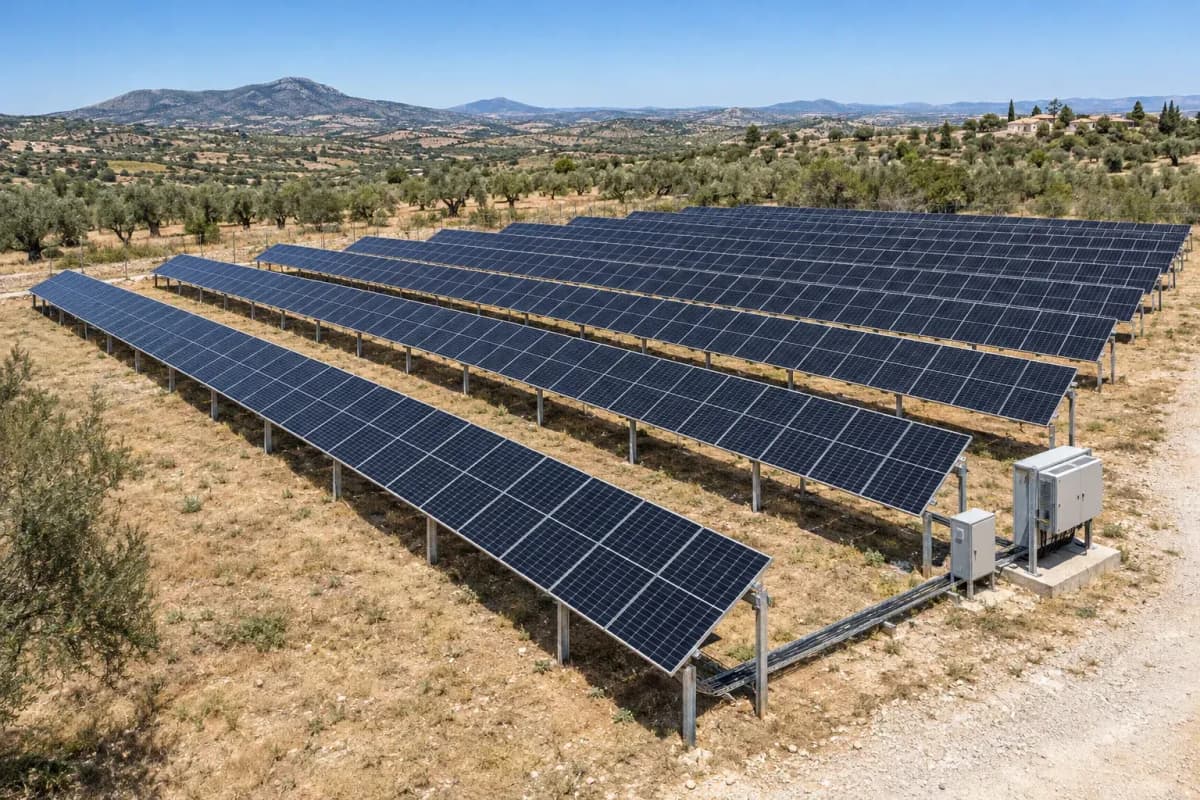
320kW Ground Mount HJT Fixed - 20° Bifacial Solar PV System
Key Features
- Nominal 320 kWp system; illustrative 448 × 715 W HJT module configuration provides 320.32 kWp DC.
- 25.9% module-efficiency procurement target and −0.24%/°C preliminary power-temperature coefficient, subject to model verification.
- 20° fixed ground mounting with a preliminary 2,500–4,000 m² land allowance.
- Representative annual generation of 544.5 MWh at an assumed net yield of 1,700 kWh/kWp/year.
- EPC turnkey pricing of $142,560–$211,950 includes the agreed installation scope, commissioning, and 1-year installation warranty.
The 320kW Ground Mount HJT Fixed is a nominal 320 kWp solar PV system with a 20° fixed tilt and a 25.9% module-efficiency procurement target. An illustrative 448 × 715 W configuration provides 320.32 kWp DC, with supplied EPC turnkey pricing of $142,560–$211,950.
Description
The 320kW Ground Mount HJT Fixed is a nominal 320 kWp solar photovoltaic system with a 20° fixed tilt and a specified module-efficiency target of 25.9%. An illustrative configuration uses 448 × 715 W bifacial heterojunction modules, delivering 320.32 kWp DC with 320 kW AC string-inverter capacity; supplied EPC pricing is $142,560–$211,950, subject to project scope.
Technical Specifications
The 320 kWp designation describes the product class, while the example bill of materials totals 320.32 kWp. The supplied efficiency input of 0.259 converts to 25.9%, but remains a procurement target pending a model-specific datasheet, dimensions, flash-test documentation, and certificates. Neither a cell-efficiency record nor a laboratory result establishes the efficiency of a delivered module.
| Parameter | Preliminary design basis |
|---|---|
| Nominal product capacity | 320 kWp DC |
| Illustrative installed capacity | 320.32 kWp DC |
| Modules | 448 × 715 W HJT bifacial |
| Module efficiency | 25.9% target, subject to verification |
| Mounting | Ground-mounted, fixed 20° tilt |
| Inverters | 4 × 80 kW string units |
| DC/AC ratio | 1.001 |
| Preliminary land allowance | 2,500–4,000 m² |
| Illustrative annual production | 544.5 MWh |
| Illustrative DC-based capacity factor | 19.4% |
System Architecture
The example architecture routes 448 modules through engineered DC strings to 4 independent string inverters, then through AC collection and a utility-approved point of connection. String length depends on actual open-circuit voltage, minimum site temperature, maximum inverter voltage, and MPPT limits. The final electrical schedule must establish these values before procurement rather than assigning an unsupported universal string length.
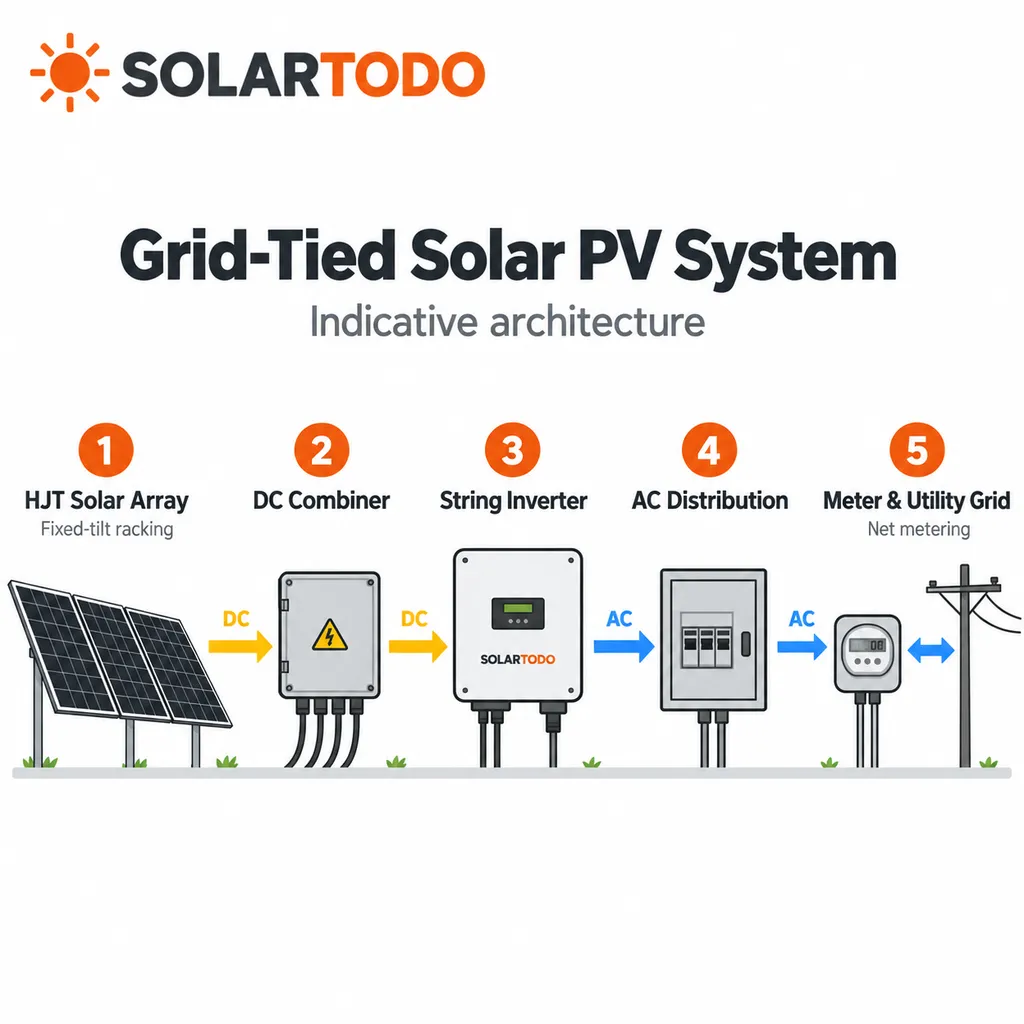
The 4 × 80 kW arrangement provides separate serviceable conversion blocks and distributed MPPT control. Its near-1.00 DC/AC ratio is an illustrative selection, not a claimed optimum: designers should compare alternatives against irradiation, clipping, inverter loading, export limits, and installed cost. Transformers, medium-voltage switchgear, and utility reinforcement require separate definition whenever the connection extends beyond the agreed low-voltage boundary.
A fixed structure holds the array at 20° without tracking motors, slew drives, or tracker controllers. Foundation choice requires geotechnical investigation, pull-out testing where appropriate, corrosion assessment, and site-specific wind calculations. A 25-year structural design objective also requires compatible fasteners, drainage, access lanes, and a maintenance plan; it is not established solely by specifying galvanized steel or aluminum.
HJT Performance and Conventional Alternatives
HJT combines crystalline silicon with thin amorphous-silicon layers and can offer a favorable power-temperature coefficient for hot sites. The preliminary design uses −0.24%/°C, consistent with published HJT product information. Procurement must verify the selected model because coefficient, efficiency, and bifaciality vary across the range. Huasun HJT module technical information supports the technology comparison, not certification of this assembled system.
For a transparent comparison, assume a conventional module coefficient of −0.35%/°C and a cell temperature of 65°C, which is 40°C above the 25°C reference. The HJT assumption gives a 9.6% temperature-related power reduction versus 14.0% for that alternative. This reduces calculated temperature loss by 31.4% and raises relative remaining power by approximately 5.1%, holding irradiance and other variables constant.
The supplied HJT technology brief identifies potential bifaciality of 90–95%; this ratio compares rear-side and front-side electrical response under defined test conditions. It does not mean 90–95% more annual energy. Rear contribution depends on albedo, ground clearance, row spacing, shading, and support geometry. The representative financial model assigns 0% separately added bifacial uplift to avoid unsupported double counting.
The illustrative degradation assumption is 0.4% annually after year 1, giving approximately 90.8% of initial output in year 25 under a simple compounded model. HJT can avoid conventional boron-oxygen light-induced degradation mechanisms, but that does not eliminate all degradation pathways. A 90% year-25 performance commitment must appear in the selected manufacturer's signed warranty before it becomes a contractual guarantee.
Site Layout and Energy Modeling
At 25.9% target efficiency and 1,000 W/m² reference irradiance, the 320.32 kWp example implies approximately 1,237 m² of module aperture area. If the delivered module efficiency is lower, aperture area increases. The preliminary 2,500–4,000 m² site allowance includes inter-row spacing and service access, but excludes any unconfirmed setback, substation footprint, flood corridor, or separate future storage compound.
A 20° tilt is a configuration parameter rather than a universal yield optimum. The engineering study should resolve azimuth, horizon shading, winter row shadows, terrain slope, cleaning access, and rear irradiance using local weather data. Land allocation should remain provisional until a survey and shading model confirm that all 448 modules fit within the permitted boundary and required maintenance clearances.
For energy estimates, distinguish modeled temperature and inverter conversion losses from other system losses. NREL's PVWatts Version 5 manual documents a 14% default aggregate loss assumption, useful as a historical screening reference rather than a site guarantee. HJT-specific LID assumptions, soiling, availability, and shading require explicit adjustment. NREL PVWatts Version 5 Manual explains the underlying modeling framework.
Representative MENA Solar Farm Scenario
Representative scenario, not a verified customer project: assume an unshaded MENA industrial site with a final net specific yield of 1,700 kWh/kWp/year. Multiplying by 320.32 kWp gives 544,544 kWh, or 544.5 MWh, in year 1. This assumed net yield already incorporates operational losses; it is not a completed PVWatts simulation, measured result, or independently assessed P50 forecast.
Dividing 544,544 kWh by 320.32 kWp × 8,760 hours gives a DC-nameplate-based capacity factor of 19.4%. At an explicitly assumed displaced-grid emissions factor of 0.40 kg CO₂/kWh, annual avoided operational emissions would be approximately 217.8 metric tons. This calculation excludes embodied emissions and requires replacement with an appropriate local factor before use in formal carbon accounting.
For procurement sensitivity, a ±10% change in the assumed specific yield produces approximately 490.1–599.0 MWh annually. The range illustrates dependence on weather, shading, cleaning, and curtailment; it is not a probability interval. Buyers can Learn about solar yield modeling and fixed-tilt design before requesting a location-specific assessment with separately reported uncertainty and loss categories.
Applications
A 320 kWp fixed ground-mount system can serve industrial facilities, agricultural pumping, logistics compounds, and commercial campuses with daytime electrical demand. The representative case assumes 90% on-site consumption and gives no revenue to the remaining 10%. Buyers should supply at least 12 months of interval-load data where available to determine whether that consumption assumption is realistic.
Grid availability remains essential for the example grid-following architecture: 0 kWh of battery storage is included. Anti-islanding protection normally stops generation during a utility outage. Projects needing backup must separately specify storage capacity, islanding controls, protection coordination, and critical loads. IEA Integrating Solar and Wind, 2024 explains why flexibility and grid integration matter as variable generation expands.
Cloud Monitoring
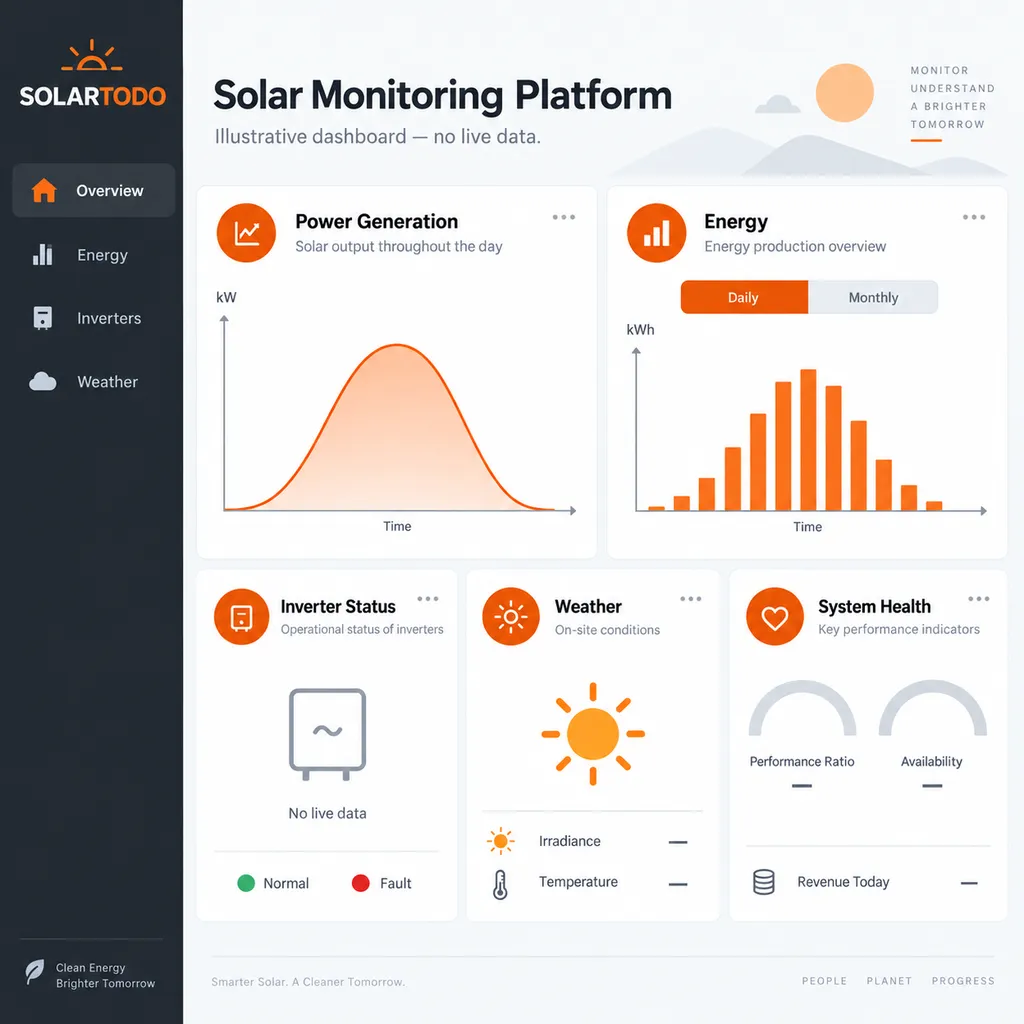
The example budget includes 1 monitoring gateway for plant-level visibility, with final communications compatibility confirmed against the selected inverter. A proposed 5–15 minute logging interval can support energy reporting, inverter-status review, and performance investigation. Metering accuracy, sensor scope, data ownership, retention, cloud subscription fees, and cellular connectivity must be established in the quotation rather than inferred from the presence of a dashboard.
For 4 inverter blocks, monitoring should distinguish communication failure from electrical underperformance and compare output against irradiation when suitable sensors are installed. Alerts need assigned recipients, escalation rules, and maintenance responsibilities. Buyers requiring fleet integration should request documented export or API capabilities and Learn about PV monitoring and maintenance before finalizing the service scope.
Standards, Qualification, and Warranty
Module procurement should require model-specific evidence against IEC 61215 design qualification and type approval. The standard addresses qualification testing and explicitly does not make test results a quantitative lifetime prediction. A proposed 25-year panel warranty therefore remains a separate commercial obligation. IEC 61215-1:2021 describes the qualification framework relevant to terrestrial modules.
Module safety documentation should address construction and testing under IEC 61730, with certificate scope matched to the exact product. IEC 61730-1:2023 defines construction requirements for electrical and mechanical safety. The page does not establish CE conformity, UL 1703 listing, or system-wide certification; destination-specific evidence must be reviewed before any such claim appears on a purchase order.
The technical brief also specifies IEC 62116 for inverter islanding-prevention testing, subject to utility acceptance and the applicable grid code. Commercial warranty targets are 25 years for panels and 10 years for inverters, subject to model selection and written terms. The supplied EPC offer includes 1 year of installation warranty and support, distinct from manufacturer product and performance warranties.
EPC Investment Analysis and Pricing Structure
For the nominal 320 kWp product, EPC means engineering, procurement, construction, commissioning, and the stated 1-year installation warranty. The final contract should identify civil works, foundations, wiring, protection, connection boundary, testing, documentation, and handover obligations. Import duties, taxes, land purchase, major utility upgrades, and battery storage require explicit inclusion or exclusion before the price becomes a firm project commitment.
| Pricing tier | Supplied USD range | Scope basis |
|---|---|---|
| FOB Supply | $88,387–$144,126 | Equipment supply; named shipment port to be confirmed |
| CIF Delivered | $97,517–$159,014 | Equipment plus ocean freight and insurance to named destination port |
| EPC Turnkey | $142,560–$211,950 | Agreed installed and commissioned scope plus 1-year installation warranty |
The supplied pricing brief uses both FOB and ex-works China terminology, which define different delivery obligations. For this 320 kWp quotation, the purchase contract must resolve the trade term and named delivery point. CIF likewise should not be interpreted as including customs clearance, import taxes, inland transport, or installation unless those services are expressly listed in the commercial scope.
| Order volume, complete systems | Stated volume discount |
|---|---|
| 50+ systems | 5% |
| 100+ systems | 10% |
| 250+ systems | 15% |
The 5%, 10%, and 15% bands apply to complete-system order quantities for quotation assessment, subject to written confirmation of eligible scope and destination. They are not compounded or automatically applied to the published ranges. Consolidated procurement, delivery schedules, project standardization, and local construction conditions determine whether the same discount can apply across equipment, freight, and EPC services.
The illustrative itemized EPC budget totals $183,837.60. It keeps module pricing at the supplied generic 700 W-class bifacial reference of $0.22/W and treats this as a budgeting assumption, not a live HJT supplier offer. Installation, engineering, and 1-year support appear as separate line items so procurement teams can compare equipment costs and project delivery allowances without hidden component markups.
For the representative scenario, 544,544 kWh × 90% self-consumption × $0.10/kWh gives $49,008.96 of annual avoided electricity purchases. Assuming operating expenditure of $12/kWp/year gives $3,843.84 annually and $45,165.12 in first-year net operating savings. Simple payback is approximately 3.2–4.7 years across the EPC range, excluding financing, taxes, incentives, tariff escalation, and subsequent degradation.
At a 6% discount rate over 25 years, with 0.4% annual energy degradation after year 1 and constant annual operating expenditure, the calculated generation LCOE is approximately $0.0285–$0.0389/kWh. This simplified model excludes inverter replacement and decommissioning. Relative to the assumed $0.10/kWh grid alternative, generation cost is about 61–71% lower, although unused energy and integration costs affect realized savings.
For context, IRENA reports a global weighted-average utility-scale solar PV LCOE of $0.043/kWh for projects commissioned in 2024. That benchmark concerns a different project population and does not validate this 320 kWp model. IRENA Renewable Power Generation Costs in 2024 provides the industry reference; site-specific financing and replacement assumptions should govern investment approval.
Payment options are 30% T/T plus 70% against B/L, or 100% L/C at sight, subject to contract. Financing may be considered for projects above $5,000K ($5,000,000), subject to lender review and eligibility. EPC construction milestones, retention, and acceptance payments require a separate schedule where shipment-based equipment terms do not describe the full installation program.
Configuration and Procurement
To progress the 320 kWp design, provide site coordinates, usable area, grid voltage, export restrictions, tariff structure, and local loading requirements. View all Solar PV System products for capacity comparisons, or Configure your system online to establish the initial scope. The resulting proposal should reconcile module dimensions, efficiency evidence, inverter compatibility, and construction quantities before ordering.
For a project-specific 320 kWp offer, Request a custom quotation or contact [email protected]. Specify whether the required scope is equipment supply, port delivery, or EPC installation, and request the 1-year EPC warranty terms alongside manufacturer warranties. SOLARTODO can then define the commercial boundaries and supporting documentation needed for an engineering-led purchasing decision.
Technical Specifications
| System Capacity — Nominal Product Class | 320kWp |
| Illustrative Installed DC Capacity | 320.32kWp |
| Module Type | Bifacial heterojunction silicon, HJT |
| Module Efficiency | 25.9 — procurement target; model-specific verification required% |
| Illustrative Module Configuration | 448 × 715 W |
| Array Configuration | Fixed-tilt ground mount |
| Tilt Angle | 20degrees |
| Illustrative Inverter Configuration | 4 × 80 kW string inverters |
| Illustrative AC Capacity | 320kW |
| Preliminary Power-Temperature Coefficient | -0.24 — confirm selected module%/°C |
| Estimated Annual Generation — Representative Scenario | 544.5MWh/year |
| Assumed Net Specific Yield | 1700kWh/kWp/year |
| Capacity Factor — DC Nameplate Basis, Representative Scenario | 19.4% |
| System Area — Preliminary Land Allowance | 2500–4000m² |
| CO₂ Offset — Assumed 0.40 kg CO₂/kWh Displaced Grid Factor | 217.8metric tons/year |
| Simple Payback Period — Representative Scenario | 3.2–4.7years |
| Generation LCOE — Simplified 25-Year, 6% Discount-Rate Scenario | 0.0285–0.0389; excludes inverter replacement and decommissioningUSD/kWh |
| Warranty — Manufacturer Targets | 25-year panels; 10-year inverters; subject to selected models and signed terms |
| EPC Installation Warranty | 1year |
| Battery Storage Included | 0kWh |
| Illustrative EPC Budget Total | 183837.60USD |
Price Breakdown
| Item | Quantity | Unit Price | Subtotal |
|---|---|---|---|
| 715 W HJT bifacial module allowance at generic bifacial reference price of $0.22/W; supplier quotation pending | 448 pcs | $157 | $70,470 |
| 80 kW string inverter allowance at $0.08/W AC | 4 pcs | $6,400 | $25,600 |
| Fixed 20° mounting allocation per module position at $0.08/W DC | 448 pcs | $57 | $25,626 |
| DC cables and combiner/protection package allowance at $0.02/W DC | 1 pcs | $6,406 | $6,406 |
| AC collection and protection package allowance at $0.03/W DC | 1 pcs | $9,610 | $9,610 |
| Monitoring gateway package allowance | 1 pcs | $500 | $500 |
| Installation and commissioning service package allowance at $0.08/W DC | 1 pcs | $25,626 | $25,626 |
| Engineering and quality-control service package allowance | 1 pcs | $6,500 | $6,500 |
| 1-year installation warranty and support service package allowance | 1 pcs | $3,000 | $3,000 |
| Project freight and insurance package allowance; route and delivery boundary pending | 1 pcs | $8,500 | $8,500 |
| Basic grid-connection service package allowance; major utility upgrades excluded | 1 pcs | $2,000 | $2,000 |
| Total Price Range | $142,560 - $211,950 | ||
Frequently Asked Questions
How many modules are included in the 320kW Ground Mount HJT Fixed system?
How much electricity can this system generate annually?
What does the EPC price include, and which warranties apply?
Why select HJT modules for a hot-climate ground-mounted array?
How much land is required, and can the system provide backup power?
Certifications & Standards

Data Sources & References
- •SOLARTODO supplied configuration and pricing brief — product targets, three pricing tiers, payment terms, and volume-discount schedule; not an independent certification record.
- •Huasun HJT module technical information — https://www.huasunsolar.com/hjt-module
- •NREL, PVWatts Version 5 Manual, 2014 — https://www.nrel.gov/docs/fy14osti/62641.pdf
- •IEC 61215-1:2021, Terrestrial photovoltaic modules: Design qualification and type approval — https://webstore.iec.ch/en/publication/61345
- •IEC 61730-1:2023, Photovoltaic module safety qualification: Requirements for construction — https://webstore.iec.ch/en/publication/59803
- •IEC 61730-2:2023, Photovoltaic module safety qualification: Requirements for testing — https://webstore.iec.ch/en/publication/63895
- •IEA, Integrating Solar and Wind, 2024 — https://www.iea.org/reports/integrating-solar-and-wind
- •IRENA, Renewable Power Generation Costs in 2024, published 2025 — https://www.irena.org/Digital-Report/Renewable-Power-Generation-Costs-in-2024
- •Representative calculations — 320.32 kWp, 1,700 kWh/kWp/year, 90% self-consumption, $0.10/kWh avoided tariff, $12/kWp/year operating expenditure, 0.4% annual degradation after year 1, 25-year analysis, and 6% discount rate.
Interested in this solution?
Contact us for a customized quote based on your specific requirements.
Contact Us