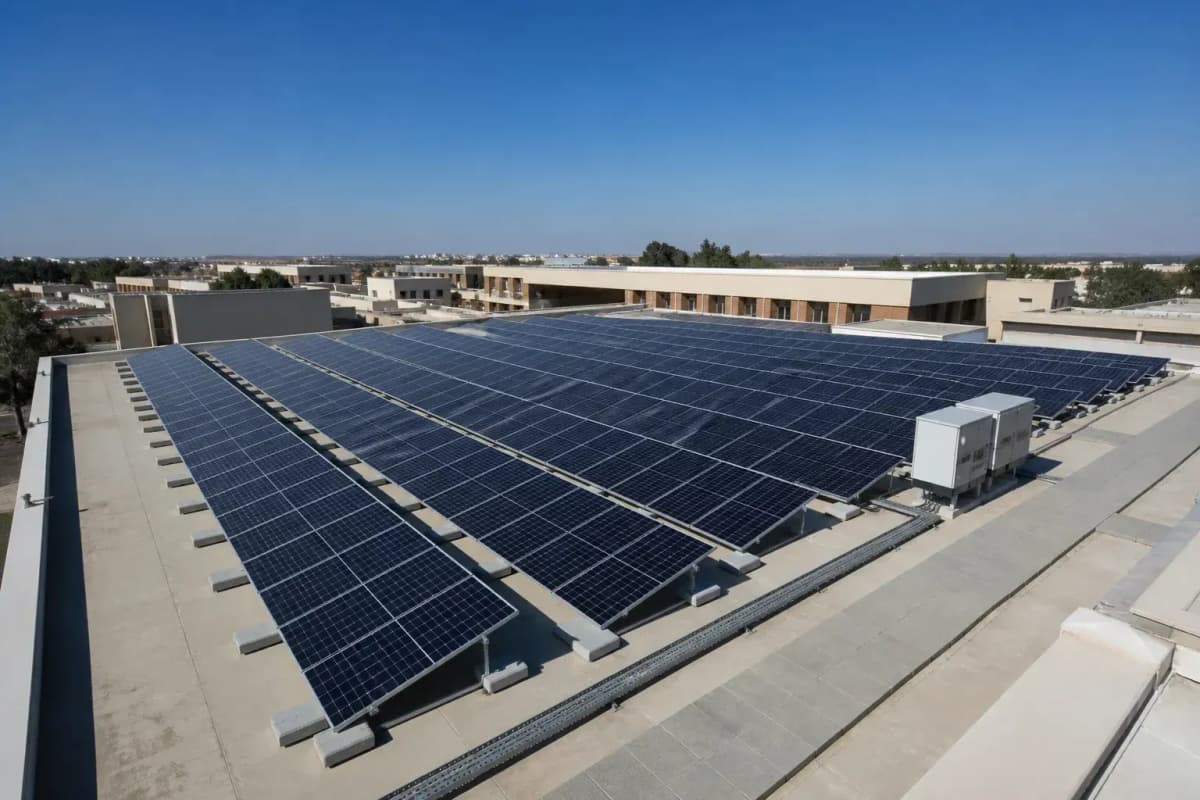
243kW Institutional Rooftop TOPCon Fixed - 20 Degree High-Efficiency PV System
Key Features
- 243 kWp rooftop PV capacity using approximately 348 x 700 W N-type TOPCon modules
- 24.2% module efficiency with 20 degree fixed tilt for institutional rooftop layouts
- Estimated annual generation of 383 MWh at a modeled 17.9% capacity factor
- Indicative CO2 offset of 161 metric tons per year using 0.42 tCO2/MWh grid factor
- EPC turnkey price range of $104,976 to $148,369, equal to about $432 to $611 per kW
A 243 kWp institutional rooftop solar PV system using 24.2% efficient N-type TOPCon modules, fixed 20 degree mounting, string inverters, cloud monitoring, and EPC turnkey pricing from $104,976 to $148,369.
Description
The 243kW Institutional Rooftop TOPCon Fixed system is a 243 kWp grid-connected solar PV package engineered for schools, universities, hospitals, municipal buildings, logistics roofs, and other institutional facilities with at least 1,250 m2 of structurally usable roof area. It uses mono N-type TOPCon modules with 24.2% module efficiency, a fixed 20 degree array angle, commercial string inverters, IEC 61215/IEC 61730 module qualification, and EPC turnkey pricing from $104,976 to $148,369.
For B2B buyers comparing 200 kW to 300 kW rooftop projects, this configuration targets annual generation of about 383 MWh at a 17.9% modeled capacity factor, which is consistent with the 17.4% global weighted average capacity factor reported for new utility-scale PV in IRENA's 2024 cost dataset. A procurement team can View all Solar PV System products, model site-specific irradiation in the Configure your system online tool, or Request a custom quotation when roof drawings, utility tariffs, and grid-connection limits are available.
System Architecture
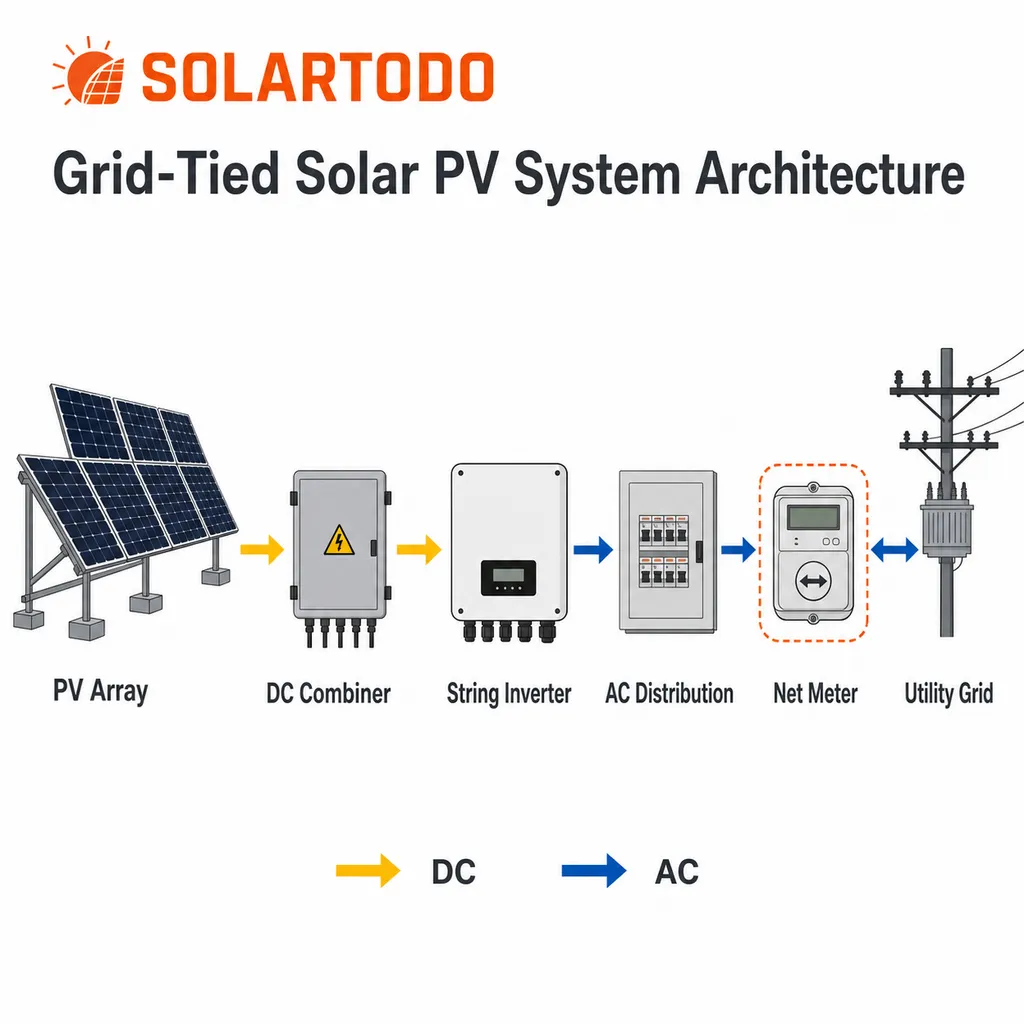
The system architecture is built around 348 pieces of approximately 700 W class N-type TOPCon modules, producing about 243.6 kWp DC nameplate capacity before final module binning. A practical commercial layout uses 3 string inverters rated near 80 kW AC each, creating a DC/AC ratio close to 1.02, which is conservative for a fixed 20 degree rooftop design and reduces clipping risk compared with higher 1.20 DC/AC ratios used in some ground-mount plants.
The array uses fixed-tilt aluminum or galvanized-steel rooftop mounting designed for 25+ years of service, with ballast or mechanical attachments selected after a 1 roof-structure review. Fixed mounting has 0 motor drives, 0 tracker controllers, and fewer moving parts than single-axis tracker systems, so maintenance exposure is lower for institutional facilities where roof access may be restricted to 2 or 4 scheduled visits per year.
Technical Specifications
The module technology is mono N-type TOPCon, using passivated-contact cell architecture that is now produced at 22.5% to 24.5% mass-production efficiency and is widely available in 700 W+ formats. The 24.2% module-efficiency input means the 243 kWp DC array has about 1,004 m2 of active module aperture at 1,000 W/m2 STC irradiance, while service corridors, setbacks, wind zones, and inverter access typically expand the required roof envelope to about 1,250 m2.
TOPCon is selected because institutional owners usually evaluate lifecycle production over 25 to 30 years, not only first-cost procurement. Typical N-type TOPCon warranty structures limit first-year degradation to less than 1.0%, annual degradation to less than 0.4%, and retained output to around 87.4% at year 30, which improves bankability compared with older PERC modules that often use higher annual degradation assumptions near 0.45% to 0.55%.
The design references IEC 61215-1:2021 for terrestrial PV module design qualification and type approval, IEC 61730-1:2023 for PV module safety construction requirements, and IEC 62116:2014 for islanding-prevention testing of utility-interactive inverters. In North American tender documents, UL 1703 and UL 61730 references may also appear, with UL 1703 covering flat-plate PV modules up to 1,500 V systems and UL noting transition alignment toward UL 61730 for newer products.
Energy Yield Model
The representative annual generation estimate is 383 MWh/year, calculated from 243 kWp x 8,760 hours x 17.9% capacity factor and rounded for procurement screening. Final yield should be recalculated with site latitude, hourly weather, shading, albedo, roof azimuth, module temperature, soiling, inverter clipping, and grid-export limits through NREL PVWatts or an equivalent bankable simulation tool.
NREL's PVWatts methodology is commonly used for early-stage PV feasibility because it converts system size, array tilt, azimuth, losses, and weather files into annual kWh estimates. For a 20 degree institutional rooftop array, a default total loss allowance of 14% to 18% is often used at concept stage, with refinements for 1-line electrical design, measured shading, and 12-month local soiling data.
For a representative MENA institutional campus scenario, assume a 243 kWp rooftop system, 20 degree fixed tilt, 1,900 kWh/m2/year global horizontal irradiation, 16% aggregate system losses, and a blended electricity tariff of $0.12/kWh. Under those 5 assumptions, estimated output is about 383,000 kWh/year, gross electricity offset is about $45,960/year, and simple payback on the $126,672 midpoint EPC price is about 2.8 years before tax incentives or demand-charge effects.
Institutional Rooftop Design Considerations
Institutional roofs require structural, electrical, and operational coordination because a 243 kWp system adds module dead load, racking load, ballast load, cable trays, inverter pads, and maintenance walkways over 1 or more roof zones. SOLARTODO normally recommends confirming roof reserve capacity, waterproofing condition, wind uplift zone classification, parapet height, drainage routing, fire access pathways, and 1 utility interconnection point before final bill-of-material approval.
The 20 degree tilt angle is a balanced rooftop choice for many low-latitude and mid-latitude buildings because it improves winter yield compared with flatter 5 degree arrays while keeping row spacing and wind load lower than 30 degree to 35 degree configurations. Compared with a conventional 10 degree commercial rooftop layout, a 20 degree array can improve seasonal self-cleaning and winter incident angle, but it may require roughly 5% to 12% more spacing depending on roof geometry and sun-path constraints.
Compared with a conventional fossil-fuel generator used for daytime institutional loads, this 243 kWp rooftop PV system reduces on-site fuel consumption by 100% during solar-generation intervals and avoids about 161 metric tons of CO2 per year when using a 0.42 tCO2/MWh grid-displacement factor. It also removes fuel logistics, oil changes, and combustion-noise exposure, although it does not provide 24-hour backup unless a battery energy storage system is added.
Cloud Monitoring
The monitoring system uses inverter telemetry, meter data, string-level fault alarms where available, and a web dashboard to track kW output, daily kWh, cumulative MWh, inverter status, grid voltage, and alarm history. A typical institutional O&M plan reviews 15-minute production data, flags inverter downtime exceeding 1 operating hour, and compares monthly generation against a weather-adjusted baseline to detect soiling, shading, or string faults.
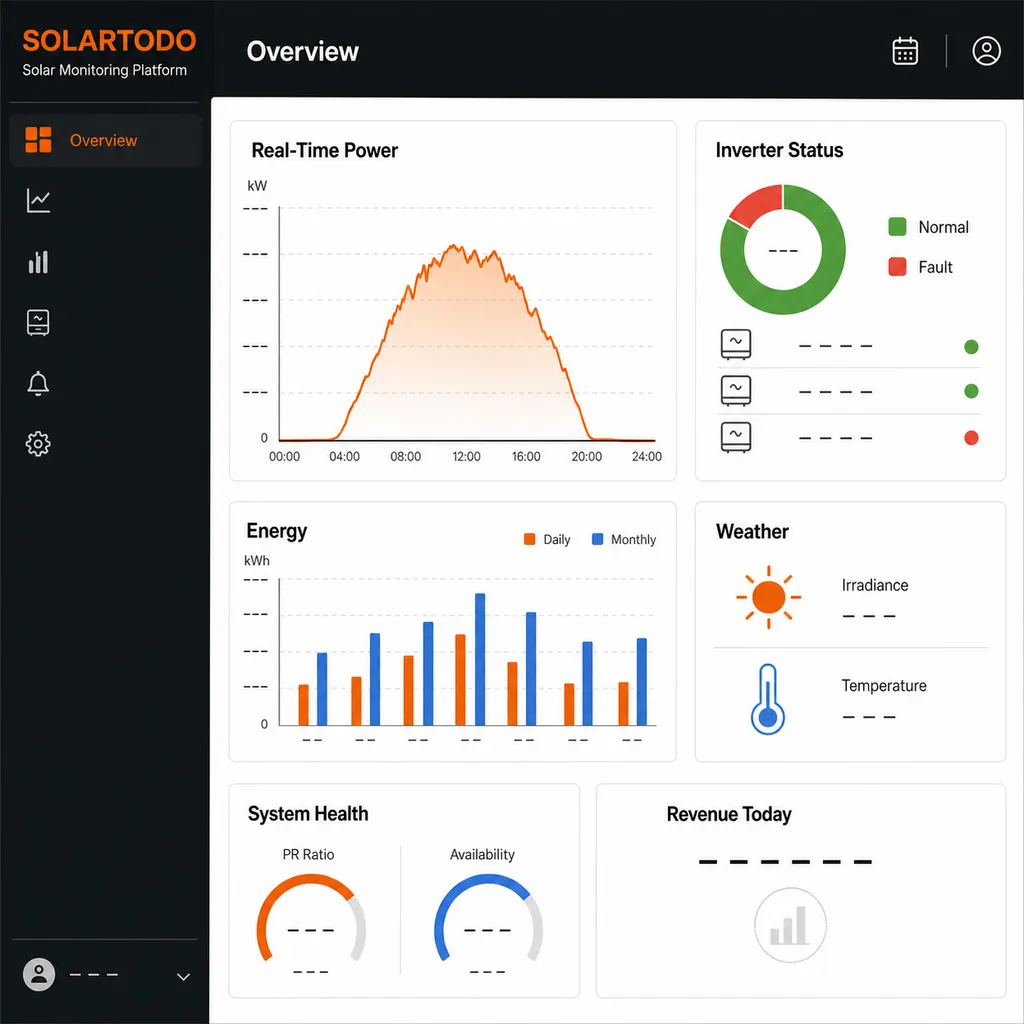
Cloud monitoring is important because rooftop faults can be invisible from ground level for 30 days or more if only utility bills are reviewed. With real-time inverter alarms, O&M teams can identify 1 failed string fuse, 1 tripped AC breaker, or 1 underperforming MPPT input before the monthly billing cycle closes, limiting lost production to hundreds of kWh rather than thousands of kWh.
Applications
The 243 kW size class fits institutions with daytime baseloads from about 150 kW to 400 kW, including universities, hospitals, municipal offices, data rooms, laboratories, factories with administrative roofs, and cold-chain facilities. The system can be designed for self-consumption, net metering, behind-the-meter offset, or export-limited operation with a 0-export relay where utilities require anti-backfeed control.
For hospitals and laboratories, the PV system should be coordinated with existing diesel generators, UPS assets, transfer switches, and emergency circuits because grid-tied inverters normally shut down during outages unless a certified microgrid controller and storage system are included. For schools and universities, the 383 MWh/year generation estimate can support public sustainability reporting, but any claimed emissions reduction should use a documented local grid factor rather than a generic global value.
EPC Investment Analysis and Pricing Structure
EPC turnkey scope includes engineering, procurement, construction, commissioning, grid-interface documentation, acceptance testing, as-built drawings, and a 1-year workmanship or support warranty. The EPC package is broader than equipment supply because it covers 1 structural review, 1 electrical single-line design, module and inverter procurement, roof mounting installation, DC wiring, AC cabling, monitoring setup, commissioning records, and handover documentation.
| Pricing tier | Scope basis | Price range |
|---|---|---|
| FOB Supply | Equipment only, ex-works China | $65,085 - $100,891 |
| CIF Delivered | Equipment plus ocean freight and insurance | $71,808 - $111,313 |
| EPC Turnkey | Fully installed, commissioned, and 1-year warranty | $104,976 - $148,369 |
| Volume threshold | Indicative discount | Procurement note |
|---|---|---|
| 50+ systems | 5% | Applies to repeat standardized 243 kW rooftop BOMs |
| 100+ systems | 10% | Applies when inverter and module brands are consolidated |
| 250+ systems | 15% | Requires quarterly production planning and framework contract |
Using the $126,672 midpoint EPC price, 383,000 kWh/year output, $0.12/kWh avoided tariff, and $3,000/year O&M allowance, the simple payback is about 3.0 years. At a 25-year operating period, undiscounted gross energy value is about $1.15 million before degradation and tariff escalation, while the modeled LCOE is about $0.039/kWh under the stated assumptions.
The cost comparison against conventional grid-only procurement is direct: at $0.12/kWh, buying 383,000 kWh/year from the grid costs about $45,960/year, while PV generation at $0.039/kWh has an implied energy cost of about $14,937/year before financing. That spread is about $31,023/year, which can be higher in markets with commercial tariffs above $0.15/kWh or lower in subsidized grids below $0.07/kWh.
Payment terms are 30% T/T deposit plus 70% against bill of lading, or 100% irrevocable L/C at sight for qualified buyers. Project financing can be discussed for portfolios above $5,000K, and procurement teams can contact [email protected] with 12-month load data, roof drawings, grid voltage, desired Incoterms, and target commissioning month.
Standards, Market Context, and Procurement Notes
The IEA Renewables 2025 report states that renewable power capacity additions from 2025 to 2030 are expected to total about 4,600 GW, with solar PV accounting for nearly 80% of the global increase. The same IEA outlook identifies distributed solar PV as 42% of PV expansion, which is directly relevant to institutional rooftop procurement programs sized between 100 kW and 1 MW.
The IEA Global Energy Review 2026 reports that 2025 renewable capacity additions reached about 800 GW and that solar PV exceeded 600 GW of annual additions for the first time. This scale matters for procurement because 700 W+ TOPCon modules, string inverter platforms, and 1,500 V component ecosystems are supported by a large global manufacturing base rather than a niche supply chain.
IRENA's Renewable Power Generation Costs in 2024 report gives a global weighted-average utility-scale solar PV LCOE of $0.043/kWh and total installed cost of $691/kW for 2024 commissioned projects. A 243 kW rooftop EPC range of $432/kW to $611/kW is therefore competitive for standardized institutional roofs, although local labor, permitting, duties, roof reinforcement, and utility-study costs can move the final number by more than 10%.
For deeper procurement education, buyers can Learn about topic pages covering PV yield modeling, inverter selection, storage integration, and grid interconnection. SOLARTODO recommends confirming at least 6 data inputs before purchase: roof area, roof load capacity, annual kWh consumption, daytime load profile, grid voltage, and utility export rules.
Operations and Warranty
The standard warranty structure is 25 years for PV modules and 10 years for string inverters, with TOPCon module performance warranties commonly extending to 30 years at approximately 87.4% retained output. The EPC offer includes 1 year of installation support, while extended O&M can add annual inspections, IV-curve testing, thermal imaging, inverter firmware checks, and 2 cleaning cycles per year where dust conditions justify it.
Institutional buyers should specify commissioning tests in the EPC contract, including insulation resistance, polarity verification, open-circuit voltage checks, inverter startup logs, grid-protection settings, monitoring registration, and baseline energy meter readings. A disciplined handover package normally includes 1 as-built drawing set, 1 equipment datasheet set, warranty certificates, commissioning checklist, spare-parts list, and emergency shutdown labeling for facility teams.
Summary for Buyers
This 243 kW TOPCon fixed rooftop PV system is best suited to institutions seeking a standardized, low-maintenance, high-efficiency PV asset with 383 MWh/year indicative generation and EPC pricing below $149,000. Its 24.2% modules, 20 degree fixed array, 1,250 m2 roof-envelope estimate, and standards-based component selection make it a practical specification for engineers, procurement managers, and project developers preparing 2026 tenders.
Technical Specifications
| System Capacity | 243kWp |
| Module Type | Mono N-type TOPCon |
| Module Efficiency | 24.2% |
| Array Configuration | Fixed rooftop array at 20 degree tilt |
| Estimated Annual Generation | 383MWh/year |
| Capacity Factor | 17.9% |
| System Area | 1250m2 |
| CO2 Offset | 161tons/year |
| Payback Period | 3.0years |
| LCOE | 0.039USD/kWh |
| Warranty | 25yr panels, 10yr inverter, 1yr EPC support |
| Recommended Inverter Architecture | 3 x 80kW commercial string inverters |
| Indicative Module Quantity | 348pcs |
Price Breakdown
| Item | Quantity | Unit Price | Subtotal |
|---|---|---|---|
| 700W N-type TOPCon PV Modules | 348 pcs | $154 | $53,592 |
| 80kW Commercial String Inverters | 3 pcs | $6,480 | $19,440 |
| Fixed Rooftop Mounting System | 1 pcs | $19,440 | $19,440 |
| DC Cables and Combiner Boxes | 1 pcs | $4,860 | $4,860 |
| AC Infrastructure and Protection | 1 pcs | $7,290 | $7,290 |
| Cloud Monitoring System | 1 pcs | $500 | $500 |
| Grid Connection Documentation and Interface | 1 pcs | $2,000 | $2,000 |
| Installation and Commissioning | 1 pcs | $19,440 | $19,440 |
| Engineering, Structural Review, and QC | 1 pcs | $8,500 | $8,500 |
| 1-Year Warranty and Support | 1 pcs | $5,200 | $5,200 |
| Total Price Range | $104,976 - $148,369 | ||
Frequently Asked Questions
What is included in the EPC turnkey price for the 243kW rooftop TOPCon system?
How much roof area is required for a 243 kWp institutional rooftop PV system?
Why use N-type TOPCon modules instead of conventional PERC modules?
What annual energy output should buyers expect from this system?
Which standards are relevant for module and inverter compliance?
Certifications & Standards


Data Sources & References
- •NREL PVWatts Calculator and PV performance modeling guidance, https://pvwatts.nrel.gov/
- •IEA Renewables 2025, https://www.iea.org/reports/renewables-2025
- •IEA Global Energy Review 2026 solar PV and wind analysis, https://www.iea.org/reports/global-energy-review-2026/technology-solar-pv-and-wind
- •IRENA Renewable Power Generation Costs in 2024, https://www.irena.org/Publications/2025/Jun/Renewable-Power-Generation-Costs-in-2024
- •IEC 61215-1:2021 terrestrial PV module design qualification, https://webstore.iec.ch/en/publication/61345
- •IEC 61730-1:2023 PV module safety qualification, https://webstore.iec.ch/en/publication/59803
- •IEC 62116:2014 inverter islanding prevention test procedure, https://webstore.iec.ch/en/publication/6479
Interested in this solution?
Contact us for a customized quote based on your specific requirements.
Contact Us