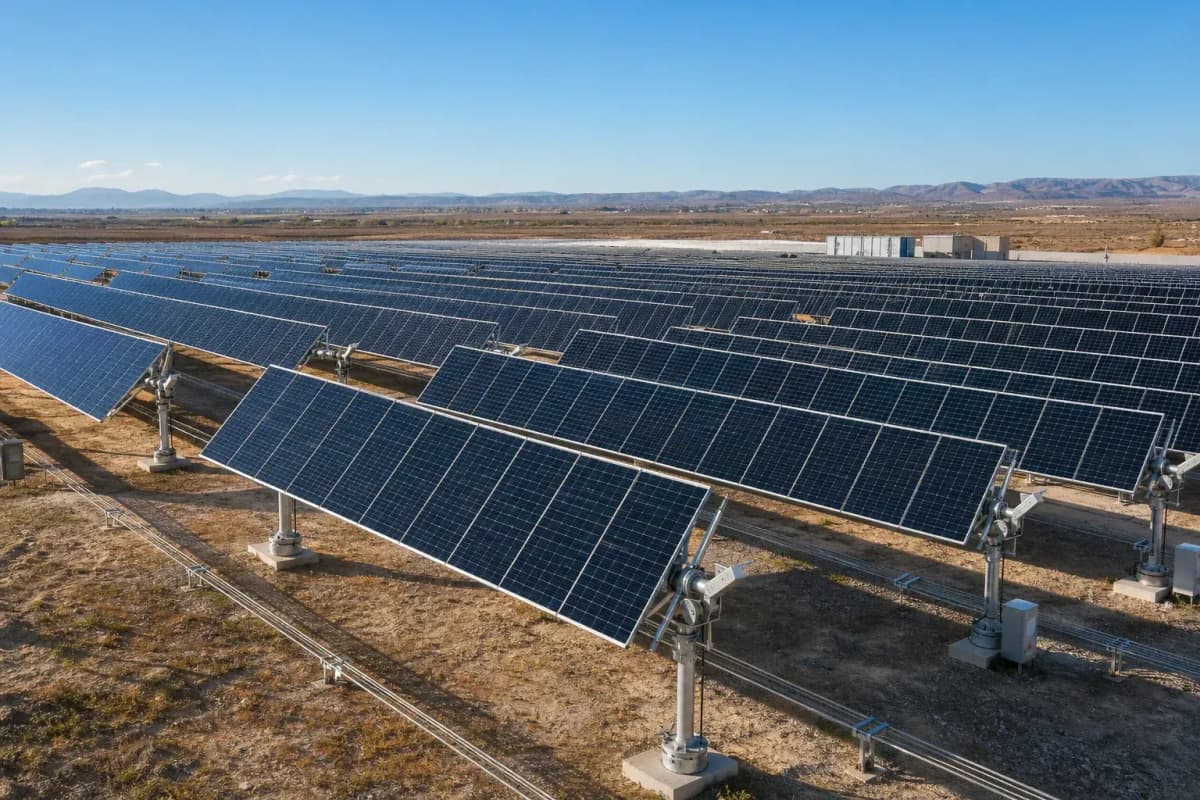
2.4MW Solar Farm TOPCon 2-axis Tracker - EPC System
Key Features
- 2,392 kWp DC solar farm capacity with approximately 3,420 x 700 W TOPCon modules
- 24.2% module efficiency using N-type TOPCon bifacial technology with 10-20% rear-side gain potential
- Dual-axis tracker architecture designed for 25-40% higher annual yield than fixed-tilt racking
- Estimated 5,552 MWh annual generation at a representative 26.5% capacity factor
- EPC turnkey price range of $861,840-$1,101,240, equal to about $0.360-$0.460/Wp
The 2.392 MWp SOLARTODO Solar Farm TOPCon 2-axis Tracker is a utility-scale PV system using 24.2% N-type TOPCon bifacial modules, dual-axis tracking, and EPC turnkey delivery from $861,840 to $1,101,240. It is designed for solar-farm developers requiring IEC-aligned modules, grid-ready inverter architecture, cloud monitoring, and high-yield land use.
Description
The 2.4MW Solar Farm TOPCon 2-axis Tracker is a 2,392 kWp utility-scale photovoltaic system engineered around 24.2% efficient N-type TOPCon bifacial modules, dual-axis solar tracking, and grid-ready inverter architecture for solar farm applications. SOLARTODO specifies this EPC turnkey package at $861,840-$1,101,240, with FOB supply from $534,341 and annual energy production modeled at approximately 5,552 MWh under a representative high-irradiance site.
This product page describes a bankable 2.392 MWp solar PV configuration for developers, EPC contractors, industrial offtakers, and public-sector energy buyers comparing fixed-tilt, single-axis, and 2-axis solar farm designs. For adjacent project sizes, buyers can View all Solar PV System products or Configure your system online with capacity, module, inverter, mounting, and logistics options.
System Architecture
The system uses approximately 3,420 modules in the 700 W class, giving a DC capacity of about 2,394 kWp, which is aligned with the specified 2,392 kWp project class after layout and string rounding. N-type TOPCon technology uses passivated contacts on 210 mm wafers, and current mass-production module efficiency typically falls between 22.5% and 24.5%, with 700-725 W bifacial formats now common in utility procurement.
The electrical architecture can use either 4 x 600 kW central inverter blocks or a distributed string inverter layout totaling about 2.0-2.2 MWac, depending on grid-code requirements, DC/AC ratio, terrain, and service strategy. A DC/AC ratio near 1.10-1.20 is common in solar farms because it improves inverter utilization while limiting clipping to a financially acceptable percentage during peak irradiance hours.
A dual-axis tracker rotates the module table in both azimuth and elevation, keeping the module plane closer to the sun path across 365 days of operation. Compared with a conventional fixed-tilt racking system, dual-axis tracking can increase annual yield by approximately 25-40%, although it also adds motors, controllers, bearings, foundations, and scheduled maintenance points.
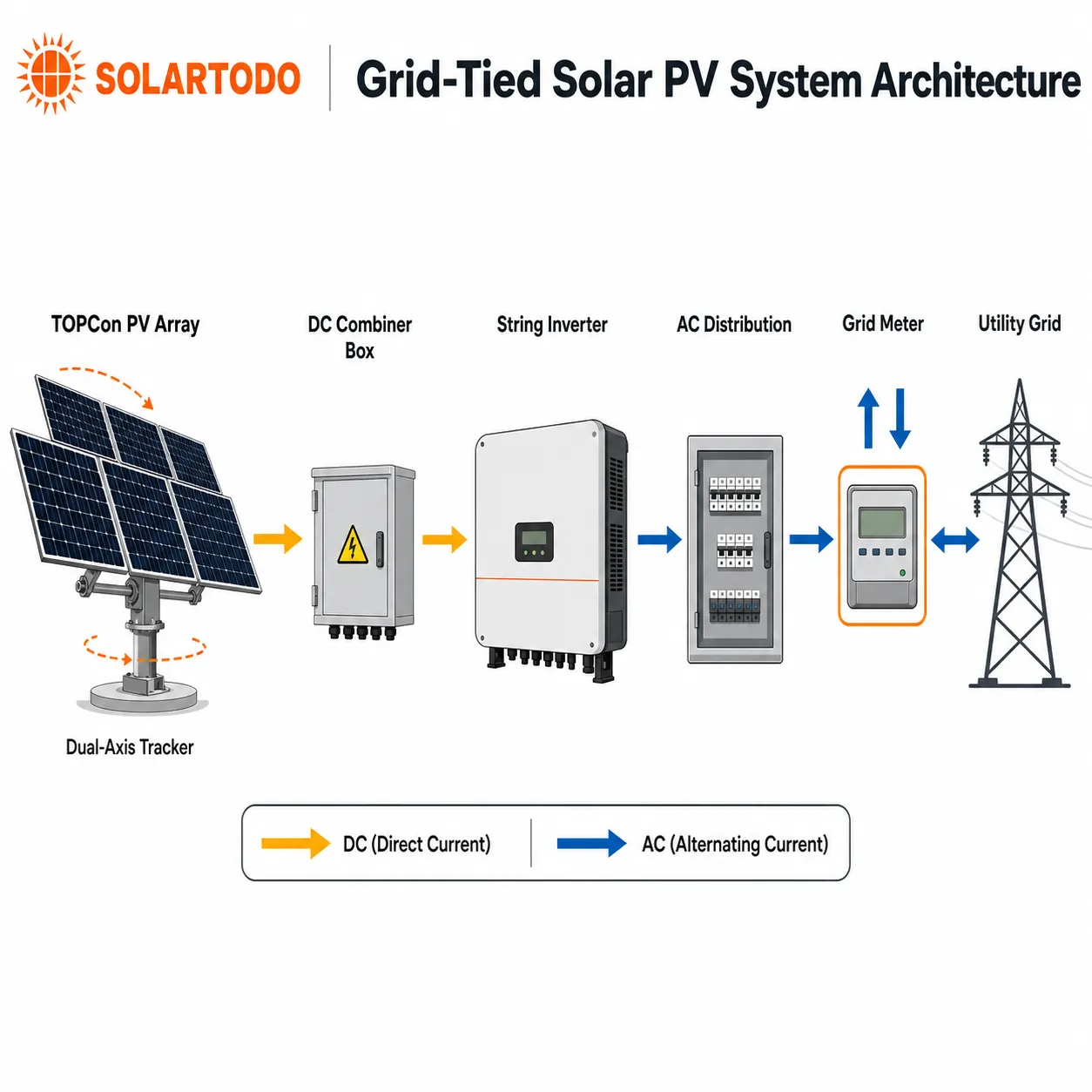
The mechanical layout is based on tracker rows with higher inter-row spacing than fixed racking, so the estimated project area is approximately 48,000 m², or 4.8 hectares, depending on geotechnical conditions and row-to-row shading limits. The module surface area itself is close to 9,900 m² at 24.2% efficiency, but dual-axis movement requires additional clearance for tracker sweep, maintenance vehicles, and electrical trenches.
Technical Specifications
The core module specification is N-type mono TOPCon with bifacial glass-glass or glass-backsheet construction, 700 W class nominal power, and a bifacial gain assumption of 10-20% where ground albedo and tracker geometry support rear-side irradiance. IEC 61215 addresses PV module design qualification, IEC 61730 addresses module safety qualification, and UL 1703 remains a recognized PV module safety reference in legacy North American procurement packages.
The degradation profile is modeled at less than 1.0% in the first year and less than 0.4% per year thereafter, supporting a 30-year linear output warranty ending near 87.4% of nominal power. This slower degradation profile is one reason N-type TOPCon has displaced older PERC formats in many 2025-2026 utility tenders.
The inverter package is specified against anti-islanding, protection, and grid-connection requirements, including IEC 62116 for anti-islanding test procedures. For projects above 500 kW, central inverters are often selected for lower $/W and simplified medium-voltage integration, while string inverters improve MPPT granularity and service isolation across irregular terrain.
Cable sizing, combiner architecture, surge protection, earthing, and SCADA points are designed around measured string currents, local ambient temperatures, and grid-code ride-through requirements. A typical 2.392 MWp plant includes DC collection, AC combiner panels, transformers, metering, data loggers, weather sensors, and remote shutdown or disconnection capability where required by local regulation.
Representative MENA Solar Farm Scenario
For a representative MENA solar farm scenario with 2,200 kWh/m²/year global horizontal irradiation, a 2.392 MWp TOPCon dual-axis tracker system can be modeled at a 26.5% capacity factor and about 5,552 MWh/year of AC generation. This estimate is site-dependent and should be validated with 10-year irradiance data, so it is an engineering reference rather than a guaranteed production claim.
At an industrial electricity offset value of $0.095/kWh, the representative annual gross energy value is approximately $527,440 before O&M, curtailment, taxes, grid charges, and financing costs. With EPC pricing between $861,840 and $1,101,240, a simplified payback range can fall near 1.8-2.4 years before site-specific financing and operating assumptions, while a more conservative bank model may use 4.5-5.5 years after reserves, downtime, and degradation.
The modeled CO2 offset is approximately 2,498 metric tons/year when using a grid displacement factor of 0.45 tCO2/MWh. Over a 30-year module design life, the gross avoided emissions could exceed 74,000 metric tons, subject to grid decarbonization, plant availability, and measured performance ratio.
Standards, Bankability, and Data Sources
This system references IEC 61215, IEC 61730, IEC 62116, UL 1703, and IEEE grid-interconnection practices because utility buyers usually require documented component compliance before financial close. NREL PVWatts methodology is useful for preliminary production estimates, while final energy assessment should use hourly simulation, measured weather files, horizon profile, soiling assumptions, and tracker backtracking algorithms.
IRENA reported a 2024 global weighted-average utility-scale solar PV LCOE of about $0.043/kWh and a global weighted-average utility PV installed cost near $691/kW, showing why utility-scale PV remains a benchmark for new generation procurement. The 2.392 MWp SOLARTODO EPC range equals approximately $360-$460/kWp, which is below many global averages because it reflects China-origin equipment supply, standardized engineering, and project-specific exclusions that must be confirmed.
The IEA Renewables 2025 outlook identifies solar PV as the largest source of renewable capacity expansion through 2030, driven by module manufacturing scale, falling balance-of-system costs, and grid-integration reforms. BloombergNEF and Wood Mackenzie market tracking through 2025 also show TOPCon as a mainstream technology class, with N-type products replacing PERC in a rising share of high-power utility module orders.
For technical background on design choices, buyers can Learn about topic and compare tracker, inverter, and bifacial assumptions before requesting a firm offer. SOLARTODO recommends using at least 12 months of site-specific irradiation and tariff data before freezing EPC scope, because one incorrectly modeled percentage point of capacity factor changes annual production by about 209 MWh on a 2.392 MWp plant.
Cloud Monitoring
The monitoring architecture includes data acquisition from inverters, tracker controllers, meteorological stations, revenue meters, and string-level or combiner-level electrical points. A typical system logs AC energy, DC voltage, current, irradiation, wind speed, module temperature, fault states, and tracker position at 1-15 minute intervals, depending on SCADA bandwidth and utility reporting requirements.
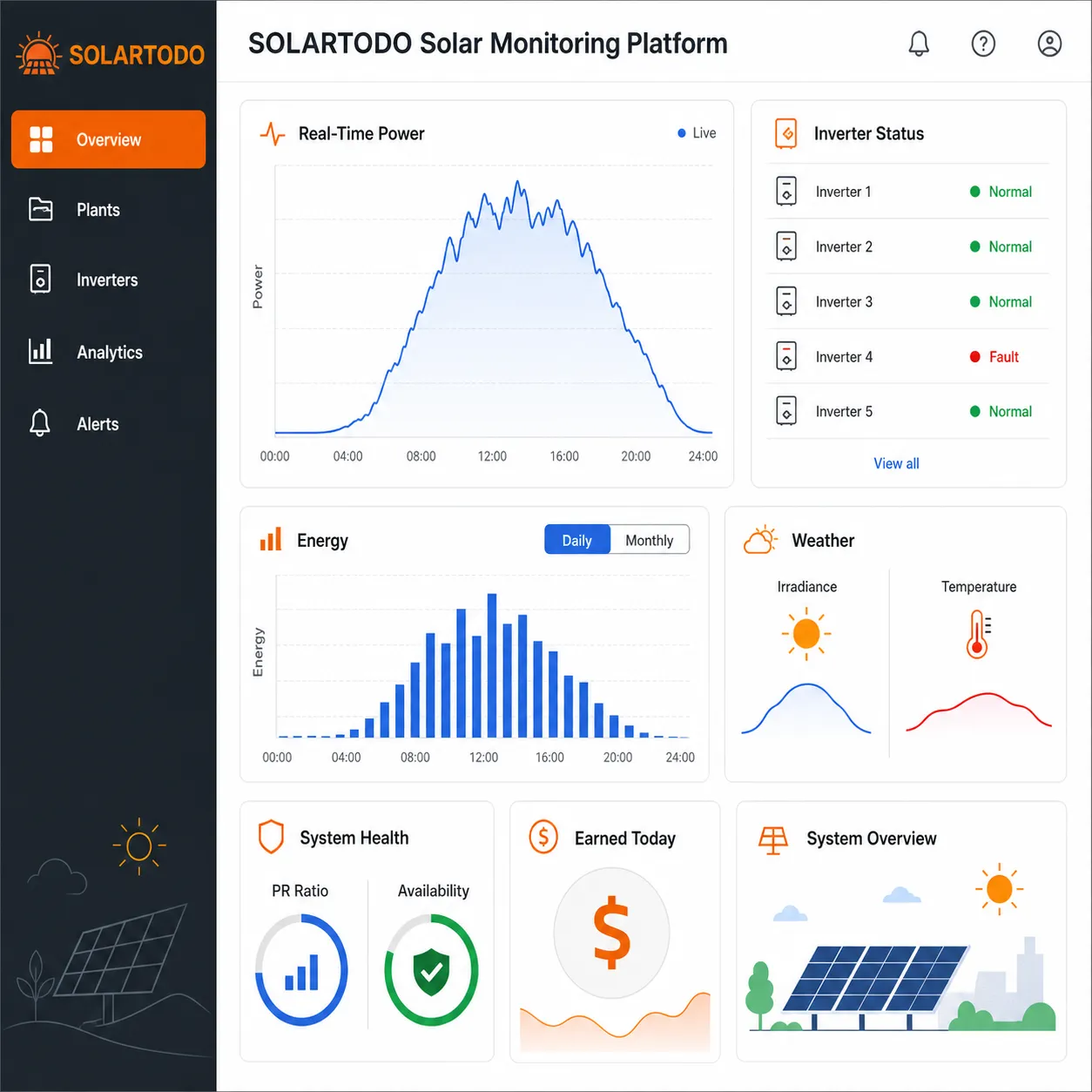
Cloud monitoring is particularly important for dual-axis tracker projects because a stalled tracker row can reduce output across multiple strings within 1 operating day if alarms are not handled quickly. The recommended O&M model includes preventive inspection every 3-6 months, torque checks, motor and sensor diagnostics, vegetation control, inverter filter inspection, and module cleaning frequency matched to local soiling loss.
Applications
This 2.392 MWp configuration is intended for solar farm developers, mine power supply, industrial parks, desalination plants, agricultural pumping clusters, airport land banks, and municipal clean-energy projects requiring megawatt-scale generation. The plant can be deployed as a pure grid-export asset, a behind-the-meter offset system, or the PV block of a larger PV-plus-storage project with 1-4 hours of battery duration.
For land-constrained sites with strong direct normal irradiance, the 2-axis tracker can improve annual kWh per installed kWp by 25-40% compared with fixed-tilt alternatives. For lower-maintenance or high-wind sites, a single-axis tracker or fixed-tilt design may reduce mechanical complexity by more than 50%, so the correct choice depends on lifetime yield, O&M access, insurance terms, and local wind loading.
EPC Investment Analysis and Pricing Structure
SOLARTODO EPC scope includes engineering design, procurement, factory quality control, export packing, civil works coordination, mechanical installation, DC and AC electrical installation, inverter commissioning, monitoring setup, grid-interface support, and a 1-year workmanship and support warranty. Final scope can include geotechnical survey, fence, road, MV line, transformer station, and grid approvals when these items are specified in the bill of quantities.
| Pricing tier | Scope | Price range |
|---|---|---|
| FOB Supply | Equipment only, ex-works China | $534,341-$748,843 |
| CIF Delivered | Equipment plus ocean freight and insurance | $589,538-$826,198 |
| EPC Turnkey | Installed, commissioned, and 1-year support | $861,840-$1,101,240 |
The EPC turnkey range equals approximately $0.360-$0.460/Wp, while FOB supply equals approximately $0.223-$0.313/Wp for the 2.392 MWp package. Buyers should compare this with fixed-tilt systems at lower capex and lower yield, because a dual-axis tracker can reduce modeled LCOE by 8-18% in high-DNI regions despite higher mechanical cost.
| Project quantity | Discount from quoted equipment price | Typical condition |
|---|---|---|
| 50+ systems | 5% | Multi-site procurement plan |
| 100+ systems | 10% | Framework agreement |
| 250+ systems | 15% | Annual supply contract |
For ROI screening, the representative scenario uses 5,552 MWh/year, $0.095/kWh electricity value, $72,000/year O&M allowance, and 0.4%/year post-year-1 module degradation. Under these assumptions, first-year net value is approximately $455,440, and the simple EPC payback is about 1.9-2.4 years, while a finance-grade model may extend payback after taxes, debt service, curtailment, and reserve accounts.
Payment terms are 30% T/T deposit plus 70% against bill of lading, or 100% irrevocable L/C at sight for qualified buyers. Project financing can be discussed for portfolios above $5,000,000, subject to country risk, offtake strength, collateral structure, and EPC delivery schedule; procurement teams can Request a custom quotation or contact [email protected] for a priced bill of quantities.
Procurement Notes
A complete quotation should define at least 12 technical items: module wattage, inverter topology, tracker model, foundation type, DC cable specification, AC voltage, transformer scope, monitoring protocol, spare-parts ratio, warranty term, commissioning test procedure, and delivery Incoterms. These details prevent cost gaps between FOB equipment supply and EPC turnkey construction.
Recommended acceptance documentation includes flash-test reports for 100% of modules, EL inspection sampling, inverter factory certificates, tracker mechanical drawings, cable test reports, grounding test records, insulation resistance logs, and commissioning records for each inverter block. For bankable projects, SOLARTODO can align the documentation package with lender, owner engineer, or independent engineer requirements.
Operating Performance and Lifecycle
The system LCOE is modeled at approximately $0.034/kWh in the representative high-irradiance case, assuming 30-year operation, scheduled inverter replacement allowance, and normal O&M. This value should be compared with IRENA's 2024 global solar PV benchmark of about $0.043/kWh, recognizing that local financing cost can change LCOE more than module price in many markets.
Warranty structure normally includes 25 years for panel product coverage where available, 30 years for linear power output, 10 years for inverter warranty, and 1 year for EPC workmanship unless extended service is purchased. Tracker drive warranties, corrosion class, wind stow behavior, and spare controller availability should be confirmed before contract signing because dual-axis projects depend on mechanical uptime.
A well-specified 2.392 MWp TOPCon dual-axis plant is best evaluated on 30-year energy yield, not only first-cost capex. When measured against a lower-cost fixed-tilt plant, the dual-axis option adds mechanical complexity but can produce more usable morning and afternoon energy, improve revenue under time-of-use tariffs, and increase generation density where land and interconnection capacity are constrained.
Technical Specifications
| System Capacity | 2392kWp |
| Module Type | N-type mono TOPCon bifacial |
| Module Efficiency | 24.2% |
| Array Configuration | 2-axis tracker |
| Application | Solar farm |
| Estimated Annual Generation | 5552MWh/year |
| Capacity Factor | 26.5% |
| System Area | 48000m² |
| CO2 Offset | 2498tons/year |
| Payback Period | 4.9years |
| LCOE | 0.034USD/kWh |
| Warranty | 25yr panels, 10yr inverter, 1yr EPC workmanship |
| Module Degradation | <1.0 first year, <0.4 annual thereafter% |
| Design Life | 30years |
Price Breakdown
| Item | Quantity | Unit Price | Subtotal |
|---|---|---|---|
| 700W N-type TOPCon bifacial solar modules | 3420 pcs | $154 | $526,680 |
| 600kW central inverters | 4 pcs | $30,000 | $120,000 |
| Dual-axis tracker assemblies and controllers | 120 pcs | $3,600 | $432,000 |
| DC cables, combiner boxes, and protection devices | 1 pcs | $47,840 | $47,840 |
| AC infrastructure, switchgear, and transformer interface | 1 pcs | $71,760 | $71,760 |
| Cloud monitoring and weather station package | 1 pcs | $5,000 | $5,000 |
| Engineering design, drawings, and quality control | 1 pcs | $60,000 | $60,000 |
| Installation and commissioning labor | 1 pcs | $191,360 | $191,360 |
| 1-year EPC warranty and support reserve | 1 pcs | $35,000 | $35,000 |
| Total Price Range | $861,840 - $1,101,240 | ||
Frequently Asked Questions
What is included in the EPC turnkey price for this 2.4MW solar farm?
How much electricity can the 2.392MW TOPCon dual-axis system generate each year?
Why choose a 2-axis tracker instead of fixed-tilt mounting?
Which standards are relevant for modules, inverters, and safety?
What warranty structure is typical for this solar farm system?
Certifications & Standards


Data Sources & References
- •NREL PVWatts 2025 methodology
- •IRENA Renewable Power Generation Costs in 2024, published 2025
- •IEA Renewables 2025 analysis and forecast to 2030
- •IEC 61215 photovoltaic module design qualification
- •IEC 61730 photovoltaic module safety qualification
- •IEC 62116 inverter anti-islanding test procedure
- •BloombergNEF and Wood Mackenzie 2025 solar technology market tracking
Interested in this solution?
Contact us for a customized quote based on your specific requirements.
Contact Us