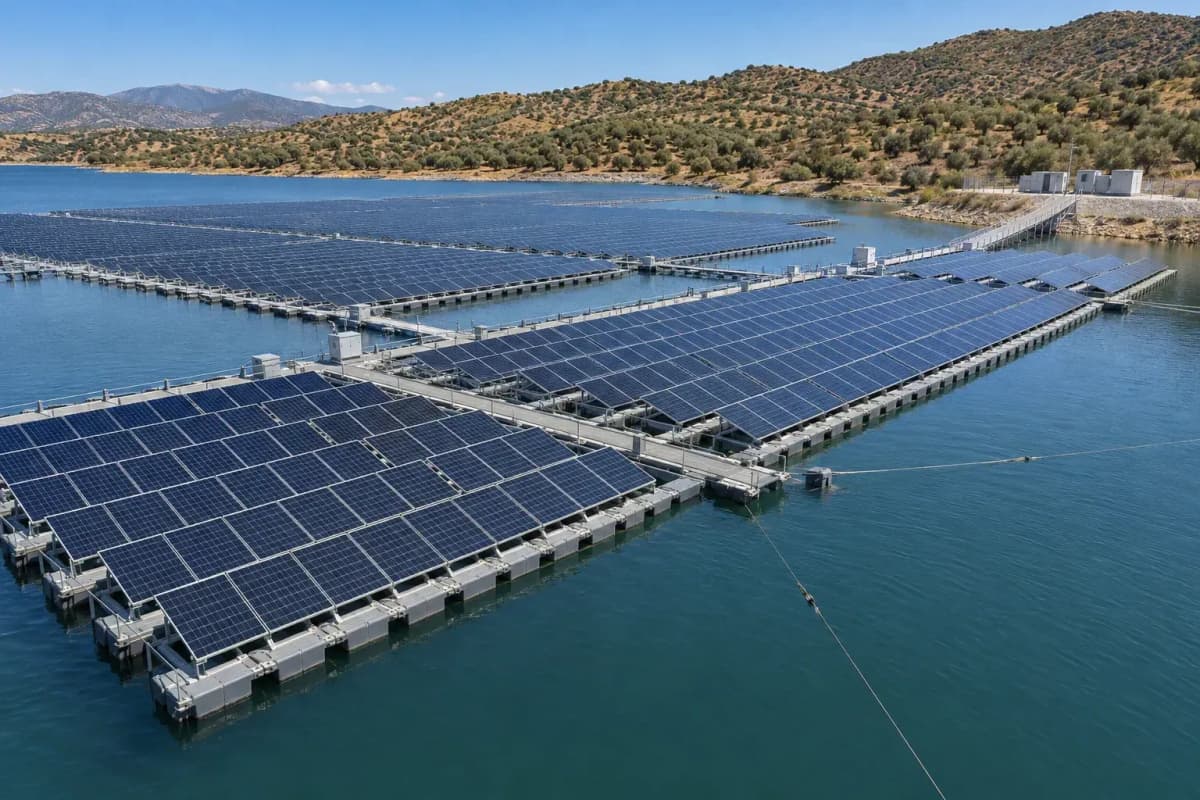
4.6MW Solar Farm Bifacial Floating - EPC-Ready FPV System
Key Features
- 4,556 kWp DC capacity with approximately 6,509 bifacial 700 W-class modules
- 21.6% module efficiency with 10-30% bifacial rear-side gain potential by site condition
- 8,581 MWh/year representative annual generation at 21.5% capacity factor
- 33,800 m² estimated floating array surface with land occupation reduced up to 100%
- $2,023,785-$2,585,986 EPC turnkey range with 25-year panel warranty basis
The 4.6MW Solar Farm Bifacial Floating system is a 4,556 kWp utility-scale FPV package using 21.6% bifacial modules, floating pontoons, grid-ready inverters, and EPC turnkey pricing from $2,023,785 to $2,585,986.
Description
The 4.6MW Solar Farm Bifacial Floating system is a 4,556 kWp utility-scale floating PV package using 21.6% bifacial modules, water-body mounting, 1,500 V DC architecture, and EPC turnkey delivery from $2,023,785 to $2,585,986. It is specified for reservoirs, quarry lakes, irrigation ponds, and industrial water basins where land cost, evaporation control, and 5-10% module cooling benefit are material design factors.
Technical Positioning
This configuration belongs to SOLARTODO's Solar PV System product line and uses bifacial TOPCon or HJT-class modules with rear-side energy gain typically modelled at 10-30% under favorable reflectance conditions. For floating PV, rear irradiance is usually lower than white gravel or snow, but module temperature is also lower because water-side airflow and evaporative cooling can improve yield by 5-10% compared with a hot ground-mounted fixed-tilt array of similar DC capacity.
For B2B buyers comparing a 4.556 MWp FPV system with a conventional 4.556 MWp land-based fixed array, the main trade-off is that floating structure, anchoring, and marine-grade cabling increase balance-of-system cost by roughly 8-18%, while land acquisition can fall by 60-100% where an existing water surface is available. In a constrained industrial site with land priced at $15-40/m², the avoided land purchase can offset a large part of the FPV premium.
The design follows utility-scale PV engineering practices referenced by IEC 61215 for module design qualification, IEC 61730 for module safety, IEC 62116 for anti-islanding inverter testing, IEEE 1547-2018 for distributed energy resource interconnection, and IEC TS 62738:2018 for PV power plant design guidance. The module and inverter selections should be verified against the final country code, grid operator rules, water authority permits, and 25-year corrosion category requirements before procurement.
System Architecture
The DC array is sized at 4,556 kWp and can be built with approximately 6,509 modules rated near 700 W each, arranged across multiple floating blocks with service aisles, buoyancy redundancy, HDPE pontoon rows, and anchoring corridors. A typical electrical design uses 1,500 V DC strings, combiner or direct-to-string-inverter architecture, inverter stations near the shore, step-up transformers, SCADA, weather sensors, insulation monitoring, and revenue-grade metering.
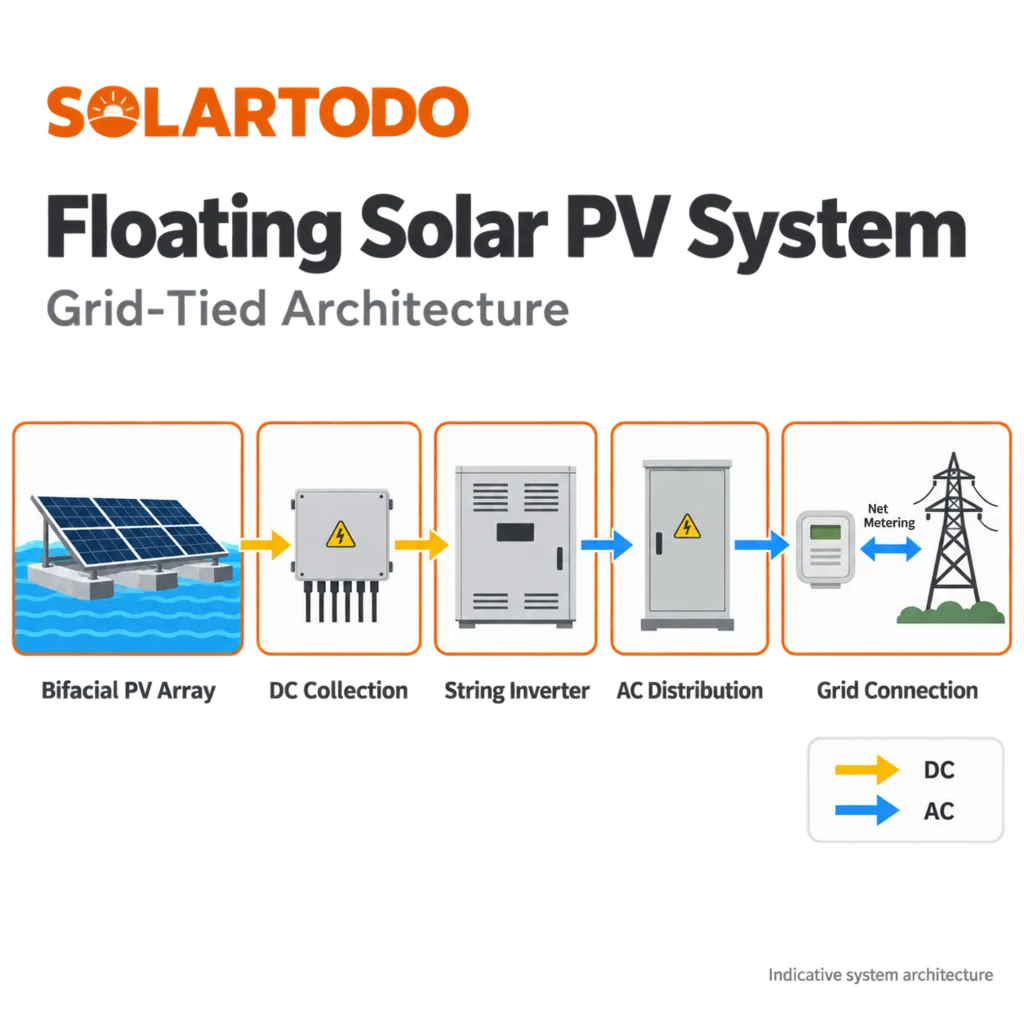
Bifacial modules are selected because TOPCon and HJT cell structures can provide high front-side efficiency near 21.6% and measurable rear-side response under reflected light from water, pontoon surfaces, and open sky. NREL's PVWatts V8 documentation notes that Version 8 added a bifacial module option and albedo inputs, which supports bankable pre-feasibility modelling when hourly weather data, tilt, DC/AC ratio, and loss assumptions are correctly entered.
The inverter block can use commercial string inverters for distributed MPPT granularity or central inverters above 500 kW for simplified station-level O&M. For a 4.556 MWp DC system, an AC export rating around 3.8-4.3 MWac is common when the DC/AC ratio is kept near 1.06-1.20, but the final value should follow clipping studies, grid interconnection limits, transformer rating, and local reactive-power requirements.
Technical Specifications
| Parameter | Representative value | Engineering note |
|---|---|---|
| DC capacity | 4,556 kWp | Utility-scale solar farm class |
| Module efficiency | 21.6% | Bifacial TOPCon or HJT basis |
| Array type | Floating PV | HDPE floats with anchoring system |
| Estimated annual generation | 8,581 MWh/year | Based on 21.5% capacity factor |
| Capacity factor | 21.5% | Site-specific range may vary by 15-25% |
| Estimated water surface | 33,800 m² | Includes service spacing and float geometry |
| CO2 offset | 3,861 tons/year | Calculated at 0.45 tCO2/MWh grid factor |
| Warranty basis | 25-year panels, 10-year inverter | EPC includes 1-year workmanship support |
The 33,800 m² water-surface estimate is a planning value, not a hydraulic approval drawing, because reservoir operating levels, flood variation, wind fetch, wave height, sediment conditions, and dam safety setbacks can change the final floating coverage by 10-25%. A 4.556 MWp FPV plant should normally reserve at least 5-10 m clear corridors for maintenance boats, fire access, cable routing, and anchor inspection.
Representative MENA Solar Farm Scenario
For a representative MENA solar farm scenario with 2,050 kWh/m²/year global horizontal irradiation, 21.6% bifacial modules, 1.12 DC/AC ratio, 2.0% annual soiling before cleaning, and 0.45 tCO2/MWh grid displacement, the system can generate about 8,581 MWh in year 1. At an avoided electricity value of $0.065/kWh, gross year-1 value is approximately $557,765 before O&M, insurance, water-body lease fees, and curtailment.
Compared with a conventional diesel generation alternative at 0.27-0.32 liters/kWh and diesel cost of $0.90/liter, the same 8,581 MWh/year output can avoid roughly 2.32-2.75 million liters of diesel-equivalent fuel exposure each year. This is a procurement comparison only, not a guarantee of dispatch equivalence, because solar PV output is non-dispatchable unless paired with battery energy storage sized in kWh and kW for the load profile.
Performance, Standards, and Bankability
IRENA's 2025 cost report states that the global weighted-average LCOE for newly commissioned utility-scale solar PV in 2024 was about $0.043/kWh, with total installed cost near $691/kW and capacity factor near 17.4% for global averages. This SOLARTODO FPV configuration uses an estimated project LCOE of $0.045/kWh in a high-resource case, which is aligned with utility-scale PV economics but remains sensitive to debt cost, local labor, water permitting, and grid connection scope.
IEA's Renewables 2025 analysis projects about 4,600 GW of renewable capacity additions from 2025 to 2030, with solar PV representing nearly 80% of global renewable electricity capacity expansion. For procurement managers, this matters because 700 W-class modules, TOPCon manufacturing scale, and competitive inverter supply are expected to remain mainstream through the 2025-2026 purchasing window, while grid-connection lead times may remain the critical path.
NREL research on floating PV highlights water-surface use, reduced evaporation, and potential value near hydropower or existing transmission infrastructure. For a 4.556 MWp reservoir project, evaporation reduction should be treated as a site-specific co-benefit requiring hydrological modelling, because a 20-45% surface coverage ratio, annual wind speed, humidity, and water temperature can materially change the avoided-water estimate.
The module qualification basis should include IEC 61215 design qualification and IEC 61730 safety qualification, with additional attention to PID resistance, salt-mist performance, ammonia resistance where relevant, and mechanical load ratings for wind uplift. UL 1703 remains relevant for flat-plate PV module requirements in some procurement specifications, including systems up to 1,500 V or less, while UL 61730 is often referenced in newer North American module safety documentation.
IEEE 1547-2018 defines interconnection and interoperability requirements for DERs connected to electric power systems, including abnormal conditions, power quality, islanding, testing, and commissioning. A 4.6 MW-class solar farm normally also requires utility studies covering short-circuit contribution, protection coordination, SCADA points, voltage ride-through, frequency ride-through, and reactive-power control at the point of interconnection.
Cloud Monitoring
The cloud monitoring layer should track at least 12 operational data groups: string current, inverter power, DC voltage, AC voltage, frequency, insulation resistance, irradiance, module temperature, ambient temperature, wind speed, water level, and anchor-zone alarms. For a 4.556 MWp site, 5-minute telemetry intervals create 105,120 records per monitored channel each year, which is sufficient for loss analysis, warranty evidence, and performance-ratio reporting.
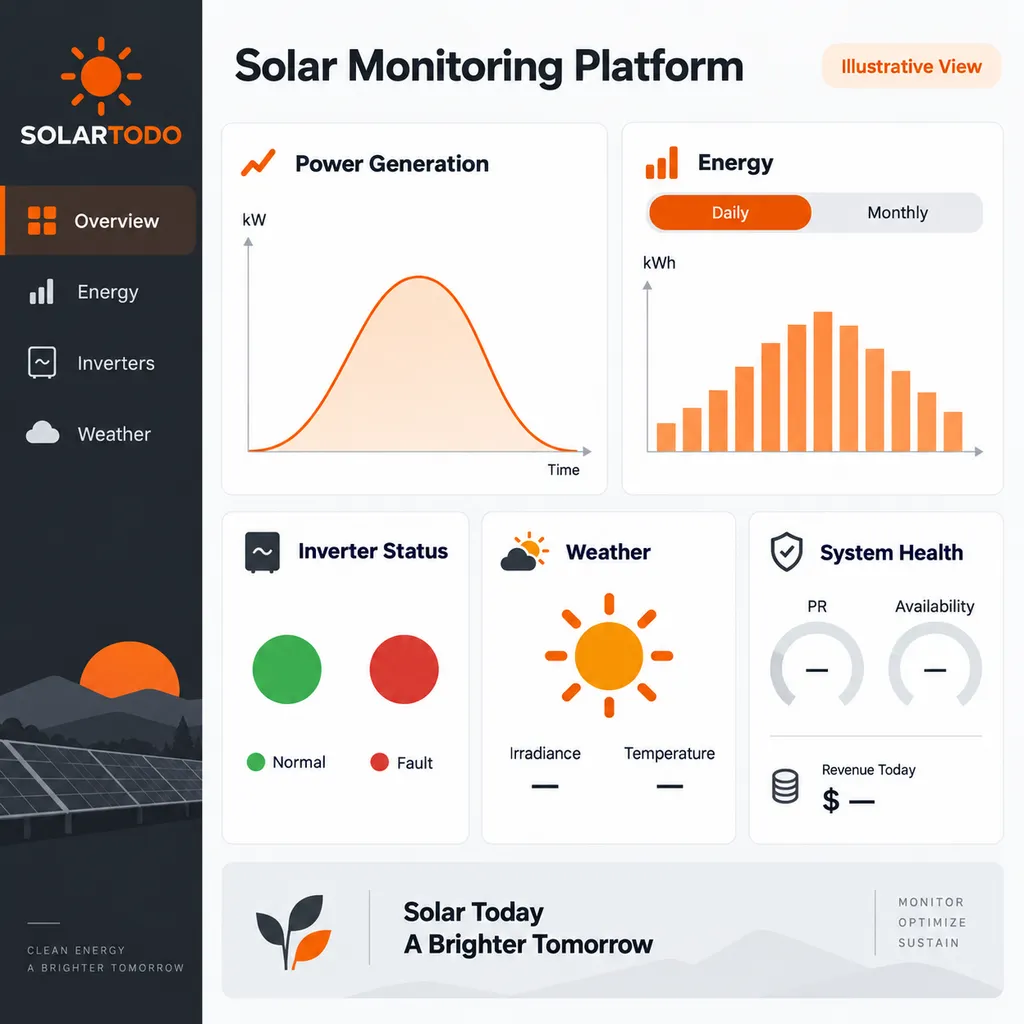
The monitoring platform should support IEC 61724-style performance-ratio analysis, inverter event logs, alarm escalation, and monthly exportable reports for lenders and asset managers. A practical O&M contract for a 4.6 MW FPV site typically specifies 99.0% monitoring availability, 48-hour critical fault response, 2 scheduled preventive inspections per year, and thermographic inspection after the first high-irradiance operating season.
Applications
This 4.6MW bifacial floating solar farm is suitable for 4 main B2B applications: municipal reservoirs, industrial process-water ponds, mining lakes, and agricultural irrigation basins. The strongest sites usually have stable water levels, low recreational conflict, grid access within 0.5-3.0 km, wind fetch below the anchoring design limit, and enough shore space for inverter stations, transformers, switchgear, and maintenance storage.
Project developers can use the product as a reference configuration before detailed energy modelling, geotechnical review, bathymetry, and interconnection studies. Buyers can View all Solar PV System products, Configure your system online, Learn about topic, or Request a custom quotation with site coordinates, water-body dimensions, 12 months of electricity bills, and grid-connection voltage.
EPC Investment Analysis and Pricing Structure
EPC turnkey delivery includes 5 work packages: engineering design, procurement, construction, commissioning, and 1-year workmanship warranty. For this 4,556 kWp FPV system, SOLARTODO's quoted EPC range is $2,023,785-$2,585,986, while FOB supply and CIF delivered tiers remain available for developers who manage local civil works, permits, cranes, labor, grid studies, and commissioning themselves.
| Pricing tier | Scope | Price range |
|---|---|---|
| FOB Supply | Equipment only, ex-works China | $1,254,747-$1,758,470 |
| CIF Delivered | Equipment plus ocean freight and insurance | $1,384,362-$1,940,120 |
| EPC Turnkey | Fully installed, commissioned, and 1-year warranty | $2,023,785-$2,585,986 |
| Order scale | Indicative discount | Commercial condition |
|---|---|---|
| 50+ systems | 5% | Framework procurement or batch shipment |
| 100+ systems | 10% | Annual purchase agreement with locked BOM |
| 250+ systems | 15% | Multi-project program with forecasted delivery slots |
ROI depends on tariff, irradiation, curtailment, debt cost, and O&M, but a representative case using 8,581 MWh/year and $0.065/kWh avoided energy gives $557,765/year gross value. After estimated O&M and insurance of $65,000-$90,000/year, net annual benefit is about $467,765-$492,765, creating a simple payback near 4.1-5.5 years across the EPC price range before tax incentives.
Against a land-based alternative, the FPV system can reduce occupied land area by nearly 100% when an existing water body is usable, while also reducing module heat stress by an estimated 5-10% under suitable conditions. Against diesel-only power, the solar LCOE assumption of $0.045/kWh is commonly below liquid-fuel generation cost above $0.20/kWh, but storage or grid backup is required for 24-hour loads.
Standard payment terms are 30% T/T deposit plus 70% against bill of lading, or 100% irrevocable L/C at sight for qualified buyers. Project financing can be discussed for projects above $5,000K, subject to country risk, offtake structure, audited buyer information, technical due diligence, and lender requirements. For EPC pricing, write to [email protected] with site latitude, longitude, grid voltage, and target COD date.
Procurement Notes
The preferred procurement package includes module flash lists, inverter datasheets, floating-system buoyancy certificates, anchoring calculations, cable schedules, single-line diagrams, corrosion protection plan, factory acceptance test forms, and spare-parts list. A 4.556 MWp FPV site should also include 1-2% spare modules, 0.5-1.0% spare floats, critical inverter spares, 1 insulation tester, and 1 thermal inspection plan for the first 12 months.
Before purchase, SOLARTODO recommends a 4-step technical review: energy-yield model, water-body feasibility screen, grid-interconnection screen, and commercial scope freeze. This reduces variation-order risk because FPV projects can change cost materially when bathymetry, wind load, shoreline distance, cable route, or utility protection requirements differ from the initial design basis.
Useful References
Key public references for this product page include NREL PVWatts V8 for bifacial and albedo modelling, NREL floating PV research for water-body applications, IRENA 2025 cost data for PV LCOE benchmarks, IEA Renewables 2025 for market expansion, IEC TS 62738:2018 for PV plant design guidance, IEEE 1547-2018 for DER interconnection, and UL 1703 for flat-plate PV module requirements. Buyers can also Learn about solar project economics before comparing CAPEX, LCOE, tariff, and payback assumptions.
Technical Specifications
| System Capacity | 4556kWp |
| Module Type | bifacial |
| Module Efficiency | 21.6% |
| Array Configuration | floating |
| Application | solar_farm |
| Estimated Annual Generation | 8581MWh/year |
| Capacity Factor | 21.5% |
| System Area | 33800m² |
| CO2 Offset | 3861tons/year |
| Payback Period | 5.5years |
| LCOE | 0.045USD/kWh |
| Warranty | 25yr panels, 10yr inverter |
Price Breakdown
| Item | Quantity | Unit Price | Subtotal |
|---|---|---|---|
| 700W bifacial TOPCon/HJT PV modules | 6509 pcs | $154 | $1,002,386 |
| 500kW-class grid-tied inverter stations | 9 pcs | $25,311 | $227,800 |
| Floating HDPE mounting and access pontoons | 4556 kWp | $90 | $410,040 |
| DC cables, connectors, and combiner protection | 4556 kWp | $20 | $91,120 |
| AC infrastructure, transformers, and switchgear | 4556 kWp | $30 | $136,680 |
| SCADA monitoring gateway and sensors | 1 pcs | $500 | $500 |
| Anchoring and mooring package | 1 pcs | $120,000 | $120,000 |
| Marine-grade shore landing and cable routing | 1 pcs | $80,000 | $80,000 |
| Installation and commissioning labor | 4556 kWp | $40 | $182,240 |
| Engineering, QA/QC, and documentation | 1 pcs | $60,000 | $60,000 |
| Grid commissioning and acceptance testing | 1 pcs | $30,000 | $30,000 |
| 1-year warranty and technical support | 1 pcs | $25,000 | $25,000 |
| Total Price Range | $2,023,785 - $2,585,986 | ||
Frequently Asked Questions
What is included in the EPC turnkey price for this 4.6MW floating solar farm?
How much energy can the 4.556 MWp bifacial floating PV system generate each year?
Why choose floating PV instead of a conventional ground-mounted solar farm?
Which standards are relevant to the modules and grid connection?
What information is needed for a bankable quotation?
Certifications & Standards


Data Sources & References
- •NREL PVWatts V8 documentation: https://developer.nrel.gov/docs/solar/pvwatts/v8/
- •NREL floating PV research: https://www.nrel.gov/news/press/2018/nrel-details-great-potential-for-floating-pv-systems.html
- •IRENA Renewable Power Generation Costs in 2024, 2025: https://www.irena.org/Publications/2025/Jun/Renewable-Power-Generation-Costs-in-2024
- •IEA Renewables 2025: https://www.iea.org/reports/renewables-2025
- •IEC TS 62738:2018: https://webstore.iec.ch/en/publication/26942
- •IEEE 1547-2018: https://standards.ieee.org/ieee/1547/5915/
- •UL 1703: https://www.shopulstandards.com/ProductDetail.aspx?UniqueKey=7893
Interested in this solution?
Contact us for a customized quote based on your specific requirements.
Contact Us