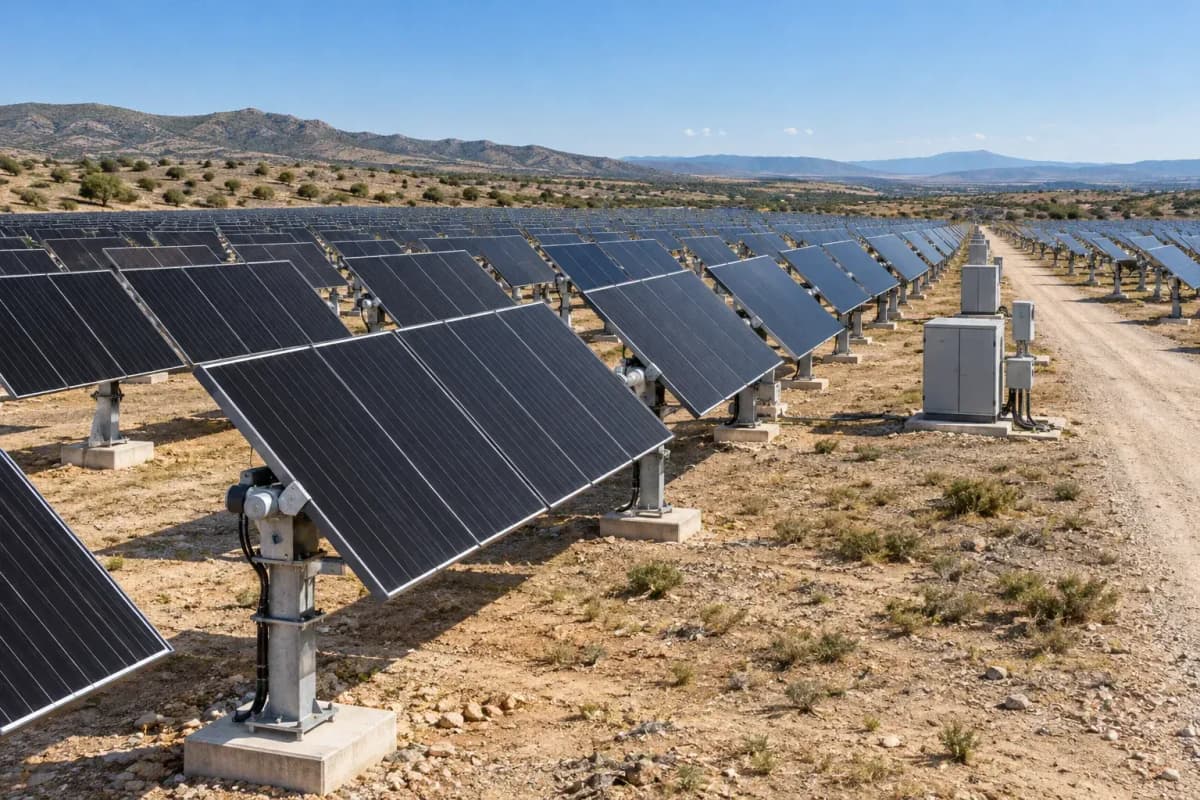
8.4MW Utility Scale Thin-Film CdTe 2-axis Tracker - 8,394 kWp Solar PV System
Key Features
- 8,394 kWp DC utility-scale CdTe configuration with 18.4% nominal module efficiency.
- 2-axis tracking; representative yield is 27.78% above the explicitly assumed fixed-mount alternative.
- Illustrative first-year generation of 19,306.2 MWh at a 26.26% DC-based capacity factor.
- Indicative EPC pricing of $3,062,986–$3,913,832, including a 1-year EPC warranty.
- Illustrative $3,763,112 EPC budget and 3.80-year simple payback at $0.06/kWh, subject to stated assumptions.
An 8,394 kWp DC utility-scale photovoltaic system combining thin-film CdTe modules, 18.4% nominal module efficiency, and dual-axis tracking. Indicative EPC pricing is $3,062,986–$3,913,832; representative annual generation of 19,306.2 MWh requires site-specific validation.
Description
The 8.4MW Utility Scale Thin-Film CdTe 2-axis Tracker is an 8,394 kWp DC photovoltaic system configured with cadmium telluride modules, 18.4% nominal module efficiency, and dual-axis solar tracking. SOLARTODO lists an indicative EPC investment of $3,062,986–$3,913,832, including installation, commissioning, and a 1-year EPC warranty, subject to an agreed site-specific scope.
Technical Specifications
The 8.4 MW product designation rounds the specified 8.394 MWp DC capacity; it does not describe continuous AC export. An illustrative electrical design uses 7,500 kW AC conversion capacity, giving a DC/AC ratio of 1.119. The 18.4% efficiency input is already a percentage conversion from 0.184 and must not be reported as 0.184%.
| Parameter | Configuration or planning assumption |
|---|---|
| DC nameplate capacity | 8,394 kWp |
| Module technology | Thin-film CdTe |
| Nominal module efficiency | 18.4% at standard test conditions |
| Illustrative module schedule | 16,788 modules × 500 W |
| Illustrative inverter schedule | 3 central inverters × 2,500 kW AC |
| Tracker arrangement | 2 axes: azimuth and elevation |
| Illustrative tracker schedule | 1,399 tables × 12 modules |
| Representative first-year generation | 19,306.2 MWh |
| DC-based capacity factor | 26.26% |
| Preliminary site allowance | 120,000–180,000 m² |
| EPC workmanship/support term | 1 year |
The 500 W module schedule is an arithmetic planning example, not a confirmed manufacturer bill of materials. First Solar Series 7 provides a relevant CdTe technology reference, but its published product page lists different wattages and efficiencies, including TR1 ratings up to 550 W and 19.7%. Selecting Series 7 therefore requires revised module counts, mounting compatibility, regional availability, and manufacturer approval. First Solar Series 7.
System Architecture
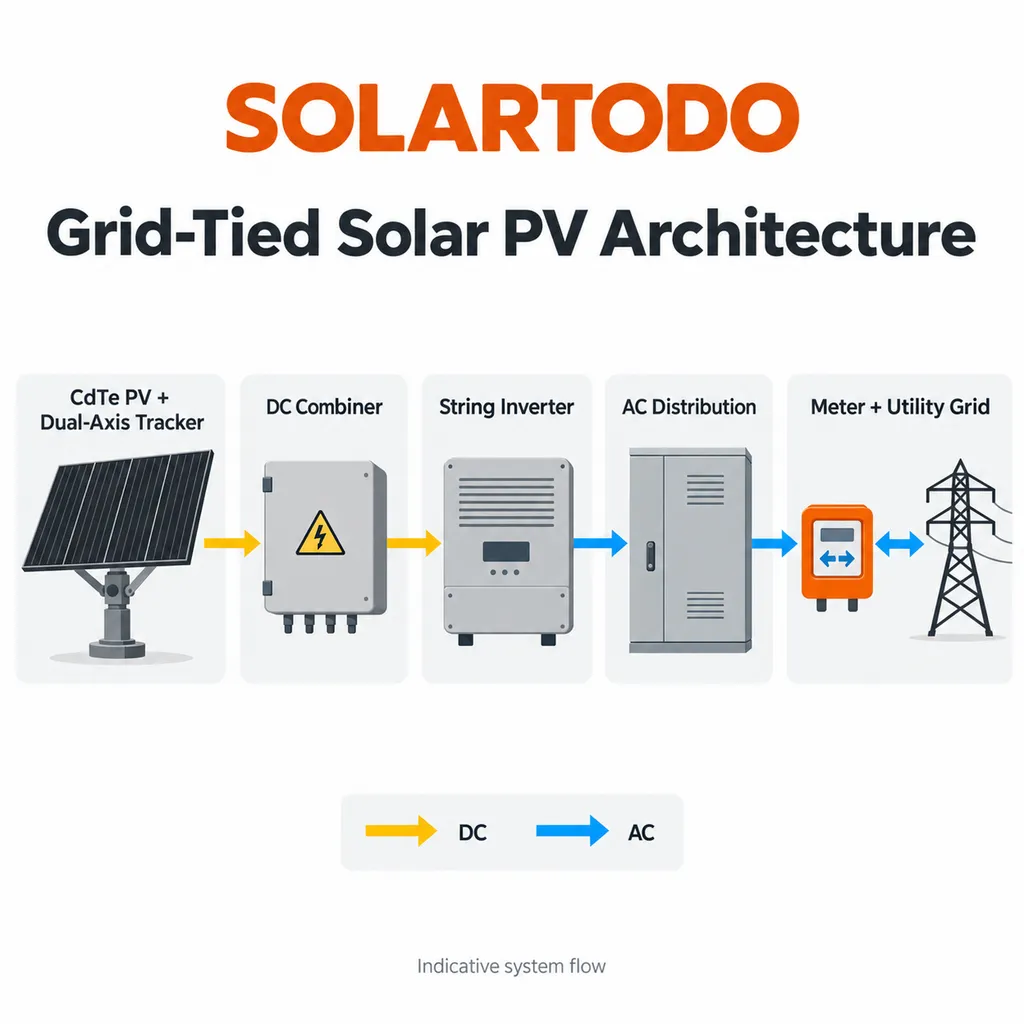
The 8,394 kWp array feeds DC collection circuits, central inverters, AC collection equipment, step-up transformers, and the utility interconnection. The illustrative 3 × 2,500 kW inverter arrangement establishes a budgeting basis rather than a final protection design. Engineers must verify maximum string voltage at minimum temperature, operating voltage at maximum temperature, input current, grounding requirements, and transformer loading before freezing the single-line diagram.
Each illustrative tracker carries 12 modules totaling 6 kWp, with 2 controlled axes adjusting elevation and azimuth. Actual actuator torque, foundation dimensions, motion limits, cable loops, and wind-stow positions depend on the selected module geometry and local loading criteria. A dual-axis structure cannot be assumed compatible with a module merely because another tracker uses the same nominal wattage or mounting rail.
CdTe Performance and Land Requirements
At standard irradiance of 1,000 W/m², the specified 18.4% efficiency corresponds to approximately 184 W of rated output per square metre of module surface. Dividing 8,394,000 W by 184 W/m² gives approximately 45,620 m² of aggregate module area. This calculation excludes tracker spacing, roads, drainage, inverter stations, fencing, and the substation; module area must never be substituted directly for the project land requirement.
A preliminary 120,000–180,000 m² site allowance equals 12–18 hectares and implies module-area coverage of approximately 25–38%. These figures are screening assumptions, not a surveyed layout or permitting commitment. Dual-axis sweep envelopes, shading, topography, and maintenance access can require more land. The final layout should evaluate collision clearances and shading across all 12 months, including low winter sun angles and storm-stow positions.
For a numerical temperature sensitivity illustration, assume power coefficients of −0.28%/°C for CdTe and −0.35%/°C for a conventional silicon alternative. At 65°C cell temperature, 40°C above the 25°C reference, calculated temperature losses are 11.2% and 14.0%, respectively: a 2.8-percentage-point difference. These coefficients are modeling assumptions, not certified values for the unselected module; approved datasheets must replace them before energy assessment.
Energy Yield and Conventional-System Comparison
For a representative MENA solar farm scenario, assume a first-year net specific yield of 2,300 kWh/kWp, after modeled conversion losses, soiling, shading, tracker consumption, and availability. Multiplying by 8,394 kWp gives 19,306,200 kWh/year, or 19,306.2 MWh/year. This is an illustrative planning scenario, not a customer installation, measured result, P50 assessment, or production guarantee; no site weather file has been supplied.
The associated DC-based capacity factor is 2,300 ÷ 8,760 = 26.26%, using a 365-day year. A bankable assessment requires hourly weather, horizon shading, loss assumptions, curtailment, and export constraints. NREL's PVWatts methodology supports 2-axis configuration, but selecting that option does not validate the assumed 2,300 kWh/kWp yield. Separate shading treatment is particularly important for dual-axis layouts. PVWatts V8 technical documentation.
For a consistent alternative comparison, assume the same 8,394 kWp capacity delivers 1,800 kWh/kWp with conventional fixed mounting. Annual production would be 15,109.2 MWh, making the representative dual-axis scenario 27.78% higher, or 4,197 MWh more annually. This comparison changes the assumed mounting yield while holding nameplate capacity constant; it does not attribute the entire uplift to CdTe chemistry or establish a universal tracking advantage.
At an assumed electricity value of $0.06/kWh, the additional 4,197,000 kWh has gross annual value of $251,820. The supplied mounting references of $0.18/W for dual-axis and $0.08/W for fixed mounting imply an $839,400 equipment premium and approximately 3.33 years of incremental gross recovery. Higher tracker maintenance, foundations, financing, and downtime extend that recovery; a single-axis alternative also deserves a separate site-specific comparison.
Cloud Monitoring
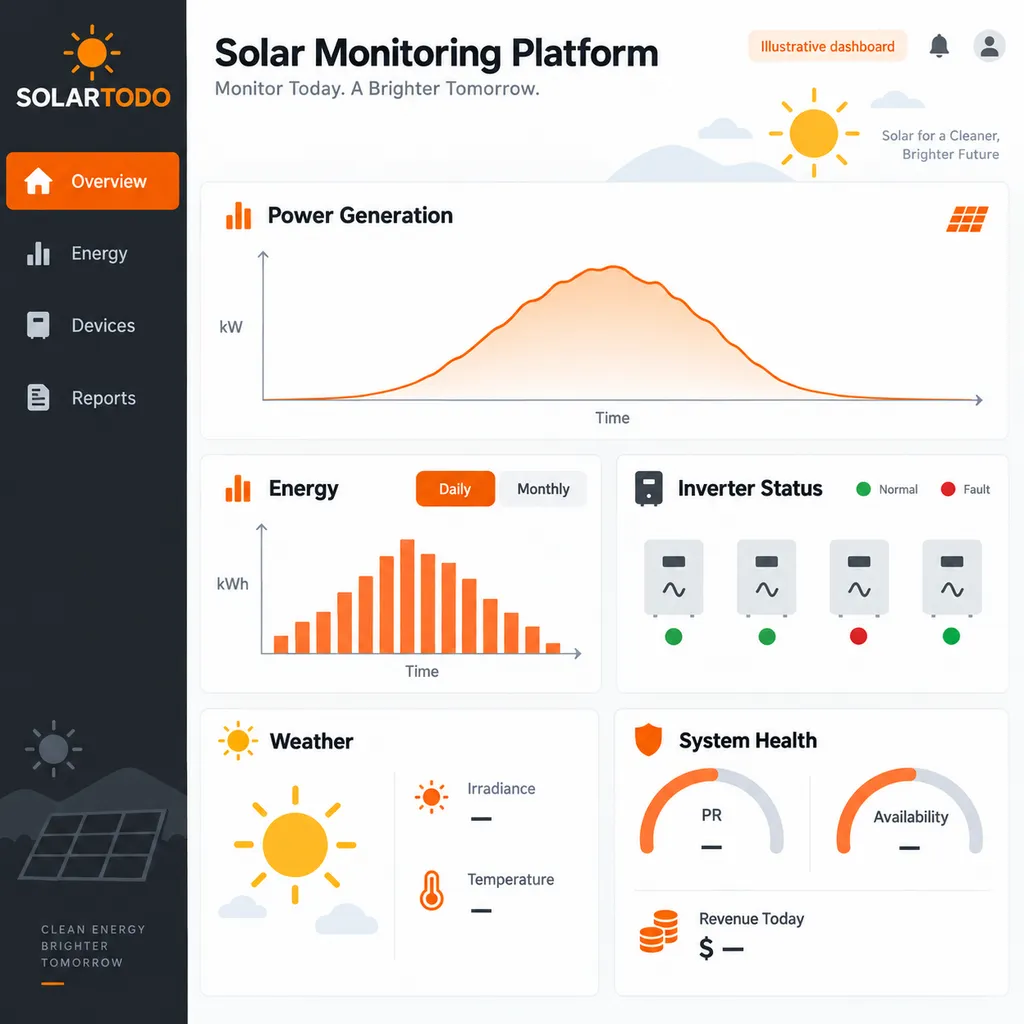
The 8,394 kWp plant should specify supervisory monitoring for inverter power, DC voltage, AC energy, tracker position, weather, and alarms. An illustrative monitoring scope uses 1-minute collection intervals and 15-minute reporting aggregates; these are procurement requirements rather than verified platform features. Include irradiance and module-temperature sensors so operators can distinguish weather-driven output changes from inverter outages, tracker misalignment, and abnormal soiling.
For the 3-inverter example, dashboards should identify each inverter and associated tracker groups, with daily energy totals and time-stamped event histories. Define data ownership, access permissions, export formats, retention periods, and communications availability in the contract. A 99% data-availability target can support operations planning, but it is separate from plant energy availability and requires an explicit measurement boundary and service agreement.
Standards, Procurement, and Commissioning
CdTe module procurement should request qualification evidence against the IEC 61215 series, including the technology-specific requirements of IEC 61215-1-2:2021 and its applicable amendments. Record the exact model, manufacturing location, certificate scope, and test-report identifiers. These references define procurement requirements; this page does not establish that the proposed 8,394 kWp assembly or an unspecified module already holds certification. IEC CdTe qualification requirements.
Module electrical and mechanical safety should be evaluated against the applicable IEC 61730 series, including the construction requirements in IEC 61730-1:2023. For North American projects, confirm the utility, authority, and applicable UL listing requirements for the exact model; a generic UL 1703 reference is insufficient evidence of present market acceptance. CE documentation, where required, must likewise be verified for the supplied equipment. IEC 61730-1:2023.
Inverter anti-islanding assessment should reference IEC 62116:2014, which specifies a test procedure rather than complete grid-code approval. The 7,500 kW AC example also requires utility review of reactive-power control, voltage and frequency response, protection coordination, and export limits. Commissioning records should document functional tests, meter checks, tracker stow, communications, and agreed performance baselines before handover. IEC 62116:2014.
EPC Investment Analysis and Pricing Structure
The quoted EPC range of $3,062,986–$3,913,832 corresponds to approximately $0.365–$0.466/Wp DC. Engineering covers the agreed electrical, structural, and civil design; procurement covers approved equipment; construction covers agreed installation works; commissioning covers documented testing and handover. The package includes 1 year of EPC warranty support. Land acquisition, taxes, extraordinary groundworks, and utility network reinforcement require explicit inclusion or separate allowances.
| Procurement tier | Indicative USD range | Principal scope |
|---|---|---|
| FOB Supply | $1,899,051–$2,661,406 | Equipment supply; named loading port to be agreed |
| CIF Delivered | $2,095,223–$2,936,329 | Supply plus ocean freight and insurance to the named destination port |
| EPC Turnkey | $3,062,986–$3,913,832 | Agreed engineering, equipment, construction, commissioning, and 1-year EPC warranty |
The 3 tiers are commercial budget ranges, not interchangeable delivery obligations. The supplied equipment tier was described as both FOB and ex-works China; those terms require different responsibilities and must be resolved in the quotation. CIF does not automatically include import duties, inland transport, or installation. A First Solar selection also requires confirmation of actual manufacturing origin, authorized sourcing, shipping route, and country-specific import requirements.
| Consolidated order threshold | Indicative discount |
|---|---|
| 50+ equivalent system packages | 5% |
| 100+ equivalent system packages | 10% |
| 250+ equivalent system packages | 15% |
The 50+, 100+, and 250+ thresholds refer to equivalent complete system packages, not individual panels; at 8.394 MWp each, they represent very large portfolios. Discounts require written confirmation of standardized scope, delivery schedule, and the eligible price base. Apply the single qualifying discount rather than adding percentages, and do not assume that freight, taxes, utility charges, or subcontracted work receive the same reduction.
The illustrative itemized EPC budget totals $3,763,112: $2,644,592 for equipment, $220,000 for freight and insurance, and $898,520 for installation, engineering, commissioning, grid-connection allowance, and 1-year support. Equipment prices are estimating allocations, not verified supplier quotations. The tracker allowance of $720 per 6 kWp table equals $0.12/Wp, below the supplied $0.18/W reference; procurement must confirm this assumption before financial commitment.
For the representative 19,306,200 kWh annual output, a flat $0.06/kWh realized energy value produces $1,158,372/year in gross benefit. With an assumed $20/kWp-year operating budget, annual operating cost is $167,880 and first-year net operating benefit is $990,492. This is avoided electricity expenditure only where consumption and settlement permit it; for an export project, use the applicable PPA revenue and curtailment provisions instead.
Dividing the EPC range by $990,492 gives a simple payback of approximately 3.09–3.95 years, with 3.80 years for the itemized budget. At energy values of $0.04/kWh and $0.08/kWh, the same itemized budget gives approximately 6.23 and 2.73 years, respectively. These calculations exclude debt service, tax, working capital, degradation, and residual value; they do not establish a guaranteed investment return.
Using the $3,763,112 budget, a 25-year analysis, 6% real discount rate, 0.5% annual energy degradation, $167,880 annual operating cost, and $150,000 inverter reserve in year 13 gives an illustrative discounted LCOE of approximately $0.0253/kWh. IRENA reports $0.043/kWh as the global weighted average for utility-scale solar commissioned in 2024; that historical benchmark does not validate this project's unusually low supplied capital budget. IRENA renewable generation costs.
Payment options are 30% T/T deposit plus 70% against B/L, or 100% L/C at sight, subject to the signed contract. For EPC, construction milestones and acceptance security should be documented separately from shipment payment. Financing enquiries can be evaluated for projects above $5,000,000, subject to lender approval; the single-system range here is below that threshold. Contact [email protected] for scope and commercial clarification.
Applications, Maintenance, and Project Configuration
The 8.394 MWp configuration suits utility export, industrial power supply, and appropriately permitted energy infrastructure where land, grid access, and tracking economics align. Hot climates warrant close review of module temperature behavior; humid or diffuse-light sites still need local weather and corrosion assessment. For category alternatives, View all Solar PV System products, comparing identical DC capacities and clearly defined AC export limits.
For maintenance planning, the illustrative 1,399-table arrangement requires inspections of 2-axis drives, bearings, cable movement, fasteners, and stow operation. Establish cleaning frequency using measured soiling and available water rather than a universal calendar. The commercial template targets 25-year panel performance coverage and 10-year inverter coverage, subject to selected manufacturer terms; these are distinct from the included 1-year EPC warranty and require written confirmation.
Applying an illustrative displaced-grid factor of 0.45 tCO₂/MWh to 19,306.2 MWh gives 8,687.8 tCO₂/year of estimated operational displacement. This excludes embodied emissions and is not a certified carbon credit. To refine the 8,394 kWp design, Configure your system online, Learn about solar yield and lifecycle economics, and Request a custom quotation with site coordinates, grid requirements, and delivery scope.
Technical Specifications
| System Capacity | 8394kWp DC |
| Module Type | Thin-film cadmium telluride (CdTe); manufacturer and model to be selected |
| Module Efficiency | 18.4% |
| Array Configuration | 2-axis tracking: azimuth and elevation |
| Application | Utility-scale ground-mounted solar PV |
| Illustrative Module Quantity | 16788 modules rated at 500 W each; final schedule subject to selection |
| Illustrative Inverter Capacity | 7500kW AC |
| Illustrative DC/AC Ratio | 1.119 |
| Est. Annual Generation | 19306.2; representative first-year scenario, not a site-specific forecastMWh/year |
| Capacity Factor | 26.26; DC-nameplate basis, representative scenario% |
| Aggregate Module Surface Area | Approximately 45620; calculated from rated capacity and 18.4% efficiencym² |
| System Area | 120000–180000; preliminary land allowance, subject to layout and surveym² |
| CO₂ Offset | 8687.8; illustrative operational displacement at 0.45 tCO₂/MWh, excluding lifecycle emissionsmetric tons/year |
| Payback Period | 3.09–3.95; simple payback at $0.06/kWh and stated operating assumptionsyears |
| LCOE | 0.0253; illustrative discounted result using the $3,763,112 budget and stated assumptionsUSD/kWh |
| Panel Warranty | 25-year performance coverage target; selected manufacturer terms require confirmation |
| Inverter Warranty | 10-year coverage target; selected manufacturer terms require confirmation |
| EPC Warranty | 1 year; scope and remedies defined by contract |
| Illustrative EPC Budget | 3763112USD |
Price Breakdown
| Item | Quantity | Unit Price | Subtotal |
|---|---|---|---|
| CdTe module, illustrative 500 W specification | 16788 pcs | $49 | $822,612 |
| Dual-axis tracker assembly, illustrative 6 kWp table | 1399 pcs | $720 | $1,007,280 |
| Central inverter, 2500 kW AC | 3 pcs | $125,000 | $375,000 |
| DC cables and combiner equipment package | 1 pcs | $167,880 | $167,880 |
| AC collection, transformers and switchgear package | 1 pcs | $251,820 | $251,820 |
| SCADA, weather sensors and monitoring package | 1 pcs | $20,000 | $20,000 |
| Ocean freight and insurance allowance | 1 pcs | $220,000 | $220,000 |
| Civil works and installation labor | 1 pcs | $671,520 | $671,520 |
| Engineering and quality control | 1 pcs | $100,000 | $100,000 |
| Testing and commissioning | 1 pcs | $75,000 | $75,000 |
| 1-Year EPC Warranty and Support | 1 pcs | $50,000 | $50,000 |
| Routine grid-connection allowance, excluding network reinforcement | 1 pcs | $2,000 | $2,000 |
| Total Price Range | $3,062,986 - $3,913,832 | ||
Frequently Asked Questions
What does the 8.4 MW rating represent?
Are First Solar Series 7 modules included as standard?
How much electricity can the dual-axis system generate?
What do the EPC price and warranty cover?
What information is needed for a binding quotation?
Certifications & Standards

Data Sources & References
- •SOLARTODO supplied configuration and commercial ranges: 8,394 kWp, 18.4% efficiency, dual-axis tracking; indicative prices, not verified supplier quotations.
- •First Solar, Series 7 product specifications and regional application information: https://www.firstsolar.com/en/Products/Series-7
- •NREL-developed PVWatts V8 methodology and array-type documentation: https://developer.nlr.gov/docs/solar/pvwatts/v8/
- •IEC 61215-1-2:2021, CdTe-specific module qualification requirements: https://webstore.iec.ch/en/publication/61347
- •IEC 61730-1:2023, photovoltaic module safety construction requirements: https://webstore.iec.ch/en/publication/59803
- •IEC 62116:2014, inverter islanding-prevention test procedure: https://webstore.iec.ch/en/publication/6479
- •IRENA, Renewable Power Generation Costs in 2024, published 2025: https://www.irena.org/Digital-Report/Renewable-Power-Generation-Costs-in-2024
- •Illustrative engineering and financial calculations: 2,300 kWh/kWp-year, $0.06/kWh energy value, $20/kWp-year operating cost, 25-year evaluation, 6% real discount rate, and 0.5% annual degradation; no site-specific simulation performed.
Interested in this solution?
Contact us for a customized quote based on your specific requirements.
Contact Us