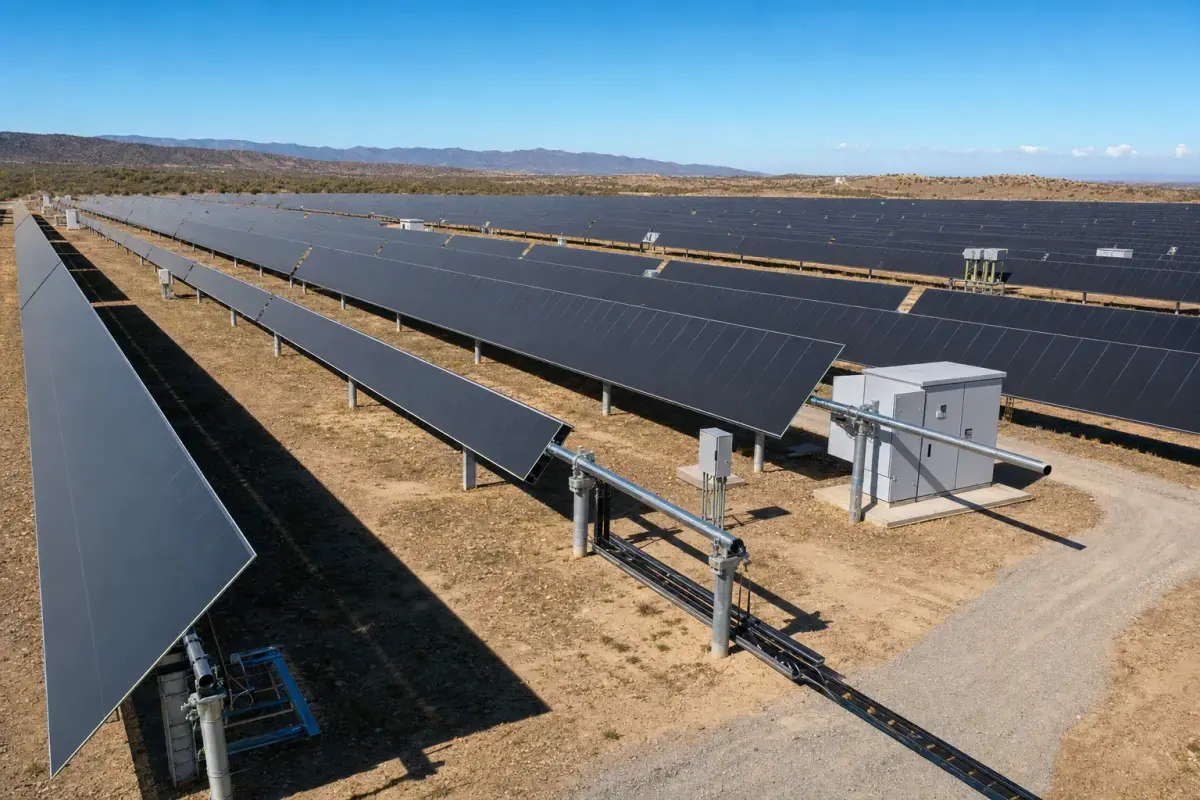
10MW Utility Scale Thin-Film CdTe 1-axis Tracker - 9.957 MWp Utility PV Plant
Key Features
- 9.957 MWp DC capacity with thin-film CdTe modules and 1-axis tracking
- Estimated 20,500 MWh/year generation and 23.5% capacity factor
- EPC turnkey price range of $3,410,441-$4,357,786
- Approximate 9,225 tCO₂/year offset at 0.45 tCO₂/MWh
- Modeled LCOE of $0.024/kWh with 25-year panel warranty basis
A 9.957 MWp utility-scale thin-film CdTe solar PV system with single-axis tracking, central inverters, IEC-aligned design, and an estimated 20,500 MWh annual output. EPC turnkey pricing is $3,410,441-$4,357,786, with FOB and CIF supply options for utility developers and EPC buyers.
Description
The 10MW Utility Scale Thin-Film CdTe 1-axis Tracker is a 9.957 MWp grid-connected solar PV system engineered for utility projects that require high energy yield in hot, humid, or diffuse-light regions. The reference configuration uses CdTe thin-film modules at 18.1% planning efficiency, horizontal single-axis trackers, 20 central inverter blocks, and an estimated 20,500 MWh of annual generation under a representative high-irradiance site model.
This SOLARTODO utility PV package is designed for procurement teams, independent power producers, public infrastructure developers, and EPC contractors evaluating 10 MW-class solar assets with bankable standards, traceable bill of materials, and USD pricing. The turnkey EPC range is $3,410,441-$4,357,786, while equipment-only FOB supply starts at $2,114,473, allowing buyers to compare supply-chain, delivered, and fully installed cost positions across 3 procurement models.
Product Overview for 9.957 MWp Utility PV
The system is a DC-rated 9,957 kWp solar PV plant using thin-film cadmium telluride technology, a module class often selected for high-temperature regions because CdTe typically has a lower temperature coefficient than crystalline silicon alternatives. For utility sites with 2,000-2,200 kWh/m² annual global horizontal irradiation, the modeled annual output of 20,500 MWh corresponds to a 23.5% DC capacity factor, which is consistent with single-axis tracking assumptions used in NREL PVWatts v8 modeling workflows.
CdTe thin-film modules are structurally different from 550 W TOPCon or 700 W bifacial crystalline silicon products because the semiconductor is deposited as a thin layer rather than assembled from silicon wafers. First Solar Series 7 product literature reports large-format CdTe modules with about 19%-21% class module efficiency depending on SKU, while this commercial quotation keeps the planning efficiency at 18.1% to preserve a conservative system-area and procurement basis.
Single-axis tracking is the primary yield lever in this 10 MW configuration, because the north-south tracker rows rotate east-west during the day to reduce incidence-angle loss. Compared with a conventional fixed-tilt utility PV array at the same 9.957 MWp DC size, a horizontal 1-axis tracker can increase annual energy by 15%-25% in suitable latitudes, while adding about $0.115-$0.12/W in tracker hardware and control cost.
Utility buyers comparing product families can View all Solar PV System products or Configure your system online using a 9,957 kWp DC base case. For design background on PV sizing, irradiance, and grid connection, SOLARTODO also maintains technical resources at Learn about topic, including 2026 buyer guidance for EPC specification review.
System Architecture for 9.957 MWp
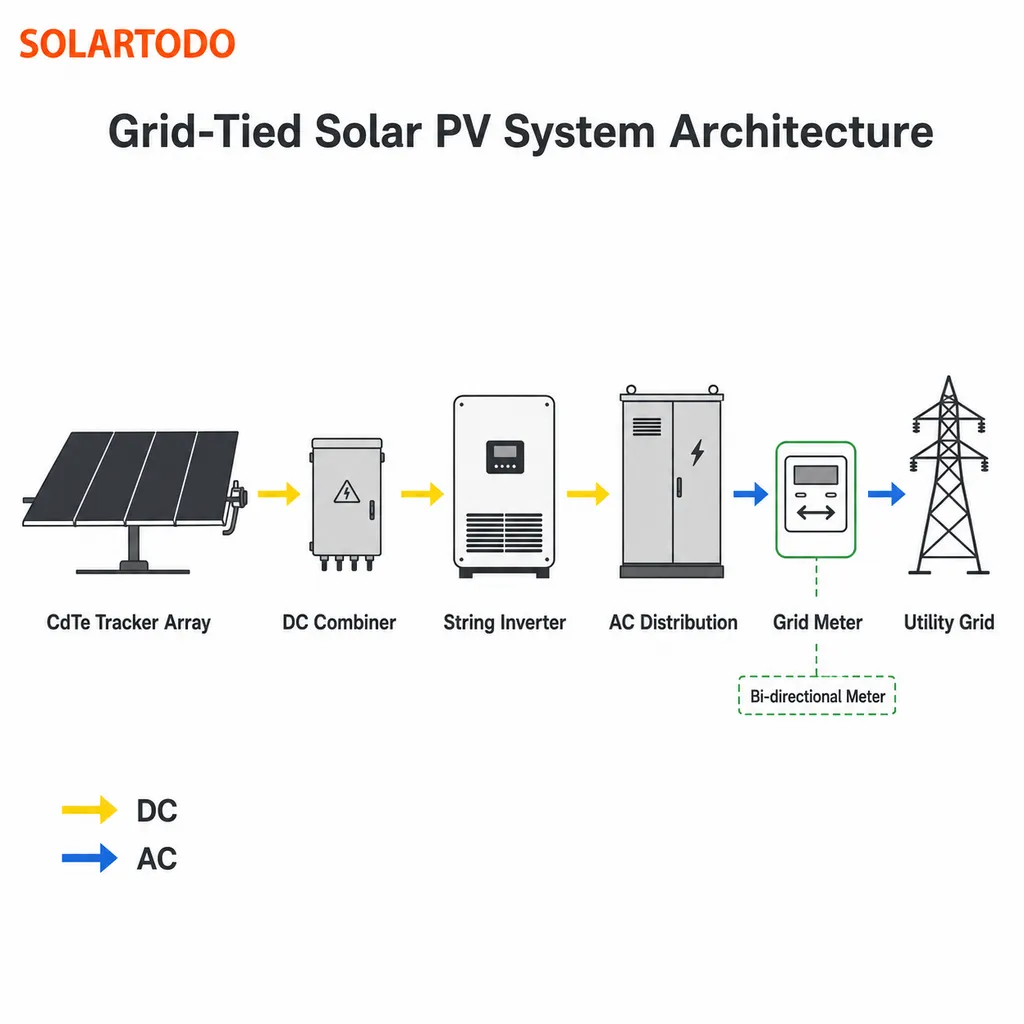
The architecture uses approximately 17,170 thin-film CdTe modules, 620 tracker-row equivalent structural sets, 20 central inverter blocks, DC combiner aggregation, medium-voltage AC infrastructure, SCADA monitoring, weather sensors, and grid interconnection protection. A typical DC string layout is configured around inverter MPPT windows, cable voltage drop below 1.5%-2.0%, and protection coordination aligned with IEC 62548, IEC 62109, IEEE 1547, and local utility interconnection rules.
The DC field is divided into tracker zones so that each tracker controller, motor drive, slew bearing, and row string group can be isolated for maintenance without shutting down the full 9.957 MWp plant. This architecture reduces operational exposure because a single tracker-zone outage affects a limited portion of the array rather than the entire 10 MW site, and it supports fault localization through inverter telemetry at 5-minute or 15-minute intervals.
The AC side aggregates inverter output through transformer stations, protection relays, revenue metering, and a point of common coupling designed for anti-islanding, voltage ride-through, frequency ride-through, and reactive power control. IEC 62116 covers anti-islanding test methods for utility-interconnected PV inverters, while IEEE 1547 defines interconnection and interoperability requirements used in many 60 Hz markets.
Technical Specifications for 10 MW-Class Procurement
| Parameter | Reference value |
|---|---|
| DC system capacity | 9,957 kWp |
| Module technology | Thin-film CdTe |
| Planning module efficiency | 18.1% |
| Array configuration | Horizontal 1-axis tracker |
| Estimated annual generation | 20,500 MWh/year |
| Capacity factor | 23.5% |
| Approximate system area | 180,000 m² |
| CO₂ offset basis | 9,225 tons/year at 0.45 tCO₂/MWh |
| Modeled LCOE | $0.024/kWh |
| Warranty basis | 25-year panels, 10-year inverter, 1-year EPC support |
The system-area estimate separates active module aperture from project land area, because 18.1% module efficiency implies roughly 55,000 m² of active module surface, while tracker spacing, access roads, inverters, drainage, and setbacks can raise the practical utility footprint to about 180,000 m². A higher ground coverage ratio may reduce land use by 8%-15%, but it can also increase row-to-row shading and reduce morning or afternoon yield.
The annual generation estimate uses a 20,500 MWh/year planning case rather than a guaranteed performance claim, because bankable energy yield requires a site-specific P50/P90 analysis, meteorological data, horizon shading, soiling rate, grid curtailment model, and final inverter clipping study. NREL PVWatts guidance is useful for early feasibility screening, while lenders normally require an independent engineer report for 10 MW and larger project finance.
Thin-Film CdTe Performance and Standards
CdTe thin-film technology is attractive for hot climates because its field performance is less penalized by module operating temperatures above the 25°C standard test condition. In many desert or tropical utility sites, module backsheet or glass temperatures can exceed 60°C during peak irradiance hours, and the lower temperature coefficient of CdTe can preserve several percentage points of output compared with conventional crystalline silicon modules.
The module compliance basis should reference IEC 61215 for terrestrial PV module design qualification and type approval, IEC 61730 for PV module safety qualification, and UL 1703 where North American legacy certification language is required. Inverter and grid-interface specifications should include IEC 62116 anti-islanding, IEC 62109 safety, UL 1741 where applicable, and IEEE 1547 interconnection behavior for distributed energy resources.
CdTe modules are especially relevant where buyers value lower embodied carbon, strong diffuse-light response, and utility-scale manufacturing traceability. IRENA renewable cost reporting shows utility solar PV remains one of the lowest-cost new generation sources in many regions, while IEA renewable market updates continue to identify solar PV as the largest contributor to new renewable capacity additions during 2025-2026.
Representative MENA Solar Farm Scenario
For a representative MENA solar farm scenario with 2,100 kWh/m²/year irradiation, 1.25 DC/AC ratio, 2.0% soiling loss after cleaning, and 0.5% annual degradation, the 9.957 MWp CdTe tracker system can be screened at about 20,500 MWh in year 1. At a wholesale or avoided-energy value of $0.085/kWh, gross annual energy value is about $1,742,500 before O&M, land lease, curtailment, tax, and financing assumptions.
Using the EPC midpoint of about $3,884,000 and an indicative annual O&M budget of $15/kW-year, the simple payback screens at approximately 2.4 years under the representative tariff case. This is not a guaranteed investor return, because debt tenor, grid curtailment, connection charges, tax incentives, wheeling fees, exchange rates, and P90 generation can shift project IRR by more than 3-6 percentage points.
Compared with a diesel generation alternative using 0.26 liters/kWh and $0.90/liter fuel, the 20,500 MWh/year PV output can avoid about 5.33 million liters of diesel consumption per year before generator efficiency and part-load corrections. At a grid emissions factor of 0.45 tCO₂/MWh, the same energy output corresponds to about 9,225 tCO₂/year of avoided operational emissions.
Cloud Monitoring and Plant Controls
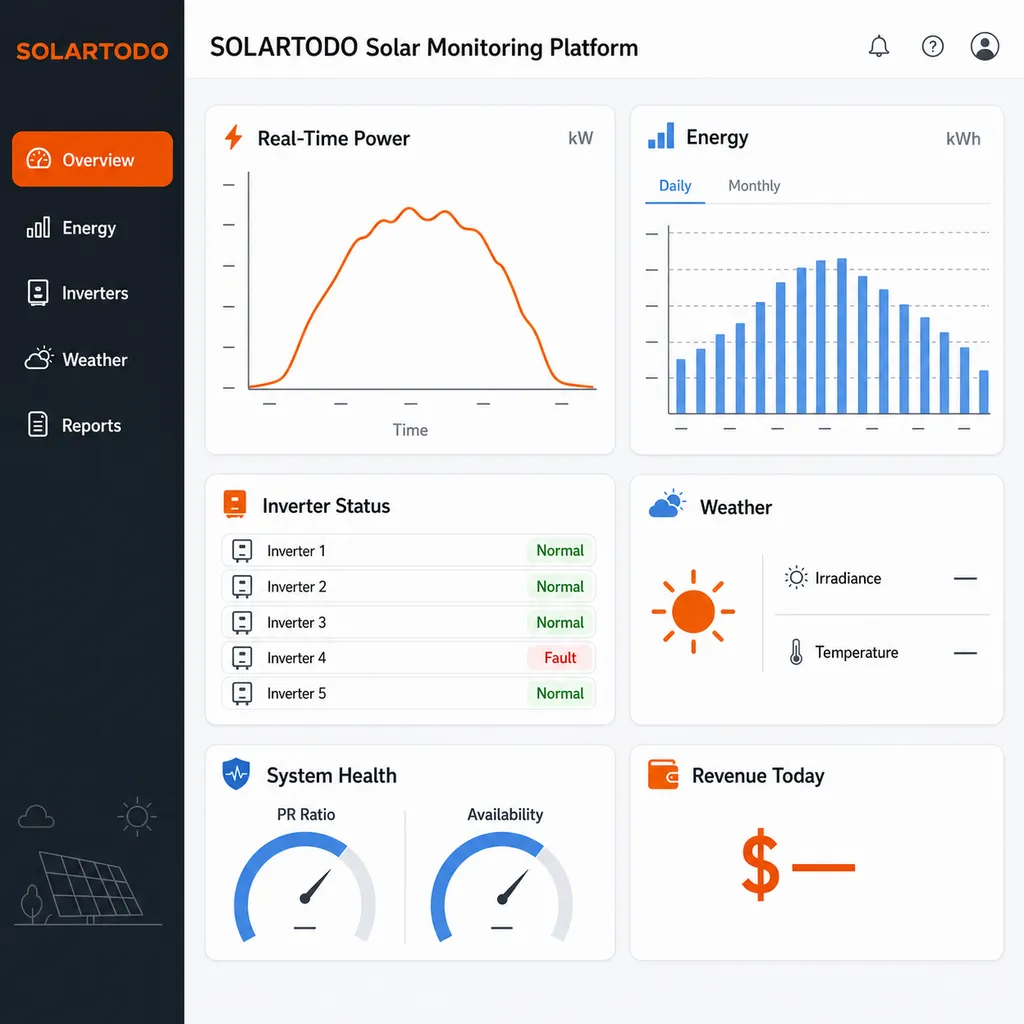
The monitoring package includes inverter data, tracker position feedback, pyranometer or reference-cell data, ambient temperature, module temperature, wind speed, fault alarms, energy counters, and plant-level performance ratio reporting. IEC 61724-1 is the relevant PV monitoring reference, and a 10 MW asset normally uses 1-minute to 15-minute data granularity depending on SCADA bandwidth, utility dispatch requirements, and O&M contract terms.
The cloud platform can compare actual AC output against irradiance-adjusted expected output, detect underperforming tracker zones, and trigger service tickets for inverter faults, string anomalies, or communication dropouts. For a plant with 20 inverter blocks and 620 tracker-row equivalents, alert prioritization is essential because a 1% persistent performance loss represents about 205 MWh/year of missed generation in this reference model.
EPC Investment Analysis and Pricing Structure
SOLARTODO EPC scope includes engineering, procurement, construction, commissioning, documentation, and a 1-year project support warranty for the installed 9.957 MWp system. Engineering covers single-line diagrams, equipment selection, DC and AC sizing, grounding, lightning protection, civil layout, tracker foundation assumptions, monitoring architecture, and grid-connection documentation required by the local utility.
| Pricing tier | Scope | Price range |
|---|---|---|
| FOB Supply | Equipment only, ex-works China | $2,114,473-$2,963,294 |
| CIF Delivered | Equipment plus ocean freight and insurance | $2,332,898-$3,269,402 |
| EPC Turnkey | Installed, commissioned, and 1-year supported | $3,410,441-$4,357,786 |
| Volume band | Discount basis | Effective commercial note |
|---|---|---|
| 50+ systems | 5% | Applies to repeat 10 MW-class framework orders |
| 100+ systems | 10% | Requires consolidated procurement schedule and forecast |
| 250+ systems | 15% | Requires master supply agreement and phased delivery plan |
The ROI case should be evaluated against site-specific electricity value, curtailment risk, and financing cost rather than headline module price alone. At 20,500 MWh/year and $0.085/kWh energy value, annual gross savings are about $1.74 million; after indicative O&M of $149,355/year, the net pre-financing benefit is about $1.59 million/year, which supports a simple payback of 2.1-2.7 years across the EPC price range.
Payment terms are 30% T/T advance plus 70% against bill of lading, or 100% irrevocable L/C at sight for approved counterparties. Project financing support can be discussed for transactions above $5,000K, and buyers can Request a custom quotation or email [email protected] with land coordinates, grid voltage, target COD date, and preferred Incoterms.
Applications and Buyer Fit
This 10 MW CdTe tracker configuration is best suited to utility solar farms, corporate power purchase agreement projects, industrial self-generation sites above 5 MW, mine power systems, water-treatment plants, and public infrastructure portfolios with available land. It is less suitable for constrained rooftops below 1 MW because tracker spacing, wind stow design, and maintenance corridors require utility-scale land geometry.
The system can be paired with battery energy storage when evening peak delivery, ramp-rate control, or grid-code compliance requires dispatchability beyond daylight production. For BESS-coupled procurement, the PV plant should be modeled with hourly generation, clipping recovery, battery round-trip efficiency, degradation, and a 10-year or 15-year augmentation strategy rather than a single annual MWh number.
Procurement Notes for Engineers and Developers
Before order placement, buyers should confirm 8 technical inputs: site coordinates, soil bearing capacity, flood level, wind speed, corrosion class, grid voltage, utility protection code, and annual soiling profile. These inputs determine tracker foundation type, pile depth, galvanization level, inverter station rating, cable section, grounding design, and whether additional reactive power equipment is needed.
SOLARTODO can support equipment-only procurement, delivered supply, or turnkey EPC execution depending on local installation responsibility and licensing requirements. For early design comparison across fixed tilt, 1-axis tracking, TOPCon, bifacial, CdTe, and storage-coupled architectures, buyers can use Learn about topic and then submit a bankable layout request through the configurator with 10 MW-class assumptions.
Technical Specifications
| System Capacity | 9957kWp |
| Module Type | thin_film_cdte |
| Module Efficiency | 18.1% |
| Array Configuration | 1-axis |
| Est. Annual Generation | 20500MWh |
| Capacity Factor | 23.5% |
| System Area | 180000m² |
| CO₂ Offset | 9225tons/year |
| Payback Period | 2.4years |
| LCOE | 0.024USD/kWh |
| Warranty | 25yr panels, 10yr inverter |
Price Breakdown
| Item | Quantity | Unit Price | Subtotal |
|---|---|---|---|
| Thin-film CdTe PV modules, 580W class | 17170 pcs | $58 | $995,860 |
| Single-axis tracker row sets with drives and controllers | 620 pcs | $1,847 | $1,145,053 |
| Central inverter blocks, 500kW class | 20 pcs | $24,893 | $497,850 |
| DC combiner boxes and DC cable sets | 120 pcs | $1,660 | $199,140 |
| Medium-voltage AC infrastructure packages | 10 pcs | $29,871 | $298,710 |
| Plant monitoring and SCADA gateway | 1 pcs | $500 | $500 |
| Grid connection protection and metering allowance | 1 pcs | $2,000 | $2,000 |
| Installation and commissioning labor | 9957 pcs | $80 | $796,560 |
| Engineering, design review, and QC documentation | 1 pcs | $90,000 | $90,000 |
| Commissioning tests and grid synchronization support | 1 pcs | $35,000 | $35,000 |
| 1-year EPC warranty and technical support | 1 pcs | $20,000 | $20,000 |
| Total Price Range | $3,410,441 - $4,357,786 | ||
Frequently Asked Questions
What is included in the EPC turnkey price for this 10MW CdTe tracker system?
Why use CdTe thin-film modules instead of TOPCon crystalline silicon modules?
How much land is required for the 9.957 MWp single-axis tracker plant?
Is the estimated 20,500 MWh annual generation guaranteed?
Which standards should procurement teams specify for this system?
Certifications & Standards


Data Sources & References
- •NREL PVWatts v8 documentation, https://pvwatts.nrel.gov/
- •IEC 61215 terrestrial PV module design qualification and type approval, https://webstore.iec.ch/
- •IEC 61730 PV module safety qualification, https://webstore.iec.ch/
- •IEC 61724-1 photovoltaic system performance monitoring, https://webstore.iec.ch/
- •IRENA Renewable Power Generation Costs 2024, https://www.irena.org/
- •IEA Renewables 2025 market analysis, https://www.iea.org/
- •First Solar Series 7 CdTe module product literature, https://www.firstsolar.com/
Interested in this solution?
Contact us for a customized quote based on your specific requirements.
Contact Us