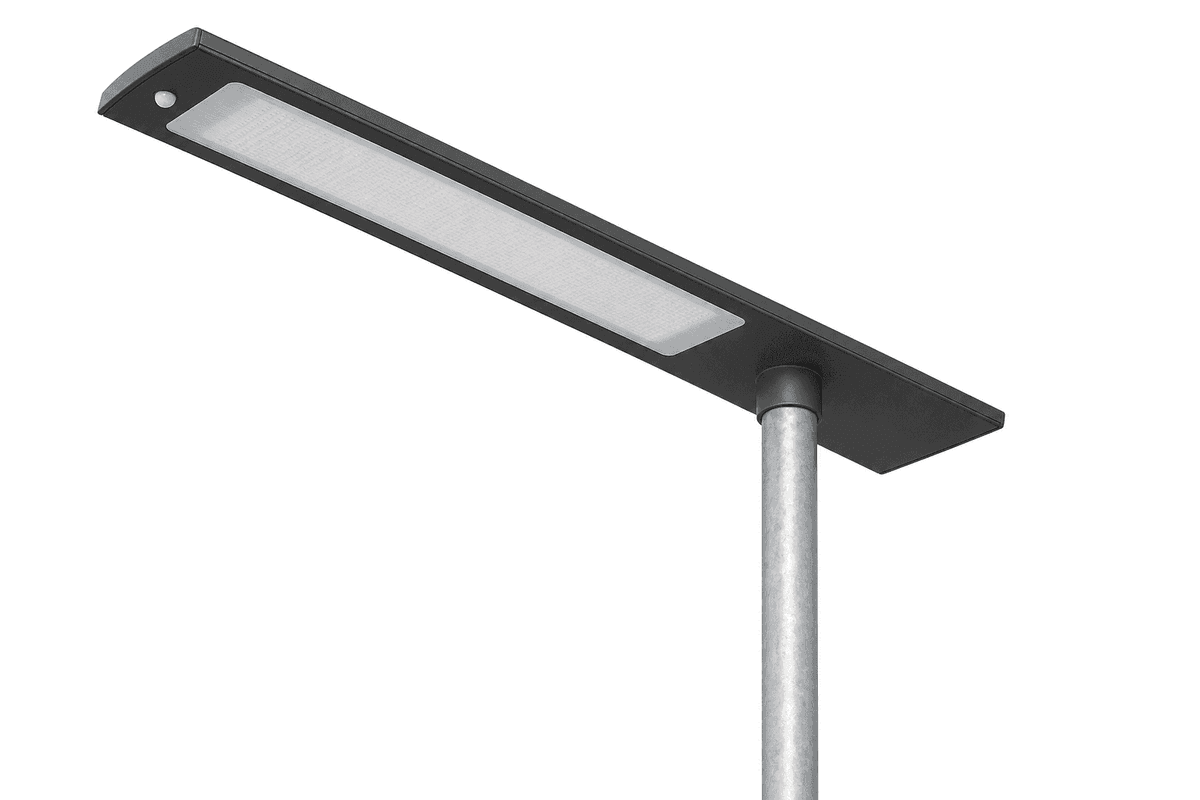
6m All-in-One Security Streetlight 70W - 7-Day LFP Autonomy
Key Features
- 70W LED output delivers approximately 11,900 lm at >170 lm/W for 6m security lighting.
- 154Wp TOPCon solar panel and 560Wh LiFePO4 battery support 7 rainy days of autonomy.
- All-in-one-plus design reduces field wiring points by more than 70% versus split systems.
- MPPT controller efficiency exceeds 98% with PIR/time-based dimming for up to 60% energy saving.
- EPC turnkey price range is $264-$495 per pole with 3-year system and 5-year pole warranty.
The 6m All-in-One Security Streetlight 70W integrates a 154Wp TOPCon solar module, 560Wh LiFePO4 battery, MPPT control, and >11,900 lm LED output for 12-hour dusk-to-dawn security lighting. EPC turnkey pricing is $264-$495 per pole with 7 rainy-day autonomy for subtropical roads, campuses, logistics yards, and perimeter zones.
Description
The 6m All-in-One Security Streetlight 70W is a pole-top integrated solar lighting system with a 154Wp monocrystalline TOPCon panel, 560Wh LiFePO4 battery, 70W LED engine, and aluminum-alloy pole package for 12h/night operation. Designed for subtropical climates, the system targets 7 rainy days of autonomy, >11,900 lm luminous output at >170 lm/W, and EPC turnkey delivery from $264 to $495 per installed pole.
SOLARTODO positions this model in the Solar Street Light product line for B2B buyers specifying security lighting across 6m roadways, solar farm perimeters, logistics depots, rural access roads, and smart-infrastructure corridors. The all-in-one-plus format places the panel, battery, MPPT controller, sensor, and LED array in 1 compact head, reducing field wiring points by more than 70% compared with split solar streetlights using 3 or more separate outdoor enclosures.
Product Definition and Buyer Fit
A 6m mounting height is commonly selected for 5m to 8m internal roads, parking lanes, pedestrian security corridors, and asset perimeters where 20 lux to 35 lux average illuminance is often more useful than high-mast floodlighting. This 70W version fits procurement programs that need a balanced midpoint between 40W pathway lights and 100W roadway luminaires, while maintaining a 154Wp charging surface and 560Wh storage reserve.
For buyers comparing multiple SOLARTODO categories, the complete product family is available at View all Solar Street Light products, and project-specific pole spacing, dimming schedules, and battery reserve can be modeled at Configure your system online. A typical bill of quantities for 100 poles uses 100 integrated heads, 100 aluminum-alloy poles, 100 foundation sets, and 1 commissioning checklist per installation zone.
The system follows the standalone photovoltaic design logic described in IEC 62124, the luminaire safety framework of IEC 60598, and common ingress expectations of IP66/IP67 outdoor lighting. NREL guidance for photovoltaic energy modeling emphasizes local irradiation and loss assumptions, so SOLARTODO sizes this 154Wp/560Wh configuration around subtropical use where daily solar availability and 7-day reserve requirements must be reconciled during engineering.
System Architecture
The all-in-one architecture combines 5 major subsystems: 154Wp TOPCon PV module, 560Wh LiFePO4 battery pack, MPPT controller, 70W LED module, and PIR/time-based dimming electronics. In a conventional split solar light, these 5 functions may be distributed across separate panel brackets, battery boxes, controller cabinets, luminaire arms, and cable glands, increasing installation labor and potential water-entry points.
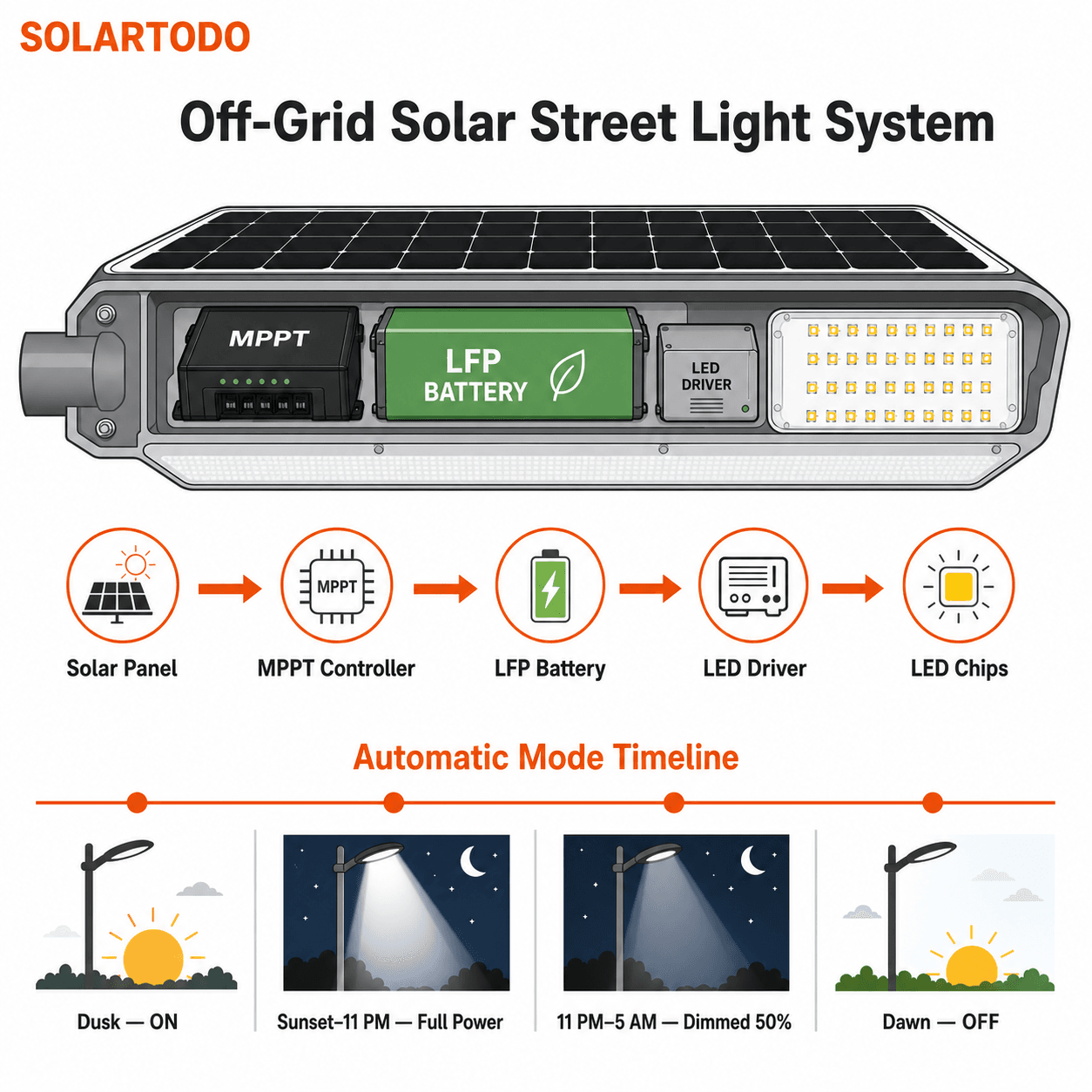
The 154Wp PV module uses monocrystalline TOPCon cell technology, typically associated with 19% to 23% module efficiency and a 25-year PV service life under standard warranty assumptions. IRENA has reported that solar PV cost reductions over the last decade have made distributed off-grid lighting more viable, and this product uses that cost structure to avoid trenching, cable theft exposure, and AC distribution work on projects as small as 50 poles.
The 560Wh LiFePO4 battery provides 7 rainy days of nominal autonomy when paired with a smart dimming profile, such as 100% output for 4h, 40% output for 6h, and PIR-triggered security boost during low-traffic periods. LiFePO4 chemistry is selected because 2,000+ deep-cycle capability, integrated BMS protection, and thermal stability are better aligned with outdoor infrastructure than lead-acid gel batteries that may require replacement after 2 to 4 years in hot environments.
The controller uses MPPT conversion with a rated efficiency above 98%, allowing the 154Wp panel to charge more effectively than PWM control during morning, afternoon, and partly cloudy conditions. The control logic supports dusk-to-dawn switching, 3 to 5 time blocks, motion-adaptive dimming, and fault alerts through optional 4G or LoRa monitoring, depending on project scale.
Technical Specifications
| Parameter | Specification |
|---|---|
| Pole height | 6 m |
| LED power | 70 W |
| Estimated luminous flux | 11,900 lm |
| Solar panel | 154 Wp TOPCon |
| Battery capacity | 560 Wh LiFePO4 |
| Autonomy | 7 rainy days |
| Operating schedule | 12 h/night |
| Pole material | Aluminum alloy |
| Wind resistance | 150 km/h |
| Operating temperature | -20°C to +60°C |
| System warranty | 3 years |
| Pole warranty | 5 years |
The 70W LED engine is specified around premium chip families such as Bridgelux, Cree, or Lumileds, with luminous efficacy above 170 lm/W and an expected LED life exceeding 50,000h. At 12h/day operation, 50,000h corresponds to approximately 11.4 years of night use, although battery service life, local heat, and cleaning intervals should be reviewed every 12 months.
The aluminum-alloy pole option is lighter than a comparable 6m galvanized steel pole and costs about 30% more by reference pricing, but it improves handling speed for remote installation teams and reduces corrosion risk in humid subtropical sites. For coastal projects with chloride exposure above normal inland levels, buyers can evaluate FRP composite alternatives through Learn about solar streetlight materials.
Lighting Performance and Energy Logic
A 70W grid-connected LED streetlight operating 12h/night consumes about 306.6 kWh/year before ballast or driver losses, calculated as 70W x 12h x 365 days. The solar all-in-one design offsets that grid energy at the pole, and in remote corridors it can eliminate 100% of trenching, AC cabling, panel-board expansion, and utility metering for each lighting point.
Compared with a conventional AC streetlight requiring trenching and copper cabling over a 1,000m road, a 100-pole solar deployment can reduce civil electrical works by 60% to 80% depending on cable depth, pavement cutting, and transformer distance. IEA energy-efficiency analysis has repeatedly identified efficient lighting as a high-impact electricity-reduction measure, and combining >170 lm/W LEDs with motion dimming can lower nightly energy demand by about 60% versus fixed-output operation.
For security applications, the PIR dimming strategy is important because 100% output for all 12h is rarely necessary on low-traffic roads. A programmed profile can maintain 30% to 40% background light for surveillance continuity, then raise output to 100% for 20s to 60s when motion is detected, improving visual identification without oversizing the battery by 2x.
Cloud Monitoring
Optional 4G or LoRa monitoring adds remote visibility for battery voltage, charge current, LED status, dimming state, and fault alarms across 50 to 5,000 poles. This function is especially useful for EPC contractors managing multiple districts because a single dashboard can reduce truck rolls by 20% to 40% when failed batteries, blocked panels, or controller alarms are identified before a night inspection.
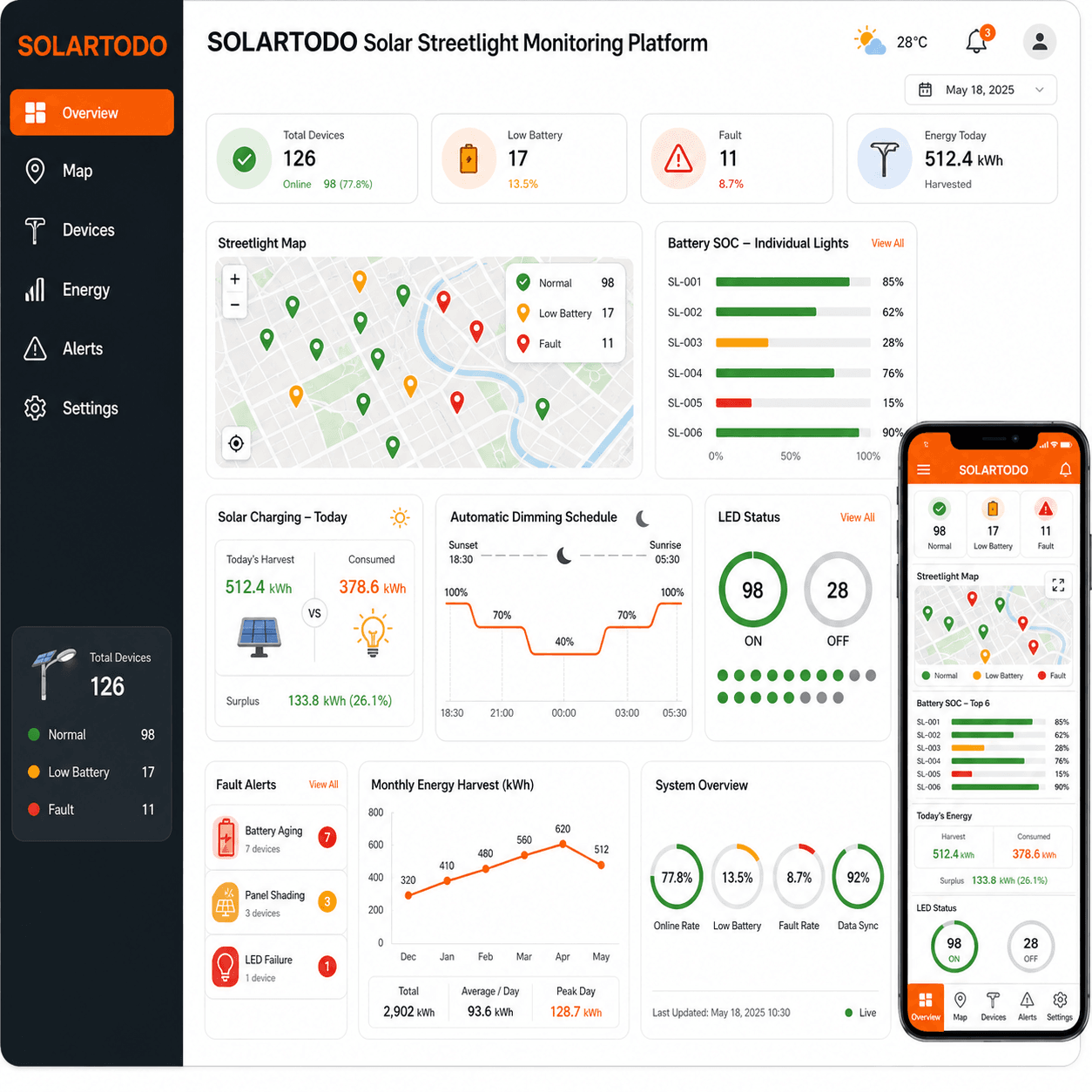
Cloud monitoring also supports commissioning records, including GPS position, installation date, device ID, and dimming schedule for each 6m pole. For public-private partnership programs, these records create a traceable maintenance file across the 3-year system warranty and can support performance reporting for lenders, municipalities, and asset owners.
Application Scenario
A solar farm operator in a subtropical MENA logistics corridor can deploy 120 units of the 6m 70W all-in-one security streetlight along internal roads, inverter station access points, and perimeter gates. With 120 poles, the project installs 8.4 kW of LED load, 18.48 kWp of distributed PV charging capacity, and 67.2 kWh of LiFePO4 storage at the lighting layer.
In this scenario, each pole operates independently, so a single cable fault cannot darken a 500m branch circuit or disable 20 adjacent lights. Security teams receive 12h/night lighting coverage, while procurement teams avoid AC cable routes, distribution boards, and trench reinstatement costs that can exceed the luminaire cost on hard-surface industrial roads.
EPC Investment Analysis and Pricing Structure
SOLARTODO’s EPC turnkey scope includes 5 work packages: engineering, procurement, construction, commissioning, and 1-year field warranty support. Engineering covers photometric spacing review and foundation checks; procurement covers luminaires, 6m aluminum-alloy poles, anchors, and batteries; construction covers foundation setting and pole erection; commissioning covers 100% functional testing; warranty support covers defect response during the first 12 months.
| Pricing tier | Scope | Unit price, USD |
|---|---|---|
| FOB Supply | Equipment only, ex-works China | $164-$337 |
| CIF Delivered | Equipment plus ocean freight and insurance | $184-$379 |
| EPC Turnkey | Installed, commissioned, and supported for 1 year | $264-$495 |
| Order volume | Discount from base equipment price |
|---|---|
| 50+ units | 5% |
| 100+ units | 10% |
| 250+ units | 15% |
A baseline grid-connected 70W LED pole may cost less at the fixture level, but the installed project cost changes when trenching, AC cabling, distribution panels, metering, and reinstatement are included. If a conventional alternative consumes 306.6 kWh/year per pole and electricity costs $0.15/kWh, annual energy savings are about $46 per pole, before avoided trenching and maintenance travel are counted.
For a 100-pole project, annual avoided electricity is about 30,660 kWh, equivalent to $4,599/year at $0.15/kWh. If avoided cabling and trenching save $150 to $300 per pole, the effective payback against conventional AC lighting can fall within 3 to 6 years, while remote sites with diesel-generated electricity can reach payback in 1.5 to 3 years.
Payment terms are 30% T/T deposit plus 70% against bill of lading, or 100% irrevocable L/C at sight for qualified orders. Project financing can be evaluated for programs above $1,000K, and procurement teams can Request a custom quotation or contact [email protected] with pole quantity, road width, site coordinates, and required lux level.
Standards, Compliance, and Quality Control
The PV subsystem should be reviewed against IEC 62124 for standalone PV performance testing and IEC 61215/IEC 61730 principles for crystalline module durability and safety where applicable. The luminaire assembly should align with IEC 60598, while ingress protection targets IP66/IP67 and corrosion checks should be adapted to the 6m pole material and local humidity.
UL 8750 principles for LED equipment safety and IEEE guidance for surge protection are relevant for buyers standardizing procurement across mixed AC and solar lighting assets. BloombergNEF has tracked continuing lithium battery cost reductions, but SOLARTODO still specifies BMS-controlled LiFePO4 packs because lifecycle cost depends on 2,000+ cycles, charge management, and thermal protection rather than cell price alone.
Factory quality control uses 4 inspection stages: incoming component check, battery capacity sampling, controller function test, and final assembled luminaire burn-in. For orders above 250 units, SOLARTODO can add AQL sampling, serial-number traceability, and export packaging checks before CIF shipment.
Procurement Notes
Project developers should provide 6 inputs before final engineering: latitude and longitude, road width, pole spacing target, required lux level, dimming schedule, and soil/foundation assumptions. These 6 inputs allow SOLARTODO to verify whether the 154Wp panel and 560Wh battery are suitable or whether a higher panel wattage, larger battery, or split configuration is required.
The 6m all-in-one-plus configuration is strongest when fast deployment, clean appearance, and anti-theft integration matter more than maximum modular serviceability. For very high wind zones above 150 km/h, coastal salt exposure, or roads requiring more than 35 lux average illuminance, SOLARTODO may recommend a split solar streetlight or hybrid pole design after photometric review.
For further technical reading, buyers can review Learn about off-grid solar lighting design and compare dimming, battery autonomy, pole materials, and monitoring options before issuing a final RFQ. A complete RFQ package for 50 to 500 poles should include drawings, quantities, delivery port, installation country, and required documentation language.
Technical Specifications
| Pole Height | 6m |
| LED Power | 70W |
| Luminous Flux | 11900lm |
| Solar Panel | 154Wp |
| Battery Capacity | 560Wh |
| Battery Type | LiFePO4 |
| Autonomy | 7rainy days |
| Pole Material | Aluminum alloy |
| Wind Resistance | 150km/h |
| Operating Temperature | -20 to +60°C |
| Lighting Hours | 12h/day |
| Warranty | 3 years system, 5 years pole |
Price Breakdown
| Item | Quantity | Unit Price | Subtotal |
|---|---|---|---|
| All-in-One 70W Solar Luminaire | 1 pcs | $85 | $85 |
| 6m Aluminum Alloy Pole | 1 pcs | $132 | $132 |
| Foundation and Anchor Set | 1 pcs | $80 | $80 |
| Installation and Commissioning | 1 pcs | $90 | $90 |
| Engineering and Quality Control | 1 pcs | $45 | $45 |
| 1-Year Warranty and Field Support | 1 pcs | $28 | $28 |
| Total Price Range | $264 - $495 | ||
Frequently Asked Questions
What is included in the EPC turnkey price of $264-$495 per pole?
How does the 560Wh LiFePO4 battery provide 7 rainy days of autonomy?
Is a 6m pole suitable for roadway lighting?
Which standards are relevant for this solar streetlight?
Can the streetlight be monitored remotely?
Certifications & Standards



Data Sources & References
- •IEC 62124 standalone photovoltaic system performance guidance
- •IEC 60598 luminaire safety standard
- •NREL photovoltaic energy modeling guidance
- •IRENA renewable power generation cost reports
- •IEA energy efficiency and lighting analysis
- •BloombergNEF lithium battery cost analysis
- •IEEE surge protection engineering references
Interested in this solution?
Contact us for a customized quote based on your specific requirements.
Contact Us