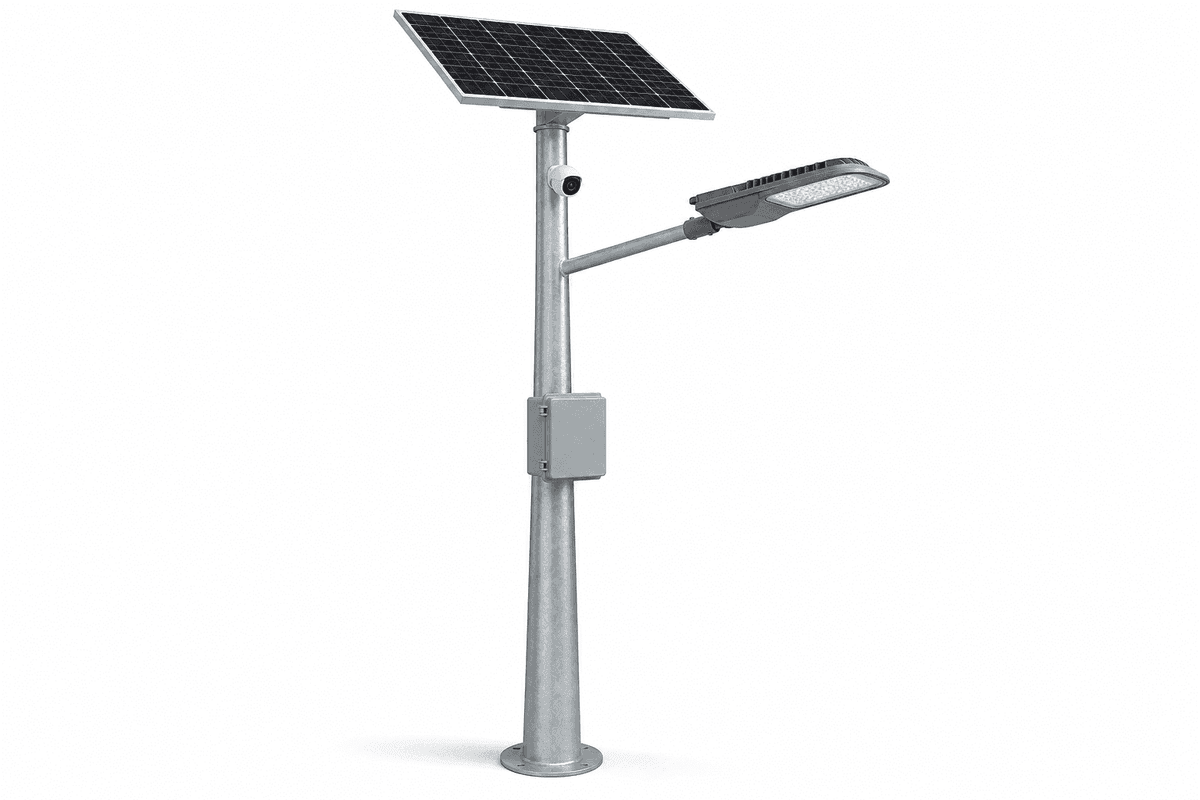
80W Border Patrol Road Split - 8m Solar Street Light with 4MP 4G Camera
Key Features
- 80 W LED output delivers approximately 13,600 lm at >170 lm/W for 8 m patrol-road mounting.
- 200 Wp TOPCon solar panel supports adjustable split mounting for 15°-35° latitude optimization.
- 800 Wh high-temperature LiFePO4 battery provides 8-day autonomy under smart dimming profiles.
- 4MP 4G camera includes IR night vision and 7-day cloud storage for remote security corridors.
- EPC turnkey price range is $670-$800 per unit, with 5%-15% volume discounts from 50+ units.
The 80W Border Patrol Road Split is an 8 m split-type solar street light with a 200 Wp TOPCon panel, 800 Wh high-temperature LFP battery, 80 W LED engine, and 4MP 4G security camera for desert patrol roads and remote perimeter corridors.
Description
The 80W Border Patrol Road Split is an 8 m split-type solar street light engineered for desert patrol roads, border access lanes, solar farm perimeters, and remote security corridors requiring 12 h/night illumination. Each system combines an 80 W LED luminaire, 200 Wp monocrystalline TOPCon PV module, 800 Wh LiFePO4 battery, 4MP 4G camera, galvanized-steel pole, MPPT controller, and 8-day autonomy package in a single EPC-ready supply scope.
For B2B procurement teams, the product sits in the 30-200 W split solar street light class and is optimized for projects where grid extension exceeds 500 m, trenching costs are high, or 4G video surveillance is required at every pole. Compared with a conventional 80 W grid-tied road light operating 4,380 h/year, the solar split architecture can remove 350 kWh/year of grid electricity per pole and reduce cable-trenching work by more than 70% on remote routes, based on 12 h/night operation and typical 1.0 m cable trench designs.
Product Overview
The system is part of SOLARTODO's Solar Street Light line, which covers 6-14 m pole heights, 30-200 W LED ratings, and split, all-in-one, hybrid, and camera-integrated designs. Buyers comparing patrol-road, mining-road, and perimeter-lighting specifications can View all Solar Street Light products or Configure your system online using the same 8 m, 80 W, 200 Wp, and 800 Wh baseline values.
The split configuration separates the PV module, luminaire, battery box, and pole interface so the 200 Wp panel angle can be adjusted for latitude bands from 15° to 35°. This layout improves solar yield versus fixed compact housings, supports larger battery packs above 800 Wh, and simplifies field maintenance because a technician can replace the 4MP camera or MPPT controller without removing the 8 m pole.
The lighting package targets border-patrol roads with 4-8 m carriageway widths, 20-30 m pole spacing, and low pedestrian density but high security sensitivity. With LED efficacy above 170 lm/W, the 80 W optical engine produces about 13,600 lm, which is suitable for patrol lanes, checkpoint approaches, fence-line tracks, and unpaved service roads where uniformity and camera visibility matter more than decorative illumination.
System Architecture
A complete unit uses 1 luminaire head, 1 hot-dip galvanized 8 m pole, 1 200 Wp TOPCon solar panel, 1 800 Wh LFP battery, 1 MPPT controller, 1 4MP 4G camera, and 1 concrete foundation kit. The major subsystems are electrically isolated through DC-rated connectors, protected by a BMS, and configured for dusk-to-dawn logic with time-based dimming and optional PIR triggering.
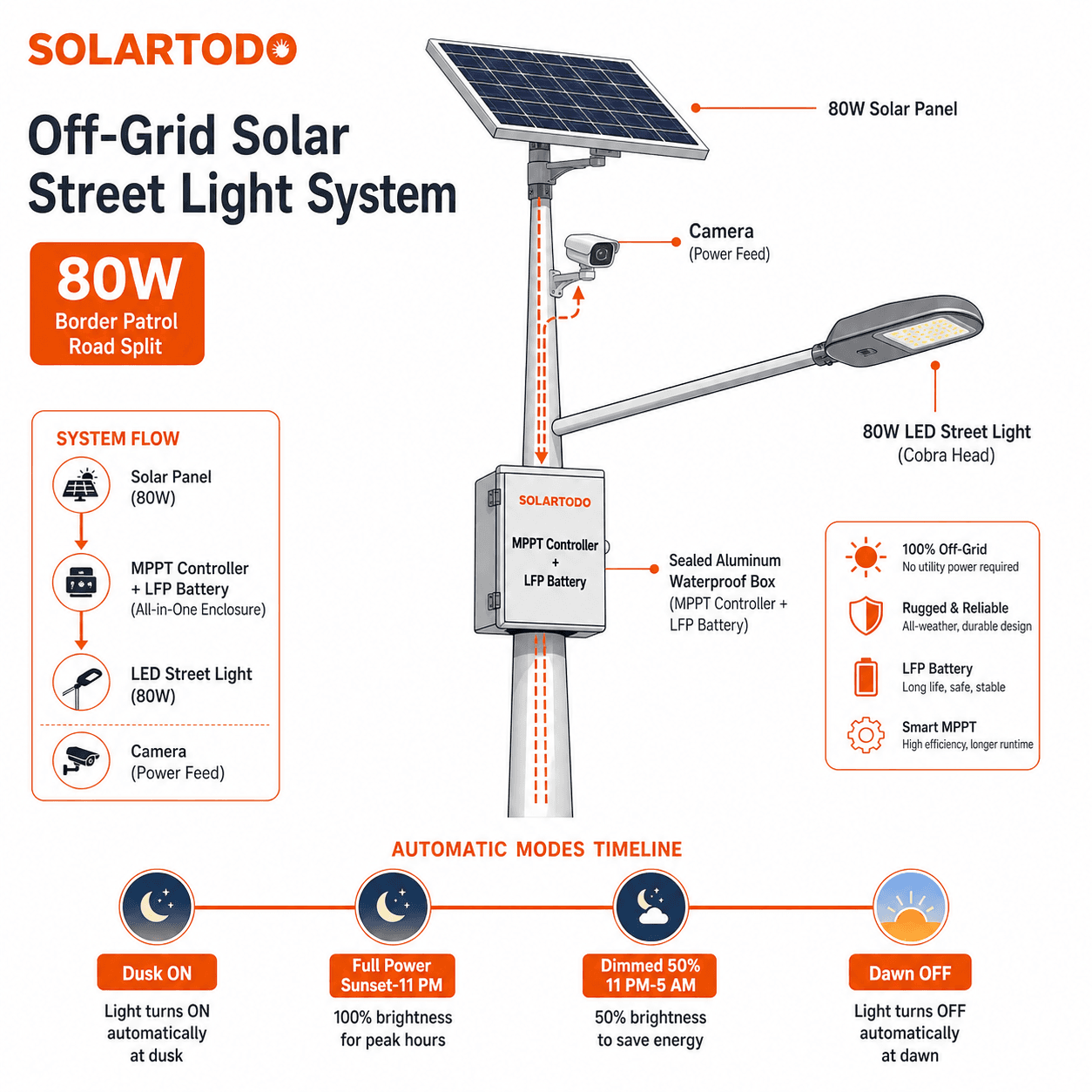
The 200 Wp monocrystalline TOPCon module is selected for 19-23% cell efficiency and a nominal 25-year service life under standard PV qualification practices. IEC 61215 and IEC 61730 are relevant PV module references, while IEC 62124 provides the recognized framework for stand-alone photovoltaic system design verification, including energy balance and storage sufficiency for off-grid lighting loads.
The 800 Wh LiFePO4 battery uses high-temperature cells specified for desert service up to +70°C inside ventilated or shaded enclosures. At 80 W full output for 12 h, the theoretical load is 960 Wh/night, so the controller normally applies scheduled dimming such as 100% for 4 h, 60% for 4 h, and 30% for 4 h to keep daily consumption near 608 Wh while maintaining visible security coverage through the full night.
The MPPT controller operates with conversion efficiency above 98% and supervises charging, discharging, low-voltage cutoff, temperature protection, dimming schedules, and remote fault reporting. MPPT control is important in desert climates because module voltage changes with temperature by roughly 0.30-0.35%/°C, and a hot 65°C module can lose more than 12% of nameplate voltage compared with 25°C test conditions.
Technical Specifications
| Parameter | Specification |
|---|---|
| Pole height | 8 m |
| LED power | 80 W |
| Luminous flux | 13,600 lm |
| Solar panel | 200 Wp TOPCon mono |
| Battery capacity | 800 Wh LiFePO4 |
| Autonomy | 8 rainy or low-sun days under dimming profile |
| Camera | 4MP 4G with IR night vision and 7-day cloud storage |
| Pole material | Hot-dip galvanized steel |
| Operating temperature | -20°C to +70°C |
| Wind resistance | 150 km/h design class |
| Lighting schedule | 12 h/day dusk-to-dawn |
| Warranty | 3 years system, 5 years pole |
The 8 m galvanized-steel pole is the standard structural selection for inland desert projects because it balances cost, corrosion protection, and mechanical rigidity. For coastal borders or salt-fog areas, SOLARTODO can substitute FRP composite or aluminum alloy poles, but the listed EPC range of $670-$800 is based on the specified 8 m galvanized-steel pole at $60 FOB per unit.
The luminaire optics are designed around roadway and patrol-lane distributions rather than building-area flood lighting. With approximately 13,600 lm from an 80 W LED array, a 25 m pole spacing can deliver practical surveillance visibility on 4-8 m roads, while denser 20 m spacing is recommended for gates, inspection zones, and curves where vehicle speeds may fall below 20 km/h.
The camera package uses a 4MP sensor, 4G cellular upload, infrared night operation, and 7-day cloud storage. On a 1 km patrol road using 25 m spacing, approximately 40 poles can create a continuous lighting and video chain, reducing the number of separate camera masts, grid-fed luminaires, and underground power cabinets that must be procured and maintained.
Desert Engineering and Reliability
Desert solar street lighting is primarily an energy-balance and thermal-management problem, not only a luminaire problem. NREL's PVWatts methodology shows that irradiance, module temperature, tilt, and system losses directly affect daily yield, so this system uses an adjustable split-panel format rather than a fixed lamp-integrated panel for high-temperature regions with strong seasonal sun-angle variation.
The 8-day autonomy rating is calculated for smart dimming, not for 80 W continuous full-power discharge across 96 h. In a realistic patrol-road profile, the controller can reduce the LED load by about 60% during low-traffic hours while keeping the 4MP camera active, which helps the 800 Wh LFP battery bridge sandstorms, cloud cover, or maintenance delays.
The enclosure strategy targets IP66 or IP67 protection for the luminaire, controller, cable glands, and camera connectors. IEC 60598 is the main luminaire safety reference, while IEC 60529 defines ingress-protection test levels; for desert corridors, IP66 dust and water-jet resistance is a practical minimum because windblown sand can remain suspended for several hours during 50-80 km/h events.
Battery chemistry is specified as LiFePO4 because LFP cells typically provide 2,000+ deep cycles and better thermal stability than many high-energy lithium chemistries. For a 12 h/night application cycling once per day, 2,000 cycles equals about 5.5 years of daily cycling before capacity degradation assumptions must be reviewed in the maintenance plan.
The galvanized pole and mounting hardware are selected for 150 km/h wind resistance, which is suitable for many inland desert and border installations after local foundation calculations. Final foundation size must still consider soil bearing capacity, pole-top area, panel wind load, camera bracket offset, and any national code requirements applicable within the project country.
Cloud Monitoring
The integrated smart controller and 4G camera can report battery voltage, PV charge current, LED status, camera connectivity, fault alarms, and operating hours through a cloud dashboard. For a 100-pole project, this changes maintenance from manual night patrol inspection to exception-based service, where technicians respond to the 1-5 poles reporting abnormal charging or communication status.
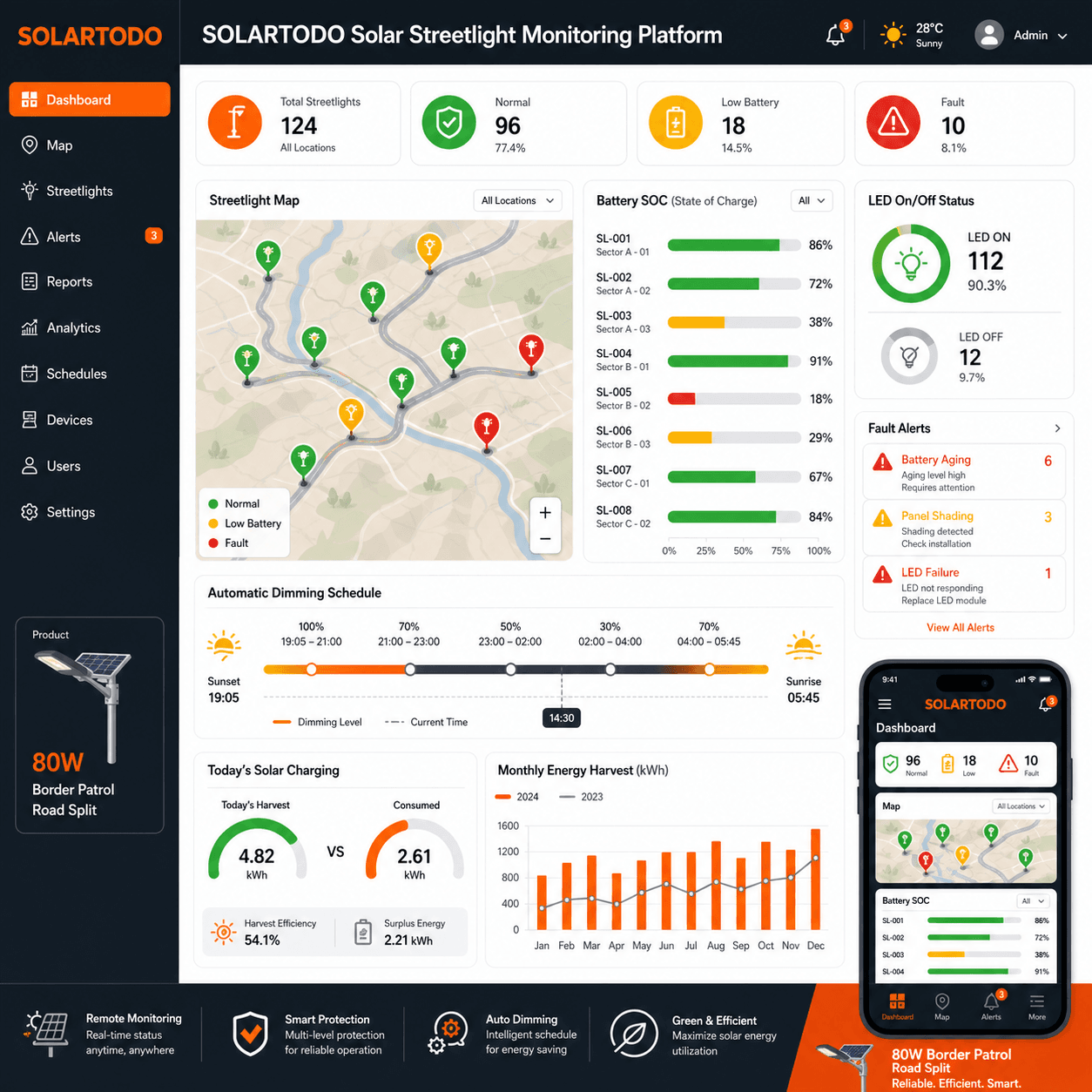
A 4MP 4G camera is appropriate where fiber or LAN cabling is unavailable and where video evidence must be retained for at least 7 days. The camera can support border checkpoints, industrial security gates, solar farm substations, construction laydown yards, and rural intersections where a single pole must provide lighting, power autonomy, and cellular surveillance.
Remote monitoring also improves lifecycle cost control because battery undercharge, LED driver failure, and PV soiling can be detected before a full blackout occurs. In desert deployments, monthly panel cleaning can recover 5-20% of lost yield depending on dust deposition, and fault alerts help crews schedule cleaning for the worst-performing 10-20% of poles first.
Application Scenario
A solar farm operator in the MENA region can deploy 80 units along a 2 km perimeter road using 25 m spacing, 8 m poles, and 4MP 4G camera coverage at each second or third critical gate position. With 80 W luminaires and smart dimming, the project avoids roughly 6.4 kW of connected grid lighting load and eliminates more than 2 km of low-voltage trenching, ducts, and feeder-cable coordination.
In this scenario, a conventional grid alternative could require cable trenching, distribution boards, protection devices, and utility connection approval, while the split solar design arrives as a repeatable pole-level package. If grid trenching, cabling, and power cabinets cost $25-$60 per meter in remote terrain, avoiding 2,000 m of trenching can reduce civil and electrical work by $50,000-$120,000 before energy savings are counted.
Compared with diesel-generator lighting towers, the 80 W solar split unit also removes fuel logistics and generator run-time maintenance. A small generator burning 0.3-0.6 L/h for security lighting can consume 1,314-2,628 L/year at 12 h/night, while the solar pole uses 0 L of diesel and produces its operating energy from the 200 Wp PV module.
EPC Investment Analysis and Pricing Structure
SOLARTODO defines EPC as engineering, procurement, construction, commissioning, and 1-year operating support for a complete off-grid lighting point. The scope includes lighting design, bill of materials, factory procurement, pre-shipment QC, logistics coordination, foundation works, pole erection, PV alignment, battery and controller commissioning, camera activation, cloud account setup, and 12-month warranty support.
| Pricing tier | Scope | Unit price range |
|---|---|---|
| FOB Supply | Equipment only, ex-works China | $415-$544 |
| CIF Delivered | Equipment plus ocean freight and insurance | $466-$611 |
| EPC Turnkey | Fully installed, commissioned, and covered by 1-year warranty | $670-$800 |
The EPC reference price of $670-$800 per unit is built from real SOLARTODO component costs plus separate engineering, installation, logistics, QC, and support line items. The actual component FOB values used for this product are $85 for the 80 W luminaire, $60 for the 8 m galvanized-steel pole, and $94 for the 4G/IR camera module, with battery, panel, controller, foundation, and labor priced as separate items.
| Order volume | Discount from published unit EPC range | Approximate EPC after discount |
|---|---|---|
| 50+ units | 5% | $637-$760 |
| 100+ units | 10% | $603-$720 |
| 250+ units | 15% | $570-$680 |
ROI is strongest where grid extension or generator operation is the alternative. A single 80 W grid light consumes about 350 kWh/year at 12 h/night; at $0.15/kWh, energy savings are about $53/year, but trenching avoidance of $500-$1,500 per pole can shorten project payback to 1-3 years on remote roads. Against diesel lighting, avoided fuel and service visits can raise annual savings above $300 per location.
Payment terms are normally 30% T/T deposit and 70% against bill of lading, with 100% irrevocable L/C at sight available for qualified importers. For project portfolios above $1,000K, SOLARTODO can discuss staged delivery, EPC milestone billing, and financing coordination; buyers can Request a custom quotation or contact [email protected] for a quantity-based pro forma invoice.
Standards, Data Sources, and Procurement Notes
The system is specified against globally recognized solar and lighting references rather than a single local code. Relevant references include IEC 62124 for stand-alone PV systems, IEC 60598 for luminaires, IEC 60529 for IP protection, IEC 61215 and IEC 61730 for PV modules, and IEEE 1562 for stand-alone photovoltaic system sizing and performance considerations.
For market and energy assumptions, SOLARTODO aligns product documentation with NREL PVWatts for solar yield factors, IEA electricity-sector analysis for grid-emission context, IRENA renewable-cost reporting for off-grid system economics, and BloombergNEF lithium-battery market tracking for LFP cost trends. These sources help procurement teams compare 1-unit samples, 50-unit pilots, and 250-unit EPC rollouts using transparent assumptions.
B2B buyers should verify road width, target illuminance, pole spacing, mobile network signal, soil bearing capacity, and ambient temperature before procurement. For example, an 8 m pole on a 6 m road may use 25 m spacing, while an inspection yard with 12 m wide turning areas may require a different optic, 2-head pole, or 100 W luminaire to maintain uniformity.
Procurement teams can use Learn about topic to compare LFP batteries, MPPT controllers, and solar lighting autonomy assumptions before issuing an RFQ. For larger border, mining, telecom, or energy-storage sites, SOLARTODO can map a 1 km, 5 km, or 10 km corridor and produce a pole schedule with quantities, panel azimuths, camera placements, and EPC milestones.
Why This Split Design Fits Border Patrol Roads
The 80 W Border Patrol Road Split is best suited where lighting, camera visibility, and autonomous power must be deployed together at 8 m mounting height. Its 200 Wp panel and 800 Wh LFP storage make it more serviceable than compact all-in-one fixtures, while the 4MP 4G module reduces the need for a separate surveillance pole, AC power cabinet, and fiber trench.
The product is not intended to replace high-mast highway lighting, 20 m stadium masts, or utility-grade CCTV towers with pan-tilt-zoom payloads above 10 kg. It is a practical 1-pole security infrastructure unit for 4-8 m patrol roads, 20-30 m spacing, and projects that need equipment pricing, CIF delivery, and EPC installation to remain within a predictable $670-$800 turnkey envelope.
For specification control, SOLARTODO can provide datasheets, IES files, pole drawings, foundation assumptions, packing lists, and EPC method statements for projects from 50 to 250+ units. The recommended next step is to define the route length, latitude, wind design value, 4G carrier, and camera storage period so the 80 W, 200 Wp, and 800 Wh configuration can be validated before production.
Technical Specifications
| Pole Height | 8m |
| LED Power | 80W |
| Luminous Flux | 13600lm |
| Solar Panel | 200Wp |
| Battery Capacity | 800Wh LFP |
| Autonomy | 8days |
| Pole Material | Hot-dip galvanized steel |
| Wind Resistance | 150km/h |
| Operating Temperature | -20 to +70°C |
| Lighting Hours | 12h/day |
| Camera | 4MP 4G with 7-day cloud storage |
| Warranty | 3 years system, 5 years pole |
Price Breakdown
| Item | Quantity | Unit Price | Subtotal |
|---|---|---|---|
| Luminaire 80W | 1 pcs | $85 | $85 |
| Pole 8m (galvanized steel) | 1 pcs | $60 | $60 |
| 4G/IR Camera Module | 1 pcs | $94 | $94 |
| Mono TOPCon Solar Panel 200W | 1 pcs | $20 | $20 |
| High-Temperature LFP Battery 800Wh | 1 pcs | $104 | $104 |
| MPPT Controller 200W Panel Rated | 1 pcs | $60 | $60 |
| Concrete Foundation and Anchor Kit | 1 pcs | $80 | $80 |
| Installation and Commissioning | 1 pcs | $95 | $95 |
| Engineering, QC, and Documentation | 1 pcs | $55 | $55 |
| 1-Year Warranty and Remote Support | 1 pcs | $35 | $35 |
| Total Price Range | $670 - $800 | ||
Frequently Asked Questions
What is included in the $670-$800 EPC turnkey price?
How does the 8-day autonomy rating work with an 80 W LED?
Is the 4MP 4G camera suitable for remote border roads?
Which standards apply to this split solar street light?
Can SOLARTODO adjust the design for hotter, coastal, or wider-road projects?
Certifications & Standards


Data Sources & References
- •NREL PVWatts solar resource and PV performance methodology
- •IEC 62124 photovoltaic standalone system design verification
- •IEC 60598 luminaires safety standard
- •IEC 60529 ingress protection rating standard
- •IRENA renewable power generation cost reports
- •IEA electricity and renewables market analysis
- •BloombergNEF lithium battery price survey
Interested in this solution?
Contact us for a customized quote based on your specific requirements.
Contact Us